Nu lämnar vi Tuvalu. Tyvärr mycket tidigare än planerat och utan att ha åkt till andra atoller. Som jag verkligen ville. Men vi måste ta tag i våra problem med båten. Och då måste vi till en större plats där det finns ett varv som kan titta till problemet vid propelleraxeln. Vi har också beställt reservdelar från Sverige för att kunna reparera. Så som vi hade sett fram emot att segla till andra atoller i Tuvalu, men nu blev det inte så. Tur att vi fick med oss både segling inne i Funafuti-atollen, flygplatsen och Independence day i alla fall. Vi har ca sju dagar framför oss tills vi kommer till Kiribatis huvudstad Tarawa. Vi hoppas på bra vind och inga squalls men sådan tur har vi nog inte. Under flera dagar har vi letat efter ett bra väderfönster men det finns inte. Så det är bara att ge sig iväg. Vi kommer korsa ekvatorn på denna segling så vi kommer över till norra halvklotet igen. Kiribati ligger på båda sidor om ekvatorn och på båda sidor om datumlinjen. Som enda land i världen i alla fyra hemisfärer. Det är ett väldigt utspritt land men bara två platser vi kan checka in. Stopp på vägen är totalt förbjudet.
We are now leaving Tuvalu, unfortunately much sooner than planned, and without having visited any other atolls, which I had really wanted to do. However, we need to address some issues with the boat, which means heading to a larger location with a shipyard that can take a look at the problem with the propeller shaft. We have also ordered spare parts from Sweden to carry out the repairs. We had really looked forward to sailing to other atolls in Tuvalu, but that wasn’t to be. At least we managed to experience sailing within the Funafuti atoll, visit the airport, and take part in Independence Day celebrations. We have about seven days of sailing ahead of us before we reach Tarawa, the capital of Kiribati. We’re hoping for good winds and no squalls, though we probably shouldn’t count on that. We’ve been searching for a decent weather window for several days, but none has appeared,so, it’s time to set off. During this passage, we will cross the equator, bringing us back into the Northern Hemisphere. Kiribati straddles both the equator and the International Date Line, making it the only country in the world to span all four hemispheres. It is a very widely dispersed nation, yet there are only two ports of entry where we are permitted to check in. Any stops along the way are strictly prohibited.


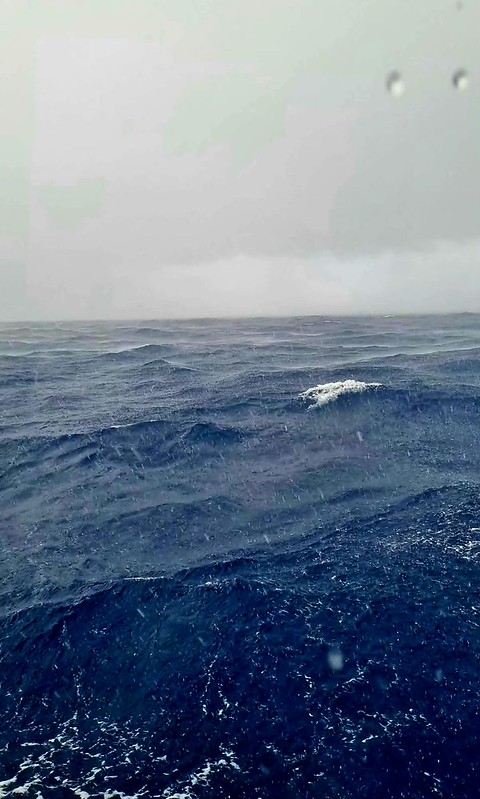
Vi seglar norrut genom Funafuti-atollen och går ut genom det nordliga passet. Vinden är slör vilket vi tycker om så det är bäst att njuta så länge det går. Runt omkring oss hänger tunga mörka moln så vi är beredda på en första squall med starka vindar och ösregn. För säkerhets skull drar vi in mycket på genuan ( förseglet) och på nästan noll tid är den över oss. Vindarna går upp mot 25 – 30 knop och regnet regnar nästan horisontalt in i sittbrunnen. Lika snabbt som den kom över oss avtar det igen. Fast det är fortfarande gråa tunga moln.
We sail northward through the Funafuti Atoll and exit via the northern pass. We have a broad reach, a point of sail we quite enjoy, so we decide to make the most of it while we can. Heavy, dark clouds loom all around us, and we brace ourselves for an initial squall, complete with strong winds and a downpour. As a precaution, we significantly furl the genoa (headsail), and in no time at all, the squall is upon us. The winds climb to 25–30 knots, and the rain drives almost horizontally into the cockpit. Just as quickly as it arrived, it subsides, though the heavy, grey clouds remain.
Och så tog vinden slut. Väntat men ändå trist. Är så mycket härligare när vi seglar fram i god fart. När vinden avtar och det fortfarande är sjö rullar båten mycket och bommen flyger fram och tillbaka, även om vi har en preventer. Det är kväll och jag sitter på vakt igen. Mörkret omsluter mig och Vilja och Jan ligger nere i båten och försöker sova. Jag har lagt om kursen och skotat hem för att minska fladdret i båda seglen så nu styr vi mot N i stället för NV. Om vi fortsätter att segla i endast 2 – 2,5 knop startar vi nog motorn snart.

And then the wind died down. Expected, perhaps, but still a shame. It’s so much more pleasant when we’re sailing along at a good speed. When the wind drops but there’s still a swell, the boat rolls heavily and the boom swings back and forth—even with a preventer rigged. It’s evening, and I’m on watch again. Darkness envelops me, while Vilja and Jan are down below, trying to sleep. I’ve adjusted our course and sheeted in to reduce the flapping in both sails; we’re now heading north instead of northwest. If our speed remains only 2–2.5 knots, we’ll likely start the engine soon.
Ikväll är det lite mer spänning än önskvärt i mörkret här ute på havet. Vi är precis norr om Tuvalus nordligaste atoller och närmar oss Kiribatis sydligaste. På plottern har vi, sedan ett bra tag, sett en kinesisk ganska stor fiskebåt. Vi ligger nästan i kollisions kurs och kommer mötas om ca fyrtiofem minuter. Jag väjer redan nu några grader så att vi skall gå akter om den. Tittar på plottern väldigt ofta för att göra ny bedömning. Behöver jag kanske även sakta ner farten? Vi har fått till oss att vi ( vår ais) inte syns för andra båtar så vi måste vara extra vaksamma. Våra lanternor kanske de inte ser förrän det är för sent. Plötsligt ser jag starkt ljus från en båt mycket närmre än den vi ser på ais. Jag ropar upp Jan, som jag vet är vaken. Strax därefter ser jag ännu en upplyst båt. Och de kör rakt mot oss på vår babords sida. Vi väljer att ändra vår kurs ca nittio grader för att gå akter om dem. Eftersom vi inte ser dem på vår plotter vet vi inte alls avståndet eller vilken fart de gör. Den första båten ( den på plottern) ser vi både lanternorna på och på plottern så den har vi full koll på. Sedan blir det plötsligt svart från de andra två båtarna. Inga lanternor längre. Var är de i förhållande till oss? Hur nära? Hur stora är de o vilken fart gör de? Men, totalt mörker. Vi vet att de finns där men har ingen aning om var. Vi ser dem inte ens på radarn. Och de kan troligen inte se oss på sina instrument. Otäckt. Jag ropar upp båten vi ser, på vhf, och får svar. Han bekräftar att han inte ser oss på instrumenten. Jag frågar hur många båtar de är, kinesiska fiskebåtar brukar ju vara många. Får svar att de är fem stycken. Vi får lite panik. Fem. Och vi ser bara en. Ber honom att säga till de andra båtarna att sätta på sina lanternor. Men tyvärr, hans engelska är dålig och han förstår inget av vad jag säger. Trots att jag pratar långsamt och med enkla ord.

Tonight, out here in the darkness at sea, there is a bit more tension than I would like. We are just north of Tuvalu’s northernmost atolls, approaching the southernmost ones of Kiribati. For quite some time now, we have been tracking a fairly large Chinese fishing vessel on our chart plotter. We are on a near-collision course and are set to cross paths in about forty-five minutes. I am already altering our course by a few degrees to ensure we pass behind it. I keep checking the plotter, constantly re-evaluating the situation. Should I perhaps slow down as well? We’ve been told that we, or rather, our AIS, aren’t visible to other vessels, so we have to be extra vigilant. They might not even spot our navigation lights until it’s too late. Suddenly, I see bright lights from a vessel much closer than the one showing up on our AIS. I call out to Jan, knowing he’s awake. Moments later, I spot yet another illuminated vessel, and they are heading straight toward us on our port side. We decide to alter our course by about ninety degrees to pass behind them. Since they don’t appear on our plotter, we have no way of knowing how far away they are or how fast they’re moving. As for the first vessel, the one on the plotter, we can see both its navigation lights and its position on the screen, so we have a clear handle on that one. Then, suddenly, the other two vessels go completely dark. No more navigation lights. Where are they in relation to us? How close are they? How big are they, and what speed are they making? Nothing but total darkness. We know they’re out there, but we have no idea where. We can’t even pick them up on our radar, and they likely can’t see us on their instruments, either. It’s unsettling. I hail the vessel we can see over the VHF radio, and I get a response. He confirms that he doesn’t see us on his instruments. I ask how many boats there are, Chinese fishing fleets usually consist of quite a few. He replies that there are five. We start to panic a little. Five. And we can only see one. I ask him to tell the other boats to turn on their navigation lights. But unfortunately, his English is poor, and he doesn’t understand a word of what I’m saying—even though I’m speaking slowly and using simple words.Får till svar ”Thank you! Thank you!” Vad jag än frågar om. Nu gäller det att hålla utkik i mörkret och att lysa upp Vilja så gott vi kan. Alla lanternor tända och även däcks belysningen. Och vi sitter med var vår strålkastare i handen som vi lyser på seglet med samt lyser ut i mörkret. En av oss på varje sida och spanar o spanar ut i mörkret. Efter ett tag ser jag ljus prickar överallt var jag tittar. Det kan vara stjärnor borta vid horisonten eller som speglar sig i havet. Det är otäckt att veta att det finns fyra fiskebåtar, sannolikt mindre, men de kan ju vara stora, som vi inte ser och inte har någon aning om var de befinner sig. Förutom att jag såg två av dem upplysta för ett tag sedan. Så här sitter vi i en till två timmar. Vi har gått tillbaka till vår kurs nu mot Tarawa men känner oss inte säkra förrän den båt vi ser på ais är ganska långt borta. Så nu kan Jan gå och lägga sig igen.The response we get is ”Thank you! Thank you!”, no matter what I ask. Now it’s a matter of keeping a sharp lookout in the darkness and illuminating Vilja as best we can. All navigation lights are on, as well as the deck lights. We each hold a spotlight, using them to illuminate the sails and scan the surrounding darkness. One of us is positioned on each side, peering intently out into the night. After a while, I start seeing points of light everywhere I look, perhaps stars near the horizon, or reflections on the sea. It’s unsettling to know that there are four fishing boats out there, likely small, though they could be large,that we cannot see and whose exact locations are unknown to us. (Though I did see two of them lit up a little while ago.) So, we sit here for an hour or two. We have returned to our course toward Tarawa, but we won’t feel truly secure until the vessel we see on the AIS is a good distance away. Now, Jan can go back to bed.


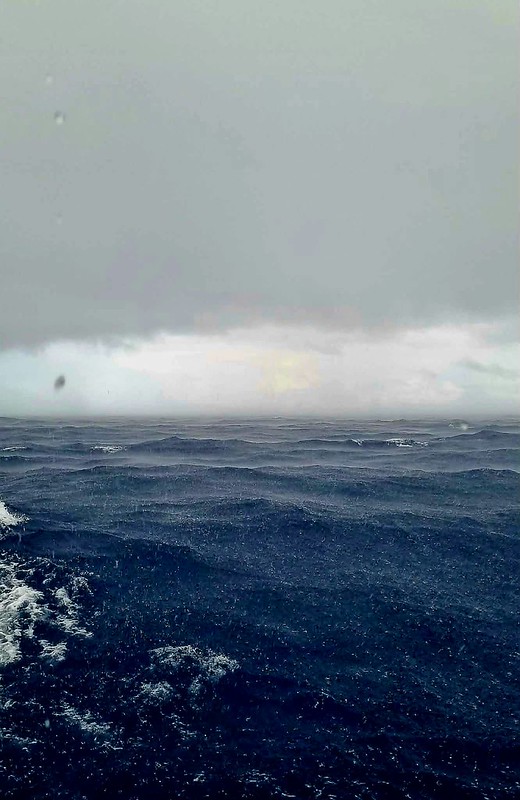
Molnen bygger upp sig runt omkring oss och över oss. Mörka tunga moln fulla med regn. Vi kan se hur regnet öser ner inte långt bort från oss och det rör sig snabbt närmre. På radarn är det stora röda fält med fläckar av gult i. Det gula visar ännu mer intensivt oväder. Blixtar börjar lysa upp den grå himmelen. Än så länge ganska långt bort. Vi är ensamma ute på havet och vår mast är definitivt högsta punkten. Jag tycker i och för sig om åskoväder o är inte rädd. Men måste ändå inse fakta att vi inte vill att blixten skall slå ner. Nu är det fyra sekunder mellan blixt och åska. Regnet fortsätter ösa ner och det är dyngblött i hela sittbrunnen. Vi pratar om att göra i ordning våra ”grab-bagar”. Vattentäta väskor där vi har det nödvändigaste. Två ligger färdigpackade med reservmat och lite vatten, medicin, passkopior och en hel del annat nödvändigt om det värsta skulle ske. Alla långseglare har sådana väskor som vi går igenom med jämna mellanrum. Nu packar vi även var sin egen med personliga saker som vi anser livsnödvändigt. Våra mobiler och powerbankar har vi lagt in i micron där de förhoppningsvis ligger bättre skyddade. Vid eventuellt blixtnedslag.
Clouds are building up all around us and overhead, dark, heavy clouds, laden with rain. We can see the rain pouring down not far away, and it is moving toward us rapidly. On the radar, there are large red patches flecked with yellow; the yellow indicates even more intense weather. Lightning begins to illuminate the gray sky, still quite a distance off, for now. We are alone out at sea, and our mast is, without a doubt, the highest point around. Personally, I quite enjoy thunderstorms and am not afraid, but I have to face the facts: we certainly don’t want lightning to strike. There is now a four-second interval between the flash and the thunder. The rain continues to pour, leaving the entire cockpit soaking wet. We discuss getting our ”grab bags” ready,waterproof bags containing the bare essentials. Two are already packed with emergency food, some water, medicine, copies of our passports, and various other necessities, just in case the worst should happen. Long-distance sailors all keep such bags, which we check and update periodically. Now, we are each packing an additional bag with personal items we consider absolutely vital. We’ve placed our mobile phones and power banks inside the microwave, where they should hopefully be better protected—in the event of a lightning strike.

Kaboooom. Blixt och åska samtidigt. Nu är ovädret rakt över oss. Även jag reagerar vid den höga smällen. Och en till. Vi känner oss små i världen ensamma i vår lilla båt på detta stora hav. Väldigt långt bort från civilisation. Vi har seglat tre dygn från Funafuti och har tre till fem dygn kvar innan vi når Tarawa i Kiribati. Vi befinner oss bland de mest isolerade länderna i världen. Ytterligare några blixtar slår ner, precis i närheten. Himmelen blir upplyst och de mörkgrå molnen tornar upp sig och ser ännu tyngre ut i blixtens sken. Efter några minuter som känns mer som timmar, börjar det gå fler sekunder mellan blixt och åska. Skönt. Vi har tur att det inte har slått ner i båten. Då skulle alla våra navigationsinstrument, vhf mm slås ut. Vi har redan problem med att ett viktigt instrument har dött. Displayen där vi avläser vindriktningen i förhållande till båten samt vindstyrkan. En jätteviktig display. Eftersom vindarna snurrar runt hela tiden på grund av ovädret så blir det jättesvårt att segla även med instrument. Och utan känns det hopplöst då vi plötsligt kan få en oplanerad gipp eller slå utan att vara beredda på det. Vi har redan fått back i seglet ett flertal gånger. Och nu är det ändå dag så vi kan orientera oss bättre och se på seglen vad som händer. Frågan är hur vi skall göra när mörkret faller om någon timma. Att säkerheten går först råder det inget tvivel om. Vi sitter ensamma på vakt och har svårt för att hantera allt som är så oförutsägbart. Speciellt när vi inte har displayen att titta på och det är kolsvart runt omkring. Så vi beslutar oss för att sätta ett andra rev på storseglet och rulla in rullgenuan tills vi bara har en liten trekant kvar. Vi kommer dessutom köra med motor så vi tar oss framåt mot vårat mål. Tråkigt men vi vill inte riskera att slita sönder segel och annan utrustning.
Kaboom. Lightning and thunder, simultaneously. The storm is right on top of us now. Even I flinch at the loud crash. And another one. We feel small in this world, alone in our little boat on this vast ocean—so very far from civilization. We have been sailing for three days since leaving Funafuti, and we have another three to five days to go before reaching Tarawa in Kiribati. We are in one of the most isolated parts of the world. A few more lightning bolts strike, very close by. The sky lights up, and the dark gray clouds tower above us, appearing even heavier in the flash of lightning. After a few minutes, which feel more like hours, the interval between the lightning and the thunder begins to grow. A relief. We are lucky that the boat hasn’t been struck; if it had, all our navigation instruments, our VHF radio, and more would have been knocked out. We are already dealing with the failure of one crucial instrument: the display that shows wind direction relative to the boat, as well as wind speed, a vital piece of equipment. Because the storm causes the winds to shift constantly, sailing is extremely difficult even with instruments; without them, it feels hopeless, as we could suddenly find ourselves in an unplanned jibe or tack, caught completely off guard. We’ve already had the wind catch the wrong side of the sails several times. At least it’s still daylight, which helps us orient ourselves and observe what’s happening with the sails. The question is, what will we do when darkness falls in an hour or so? There is no doubt that safety comes first. We are on watch, all alone, struggling to manage a situation that is so entirely unpredictable. Especially since we don’t have the display to look at, and it’s pitch black all around us. So, we decide to put a second reef in the mainsail and furl the headsail until only a small triangle remains. We’ll also be using the engine to keep moving toward our destination. It’s a shame, but we don’t want to risk tearing the sails or damaging other equipment.


Så nu sitter jag på vakt. Eller rättare sagt så är jag inne i båten. Ute är det totalt blött och vi behöver ju inte utsätta oss för att vara genomvåta i flera timmar. Jag går upp ungefär var tjugonde minut och tittar på plottern och tar en kik runtomkring. Det kan ju plötsligt dyka upp en båt som inte syns på plottern. Eller ännu värre, som igår, så syns de inte på plottern och har inte heller lanternor tända. Det känns konstigt att inte ta vakten uppe i sittbrunnen och dessutom att gå för motor trots att det blåser runt 5 m/ s. Just nu relativt stabilt utan att snurra runt. Vi verkar äntligen ha kommit ur det intensiva och långvariga ovädret som kretsar runt oss i över sex timmar. Pust.
So, now I’m on watch, or rather, I’m inside the boat. It’s absolutely soaking wet out there, and there’s no need for us to end up completely drenched for hours on end. Every twenty minutes or so, I head up to check the plotter and take a look around. After all, a boat could suddenly appear that doesn’t show up on the plotter. Or worse, like what happened yesterday, a vessel might not appear on the plotter and have no navigation lights on. It feels strange not to be keeping watch from the cockpit, and also to be motoring when the wind is blowing at around 5 m/s. Right now, things are relatively stable, without the boat spinning around. It seems we’ve finally emerged from the intense, long-lasting storm that’s been circling us for over six hours. Phew.
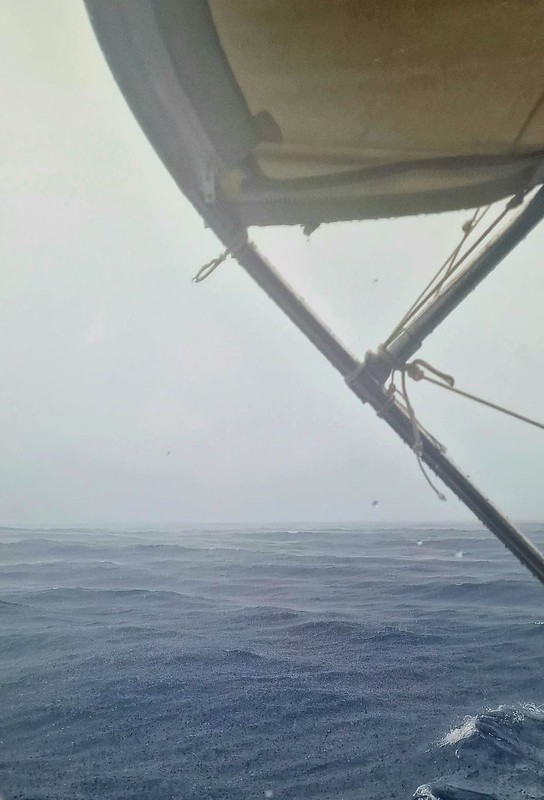
Igår hände något helt fantastiskt! Jans son, Victor, och hans sambo Linda fick en liten pojke! Så nu är Jan farfar. Föräldrarna är redan hemma med sitt lilla mirakel. Det var många glädjetårar som fälldes av den nyblivna farfadern. Tänk att en helt ny människa har kommit till familjen. En otroligt efterlängtad och önskad liten pojke. Så nu längtar självklart Jan hem för att få se och hålla sitt tredje barnbarn 🩵
Something absolutely wonderful happened yesterday! Jan’s son, Victor, and his partner, Linda, welcomed a baby boy! So, Jan is now a grandfather. The parents are already home with their little miracle. The new grandfather shed many tears of joy. Just think,a brand-new human being has joined the family; a little boy who was so incredibly longed for and desired. Naturally, Jan is now eager to get home to see and hold his third grandchild 🩵

Åh vad skönt. Efter flera timmar med riktigt tuff sjö, stark vind o höga vågor seglar vi nu i lä bakom en atoll. Vattnet mer porlar runt båten i stället för forsar och ingen vind sliter och drar i segel och rigg. Visst går det ganska långsamt, 1,5 – 2 knop. Men det gör inget. Vi hade hoppats att gå på västsidan om den för det är bättre vinkel mot slutmålet – Tarawa. Men vi fick pressa för hårt mot vinden och det var tufft även om vi startade motorn. Så vi gjorde en 90° sväng österut i stället. Annars har dagen varit riktigt bra. Vi har duschat och tvättat håret på akterdäck, fyllt diesel från åtta jerrykans till stora tanken och ”bara varit”. Står fast vid att dessa överfarter är helt ok, t o m rogivande och fridfulla. Lite meditativt. Och vi sakna ju inte spänning med alla squalls och mörklagda kinesiska fiskebåtar 🤗
Oh, what a relief. After several hours in really rough seas, strong winds and high waves, we are now sailing in the lee of an atoll. The water just laps gently around the boat instead of rushing past, and there’s no wind tugging or pulling at the sails and rigging. Sure, we’re moving quite slowly, 1.5 to 2 knots, but that doesn’t matter. We had hoped to pass on the western side, as that would have offered a better angle toward our final destination, Tarawa. But we would have had to push too hard against the wind, it was tough going, even with the engine running, so we made a 90-degree turn to the east instead. Otherwise, it’s been a really good day. We’ve showered and washed our hair on the aft deck, transferred diesel from eight jerrycans into the main tank, and simply ”just been.” I still maintain that these ocean crossings are perfectly fine—even soothing and peaceful. Almost meditative. And it’s not as if we’re lacking excitement, what with all the squalls and unlit Chinese fishing boats! 🤗

Fylla upp diesel är inte lätt ite på öppet hav med stora vågor. Vi har bävat för det men nu måste vi. Eftersom det varit tuffa förhållanden i flera dagar har vi kört mer motor än beräknat. Så vi hämtar sex jerrycans och häller över. I samarbete eftersom vi inte vill tömma ner bottensatsen. Vill man så kan man – o nu har vi mer diesel i vår tanke ombord.
Refueling with diesel is no easy task out on the open sea with large waves. We’ve been dreading it, but now it has to be done. Because conditions have been rough for several days, we’ve relied on the engine more than anticipated. So, we fetch six jerrycans and pour the fuel in, working together, as we want to avoid stirring up any sediment from the bottom of the cans. Where there’s a will, there’s a way, and now we have more diesel in our onboard tank.


Något som däremot bekymrar mig är att min bästa telefon, den där jag har absolut allt viktigt, har fått pepsi cola över sig. Nu ligger den urladdad och med hushållspapper runt sig i en tät plastlåda. Den måste lämnas in för rengöring så fort vi är incheckade i Kiribati. Där har jag alla foton, alla viktiga appar och alla viktiga anteckningar mm mm. Tyvärr är det ju så att hela livet kretsar kring telefonen numera. Mest orolig är jag för alla foton o videor från de senaste femton åren ungefär, som inte är kopierade någon annan stans. Och inte heller finns i något moln. Kanske jag får överväga att betala för molnlagring i alla fall.
Something that does worry me, however, is that my best phone, the one containing absolutely everything important, has had Pepsi-Cola spilled all over it. It’s currently sitting there, powered down and wrapped in paper towels inside an airtight plastic container. I’ll need to have it professionally cleaned as soon as we’ve checked in at Kiribati. It holds all my photos, all my essential apps, all my important notes, and so on. Unfortunately, life these days pretty much revolves around one’s phone. I’m most concerned about all the photos and videos from the last fifteen years or so, none of which have been backed up anywhere else, nor are they stored in the cloud. Perhaps I should consider paying for cloud storage after all.
Upp emot 40 knops vind, eller nästan 20 m/s…..nu blåser det ordentligt. Vinden rycker tag i Vilja och jag parerar kursen utifrån vilken vindriktning vi har. Bommen med storseglet slår hela tiden och jag faller mer och mer. Bort från vinden med fören. Det är det viktigaste. Vart vi styr blir sekundärt så länge det är öppet vatten. Har ändrat kursen nästan 100° nu, mer än ett kvarts varv o just nu styr vi bort från vårat mål. Men med dessa vindar får det bli så. Det är totalt kolsvart runt omkring mig så jag har inget att ta sikte på eller jämföra med. Tur vi har en plotter i alla fall. Regnet öser ner o jag sitter i den stenhårda trappan. Genomblöt. Är tvungen att gå akterut med jämna mellanrum för att se vindriktningen o vindstyrkan. Vår display som vi brukar se på är ju nollställd och visar ingenting. Fyrtio minuter har squallen hållit i sig nu men det verkar som den avtar. Och det snabbt. Nu har vi väldigt obestämd vind som blåser ena sekunden från fören o nästa in i aktern. Får starta motorn för vi gör ingen fart och kan då inte hålla en bra kurs. En dryg timma kvar på mitt pass. Men fortsätter natten så här så kommer jag få vara uppe en del även under Jans pass.
Winds of up to 40 knots, nearly 20 meters per second,it’s blowing hard now. The wind jerks Vilja around, and I adjust our heading based on the wind direction. The boom, with the mainsail attached, keeps slamming back and forth, so I bear away, turning the bow further and further away from the wind. That’s the priority; our exact heading is secondary, as long as there’s open water ahead. I’ve altered course by nearly 100 degrees, more than a quarter-turn, and right now, we’re steering away from our destination. But in conditions like these, that’s just how it has to be. It’s pitch-black all around me; there’s nothing to use as a reference point or a bearing. Thank goodness we have a chart plotter. The rain is pouring down, and I’m sitting on the rock-hard companionway steps, soaked to the bone. Every so often, I have to head aft to check the wind direction and strength; the display we usually rely on has reset and isn’t showing anything. The squall has been going on for forty minutes now, but it seems to be easing, and fast. The wind has become completely erratic, shifting from the bow one second to the stern the next. I have to start the engine; we’ve lost all speed, which makes it impossible to maintain a proper course. I’ve got a little over an hour left on my watch, but if the night continues like this, I’ll likely end up staying awake through part of Jan’s watch, too.
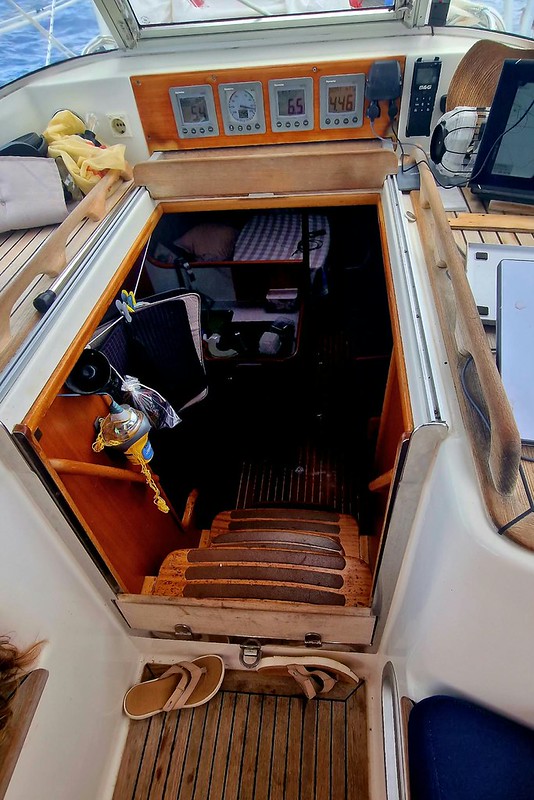


0°00.000 vet ni vad det är? Ekvatorn! Aldeles nyss passerade vi den. Exakt klockan 14.00 idag 10 oktober. Andra gången vi gör det med egen liten segelbåt. Denna gång från södra till norra halvklotet. Förra gången var i februari 2025 strax innan vi kom till Galapagos från Panama. Självklart måste detta firas. Så vi öppnar en flaska bubbel som vi hade på kylning. Det smakar riktigt gott och vi känner oss stolta över hur långt vi seglat. Mestadels ensamma i vår lilla båt på de stora haven.
0°00.000—do you know what that is? The equator! We just crossed it, at exactly 2:00 PM today, October 10th. This is the second time we’ve done this in our own little sailboat; this time, we’re moving from the Southern Hemisphere to the Northern Hemisphere. The first time was in February 2025, just before we arrived in the Galápagos from Panama. Naturally, this calls for a celebration, so we’re popping open a bottle of bubbly we had chilling. It tastes absolutely wonderful, and we feel proud of how far we’ve sailed, mostly on our own, in our little boat, across the vast oceans.


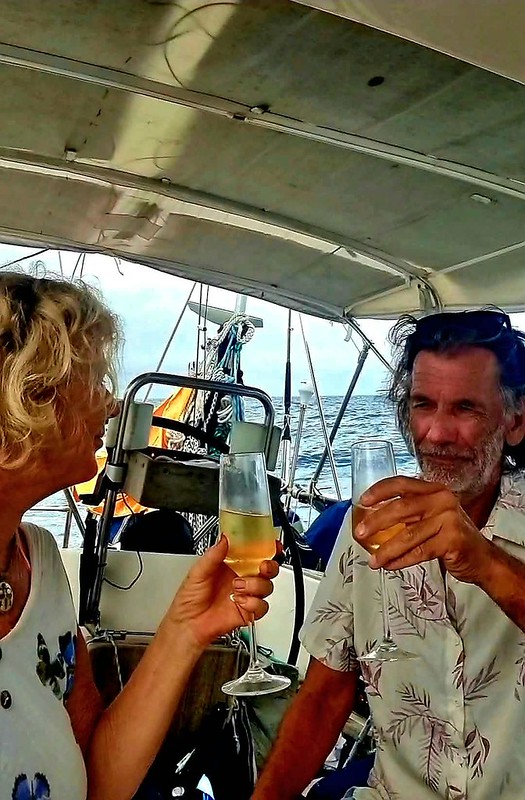
Nu är vi trötta. Vi har kämpat i åtta dygn med motvind, motström, kraftiga regnskurar, åskoväder och tidvis starka kuling vindar. Ingen kan säga att det är som att ha semester. Det är jobb och slit utan tillräcklig sömn och superenkel mat – typ nudlar. Vi närmar oss vårt mål och hoppas kunna segla in i hamn idag. Men det är osäkert om vi hinner före mörkrets inbrott. Och att komma in i hamnen och ankra i mörkret samtidigt som vinden blåser rakt in i atołlen vill vi definitivt inte. Våra instrument säger att vi kan hinna men det känns inte bra. Troligen tar det längre tid att komma fram än vad vi tror. Så vad gör vi nu? Det blåser jättemycket med höga vågor och vi har ingen direkt plats att söka lä.
We are exhausted now. For eight days, we’ve battled headwinds, opposing currents, heavy downpours, thunderstorms, and, at times, strong gale-force winds. No one could call this a vacation. It’s hard, grueling work—lacking proper sleep and fueled by the simplest of meals, like instant noodles. We’re nearing our destination and hoping to sail into the harbor today, though it’s uncertain whether we’ll make it before nightfall. Entering the harbor and dropping anchor in the dark, with the wind blowing straight into the atoll, is definitely something we want to avoid. Our instruments suggest we might make it, but it doesn’t feel right; the journey will likely take longer than we anticipate. So, what do we do now? The wind is howling, the waves are high, and there’s nowhere obvious to seek shelter.


Vi tar oss i närheten av South Tarawa atołl för att känna hur det är där. Det blir lite våglä i alla fall men vinden blåser runt åt båda hållen. Atollen är ju väldigt låg, endast korallrev. Vi funderar på hur vi skall göra. Segla fram och tillbaka i ca 15 timmar låter inte kul. Då kommer Jan på att vi kan ”dreja bi”. Något ingen av oss gjort tidigare. Vi bestämmer oss för att försöka. Det går till så att vi seglar dikt bidevind ( nära vindögat med fören) med liten segelytan. Så slår vi långsamt över vindögat men låter focken vara kvar skotad i lovart. Samtidigt ställer vi rodret som att vi vill styra tillbaka i vindögat. Gör man rätt med segel och allting så ligger båten stilla. Förutom att den driver sidledes med vind och ström. Vi gör några misslyckade försök men så lyckas vi! Visst driver vi långsamt men vi ligger ändå väldigt stilla. Hela eftermiddagen och kommande natt drejar vi bi. Vi beslutar oss iofs att köra tillbaka och göra om manövern när vi drivit för långt. Men vi får en relativt lugn natt. Klockan 04.00 startar vi vår färd mot Tarawa i mörkret.
We’re heading toward the South Tarawa atoll to see what conditions are like there. We might find a bit of protection from the waves, but the wind is swirling from all directions, the atoll itself is very low, consisting only of coral reefs. We’re weighing our options; sailing back and forth for about 15 hours doesn’t sound like much fun. Then, Jan suggests we ”heave-to”, something neither of us has done before. We decide to give it a try. The technique involves sailing close-hauled (with the bow pointed near the wind) using a reduced sail area. We then slowly tack through the eye of the wind, but keep the jib sheeted to the windward side. At the same time, we set the rudder as if we were trying to steer back into the wind. When the sails and rigging are adjusted correctly, the boat comes to a standstill, though it will still drift sideways, pushed by the wind and current. We make a few unsuccessful attempts, but then we succeed! Although we are drifting, we remain essentially stationary. We spend the entire afternoon and the following night hove-to. We do decide, however, to head back and repeat the maneuver once we have drifted too far. But we have a relatively calm night. At 04:00, in the darkness, we begin our voyage toward Tarawa.


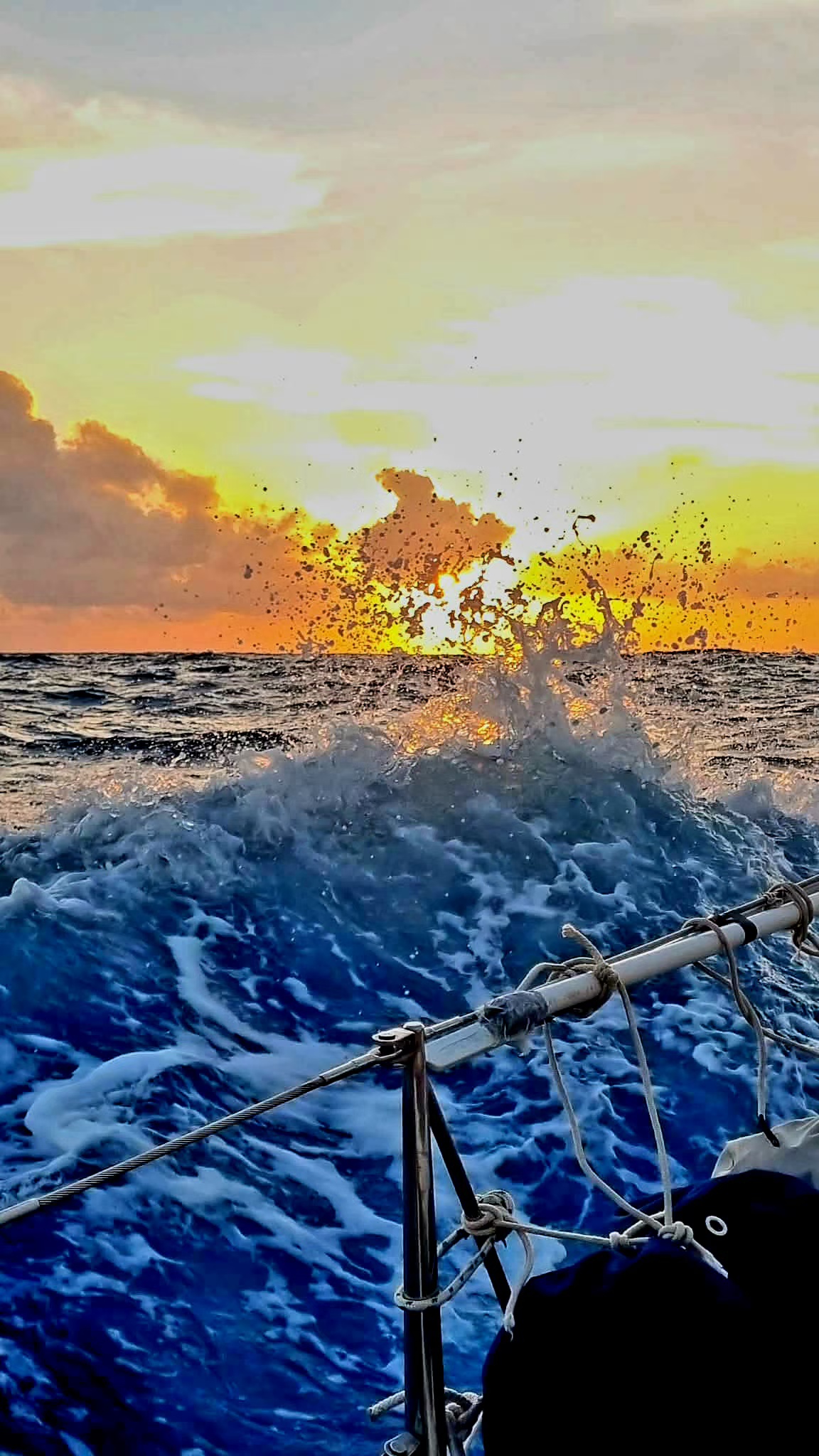
Och vilken vacker soluppgång vi får uppleva. Från tidigt ljus skymtande i lila och rosa vidare till orange och därefter en lysande gul sol. Om några timmar är vi äntligen framme i ”Kiribass” som landets namn uttalas av lokalbefolkningen. Ser fram till att utforska ett nytt land 🇰🇮
And what a beautiful sunrise we get to witness. From the first light, with hints of purple and pink, transitioning to orange, and then a brilliant yellow sun. In a few hours, we will finally arrive in ”Kiribass”, which is how the locals pronounce the country’s name. Looking forward to exploring a new country! 🇰🇮


