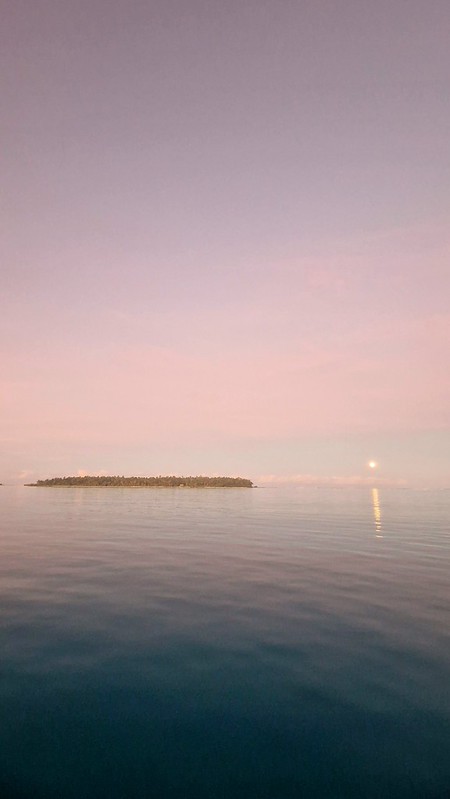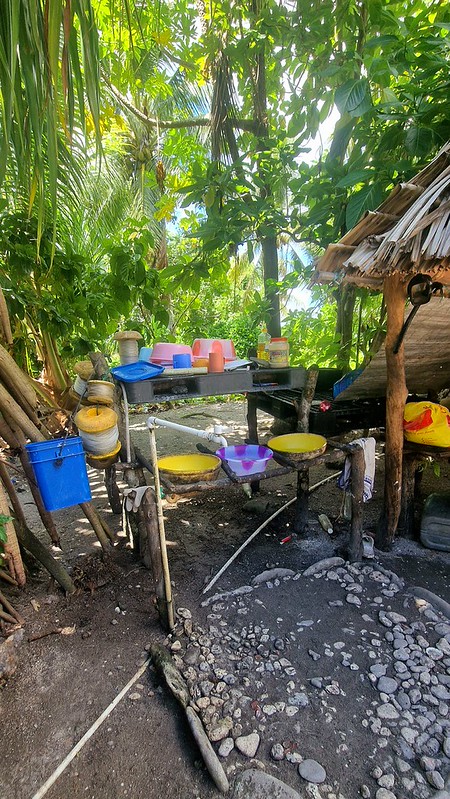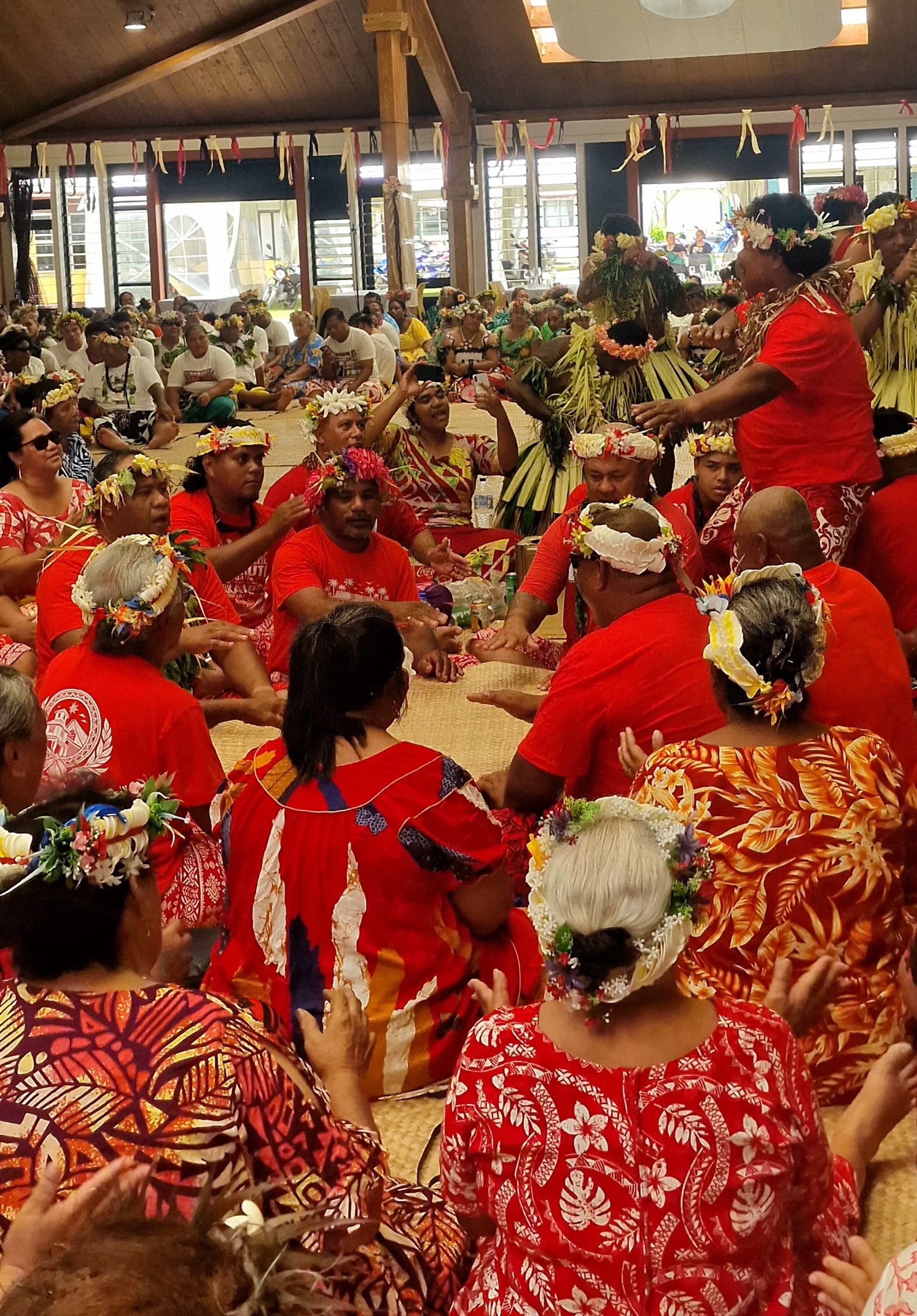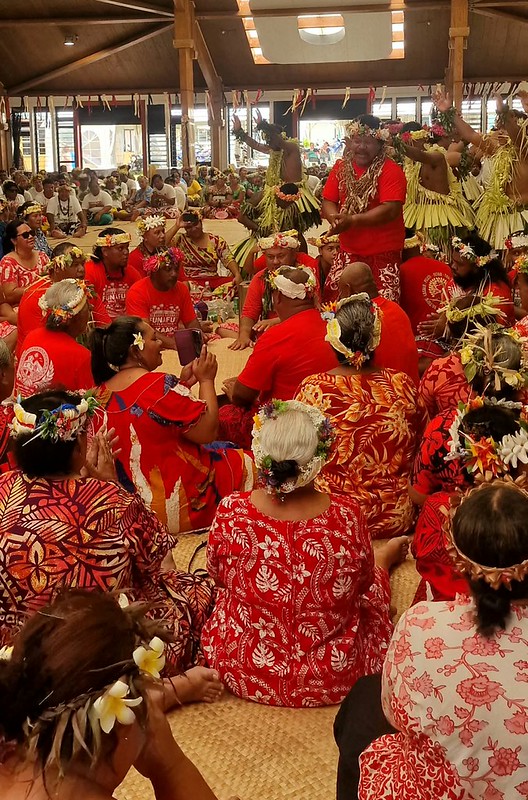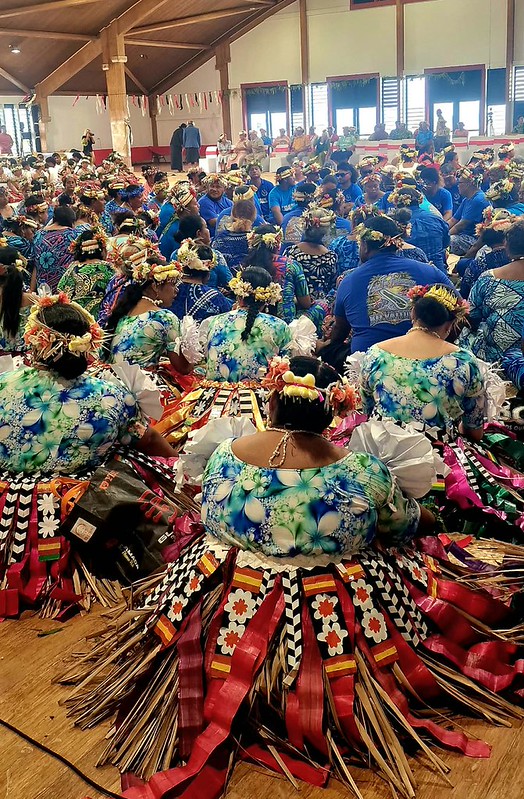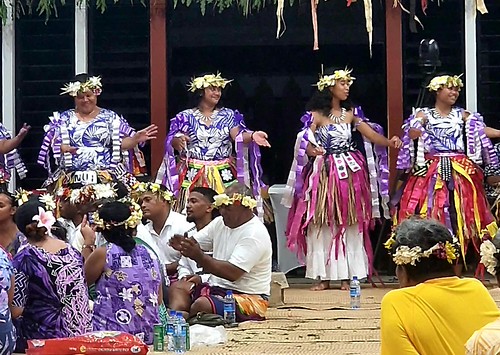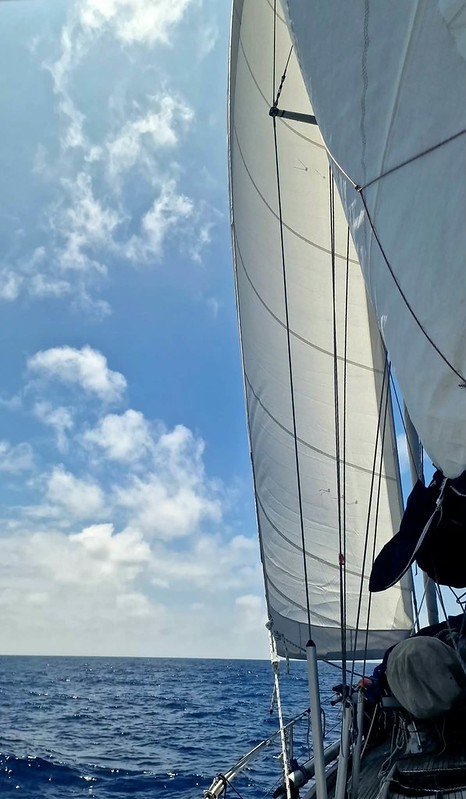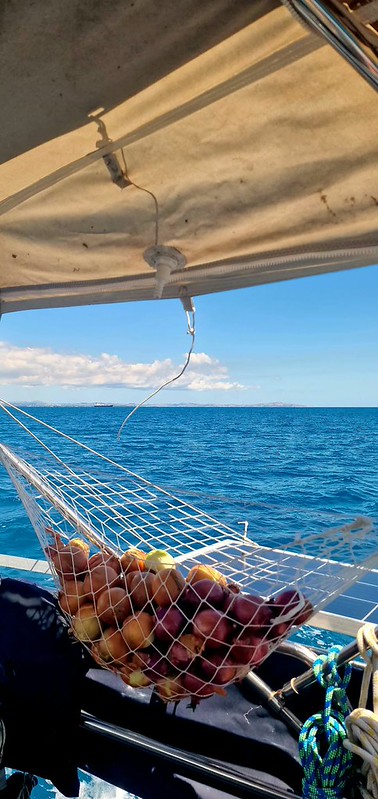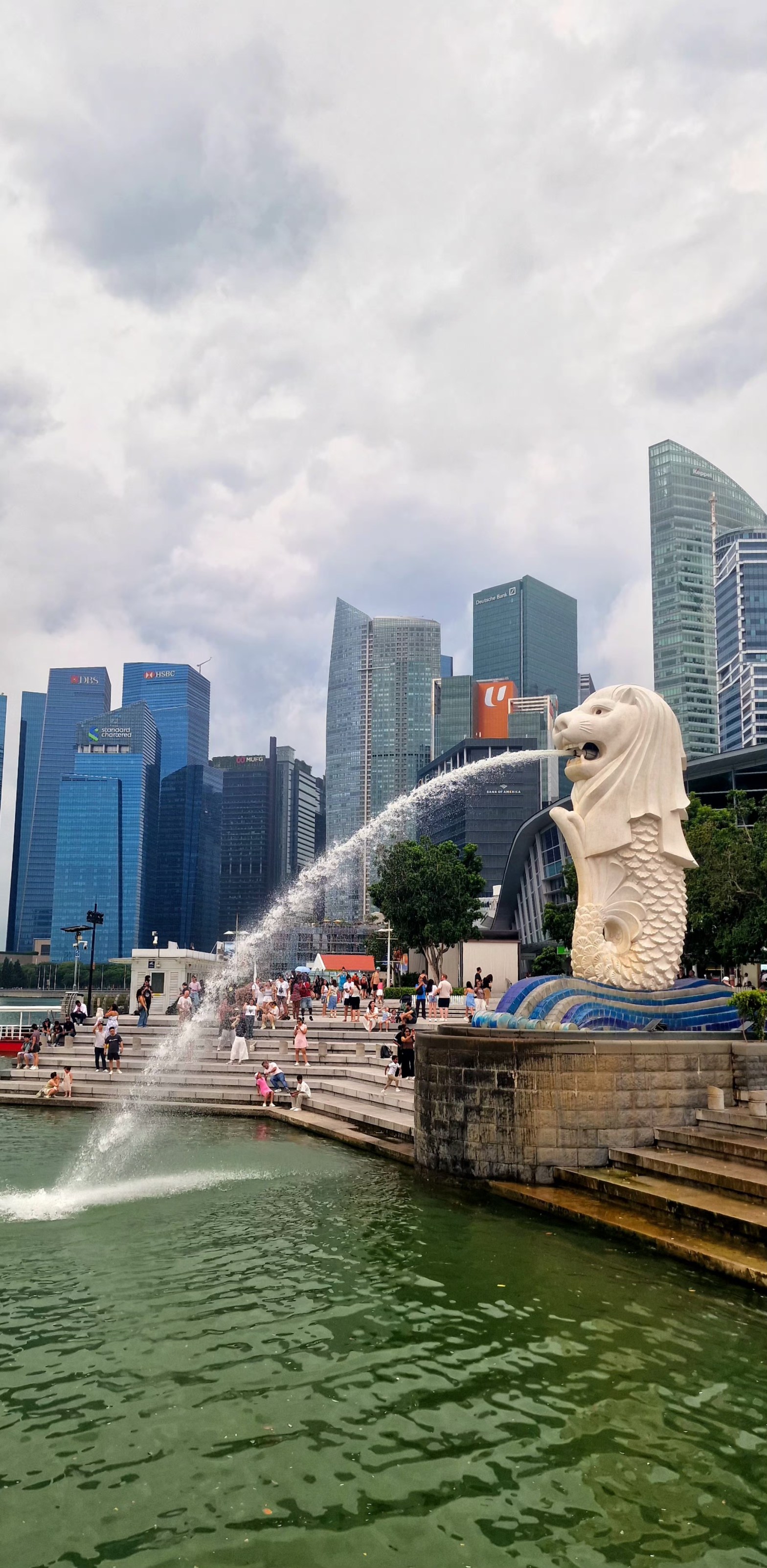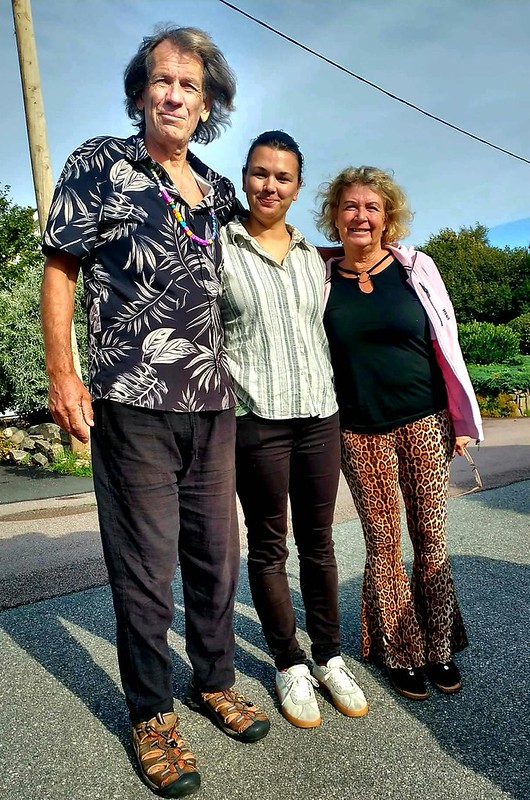
Butaritari – an island we fell in love with

Inloppet är lugnt o stilla. Vi väntade oss eventuellt några stående vågor då vi är mitt emellan lågvatten och högvatten. Men det är knappt ens strömt. Kanske det beror på att hela inloppet är brett men med 2 kanaler att ta sig in igenom där det är djupare vatten. Tidvattnet kan röra sig mer fritt. Vi är ju vana vid Tuamotus i Franska Polynesien där vattnet verkligen kokade i varje inlopp och den fem meter höga våg vi plöjde oss rakt igenom. Går att läsa om tidigare i bloggen, från 5 juli 2025.

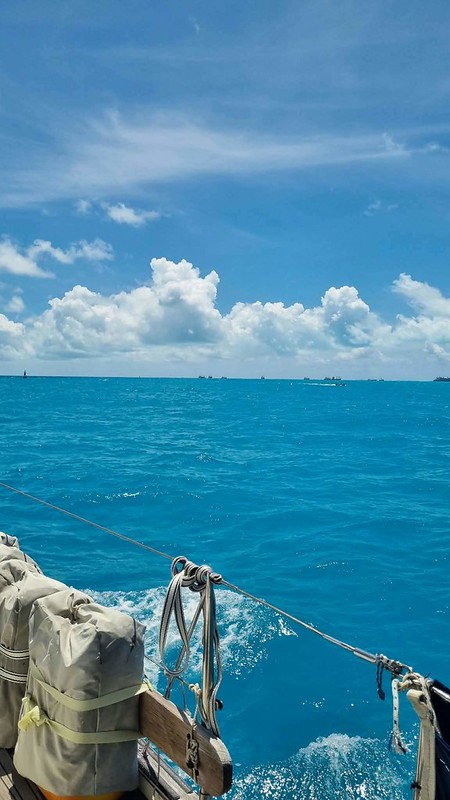
The pass is calm and still. We were expecting some standing waves since we are right between low and high tide, yet there is barely even a current. Perhaps it’s because the entire entrance is wide with two deeper channels to enter through, allowing the tide to move more freely. We are used to the Tuamotus in French Polynesia, where the water truly boiled in every pass—and that five-meter-high wave we plowed straight through, which you can read about earlier in the blog from July 5, 2025.

Butaritari
Really calm in the entrance

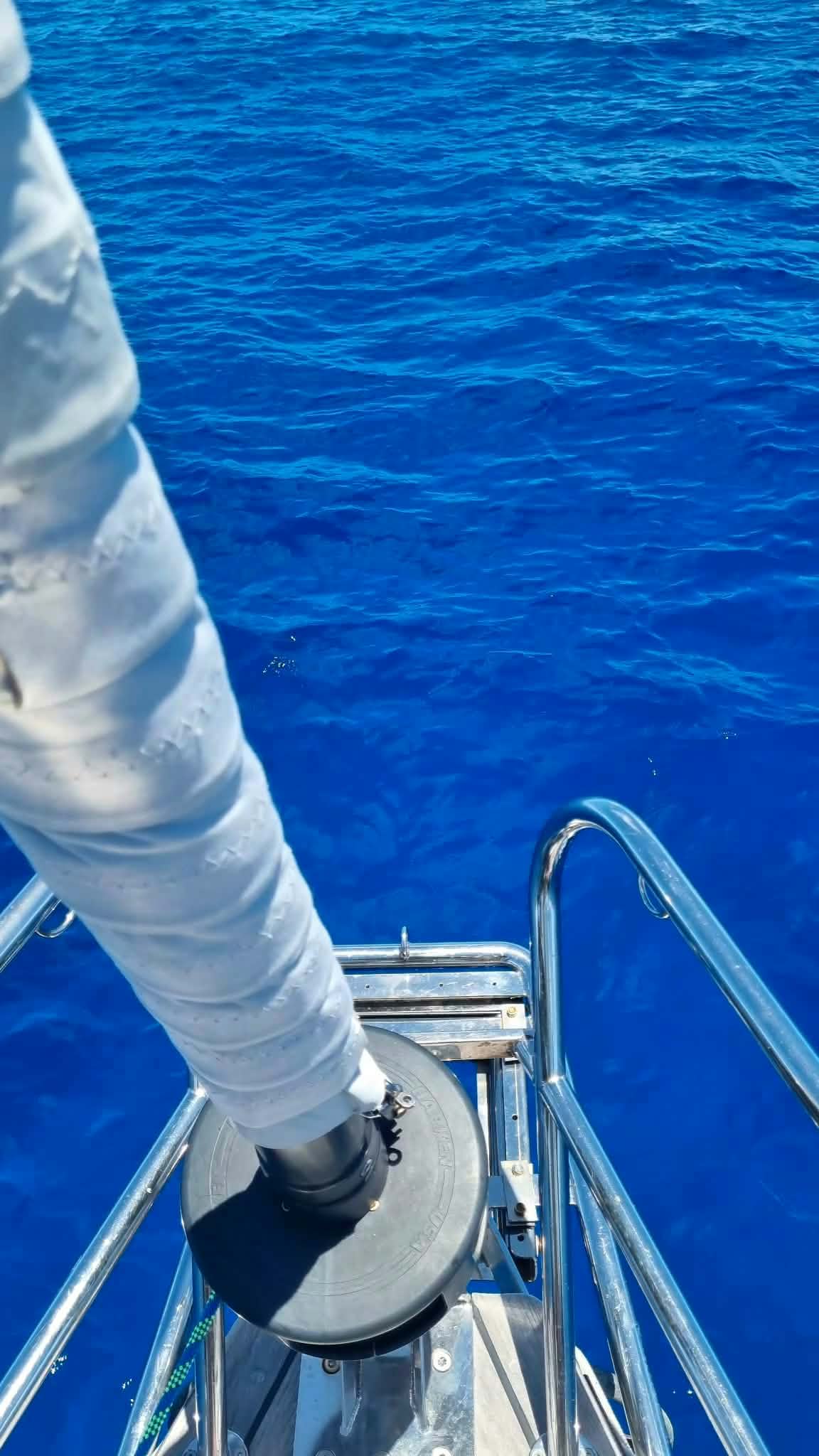
Vattnet är sååååå klart! På 35 meters djup ser jag stenar o koraller på botten och färgen på havet är magiskt blått. Frestar verkligen till att bada. Jag står vakt framme på däck så vi går klara för eventuella boomies eller grund. Pratar gör vi genom våra intercom. Det är verkligen så lätt. Inga missförstånd med tecken och jag kan göra snabba kommentarer som uppfattas omedelbart.

The water is sooooo clear! At a depth of 35 meters, I can see rocks and corals on the bottom, and the color of the ocean is a magical blue. It’s really tempting to go for a swim. I’m standing watch on the foredeck so we steer clear of any bommies or shallows. We’re talking through our intercoms. It really is so easy. No misunderstandings with hand signals, and I can make quick comments that are understood immediately!

Butaritari
The water is sooo clear and blue
Butaritari
Me in front watching with the intercom on my head

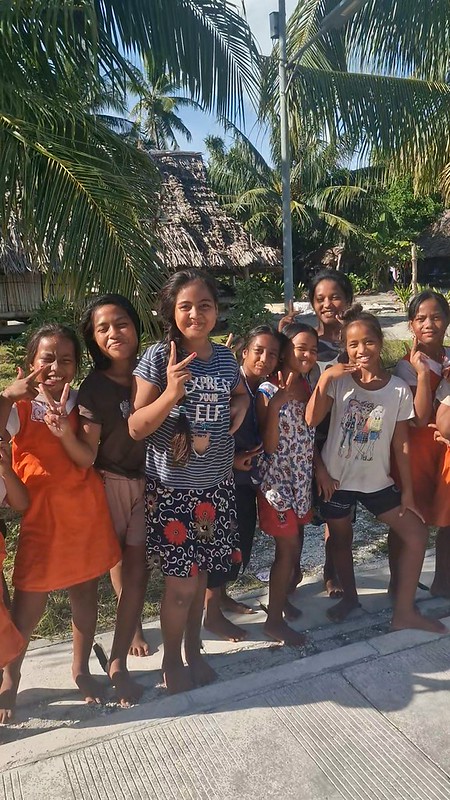
Vi tar oss till största byn i Butaritari. Vi har ju med ett ”letter of permission ” och behöver visa det för polisen. Hittar ett ställe att förtöja jollen o går in till byn. Vi slås av hur otroligt enkelt de lever här. Alla bostäder har endast en uppbyggnad av trädstammar ca 1 meter över marken, ungefär som ett fyrkantigt bord. Inga väggar o ett enkelt tak av blad. Som de flätat samman. Inne i ”byn” möts vi av otaliga hejarop och hälsningar, tjutande och jubel. Inte många båtar kommer hit så vi blir en attraktion. Skolorna har precis slutat så det är skolbarn i alla åldrar o i uniform överallt. De vinkar och visar sin glädje. Att träffa barn runt om i världen är alltid lika underbart! Samma spontanitet, samma glädje o samma oblygsel. Älskar det!

We head to the largest village in Butaritari. Since we have a ”letter of permission” with us, we need to show it to the police. We find a place to tie up the dinghy and walk into the village. We are struck by how incredibly simply they live here. All the dwellings consist only of a structure made of tree trunks about 1 meter above the ground, sort of like a square table. No walls, and a simple roof made of leaves that they’ve woven together. Inside the ”village,” we are met with countless cheers and greetings, whooping, and celebration. Not many boats come here, so we become an attraction. The schools have just let out, so there are schoolchildren of all ages in uniform everywhere. They wave and show their joy. Meeting children around the world is always just as wonderful! The same spontaneity, the same joy, and the same lack of shyness. Love it!

20261022_154358
The street in Butaritari
20261022_154446
Children walking on the street

Vi hittar poliskvinnan o lämnar vårt brev. Hon visar oss till byns enda restaurang där vi tar var vår cola o pratar lite med lokalbefolkningen.  En man, från ”counsil Office” säger att de tar en ankringsavgift på 20 eller 50 AUD pr natt, han var osäker på vilken summa 🫣 Jag ifrågasätter o säger att Tarawa tar 30 AUD för en månad. Tror han hoppades tjäna pengar men vi hörde inget mer om det. 😄

We find the policewoman and hand over our letter. She shows us to the village’s only restaurant, where we each grab a Coke and chat a bit with the locals. A man from the ”council office” says they charge an anchoring fee of 20 or 50 AUD per night; he wasn’t sure which amount 🫣 I question it and say that Tarawa charges 30 AUD for a month. I think he was hoping to make some money, but we didn’t hear anything more about it. 😄

20261022_152618
Taking a coke at the restaurant
20261022_154248
The only shop we saw in the village
20261022_154923(1)
And a cute little baby pig
20261022_154625
Street view
20261027_151730
Welcoming children
20261022_180340
Sunset out on our anchorage

Efter en natt på svaj utanför Butaritari Village är vi nu på väg inåt i atollen. Vi skall allra längst in där vi har tänkt lägga till vid en liten ö, Natata. Det är inte så många boomies här inne så vi behöver inte ha en utkik i fören hela vägen utan endast när vi känner att det behövs som t ex när vi kommer passera nära grundare områden. Vattnet är inte fullt lika klart och genomträngande blått som i inloppet igår men fortfarande helt otroligt vackert. Nu närmar vi oss och vi hittar en smal djupare tunga där vi kan komma lite närmare stranden. Ofta är det grunt en bra bit ut så vi brukar ligga långt från stranden. Så blir det även här. Skillnaden mellan hög och lågvatten är ca 1,5 – 2 meter så det måste vi också ta hänsyn till.

After a night at anchor outside Butaritari Village, we are now heading further into the atoll. We are going all the way to the innermost part, where we plan to drop anchor by a small island, Natata. There aren’t as many bommies in here, so we don’t need to keep a lookout on the bow the entire way, only when we feel it’s necessary, such as when passing close to shallower areas. The water isn’t quite as clear and piercingly blue as it was in the inlet yesterday, but it’s still completely unbelievably beautiful. Now we are getting closer, and we find a narrow, deeper channel where we can get a little nearer to the shore. Often it stays shallow a good distance out, so we usually anchor far from the beach. That turns out to be the case here as well. The difference between high and low tide is about 1.5 – 2 meters, so we have to take that into account too.

Butaritari
Almost at Natata island
Butaritari
The island looks so beautiful
Butaritari
Beach with palm trees
Butaritari
A lot of corals on the way in
20261024_103741
Taking a walk
20261024_104138
We parked the dinghy far out because of low tide coming
20261024_105609
Found some beautiful shells
Butaritari
And a small palm
Butaritari
Love the palm trees
20261024_105602
A closer look at the shells

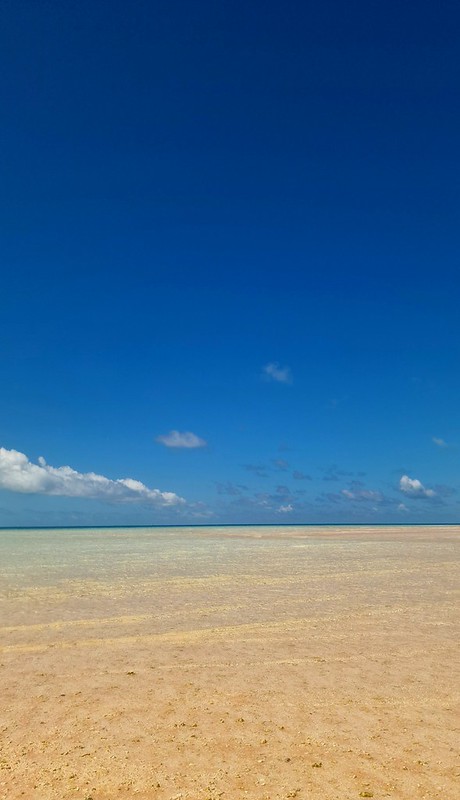
Jollen sjösatte vi i går. Så nu är vi nyfikna på att komma in till ännu en paradisstrand. Och oj, så vackert här är. En kritvit sandstrand utan några fotspår och med en massa vackra snäckor. Palmer hänger ner över stranden och en tunga av sand går ut i vattnet som vi kan promenera på. Känns som  Robinson Cruice-liv. Här skall vi stanna några dagar och bara vara och njuta av ensamhet, avskildhet och en massa badande. Vi är så tacksamma över vårat fantastiska liv.

We launched the dinghy yesterday. So now we’re eager to get ashore to yet another paradise beach. And oh, how beautiful it is here. A chalk-white sandy beach with no footprints and lots of beautiful seashells. Palm trees hang down over the beach, and a sandbar stretches out into the water that we can walk on. Feels like a Robinson Crusoe life. We are going to stay here for a few days and just be, enjoying the solitude, seclusion, and lots of swimming. We are so grateful for our fantastic life.

Butaritari
Palm trees hanging over the beach
20261024_104816
Low tide and blue sky
Butaritari
More walking in untouched sand
Butaritari
We get welcomed by the locals

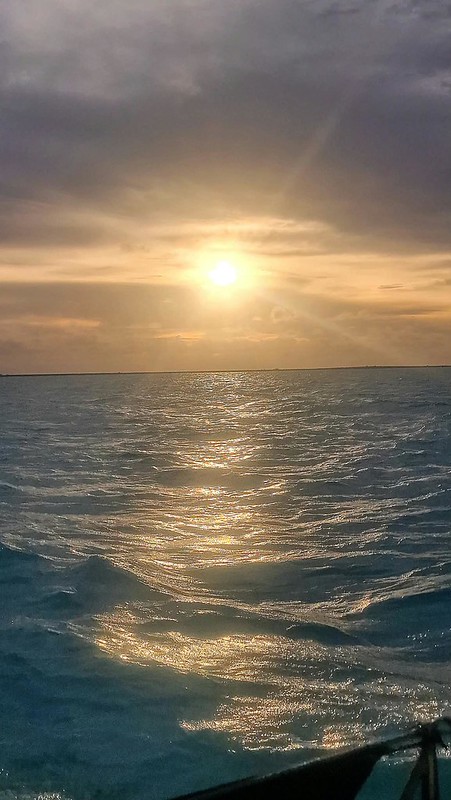
Vi har en grill ombord som vi tyvärr sällan använder, men idag blir det grillade lammkotletter och lyxig potatisgratäng med både ost och grädde i. En flaska rödvin på delning till det gör middagen till en sällsynt lyx. Allt är råvaror vi köpte i Fiji innan vi lämnade därifrån för nästan två månader sedan. Och helt omöjligt att få tag på någon stans efter det. Vi njuter verkligen av god mat o dryck och en fantastisk solnedgång. Samtidigt stiger fullmånen upp på andra sidan av båten. Färgerna blir magiskt vackra och glittrar i allsköns färger. Det är sällan vi ser en så vacker måne. Ibland känns livet lite extra bra.

We have a grill on board that we unfortunately rarely use, but today we’re having grilled lamb chops and a luxurious potato gratin with both cheese and cream in it. A bottle of red wine to share alongside it makes dinner a rare luxury. Everything is made from ingredients we bought in Fiji before we left there almost two months ago, and completely impossible to get hold of anywhere since then. We are truly enjoying good food and drink and a fantastic sunset. At the same time, the full moon is rising on the other side of the boat. The colors become magically beautiful and sparkle in all sorts of hues. It’s rare that we see such a beautiful moon. Sometimes life feels a little extra good.

20261024_171951
Potato gratin in the omnia
20261024_172150
Red wine in the glas
20261024_172150(1)
Lamb and potato gratin
20261026_182447
The sun sets
20261026_182603
As always with beautiful colors
20261026_182456
The view from Vilja
20261026_182627
And the full moon rises
20261026_182403
A small island in front
20261026_182352
It’s absolutely stunning

Här på ankringen stannar vi några dagar och rår om varandra och oss själva. Det blir många och långa bad i havet som är ljuvligt varmt men ändå lite svalkande. Vi har några flyt badleksaker som det är underbart att ligga i i vattnet och verkligen njuta av avkopplingen. Eftersom vi är ensamma kan vi kosta på oss att även bada nakna. En så härlig frihetskänsla. Speciellt jag njuter av att vara enda båten. Som jag har längtat efter det! Det är lite av målet, åtminstone för mig, med hela seglingen nu när vi tar en såpass ovanlig rutt, norr om ekvatorn. När de flesta segelbåtar valt att ta skydd i Nya Zeeland under cyklonsäsongen som startar söder om ekvatorn nu. Jag vill till platser långt bort från allfartsväg. Både till helt folktomma men också få möta en del av kulturen som fortfarande är relativt skyddad från omvärldens påtryckningar. Och här på Butaritari får jag verkligen det jag önskar. Det som jag sett på som en dröm i flera år nu.

Here at the anchorage, we stay for a few days, taking care of each other and ourselves. There are many long swims in the ocean, which is delightfully warm yet still a bit refreshing. We have some inflatable pool floats that are wonderful to lounge in on the water and really enjoy the relaxation. Since we’re alone, we can even treat ourselves to skinny-dipping. Such a wonderful feeling of freedom. I especially enjoy being the only boat here. How I have longed for this! It’s sort of the whole point, at least for me, of this entire sailing trip now that we’re taking such an unusual route, north of the equator, while most sailboats have chosen to take shelter in New Zealand during the cyclone season starting south of the equator now. I want to go to places far off the beaten path—both completely uninhabited spots, and also to experience a part of the culture that is still relatively sheltered from outside pressures. And here in Butaritari, I am truly getting what I wished for—something I’ve viewed as a dream for several years now.
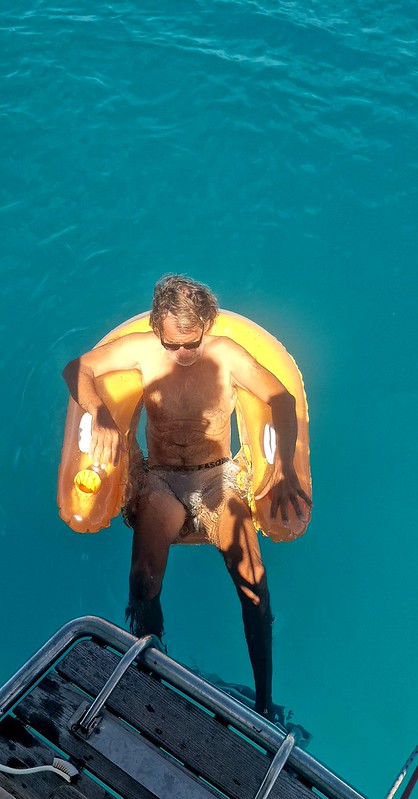
20261026_143257
Jan relaxing in the water

Efter tre dagar på denna fantastiska plats förflyttar vi oss bort till närmsta lilla byn, Kuma village. Det är en kort sträcka med båten. Nu skall det bli fint att komma in till byn och möta lokalbefolkningen. Byn är utsträckt med enkla bosättningar på var sida om den väldigt fina och troligen nya vägen. Trafiken är däremot i stort sett obefintlig.  En och annan motorcykel åker förbi oss. En kvinna stannar vid oss och frågar på lite knacklig engelska om vi vill besöka en av byns ”pre-schools” i morgon. Självklart vill vi det! Det skall bli jättekul! Det visar sig att hon är lärare där och att de har lek och undervisning mellan 09 och 11 på vardagarna. Både hon och vi känner oss upprymda för att få ta del av lite av livet i byn.

After three days in this fantastic place, we move over to the nearest small village, Kuma Village. It’s a short distance by boat. Now it will be lovely to go into the village and meet the locals. The village is spread out with simple settlements on either side of the very nice and probably new road. Traffic, however, is practically nonexistent. The occasional motorcycle passes by us. A woman stops beside us and asks in slightly broken English if we would like to visit one of the village’s ”pre-schools” tomorrow. Of course we want to! That will be so much fun! It turns out she is a teacher there and that they have play and lessons between 9 and 11 on weekdays. Both she and we feel excited to get to take part in a bit of village life.

20261027_181451
We get welcomed in our anchorage outside Kuma village
20261027_150923
A colorful canoe

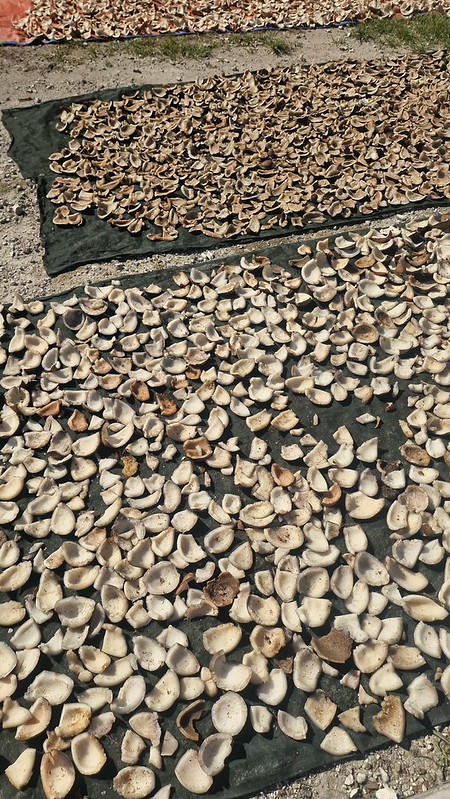
Vi promenerar vidare och förundras över hur stillsamt och fridfullt allt är. Många barn kommer fram till oss och frågar lite blygt ”what’s your name? How old are you? Where do you come from?” De vuxna är lite mer återhållsamma men hejar lite försiktigt. Här finns inga affärer förutom små ”hål i väggen” och bensinstationerna är en inhägnad rund tank med bensin och/eller diesel. Vet inte hur de betalar eller om de har någon låda de stoppar pengarna i. Utanför nästan varje klunga av hus ligger det kokoskött till tork. Det är troligen deras enda inkomstkälla.

We walk further and marvel at how quiet and peaceful everything is. Many children come up to us and shyly ask, ”What’s your name? How old are you? Where do you come from?” The adults are a bit more reserved, though they greet us gently. There are no stores here except for small ”holes in the wall,” and the gas stations are just a fenced-in round tank with petrol and/or diesel. I don’t know how they pay, or if they have a box where they put the money. Outside almost every cluster of houses, coconut meat is laid out to dry. It is likely their only source of income.

20261027_151055
Taking a first walk
20261027_151354
Traditional houses and leaves getting dried for new roof
20261022_154923
Coconuts getting dried
20261027_152200
Another stage of the drying for copra
20261022_154923(2)
The only hole-in-the-wall shop we found
20261027_160109
And the petrolstation
20261027_152120
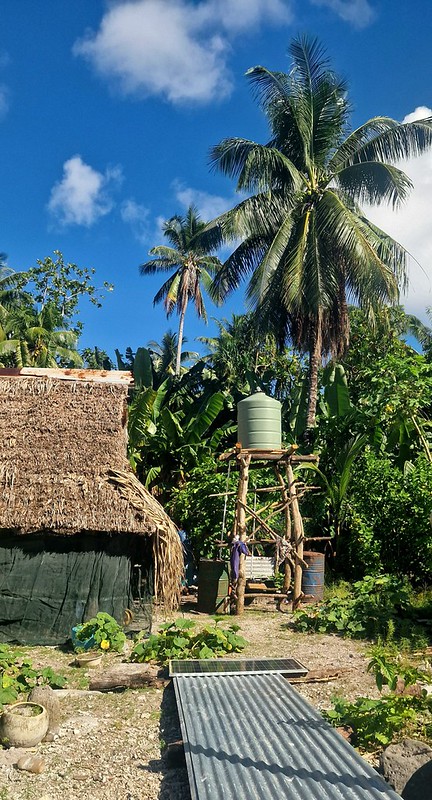
They collect and keep the rainwater high up so it comes out when they open the tap in the bottom. And many houses have one or two solarpanels
20261027_161026
Here they burn garbage under the ground
20261027_154933
We continue the walk and here the road ends
20261027_155518
Children in the primary school which is a boarding school
20261027_155035
Toilets in the school
20261027_161718
Students coming back from another school. Shouting and laughing and waving to us
20261027_161900
A beautiful canou that a man later on will go out fishing with
20261027_180554
Another sunset – stunning as always

Vi har turen att träffa på en underbar familj. En kvinna, Beretire, kommer ut till oss på vägen och börjar prata. Vi blir inbjudna i hennes familjs bostad. Det visar sig att både hon och hennes man har arbetat i Australien i nio månader var, på olika farmer. Och där har de lärt sig engelska. Det blir en två dagars fantastisk vänskap och oj så mycket vi lär oss av henne. Om livet i Kiribati och om livet på en isolerad ö som Butaritari.

We are lucky enough to meet a wonderful family. A woman, Beretire, comes out to us on the road and starts talking. We are invited into her family’s home. It turns out that both she and her husband have worked in Australia for nine months each, on different farms, and that is where they learned English. It turns into a two-day fantastic friendship, and oh, how much we learn from her—about life in Kiribati and about life on an isolated island like Butaritari.

20261027_153258
Beretire prepares coconuts for us
20261027_153800
Jan with Beretire and some of the children in the big family
20261027_153905
Different stages of coconuts getting dried to make copra
20261028_110211
The youngest cute little girl is tired and sleeping

Intressant för oss är att eftersom de levt i Australien så har de också upplevt ”vårt sätt” att leva. Hon berättade inte så mycket om det. Men när de flyttade tillbaka till Kiribati för några år sedan bosatte de sig först i Tarawa, huvudstaden med ca 70000 invånare. De bodde där i några år och jobbade för att få mat på bordet och ha tak över huvudet. Ett liv de absolut inte trivdes med. Visst de hade t o m väggar på sitt hus och en del materialistisk saker. Men hela livet gick enbart ut på stress för att tjäna pengar så de hade råd till mat och lite extra. Efter några år i denna verklighet beslöt de sig därför för att flytta tillbaka till Butaritari och byn Kuma i stället. Där de båda är uppvuxna och har sin familj. Familjen är väldigt viktig i Kiribati. De bor tillsammans med syskonen och deras familjer. Delar på kök och dusch/wc och lever som en jättestor familj.

What is interesting to us is that since they lived in Australia, they have also experienced ”our way” of living. She didn’t talk much about that. However, when they moved back to Kiribati a few years ago, they first settled in Tarawa, the capital with about 70,000 inhabitants. They lived there for a few years, working to put food on the table and keep a roof over their heads—a life they did not enjoy at all. Sure, they even had walls on their house and some materialistic things, but their entire life was solely about stress to earn money so they could afford food and a little extra. After a few years in this reality, they therefore decided to move back to Butaritari and the village of Kuma instead, where they both grew up and have their family. Family is very important in Kiribati. They live together with their siblings and their families, sharing a kitchen and shower/WC, and living like one giant family.

20261028_105738
Most of the family’s now have mobile phones and here the elderly generation is playing on onem

När de kom tillbaka till Kuma hade hennes föräldrar gått bort och platsen där de bott var nedfallen och marken täckt av högt gräs och annan växtlighet. De startade med att rensa bort all beväxtning och jobbade tillsammans med hela stora släkten för att bygga upp familjernas gemensamma hem igen. Sedan byggdes husen upp. De är uppbyggda av en trädstam i varje hörna med en platta ca en meter upp från marken däremellan. Taket är högt i mitten och sluttar ganska brant ner. Där taket tar slut finns inga väggar utan det är öppet åt alla fyra håll. Varje familj i den stora familjen har varsitt sådant här traditionellt hus som används som vardagsrum på dagen och sovrum på natten. Då lyfts bastmattor ner som de sover på. Förutom dessa hus finns ett gemensamt utomhus kök där denna familj faktiskt har rinnande vatten, de flesta familjer har inte det. Det finns också en kokplatta med ett enkelt tak över. De eldar med kokosnötter och har elden igång hela tiden. Vattnet de har är regnvatten som samlas i en stor cistern placerad högt upp. Dricksvattnet kokar de och förvarar i en särskild behållare. De lever verkligen ”ur hand i mun”. Maten de äter är den fisk, skaldjur, havsmaskar och annat de får tag på i vattnet. Till det har de brödfrukt, kokosnötter, bananer och en och annan frukt de plockar från träden. Beretire berättar att hon absolut föredrar detta liv framför både Australien och framförallt framför Tarawa. Det är bekymmersfritt och saknar stress. Både ekonomiskt och materiellt. Hela familjen umgås och arbetar tillsammans. Barn finns det gott om och de hjälps åt med att ta hand om dem. Förskola finns ju också och skolan börjar de när de är ca fem år gamla. Barnen i byn är jättemånga, varje familj har många barn. De går runt i byn barfota, badar, leker och hjälper till med att passa varandra och med en del göromål i hemmet.

When they came back to Kuma, her parents had passed away, and the place where they had lived was run-down and the ground covered in tall grass and other vegetation. They started by clearing away all the overgrowth and worked together with the entire extended family to rebuild their shared family home. Then the houses were built. They are constructed with a tree trunk in each corner and a raised platform about a meter off the ground between them. The roof is high in the middle and slopes down quite steeply. Where the roof ends, there are no walls; instead, it is open on all four sides. Each family within the extended family has their own traditional house like this, which is used as a living room during the day and a bedroom at night, when woven mats are taken down for them to sleep on. Besides these houses, there is a shared outdoor kitchen where this family actually has running water—most families don’t have that. There is also a cooking area with a simple roof over it. They burn coconut husks and shells for fuel and keep the fire going all the time. The water they use is rainwater collected in a large cistern placed high up. They boil their drinking water and store it in a separate container. They truly live ”hand to mouth.” The food they eat is whatever fish, shellfish, sea worms, and other things they can catch in the water. Alongside that, they have breadfruit, coconuts, bananas, and the occasional fruit they pick from the trees. Beretire tells us that she definitely prefers this life over both Australia and, above all, Tarawa. It is carefree and free of stress, both financially and materially. The whole family spends time together and works together. There are plenty of children, and everyone helps out with taking care of them. There is a preschool, too, and they start school when they are about five years old. There are so many children in the village; every family has many kids. They walk around the village barefoot, swim, play, and help out by looking after one another and doing various chores around the home.
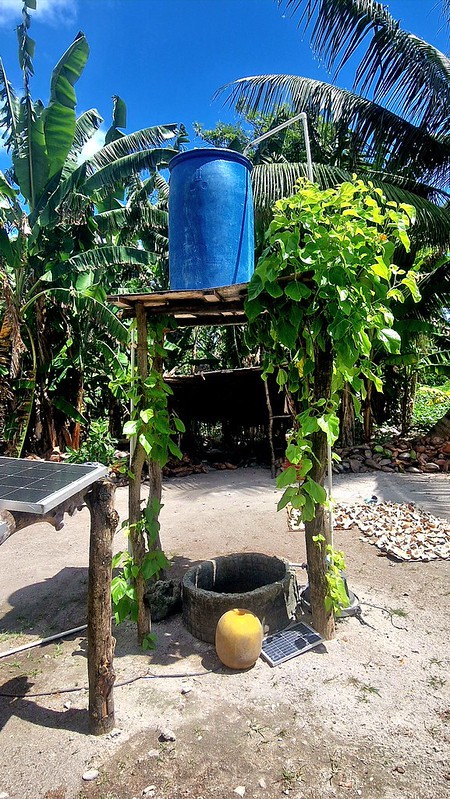
20261028_105503
The water tank. They have an electrical pump that helps them with running water
20261028_105454
And two solarpanels that gives them electricity
20261028_105440
The battery gets charged from the solarpanels
20261028_105037
The coockingarea
Butaritari
Kitchen with running water
Butaritari
Jan trying the living room / bedroom

Livet kretsar kring familjen och havet och även kyrkan. Allt de äter kommer från havet både när det är lågvatten då de plockar djur som lever i sanden, humrar och musslor och högvatten då de är ute och fiskar. De ger sig oftast ut sent på eftermiddagen när det inte är fullt lika varmt. Humrar plockar de vid lågvatten i mörkret på reven på utsidan atollen. Könsfördelningen är ganska klassisk. Kvinnorna tar mest hand om barnen och hemmet medan männen fiskar och bygger. Lite pengar får familjerna in genom kopran som de torkat av kokosnötterna. Det är ett aldrig sinande jobb att först ta bort det håriga skalet och sedan dela kokosnötterna för att plocka ut kokosen och lägga den till tork i olika stadier.

Life revolves around family, the ocean, and also the church. Everything they eat comes from the sea—both at low tide, when they gather creatures living in the sand, lobsters, and clams, and at high tide, when they are out fishing. They usually head out late in the afternoon when it isn’t quite as hot. They catch lobsters at low tide in the dark on the reefs outside the atoll. Gender roles are fairly traditional. The women mostly take care of the children and the home, while the men fish and build. The families bring in a little money from the copra they make by drying coconuts. It is a never-ending job to first remove the fibrous husk and then split the coconuts to scoop out the meat and lay it out to dry in different stages.

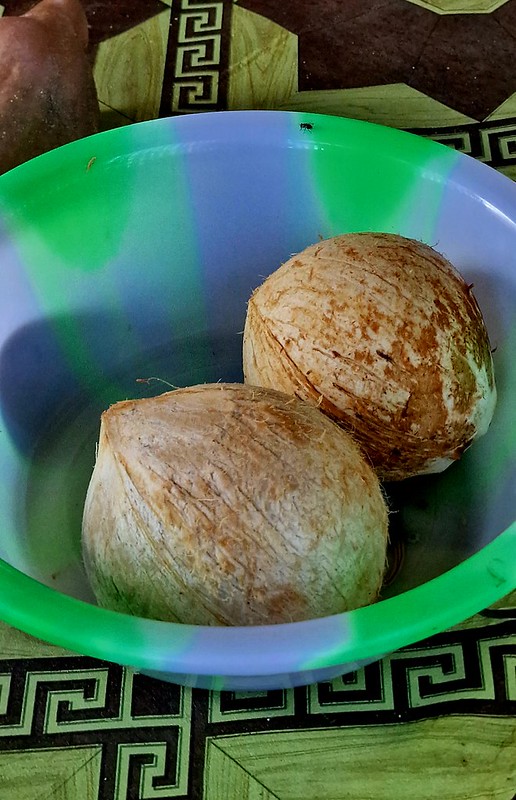
Kokosnötter är också något de älskar att dricka och att bjuda på. Vi blir bjudna vart vi än går och de smakar otroligt friskt, sött och gott i värmen.

Coconuts are also something they love to drink and offer to guests. We are offered them wherever we go, and they taste incredibly fresh, sweet, and delicious in the heat.

20261022_154426
A man climbing up the palm to get coconuts
20261022_154433
A closer look at his technique
20261028_095623
Coconuts prepared for us

Vi tar oss in till byn i långvattnet för att hälsa på i förskolan. Förväntansfulla och nyfikna. Med oss har vi ballonger, såpbubblor och kritor.  Några av barnen är lite blyga när vi kommer dit, ett av dem börjar t o m gråta men de flesta springer fram med nyfikenhet och öppna sinnen. Vi får sätta oss ner och titta på när de först ritar. Sedan kommer en lek där barnen leker något liknande ”sisten ut”. Fröken ger ordrar, delvis på engelska, och de följer genom att lägga sig ner, föra handen till pannan mm mm. Efter ytterligare lekar är det dags för lite undervisning. Hela alfabetet gås igenom och de ropar i kör hur de skall uttalas. Mest speciellt för oss är när ett och ett av barnen skall presentera sig. Alla sitter ner framför oss och när de reser sig väljer de en sång som fröken sjunger. Alla väljer samma sång visar det sig. Pojkarna efterapar vuxna mäns dans medan flickorna efterapar vuxna kvinnors. Vilket betyder, för flickorna, att de putar ut med rumpan och vickar på den. Ovanligt för oss men här i denna delen av världen, en urgammal tradition. Under tiden vi sitter där på golvet blir vi bjudna på läskande kokosnötter och barnen börjar blåsa upp sina ballonger och leker med dem.  När de två timmarna är över lämnar barnen och ropar glatt ”bye bye”. Fröknarna tackar för att vi kommit dit och ger oss en stor hel stock med bananer. Vilken underbar upplevelse att få vara med om detta!

We head into the village at low tide to visit the preschool, full of anticipation and curiosity. We bring along balloons, soap bubbles, and crayons. Some of the children are a bit shy when we arrive—one of them even starts crying—but most run up to us with curiosity and open minds. We get to sit down and watch as they start off drawing. Next comes a game where the kids play something similar to ”Simon Says” (elimination style). The teacher gives commands, partly in English, and they follow along by lying down, bringing a hand to their forehead, and so on. After a few more games, it’s time for some lessons. They go through the entire alphabet, shouting out in chorus how each letter is pronounced. Most special for us is when each child has to introduce themselves one by one. Everyone sits down in front of us, and when they stand up, they pick a song for the teacher to sing. It turns out they all choose the same song. The boys imitate the dance of adult men, while the girls imitate the dance of adult women—which, for the girls, means sticking their bottoms out and wiggling them. Unusual to us, but here in this part of the world, it’s an age-old tradition. While we sit there on the floor, we are offered refreshing coconuts, and the children start blowing up their balloons and playing with them. When the two hours are up, the children leave, cheerfully shouting ”bye bye.” The teachers thank us for coming and give us a huge, whole stalk of bananas. What a wonderful experience to be a part of!

20261028_103759
Here is the pre-school we visited
PhotoCollageMaker_2026103013648142
A child playing with a balloon
PhotoCollageMaker_2026103012912171
The presentation of each child
20261028_100904
20261028_101201
Children playing again
20261028_094212
The teachers cute daughter
20261028_100715
Preparing the sweet coconuts
20261028_101905
We got a lot of bananas when we left
20261028_104214
Leaving the pre school after some lovely hours
20261028_103941
A woman with her absolutely loving bag in front of us

Efteråt går vi tillbaka till vår familj, där vi också parkerat jollen. Det är fortfarande extremt lågvatten så den ligger helt torrlagd några hundra meter utifrån land. Det är omöjligt för oss att ta oss tillbaka till Vilja nu. Beretire vill visa oss familjens ”sommarställe” och hon ordnar så två män kör oss dit på sina motorcyklar. Det är en kort resa dit och vi kommer fram till utsidan av atollen med öppet hav utanför. Här har de fem traditionella små hus och en kokplats, diskplats och några mattor ute på marken där de brukar dricka kava. Hon berättar om alla fester och sammankomster de brukar ha här. Födelsedagar, jul – som är en väldigt stor högtid och fest i Kiribati, bröllop och sist men definitivt inte minst så firar de sina döttrars första menstruation. Och det firar de i flera dagar. Det betyder att flickan går över till att vara kvinna och det är, för dem, en stor och viktig händelse. Beretire säger att hennes familj och flera andra i byn vill ställa till med en stor fest för oss. Men de behöver några dagar för att kunna iordningställa festen. Fiska, hämta humrar, plocka frukt och grönt och tillaga allt. Det skall bli hög feststämning med god mat, skratt, musik och mycket dans. Vi blir verkligen berörda av detta och vill så gärna. Men tyvärr, vi har bara fått sju dagars tillstånd att vara på Butaritari så vi måste lämna nästa dag. Hon blir verkligen ledsen och det blir vi med. Tänk vilken upplevelse det hade varit att vara föremål för och delta i en stor fest på den mycket isolerade lilla atollen Butaritari mitt ute i Stilla havet. Något väldigt få är förunnade.

Afterward, we walk back to our host family, where we also parked the dinghy. It is still extremely low tide, so it is sitting completely high and dry a few hundred meters out from shore. It’s impossible for us to get back to Vilja right now. Beretire wants to show us the family’s ”summer place,” and she arranges for two men to drive us there on their motorcycles. It’s a short ride, and we arrive at the outer side of the atoll with the open ocean right in front of us. Here, they have five traditional little houses, a cooking area, a dishwashing area, and a few mats out on the ground where they usually drink kava. She tells us about all the parties and gatherings they usually hold here: birthdays, Christmas—which is a huge holiday and celebration in Kiribati—weddings, and last but definitely not least, they celebrate their daughters’ first menstruation, which they celebrate for several days. It signifies the girl transitioning into womanhood, and to them, it is a major and important event. Beretire says that her family and several others in the village want to throw a big party for us, though they need a few days to prepare it—going fishing, catching lobsters, picking fruits and vegetables, and cooking everything. It would be a lively celebration with good food, laughter, music, and lots of dancing. We are truly touched by this and want to so badly, but unfortunately, we were only granted a seven-day permit to stay in Butaritari, so we have to leave the next day. She is genuinely saddened by this, and so are we. Just imagine what an experience it would have been to be the guests of honor at, and take part in, a big celebration on the very isolated little atoll of Butaritari right in the middle of the Pacific Ocean—something very few people are privileged to experience.

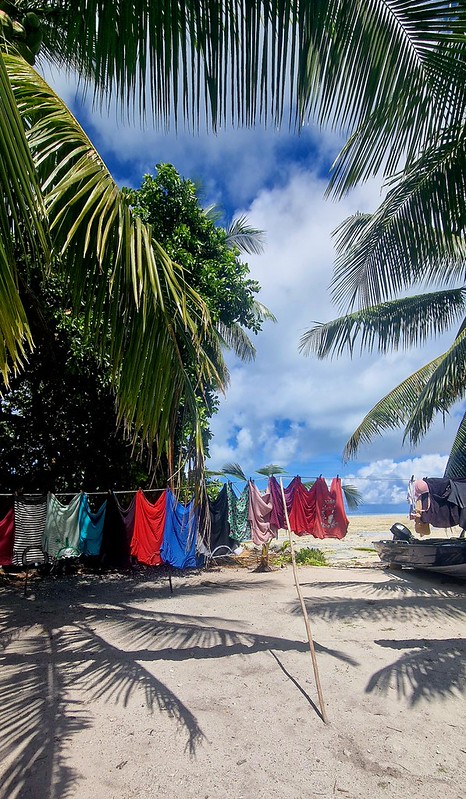
20261028_105341
Really low tide and our dinghy is stranded far out
20261028_105320
Laundry getting dry after cleaning
20261028_111657
The guys with their motorbikes that took us to the ”summerhouse” or picknick area
20261028_125012
One of the houses
20261028_124951
Coockingarea
Butaritari
The mat where to drink kava

När vi senare tar farväl av familjen blir det med tårar i ögonen. De vill att vi skall flytta dit och de skall hjälpa oss att bygga upp vår egna traditionella bostad. Med oss får vi en stor hel stock bananer och en jättestor papaya. De i sin tur får bönor och en del kvinnokläder av oss. Sådana här möten är helt underbara och vi känner oss så rika.

When we later say goodbye to the family, it is with tears in our eyes. They want us to move there and say they will help us build our own traditional home. They send us off with a huge, whole stalk of bananas and a giant papaya. In return, we give them beans and some women’s clothes. Encounters like these are truly wonderful, and we feel so rich.

20261028_170925
Beretire and her husband
20261028_171831
The bananas they gave us
20261028_171020
Saying goodbye to the children
20261028_172506
Soon reaching Vilja
20261028_172857
The second banana stock we got today
Butaritari
Jan is happy with a lot of bananas and a big pumpkin
Butaritari
A last sunset in Butaritari

I morgon lämnar vi ön som fastnat i vårt hjärta och kommer vara ännu ett minne för livet. Nästa mål är atollen Abaiang.

Tomorrow we leave the island that has captured our hearts and will remain yet another memory for a lifetime. Our next destination is Abaiang Atoll.
Arriving Kiribati

Port control, port control, port control  this is sailing vessel Vilja calling! Efter åtta timmar efter att vi drejat bi inatt når vi inloppet till South Tarawa atoll. Huvudstaden i Kiribati. Eller Kiribass som det heter på deras lokala språk Kiribatiska eller Gilbertesiska. Ti i slutet uttalas ss. Vi har verkligen kämpat för att komma hit. Det som skulle vara sju dygn blev nio tuffa dygn och mycket motvind. Det har ni redan läst om i förra inlägget

Port control, port control, port control, this is sailing vessel Vilja calling! Eight hours after heaving to last night, we are reaching the entrance to the South Tarawa atoll, the capital of Kiribati. Or ”Kiribass” as it is pronounced in the local language, Kiribati (also known as Gilbertese), the ”ti” at the end is pronounced ”ss.” We have truly fought to get here. What was supposed to be a seven-day voyage turned into nine tough days, with a great deal of headwinds. You have already read about that in the previous post.

Messenger_creation_68C7B8F3-F734-4530-8BC3-F294BF7C2A3F
Arrived and anchored in Kiribati

Incheckningen i Kiribati är lika tuff som den i Fiji. På ett annat sätt. I Fiji var det den totala kontrollen inne i båten som slutade med att båten var fullkomligt kaos efter att ha tömt ur alla förråd av mat samt att vi fick slänga över tio kilo mat. Här går just den kontrollen jätteenkelt. Men de behandlar oss som ett kommersiellt fartyg och vill ha dokument efter dokument efter dokument som vi skulle ha och dessutom redan ha skrivit ut o fyllt i. Vi har inte ens tillgång till sådana dokument. Kommersoella fartyg har alla dessa dokument men de går inte att googla upp för oss. Det är så frustrerande och tröttsamt. Vi känner oss helt utmattade och konfunderade. Hur gör vi?Vi är ju bara en liten fritidsbåt. Inte ett stott fraktfartyg. Efter mycket dividerande fram och tillbaka och flera handskrivna dokument blir vi till sist godkända. Fast vi behöver ta oss till immigration 3 km bort.

Checking in to Kiribati is just as tough as it was in Fiji, though in a different way. In Fiji, the issue was an exhaustive inspection of the boat’s interior, which left the vessel in complete chaos after every food locker had been emptied and we ended up having to discard over ten kilos of food. Here, that part of the process is a breeze. However, they treat us like a commercial vessel, demanding document after document, all of which we are supposedly expected to have, printed out and filled in advance. We don’t even have access to these kinds of forms; while commercial ships have them, they aren’t something we can simply find via a Google search. It is so frustrating and exhausting. We feel completely drained and bewildered. What are we supposed to do? We’re just a small pleasure craft, not a massive cargo ship! After a great deal of back-and-forth discussion and the creation of several handwritten documents, we are finally cleared, though we still need to make our way to the immigration office, 3 km away.

Messenger_creation_ACC4B06F-2E87-4450-A6BE-3CA42F2023FF
The Pilot boat arrives

Dessutom kräver de oss på 300 AUD i avgift till pilotbåten som körde ut alla till oss. Det var vi inte beredda på. Har ju hört att det är gratis att checka in i Kiribati. Frågan är hur de tänker. Vi får inte lov att gå iland och sköta incheckningen där. De vägrar att bli hämtade av vår jolle pga starka vindar. Och om de tar sig ut till oss skall vi betala motsvarande hutlösa 2100 svenska kronor. Vi godkände inte ens summan innan. Utan frågade vad det kostar och då kom de ombord utan att svara om priset. Får se hur det landar. Gissar att vi måste betala för att kunna checka ut.

On top of that, they are demanding a 300 AUD fee for the pilot boat that brought everyone out to us. We weren’t prepared for this. I’d heard that checking into Kiribati was free. I really don’t understand their reasoning. We aren’t allowed to go ashore to handle the check-in process there; they refuse to be picked up by our dinghy, citing strong winds. Yet, if they come out to us, we’re expected to pay an exorbitant sum, the equivalent of 2,100 Swedish kronor. We didn’t even agree to this amount beforehand; we asked what the cost would be, and they simply came aboard without giving an answer. We’ll see how it plays out, but I suspect we’ll have to pay if we ever want to be able to check out.

Efter att de varit ombord sjösätter vi jollen o kör in för att ta oss till immigration. Det är lite förvirrande var vi kan lägga jollen. Här finns många båtar, både större och mindre o precis där det är markerat som dingebrygga ligger en jättestor båt. Smutsigt är det också. En massa skräp som flyter runt överallt. Vi plöjer oss väg mellan skräp och tampar som är fästa i de stora båtarna och går iland någonstans på muren som omgärdar den lilla hamnbassängen. Här ligger även andra små båtar.

After they have been on board, we launch the dinghy and head in to reach immigration. It is a bit confusing as to where we can tie up the dinghy. There are many boats here, both large and small, and a huge vessel is moored right where the dinghy dock is marked. It’s also dirty; there is a lot of trash floating around everywhere. We make our way through the debris and lines attached to the larger boats, then go ashore somewhere along the wall that surrounds the small harbor basin. Other small boats are moored here as well.

Messenger_creation_28FB74E4-F820-480C-B041-8F7D43D3D92E
Here we put the dinghy
Messenger_creation_34797DC3-C107-4EBC-91F1-A6ECD334E22D
In the small harbour
Messenger_creation_2B2DC9D6-59F7-453E-81FF-6F82813A173E
Unfortunately it’s a lot of rubbas in the water (and on land)
Messenger_creation_4942E8DA-A178-4241-A7B0-7E5EF86396DD
Messenger_creation_C219EF79-E5DE-40CA-9784-821F454291E5
Colorful and practical boats

Vi fäster jollen o går mot huvudvägen. Vi måste hitta en busshållplats för att ta oss till immigration innan de stänger. Vi skall inte bara lämna in våra papper för båten och få stämplar. Vi har också med oss brev för att söka om tillstånd att segla till yttre atoller. Vi har valt Abaiang och Butaritari som båda ligger norr om Tarawa.

We secure the dinghy and head toward the main road. We need to find a bus stop to get to the immigration office before it closes. We aren’t just there to submit our boat paperwork and get our passports stamped; we also have letters with us to apply for permission to sail to the outer atolls. We have chosen Abaiang and Butaritari, both of which lie to the north of Tarawa.

Vi hittar busshållplatsen och väntar och väntar på en buss. Det kommer flera som kör inom denna del av staden, Betio, men ingen som kör vidare till Bairaki där immigration ligger. Vi liftar också men det går inget vidare….tills plötsligt en kvinna med hennes son stannar. Vi blir överlyckliga och hon kör oss ända till ingången till immigration. Vi erbjuder henne pengar vilket hon envist tackar nej till

We find the bus stop and wait and wait for a bus. Several buses pass through this part of the city, Betio, but none continue on to Bairiki, where the immigration office is located. We also try hitchhiking, but with little success… until, suddenly, a woman with her son stops. We are overjoyed, and she drives us all the way to the entrance of the immigration office. We offer her money, but she firmly declines.

Messenger_creation_11C5CC98-8BD9-467B-913E-17FA139340B3
Waiting for the bus

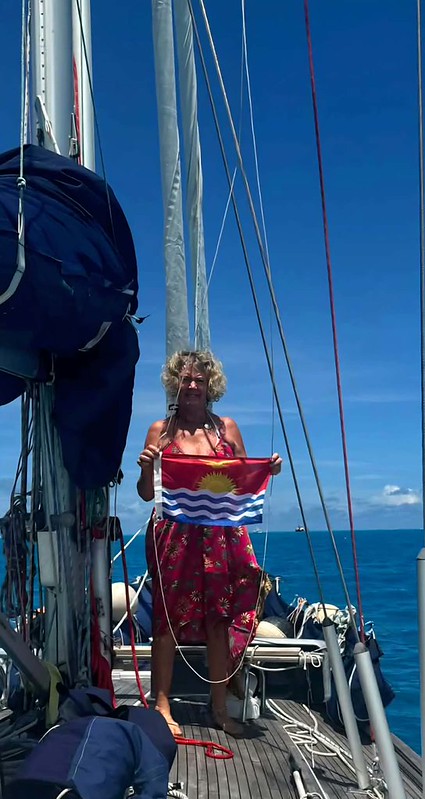
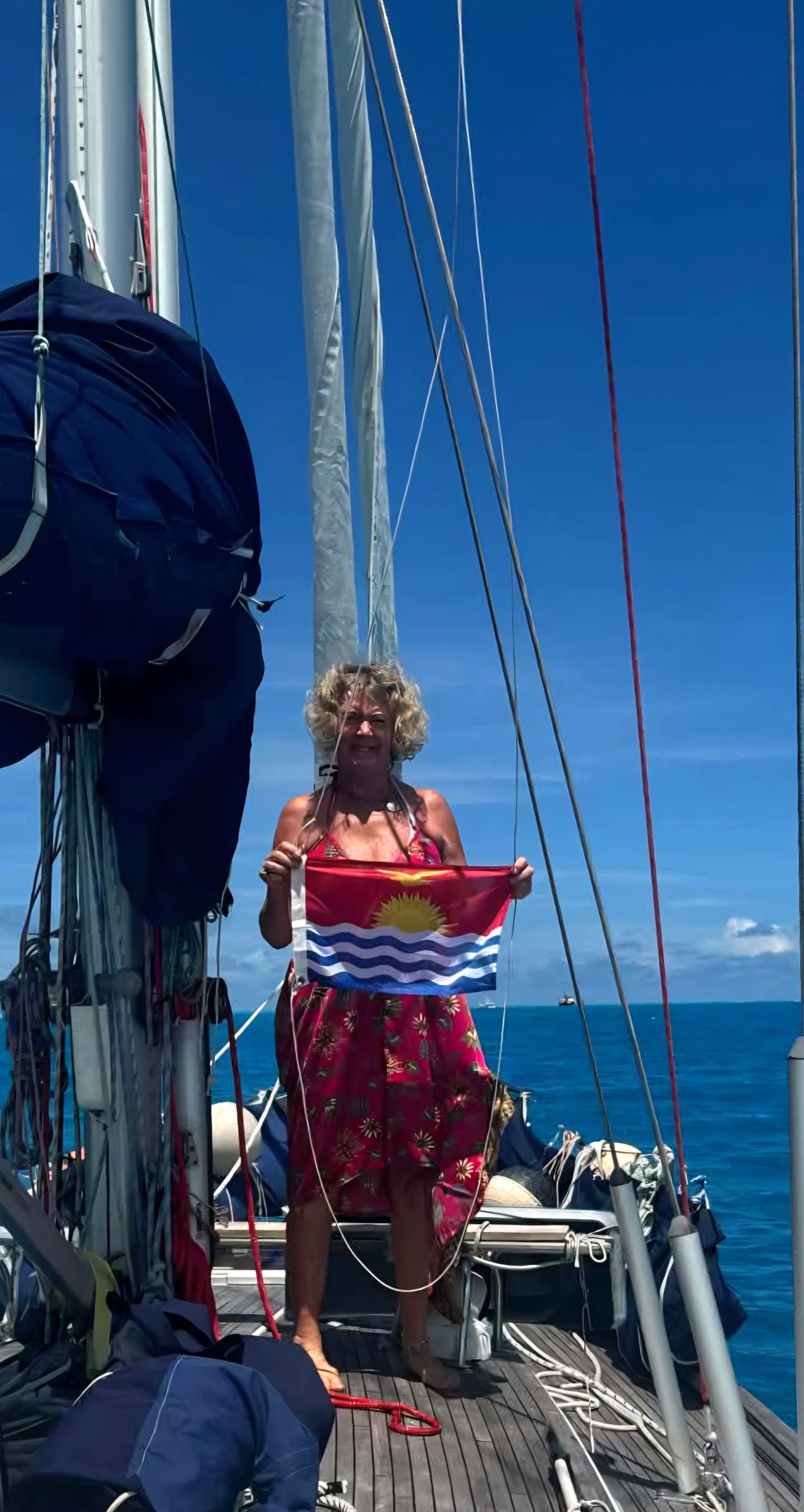
Slutligen har vi lämnat våra brev och fått våra pass stämplade. Nu kan vi hissa Kiribatis vackra flagga på båten. En av världens vackraste flaggor enligt mig.

Finally, we have dropped off our letters and had our passports stamped. Now we can hoist Kiribati’s beautiful flag on the boat, in my opinion, one of the most beautiful flags in the world.

Messenger_creation_C85BE61C-5F18-48CB-ADD5-56E043DD2608
The beautiful flsg of Kiribati
Messenger_creation_0F406D2B-7203-4877-BAC8-8B6209BDED5D
we raise the flag to the spreaders on the mast

Fast först måste min telefon som fått pepsi cola över sig, lämnas in och göras ren. Jag väntar i kö en evighet o till sist är det min tur. Reparatörer värmer upp skalet där det är limmat o använder sedan något vasst för att skära bort baksidan. Därefter börjar jag få panik…Han skruvar upp den ena lilla skruven efter den andra och plockar sedan loss en massa delar. Allt lägger han planlöst på sitt arbetsbord där det redan ligger små delar från många andra telefoner. Jag blir så orolig så jag måste gå därifrån. Tänk om han inte får ihop den på rätt sätt igen. Kan inte överleva utan den här telefonen då allt viktigt finns där. Samt foton, blogg, bank, bank-id, starlink, navigationsappar mm mm mm. Även fotokopia på allt viktigt rörande resan, min båt Kailani, min bil, och lagret. Efter mycket svettande från min sida skruvar han ihop allt och ger telefonen till mig. Nu verkar det gå att ladda den igen. Hoppas bara inget frätt sönder inuti av min pepsi cola. Han visste vad han gjorde ❤️

But first, my phone, which had Pepsi-Cola spilled all over it, needed to be handed in for cleaning. I waited in line for an eternity, and finally, it was my turn. The technicians heated up the casing where it’s glued together, then used a sharp tool to cut away the back panel. That’s when I started to panic… He unscrewed one tiny screw after another and proceeded to remove a whole bunch of components. He just tossed everything haphazardly onto his workbench, which was already covered in small parts from many other phones. I got so anxious that I had to walk away. What if he couldn’t put it back together correctly? I can’t survive without this phone, everything important is on it: photos, my blog, banking, BankID, Starlink, navigation apps, and so much more. It even contains digital copies of all the important documents regarding my trip, my boat Kailani, my car, and my storage unit. After I’d spent a good while sweating bullets, he finished reassembling everything and handed the phone back to me. It seems I can charge it again now. I just hope the Pepsi-Cola didn’t corrode anything inside. He really knew what he was doing! ❤️

Messenger_creation_DD151D6D-EC4A-4DBD-AA93-1586A7FAF544
Some of the loose parts
Messenger_creation_F4DE04C5-75A2-43B3-8D87-054361231395
Putting everything back again

Nu är vi klara här o skall ta oss tillbaka till Betio o jollen. Vi har tur! En buss kommer o de väntar på oss när vi kommer springande. Tillbaka vid jollen o här är det fullt av liv och rörelse. Alla hejar och vinkar och är glada. Trots att Tarawa är extremt skräpigt. Både på land och i vattnet. Inget ställe man vill tillbringa mycket tid. Vid dinge-landningen finns det skjul där de förvarar copra i säckar. Det stinker något fruktansvärt  så det  hjälper inte ens att hålla för näsan.

We’re finished here now and are heading back to Betio and the dinghy. We’re in luck! A bus pulls up, and they wait for us as we come running over. Back at the dinghy landing, there’s a real buzz of activity. Everyone is greeting us, waving, and smiling, even though Tarawa is incredibly littered, both on land and in the water. It’s not the kind of place where you’d want to spend much time. Near the dinghy landing, there are sheds where they store sacks of copra. The stench is absolutely awful, holding your nose doesn’t even help.

Det är längesedan vi lämnade Fiji och vi behöver fylla på vårat grönsaksförråd. Eftersom det är över 30° varmt, snarare 35°, konstant och bland den högsta luftfuktigheten i världen håller inte grönsakerna länge. Vi lägger en del i kylen men utrymmet är starkt begränsat. Så vi går till de två supermarkets som finns. Väldigt enkla o framförallt torrvaror, städartiklar och konserver finns att tillgå. Går fram till grönsakerna. Gul lök och vitlök  – that’s it. Inga morötter, vitkål eller ens potatis. Det är bara att acceptera.  Konserver har vi ombord och det är konserver det får bli framöver. Tänk vad bortskämda vi är i Sverige. Där skriver vi handlelistor o köper från den plus lite extra som vi blir sugna på när vi ser det.  Här får vi se vad som finns o köpa därefter. Mejerivaror finns över huvud taget inte. Egentligen inget som behöver förvaras i kyl. Kött, fisk mm finns knappt heller. Hittade ett paket frusna korvar och frusna kycklingvingar. O det får vi kalla lyx. Vi har torra bönor o linser ombord. Samt torkad sojafärs. Kommer ganska långt på det faktiskt.  Mätta blir vi i alla fall.

It has been a long time since we left Fiji, and we need to restock our supply of vegetables. Since the temperature is constantly above 30°C, more like 35°C, combined with some of the highest humidity levels in the world, vegetables don’t last long. We keep some in the fridge, but space is extremely limited. So, we head to the two local supermarkets. They are very basic, offering mostly dry goods, cleaning supplies, and canned items. I walk over to the produce section: yellow onions and garlic, that’s it. No carrots, white cabbage, or even potatoes. We just have to accept it. We have canned goods on board, and that’s what we’ll be eating for the foreseeable future. It’s amazing how spoiled we are in Sweden; back home, we make shopping lists and buy exactly what’s on them, plus a few extra things that catch our eye. Here, we have to see what’s available and shop accordingly. There are no dairy products whatsoever, in fact, nothing that requires refrigeration. Meat, fish, and similar items are also nearly impossible to find. I did manage to find a pack of frozen sausages and some frozen chicken wings, we’ll call that a luxury! We have dried beans and lentils on board, as well as dried soy mince. You can actually get quite far with those. At the very least, we won’t go hungry.

Messenger_creation_C4C56925-CBBC-4571-A4B9-CE635A823935
Going out to Vilja again
Messenger_creation_99461946-6692-4ACC-9DBA-5421AB66FB0A
She looks so small compared to the cargoships. Our neighbour is Temauri
Messenger_creation_04A89AB9-295A-4062-80E9-D5661E8CE0CD
A big ship at the jetty
Messenger_creation_011C09A9-05B8-455F-8A81-5CA34F8A974C
Another sunset here with a ship
Messenger_creation_FFABD731-9B76-475C-A3C7-891F7447C62C
And without.  It’s both amazing

Vår ankringsplats är definitivt inte optimalt. Det blåser 20 – 30 knop och ibland mer, bortemot 40 knop. Rakt in mot oss utan egentligt skydd. Visst det finns en sandbank men Vilja rullar oavbrutet och väldigt mycket. Vi måste ha allt sjöstuvat ombord och att röra sig eller ännu värre, laga mat, är en prövning. Det är ovanliga västliga vindar, vilket det varit länge. I nästan tio dagar nu. Det var ju de som gjorde seglingen hit så svår. Normalt är det alltid no-vindar här men eftersom det är super El Niño år har det förutspåtts västliga vindar I denna del av Stilla Havet. Och det stämmer verkligen. Många seglare har valt andra vägar just pga detta. Vi hoppas hitta väderfönster både upp till Marshall öarna o sedan västerut genom hela Micronesia federation. Hoppas det går bra.

Our anchorage is definitely not ideal. The wind is blowing at 20–30 knots, sometimes even more, approaching 40 knots, hitting us head-on with no real protection. Sure, there is a sandbank, but Vilja is rolling incessantly and quite violently. Everything on board has to be stowed securely for sea; just moving around, let alone trying to cook, s a real ordeal. We’ve been experiencing unusual westerly winds for a long time now, nearly ten days. In fact, these are the same winds that made our passage here so difficult. Normally, the winds here are always from the north, but because this is a ”super El Niño” year, westerly winds were predicted for this part of the Pacific, and that has certainly proven true. Many other sailors have chosen different routes precisely because of this. We’re hoping to find weather windows to head up to the Marshall Islands and then continue westward through the Federated States of Micronesia. Fingers crossed that it all goes well.

Messenger_creation_D6B218B3-A110-4D9F-9D09-85E4AA9D410D
The colors…
Messenger_creation_88BCE324-1A98-4A52-BF39-C7B782F0BFE6
….love them
Messenger_creation_379D7E06-5BD9-4978-8BCA-C5512E95A616
When bathing behind Vilja we almost get attacked by the dinghy
Messenger_creation_4CBF30A8-C250-4720-A3B3-55E534226A79
But the view is lovely

Vi måste acceptera att vågorna går höga och försöka ta oss för det första ombord i jollen, och sedan in i hamnbassängen. Det kommer bli två turer idag eftersom vi behöver fylla på diesel först och sedan handla lite mat. Tufft. Vågorna går så höga så jollen stundtals hamnar ovanpå vår badbrygga. O att hålla in jollen med linan är totalt omöjligt. Efter mycket om o men o stor chansning är vi båda i jollen för att åka in o köpa, först diesel. Sex jerrycans ca 20 liter var. Vi släpar dem till bensinstationen. Där är de jättehjälpsamma. Fyller först upp och bär sedan till platsen där vi har vår jolle. Och sedan…lokalbefolkningen sluter upp mandant o bär våra jerrycans samt väskor med mat och ägg till vår jolle. De är bara sååååå underbara ❤️

We have to accept that the waves are running high and try to get, first, into the dinghy, and then into the harbor basin. We’ll need to make two trips today, as we have to top up our diesel and then pick up some groceries. It’s tough going. The waves are so high that, at times, the dinghy ends up right on top of our swim platform—and holding it steady with the painter is completely impossible. After a lot of struggle and a major gamble, we both manage to get into the dinghy to head ashore—first for diesel. Six jerrycans, holding about 20 liters each. We haul them over to the gas station, where the staff are incredibly helpful; they fill them up and then carry them all the way back to where our dinghy is moored. And then… the locals pitch in, carrying our jerrycans as well as bags of groceries and eggs down to the dinghy. They are just so, so wonderful! ❤️

Messenger_creation_99589403-5E3A-4D6B-906C-439F94ADAA1D
Six jerrycans full of diesel
Messenger_creation_724392E1-E102-4009-AEEF-D0D78BC044B8
They have to be carried down the steep and slippery wall
Messenger_creation_3197FF9A-6AEE-4EBA-B7E9-8812E319DA2E
It’s not easy to keep balance and carry more thsn twenty kilos
Messenger_creation_E17021B2-30F7-43E1-B29E-8C2B4E125187
We soon get help from locals
Messenger_creation_E7D5F1C3-158E-4FF6-B90C-FE4D2E411E27
They take it all the way onboard where Jan is
Messenger_creation_D4E729F0-E04A-45BF-BA4C-E74F0FD35150
They are carefull with the eggs we bought

Stoooor tvättardag idag. Efter nio dygn till havs o sedan fem dygn med väldigt mycket blåst har tvätthögen växt. Inte bara personliga kläder. Utan tre uppsättningar sängkläder, handdukar och badlakan och en massa tvätt från köket. Dessutom fem dynor vi sitter på i sittbrunnen som stinker svett, är indränkta i saltvatten och börjar bli mögliga. Vi har en tvättmaskin ombord men använder den inte. Tyvärr.  Den är placerad på ett så dumt ställe så vi måste riva upp hela akterkojen med madrasser och allt. Jag sover i akterkojen så det skulle vara jobbigt för mig. O vi har dessutom en massa saker förvarade där. Spänner fungerar bra för oss, fast vi vet ju att det inte blir lika rent. Extra Tvättmedel eller sköljmedel så luktar det gott i alla fall

A huuuuge laundry day today. After nine days at sea, followed by five days of very strong winds, the pile of laundry has grown. It’s not just personal clothing, there are three sets of bed linens, towels and bath sheets, and a whole lot of kitchen laundry. On top of that, there are the five cockpit cushions we sit on; they reek of sweat, are soaked in salt water, and are starting to get moldy. We do have a washing machine on board, but we don’t use it, unfortunately. It’s located in such an inconvenient spot that we’d have to tear apart the entire aft berth, mattresses and all. Since I sleep in the aft berth, that would be a real hassle for me. Plus, we have a lot of other gear stored in there. Using a bucket works well enough for us, even though we know things don’t get quite as clean. But with some extra detergent or fabric softener, at least it ends up smelling nice!

Messenger_creation_88BCE324-1A98-4A52-BF39-C7B782F0BFE6
Every day the same pink, grey and turquoise
Messenger_creation_F8D11EDA-DB14-49DD-B136-FE4B9522FB18
Totally six big buckets of laundry
Messenger_creation_770E8762-AD0B-4990-BBBE-7156A00EA514
Good it’s sundhine and windy so it get’s dry quick
Messenger_creation_E654F663-FD33-48D7-9D26-5E30EA135A3D
Home sweet home

Oj vad det har blåst inatt! Vi har flyttat oss lite längre in i lagunen för att slippa de stora container- och fiskefartygen samt att få renare vatten. Men det är precis lika öppet mot västliga vindar. Och inatt har det blåst! Ordentligt! Saker har rullat runt inne I båten och det har ryckt fruktansvärt i vårt stackars ankarspel. Förhoppningsvis har snubben hållit så ankarspelet inte ryckts sönder. Vindarna har varit över fyrtio knop stundtals. Alltså upp mot stormvindar – Tänk senaste stormen i Sverige Boeli – vi bor i vår båt mitt i stormen utan något skydd. Som tur är har vi fäste för ankaret. Om det släpper o vi driver, hamnar vi fort på reven o då är det kört med Vilja – vårt hem.

Wow, has it been windy tonight! We’ve moved a bit further into the lagoon to get away from the large container ships and fishing vessels, and also to find cleaner water. But it’s just as exposed to westerly winds. And has it blown tonight! Really hard! Things have been rolling around inside the boat, and our poor windlass has been taking a terrible pounding. Hopefully, the snubber has held, preventing the windlass from being torn apart. At times, the winds have exceeded forty knots, approaching storm force. Think of the recent storm in Sweden, Boeli, well, we’re living in our boat right in the middle of a storm, with absolutely no shelter. Luckily, the anchor is holding. If it lets go and we start to drift, we’ll end up on the reefs in no time, and that would be the end of Vilja, our home.

Messenger_creation_92C2D825-EBFE-42BB-BD44-07841BE46963
Messenger_creation_D024E5C6-A0AA-40B9-B90D-BC95F437D2EE
The sea at the anchorage is ruff and the dinghy full of water after heavy rain. It was really difficult for Jan to go in and out of the dinghy to take out the water
Messenger_creation_A6103C8C-EE1D-4838-9BDF-018B6AC86EFD
But if you look far out it’s beautiful

Nu är det morgon o vi är trötta. Det har inte blivit mycket sömn inatt. Helt naturligt under en så jobbig natt. Idag blir det mest avkoppling och att röja lite i båten. Om vågorna lägger sig skall vi över med dingen till Screensaver som kom hit igår. Vi lämnade Tuvalu samtidigt men de gjorde flera stopp på vägen pga de svåra förhållandena medans vi körde på o kom hit tre dagar tidigare

It’s morning now, and we’re tired. We didn’t get much sleep last night, which is only to be expected, given how difficult the night was. Today will mostly be about relaxing and tidying up the boat a bit. If the waves die down, we’ll take the dinghy over to Screensaver, which arrived yesterday. We left Tuvalu at the same time, but they made several stops along the way due to the rough conditions, whereas we kept going and arrived three days earlier.

Det blir en jättetrevlig kväll med goda samtal och delade erfarenheter.  En flaska gott vin, nypoppade popcorn och solnedgång gör det ännu bättre.

It’s going to be a really lovely evening, with good conversation and shared experiences. A bottle of nice wine, freshly popped popcorn, and the sunset make it even better.

Messenger_creation_DCFC35C1-D789-4059-A9D4-707AB7557F3E
Yanina, Alan and Jan ( and me) onboard Screesaver having a nice evening
Messenger_creation_0BBF1B28-7915-4C46-B1F7-42860F9E383A
Yanina
Messenger_creation_87D9DA96-FEFE-4514-90C0-EC9626C39307
Me
Messenger_creation_89BD0F5F-0432-414B-94E2-8917D17ABFBC
And us together
Messenger_creation_6AB6D400-04A9-4A6A-BD01-38E470429C3A
We watched the special colors together

Nu är vi äntligen på väg mot äventyr! Att få tillstånd att åka till outher atolls togs sin tid. Vi har bett om fjorton dagar på Abaiang och fjorton dagar på Butaritari.  Det slutade tyvärr med sju dagar på varje. Men det är absolut bättre än inget. Vi är på väg mot Butaritari nu – lämnade runt lunch och har ca tjugofyra timmar dit. Vi valde den ön först eftersom den är längst bort och därmed svårare att åka tillbaka ifrån. Vi måste tillbaka till Tarawa för att checka ut innan vi kan bege oss mot nästa land – Marshall öarna. Men det är några veckor tills dess

We are finally off on an adventure! Getting permission to visit the outer atolls took some time. We had requested fourteen days on Abaiang and fourteen days on Butaritari, but in the end, we were granted seven days for each. Still, that’s definitely better than nothing! We are currently en route to Butaritari, we departed around lunchtime, and it’s about a twenty-four-hour journey. We chose that island first because it’s the furthest away, making it more difficult to return from later. We’ll need to head back to Tarawa to clear out before we can set off for our next destination, the Marshall Islands, but that’s still a few weeks away.

Messenger_creation_3B18B15D-FD1C-47BC-A081-11A5B211BE62
The permission to go to outher atolls

Seglingen, eller snarare motorseglingen, är behaglig. Vi tar oss framåt och sjön är relativt platt. Självklart dörjer vi under sådana förhållanden.  Jag längtar mig sjuk efter en tonfisk eller Mahi Mahi. Man kan tro att vi lever på fisk men det är  bristvara för oss. Det nappar tyvärr ytters sällan. Och, speciellt Jan, är livrädd för fiskar som kan bära på nervsjukdomen, Ciguterra. Små fiskar äter alger och plankton innanför revet. Sedan äter lite större fiskar de små och slutligen t ex Barracuda äter de större. Sjukdomen följer med och den går inte att koka, frysa, grilla eller steka bort tyvärr. Sjukdomen medför illamående, diarréer, kramper, muskelsvaghet och allt möjligt annat otrevligt. Går tyvärr nästan inte att bli frisk från heller tyvärr. Så enda fiskar vi äter är typ tonfisk, mahimahi – som vi fångat själva( eller en stor marlin fångad långt ute till havs som vi en gång haft tur att hitta)

The sailing, or rather, motor-sailing, is pleasant. We’re making good progress, and the sea is relatively calm. Naturally, we spend time trolling under conditions like these. I’m absolutely dying to catch a tuna or a mahi-mahi. You might assume we live on fish, but it’s actually a rarity for us; unfortunately, we hardly ever get a bite. Furthermore, Jan in particular is terrified of fish that might carry the neurological illness known as ciguatera. Small fish feed on algae and plankton inside the reef; these are then eaten by slightly larger fish, which in turn are consumed by predators like barracuda. The toxin persists, unfortunately, it cannot be eliminated by boiling, freezing, grilling, or frying. The illness causes nausea, diarrhea, cramps, muscle weakness, and a whole host of other unpleasant symptoms. Sadly, it is also nearly impossible to recover from. Consequently, the only fish we eat are species like tuna or mahi-mahi, provided we’ve caught them ourselves (or, on one lucky occasion, a large marlin caught far out at sea).

Jan tycker vi skall ta in linan. Men jag vill vänta. Ofta får vi napp i skymningen. O plötsligt! Rassel rassel rassel! Vi har napp! Först tror vi att den släppte för linan är så lös. Men, jo den är där. O den kämpar. Vi ser strax att det är en tonfisk. Mitt drömbyte! Jan drar in o jag står färdig med håven, där den snällt landar. En gulfenad aldeles ljuvlig tonfisk. Det vattnar sig redan i munnen på mig när jag tänker på en lätthalstrad tonfisk. Fast först en massa jobb. Rensa bort huvud och stjärtfena. Sedan vill jag ha fyra fina filéer som kan tillagas till perfektion. Jan vill ha dem mer stekta. Så allt är varmt. Jag vill ha en härlig tunn stekyta runtom – inget mer.

Jan thinks we should reel in the line, but I want to wait. We often get a bite at dusk. And then, suddenly, rattle, rattle, rattle! We’ve got a bite! At first, we think it’s gotten away because the line goes so slack, but no, it’s still there, and it’s putting up a fight. We soon realize it’s a tuna, my dream catch! Jan reels it in while I stand ready with the landing net, and in it goes, nice and smooth. It’s a yellowfin tuna, absolutely gorgeous. My mouth starts watering just thinking about some lightly seared tuna. But first, there’s plenty of work to do: removing the head and tail. I want four beautiful fillets that can be cooked to perfection, though Jan prefers his a bit more well-done. I’m aiming for a lovely, thin, seared crust all the way around, and nothing more.

Messenger_creation_8D4CB913-749F-4161-A4FA-2CC23B92A534
Our lovely tuna!
Messenger_creation_4474C057-1092-495E-89D7-5DBCDD76D445
Tastes so wonderful
Messenger_creation_F5F2B8D5-93A1-4026-89AA-41BF842014D4
Sunset before nightshifts

Vi tar våra nattskift som vanligt. Inget spännande med vare sig nattliga sqalls eller kinesiska fiskebåtar. Så runt lunch ankommer vi Butaritari. Längtar!

We are carrying on with our night shifts as usual. Nothing exciting to report, no squalls in the night, nor any Chinese fishing boats. So, around lunchtime, we will arrive at Butaritari. Cant’t wait!

Messenger_creation_F5F2B8D5-93A1-4026-89AA-41BF842014D4
Dark but with lovely moonshine around us
Messenger_creation_92436C8B-C6CC-4900-BC95-9FAE0995F7EA
And an amazing sailing in sunrise
Messenger_creation_E14201A0-7E95-4726-A526-BBE762A9E066
A squid had jumped onboeard during the night. Making a lot of dirt. The squid lays beside the yellow jerrycan

Sailing north towards Kiribati

Nu lämnar vi Tuvalu. Tyvärr mycket tidigare än planerat och utan att ha åkt till andra atoller. Som jag verkligen ville. Men vi måste ta tag i våra problem med båten. Och då måste vi till en större plats där det finns ett varv som kan titta till problemet vid propelleraxeln. Vi har också beställt reservdelar från Sverige för att kunna reparera. Så som vi hade sett fram emot att segla till andra atoller i Tuvalu, men nu blev det inte så. Tur att vi fick med oss både segling inne i Funafuti-atollen, flygplatsen och Independence day i alla fall. Vi har ca sju dagar framför oss tills vi kommer till Kiribatis huvudstad Tarawa. Vi hoppas på bra vind och inga squalls men sådan tur har vi nog inte. Under flera dagar har vi letat efter ett bra väderfönster men det finns inte. Så det är bara att ge sig iväg. Vi kommer korsa ekvatorn på denna segling så vi kommer över till norra halvklotet igen. Kiribati ligger på båda sidor om ekvatorn och på båda sidor om datumlinjen. Som enda land i världen i alla fyra hemisfärer. Det är ett väldigt utspritt land men bara två platser vi kan checka in. Stopp på vägen är totalt förbjudet.

We are now leaving Tuvalu, unfortunately much sooner than planned, and without having visited any other atolls, which I had really wanted to do. However, we need to address some issues with the boat, which means heading to a larger location with a shipyard that can take a look at the problem with the propeller shaft. We have also ordered spare parts from Sweden to carry out the repairs. We had really looked forward to sailing to other atolls in Tuvalu, but that wasn’t to be. At least we managed to experience sailing within the Funafuti atoll, visit the airport, and take part in Independence Day celebrations. We have about seven days of sailing ahead of us before we reach Tarawa, the capital of Kiribati. We’re hoping for good winds and no squalls, though we probably shouldn’t count on that. We’ve been searching for a decent weather window for several days, but none has appeared,so, it’s time to set off. During this passage, we will cross the equator, bringing us back into the Northern Hemisphere. Kiribati straddles both the equator and the International Date Line, making it the only country in the world to span all four hemispheres. It is a very widely dispersed nation, yet there are only two ports of entry where we are permitted to check in. Any stops along the way are strictly prohibited.

Tarawa
Jan, relsxed before  strong weather
Tarawa
All the beautiful colours

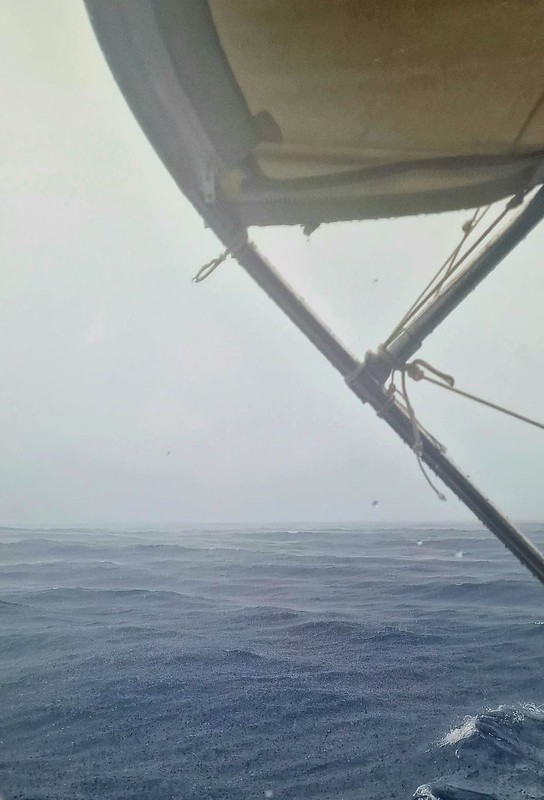
Vi seglar norrut genom Funafuti-atollen och går ut genom det nordliga passet. Vinden är slör vilket vi tycker om så det är bäst att njuta så länge det går. Runt omkring oss hänger tunga mörka moln så vi är beredda på en första squall med starka vindar och ösregn. För säkerhets skull drar vi in mycket på genuan ( förseglet) och på nästan noll tid är den över oss. Vindarna går upp mot 25 – 30 knop och regnet regnar nästan horisontalt in i sittbrunnen. Lika snabbt som den kom över oss avtar det igen. Fast det är fortfarande gråa tunga moln.

We sail northward through the Funafuti Atoll and exit via the northern pass. We have a broad reach, a point of sail we quite enjoy, so we decide to make the most of it while we can. Heavy, dark clouds loom all around us, and we brace ourselves for an initial squall, complete with strong winds and a downpour. As a precaution, we significantly furl the genoa (headsail), and in no time at all, the squall is upon us. The winds climb to 25–30 knots, and the rain drives almost horizontally into the cockpit. Just as quickly as it arrived, it subsides, though the heavy, grey clouds remain.

Och så tog vinden slut. Väntat men ändå trist. Är så mycket härligare när vi seglar fram i god fart. När vinden avtar och det fortfarande är sjö rullar båten mycket och bommen flyger fram och tillbaka, även om vi har en preventer. Det är kväll och jag sitter på vakt igen. Mörkret omsluter mig och Vilja och Jan ligger nere i båten och försöker sova. Jag har lagt om kursen och skotat hem för att minska fladdret i båda seglen så nu styr vi mot N i stället för NV. Om vi fortsätter att segla i endast 2 – 2,5 knop startar vi nog motorn snart.

And then the wind died down. Expected, perhaps, but still a shame. It’s so much more pleasant when we’re sailing along at a good speed. When the wind drops but there’s still a swell, the boat rolls heavily and the boom swings back and forth—even with a preventer rigged. It’s evening, and I’m on watch again. Darkness envelops me, while Vilja and Jan are down below, trying to sleep. I’ve adjusted our course and sheeted in to reduce the flapping in both sails; we’re now heading north instead of northwest. If our speed remains only 2–2.5 knots, we’ll likely start the engine soon.

Messenger_creation_ABC02623-E7E6-44EF-9779-B98AA54FB3A0
Bad weather
Tarawa
Bkue sky, blue water and blue skies

Ikväll är det lite mer spänning än önskvärt i mörkret här ute på havet. Vi är precis norr om Tuvalus nordligaste atoller och närmar oss Kiribatis sydligaste. På plottern har vi, sedan ett bra tag, sett en kinesisk ganska stor fiskebåt. Vi ligger nästan i kollisions kurs och kommer mötas om ca fyrtiofem minuter. Jag väjer redan nu några grader så att vi skall gå akter om den. Tittar på plottern väldigt ofta för att göra ny bedömning. Behöver jag kanske även sakta ner farten? Vi har fått till oss att vi ( vår ais) inte syns för andra båtar så vi måste vara extra vaksamma. Våra lanternor kanske de inte ser förrän det är för sent. Plötsligt ser jag starkt ljus från en båt mycket närmre än den vi ser på ais. Jag ropar upp Jan, som jag vet är vaken. Strax därefter ser jag ännu en upplyst båt. Och de kör rakt mot oss på vår babords sida. Vi väljer att ändra vår kurs ca nittio grader för att gå akter om dem. Eftersom vi inte ser dem på vår plotter vet vi inte alls avståndet eller vilken fart de gör. Den första båten ( den på plottern) ser vi både lanternorna på och på plottern så den har vi full koll på. Sedan blir det plötsligt svart från de andra två båtarna. Inga lanternor längre. Var är de i förhållande till oss? Hur nära? Hur stora är de o vilken fart gör de? Men, totalt mörker. Vi vet att de finns där men har ingen aning om var. Vi ser dem inte ens på radarn. Och de kan troligen inte se oss på sina instrument. Otäckt. Jag ropar upp båten vi ser, på vhf, och får svar. Han bekräftar att han inte ser oss på instrumenten. Jag frågar hur många båtar de är, kinesiska fiskebåtar brukar ju vara många. Får svar att de är fem stycken. Vi får lite panik. Fem. Och vi ser bara en. Ber honom att säga till de andra båtarna att sätta på sina lanternor. Men tyvärr, hans engelska är dålig och han förstår inget av vad jag säger. Trots att jag pratar långsamt och med enkla ord.

Tonight, out here in the darkness at sea, there is a bit more tension than I would like. We are just north of Tuvalu’s northernmost atolls, approaching the southernmost ones of Kiribati. For quite some time now, we have been tracking a fairly large Chinese fishing vessel on our chart plotter. We are on a near-collision course and are set to cross paths in about forty-five minutes. I am already altering our course by a few degrees to ensure we pass behind it. I keep checking the plotter, constantly re-evaluating the situation. Should I perhaps slow down as well? We’ve been told that we, or rather, our AIS, aren’t visible to other vessels, so we have to be extra vigilant. They might not even spot our navigation lights until it’s too late. Suddenly, I see bright lights from a vessel much closer than the one showing up on our AIS. I call out to Jan, knowing he’s awake. Moments later, I spot yet another illuminated vessel, and they are heading straight toward us on our port side. We decide to alter our course by about ninety degrees to pass behind them. Since they don’t appear on our plotter, we have no way of knowing how far away they are or how fast they’re moving. As for the first vessel, the one on the plotter, we can see both its navigation lights and its position on the screen, so we have a clear handle on that one. Then, suddenly, the other two vessels go completely dark. No more navigation lights. Where are they in relation to us? How close are they? How big are they, and what speed are they making? Nothing but total darkness. We know they’re out there, but we have no idea where. We can’t even pick them up on our radar, and they likely can’t see us on their instruments, either. It’s unsettling. I hail the vessel we can see over the VHF radio, and I get a response. He confirms that he doesn’t see us on his instruments. I ask how many boats there are, Chinese fishing fleets usually consist of quite a few. He replies that there are five. We start to panic a little. Five. And we can only see one. I ask him to tell the other boats to turn on their navigation lights. But unfortunately, his English is poor, and he doesn’t understand a word of what I’m saying—even though I’m speaking slowly and using simple words.

Får till svar ”Thank you! Thank you!” Vad jag än frågar om. Nu gäller det att hålla utkik i mörkret och att lysa upp Vilja så gott vi kan. Alla lanternor tända och även däcks belysningen. Och vi sitter med var vår strålkastare i handen som vi lyser på seglet med samt lyser ut i mörkret. En av oss på varje sida och spanar o spanar ut i mörkret. Efter ett tag ser jag ljus prickar överallt var jag tittar. Det kan vara stjärnor borta vid horisonten eller som speglar sig i havet. Det är otäckt att veta att det finns fyra fiskebåtar, sannolikt mindre, men de kan ju vara stora, som vi inte ser och inte har någon aning om var de befinner sig. Förutom att jag såg två av dem upplysta för ett tag sedan. Så här sitter vi i en till två timmar. Vi har gått tillbaka till vår kurs nu mot Tarawa men känner oss inte säkra förrän den båt vi ser på ais är ganska långt borta. Så nu kan Jan gå och lägga sig igen.

The response we get is ”Thank you! Thank you!”, no matter what I ask. Now it’s a matter of keeping a sharp lookout in the darkness and illuminating Vilja as best we can. All navigation lights are on, as well as the deck lights. We each hold a spotlight, using them to illuminate the sails and scan the surrounding darkness. One of us is positioned on each side, peering intently out into the night. After a while, I start seeing points of light everywhere I look, perhaps stars near the horizon, or reflections on the sea. It’s unsettling to know that there are four fishing boats out there, likely small, though they could be large,that we cannot see and whose exact locations are unknown to us. (Though I did see two of them lit up a little while ago.) So, we sit here for an hour or two. We have returned to our course toward Tarawa, but we won’t feel truly secure until the vessel we see on the AIS is a good distance away. Now, Jan can go back to bed.

Tarawa
The weather starting to get rough
Messenger_creation_2DE2C8A9-C39E-40BE-BB01-ABBA89A13754
Another fishingboat. But this one was very close to us in the morning
Messenger_creation_F8C97F1B-CFAE-45F9-8710-FA7701A0A49F
We tried to call many times in vhf but no aneere. Finally he saw us and moved a bit. It’s so much easier for him then for us who are sailing clouse-hauled
Tarawa
Love the sunset
Tarawa
Look at the skies

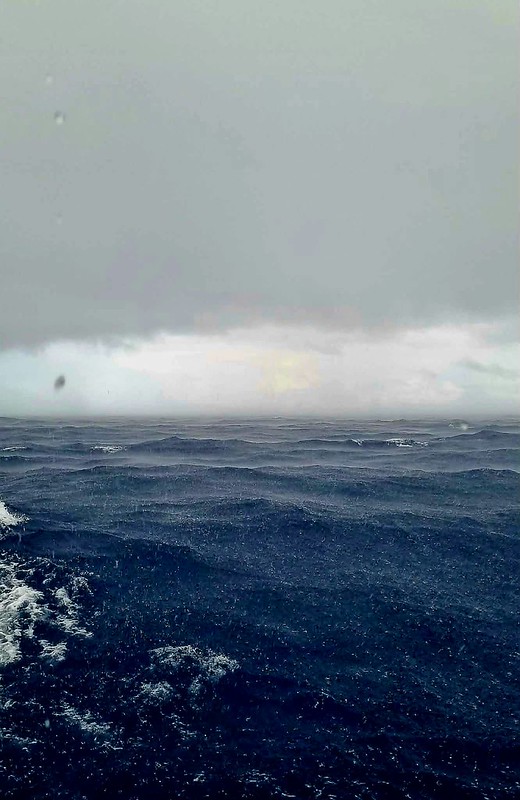
Molnen bygger upp sig runt omkring oss och över oss. Mörka tunga moln fulla med regn. Vi kan se hur regnet öser ner inte långt bort från oss och det rör sig snabbt närmre. På radarn är det stora röda fält med fläckar av gult i. Det gula visar ännu mer intensivt oväder. Blixtar börjar lysa upp den grå himmelen. Än så länge ganska långt bort. Vi är ensamma ute på havet och vår mast är definitivt högsta punkten. Jag tycker i och för sig om åskoväder o är inte rädd. Men måste ändå inse fakta att vi inte vill att blixten skall slå ner. Nu är det fyra sekunder mellan blixt och åska. Regnet fortsätter ösa ner och det är dyngblött i hela sittbrunnen. Vi pratar om att göra i ordning våra ”grab-bagar”. Vattentäta väskor där vi har det nödvändigaste. Två ligger färdigpackade med reservmat och lite vatten, medicin, passkopior och en hel del annat nödvändigt om det värsta skulle ske. Alla långseglare har sådana väskor som vi går igenom med jämna mellanrum. Nu packar vi även var sin egen med personliga saker som vi anser livsnödvändigt. Våra mobiler och powerbankar har vi lagt in i micron där de förhoppningsvis ligger bättre skyddade. Vid eventuellt blixtnedslag.

Clouds are building up all around us and overhead, dark, heavy clouds, laden with rain. We can see the rain pouring down not far away, and it is moving toward us rapidly. On the radar, there are large red patches flecked with yellow; the yellow indicates even more intense weather. Lightning begins to illuminate the gray sky, still quite a distance off, for now. We are alone out at sea, and our mast is, without a doubt, the highest point around. Personally, I quite enjoy thunderstorms and am not afraid, but I have to face the facts: we certainly don’t want lightning to strike. There is now a four-second interval between the flash and the thunder. The rain continues to pour, leaving the entire cockpit soaking wet. We discuss getting our ”grab bags” ready,waterproof bags containing the bare essentials. Two are already packed with emergency food, some water, medicine, copies of our passports, and various other necessities, just in case the worst should happen. Long-distance sailors all keep such bags, which we check and update periodically. Now, we are each packing an additional bag with personal items we consider absolutely vital. We’ve placed our mobile phones and power banks inside the microwave, where they should hopefully be better protected—in the event of a lightning strike.

Messenger_creation_1155F212-CACC-49A6-AD9C-6FF68745FE6D
Squalls and that means rain and strong wind
Tarawa
Jan is totally wet

Kaboooom. Blixt och åska samtidigt. Nu är ovädret rakt över oss. Även jag reagerar vid den höga smällen. Och en till. Vi känner oss små i världen ensamma i vår lilla båt på detta stora hav. Väldigt långt bort från civilisation. Vi har seglat tre dygn från Funafuti och har tre till fem dygn kvar innan vi når Tarawa i Kiribati. Vi befinner oss bland de mest isolerade länderna i världen. Ytterligare några blixtar slår ner, precis i närheten. Himmelen blir upplyst och de mörkgrå molnen tornar upp sig och ser ännu tyngre ut i blixtens sken. Efter några minuter som känns mer som timmar, börjar det gå fler sekunder mellan blixt och åska. Skönt. Vi har tur att det inte har slått ner i båten. Då skulle alla våra navigationsinstrument, vhf mm slås ut. Vi har redan problem med att ett viktigt instrument har dött. Displayen där vi avläser vindriktningen i förhållande till båten samt vindstyrkan. En jätteviktig display. Eftersom vindarna snurrar runt hela tiden på grund av ovädret så blir det jättesvårt att segla även med instrument. Och utan känns det hopplöst då vi plötsligt kan få en oplanerad gipp eller slå utan att vara beredda på det. Vi har redan fått back i seglet ett flertal gånger. Och nu är det ändå dag så vi kan orientera oss bättre och se på seglen vad som händer. Frågan är hur vi skall göra när mörkret faller om någon timma. Att säkerheten går först råder det inget tvivel om. Vi sitter ensamma på vakt och har svårt för att hantera allt som är så oförutsägbart. Speciellt när vi inte har displayen att titta på och det är kolsvart runt omkring. Så vi beslutar oss för att sätta ett andra rev på storseglet och rulla in rullgenuan tills vi bara har en liten trekant kvar. Vi kommer dessutom köra med motor så vi tar oss framåt mot vårat mål. Tråkigt men vi vill inte riskera att slita sönder segel och annan utrustning.

Kaboom. Lightning and thunder, simultaneously. The storm is right on top of us now. Even I flinch at the loud crash. And another one. We feel small in this world, alone in our little boat on this vast ocean—so very far from civilization. We have been sailing for three days since leaving Funafuti, and we have another three to five days to go before reaching Tarawa in Kiribati. We are in one of the most isolated parts of the world. A few more lightning bolts strike, very close by. The sky lights up, and the dark gray clouds tower above us, appearing even heavier in the flash of lightning. After a few minutes, which feel more like hours, the interval between the lightning and the thunder begins to grow. A relief. We are lucky that the boat hasn’t been struck; if it had, all our navigation instruments, our VHF radio, and more would have been knocked out. We are already dealing with the failure of one crucial instrument: the display that shows wind direction relative to the boat, as well as wind speed, a vital piece of equipment. Because the storm causes the winds to shift constantly, sailing is extremely difficult even with instruments; without them, it feels hopeless, as we could suddenly find ourselves in an unplanned jibe or tack, caught completely off guard. We’ve already had the wind catch the wrong side of the sails several times. At least it’s still daylight, which helps us orient ourselves and observe what’s happening with the sails. The question is, what will we do when darkness falls in an hour or so? There is no doubt that safety comes first. We are on watch, all alone, struggling to manage a situation that is so entirely unpredictable. Especially since we don’t have the display to look at, and it’s pitch black all around us. So, we decide to put a second reef in the mainsail and furl the headsail until only a small triangle remains. We’ll also be using the engine to keep moving toward our destination. It’s a shame, but we don’t want to risk tearing the sails or damaging other equipment.

Messenger_creation_FED29596-BBFE-4B74-B055-7617385AD2CB
On the radar we can see that we are in a middle of a big squall
Messenger_creation_812458F7-E53E-4F6A-B157-55D23108D67C
Rain rain and more rain
Tarawa
Dark skies
Tarawa
And sometimes lovely weather

Så nu sitter jag på vakt. Eller rättare sagt så är jag inne i båten. Ute är det totalt blött och vi behöver ju inte utsätta oss för att vara genomvåta i flera timmar. Jag går upp ungefär var tjugonde minut och tittar på plottern och tar en kik runtomkring. Det kan ju plötsligt dyka upp en båt som inte syns på plottern. Eller ännu värre, som igår, så syns de inte på plottern och har inte heller lanternor tända. Det känns konstigt att inte ta vakten uppe i sittbrunnen och dessutom att gå för motor trots att det blåser runt 5 m/ s. Just nu relativt stabilt utan att snurra runt. Vi  verkar äntligen ha kommit ur det intensiva och långvariga ovädret som kretsar runt oss i över sex timmar. Pust.

So, now I’m on watch, or rather, I’m inside the boat. It’s absolutely soaking wet out there, and there’s no need for us to end up completely drenched for hours on end. Every twenty minutes or so, I head up to check the plotter and take a look around. After all, a boat could suddenly appear that doesn’t show up on the plotter. Or worse, like what happened yesterday, a vessel might not appear on the plotter and have no navigation lights on. It feels strange not to be keeping watch from the cockpit, and also to be motoring when the wind is blowing at around 5 m/s. Right now, things are relatively stable, without the boat spinning around. It seems we’ve finally emerged from the intense, long-lasting storm that’s been circling us for over six hours. Phew.

Messenger_creation_E79B4814-DE0F-44B6-977D-136111684674
Guess the rain is following us

Igår hände något helt fantastiskt! Jans son, Victor, och hans sambo Linda fick en liten pojke! Så nu är Jan farfar. Föräldrarna är redan hemma med sitt lilla mirakel. Det var många glädjetårar som fälldes av den nyblivna farfadern. Tänk att en helt ny människa har kommit till familjen. En otroligt efterlängtad och önskad liten pojke. Så nu längtar självklart Jan hem för att få se och hålla sitt tredje barnbarn 🩵

Something absolutely wonderful happened yesterday! Jan’s son, Victor, and his partner, Linda, welcomed a baby boy! So, Jan is now a grandfather. The parents are already home with their little miracle. The new grandfather shed many tears of joy. Just think,a brand-new human being has joined the family; a little boy who was so incredibly longed for and desired. Naturally, Jan is now eager to get home to see and hold his third grandchild 🩵

Messenger_creation_45FEFC8B-5E02-4C1E-9D1B-34783E8BB482
A little miracle! Jan’s third grandchild and his sons and Lindas first child

Åh vad skönt. Efter flera timmar med riktigt tuff sjö, stark vind o höga vågor seglar vi nu i lä bakom en atoll. Vattnet mer porlar runt båten i stället för forsar och ingen vind sliter och drar i segel och rigg. Visst går det ganska långsamt, 1,5 – 2 knop. Men det gör inget. Vi hade hoppats att gå på västsidan om den för det är bättre vinkel mot slutmålet – Tarawa. Men vi fick pressa för hårt mot vinden och det var tufft även om vi startade motorn. Så vi gjorde en 90° sväng österut i stället. Annars har dagen varit riktigt bra. Vi har duschat och tvättat håret på akterdäck, fyllt diesel från åtta jerrykans till stora tanken och ”bara varit”. Står fast vid att dessa överfarter är helt ok, t o m rogivande och fridfulla. Lite meditativt. Och vi sakna ju inte spänning med alla squalls och mörklagda kinesiska fiskebåtar 🤗

Oh, what a relief. After several hours in really rough seas, strong winds and high waves, we are now sailing in the lee of an atoll. The water just laps gently around the boat instead of rushing past, and there’s no wind tugging or pulling at the sails and rigging. Sure, we’re moving quite slowly, 1.5 to 2 knots, but that doesn’t matter. We had hoped to pass on the western side, as that would have offered a better angle toward our final destination, Tarawa. But we would have had to push too hard against the wind, it was tough going, even with the engine running, so we made a 90-degree turn to the east instead. Otherwise, it’s been a really good day. We’ve showered and washed our hair on the aft deck, transferred diesel from eight jerrycans into the main tank, and simply ”just been.” I still maintain that these ocean crossings are perfectly fine—even soothing and peaceful. Almost meditative. And it’s not as if we’re lacking excitement, what with all the squalls and unlit Chinese fishing boats! 🤗

Messenger_creation_089551B1-E8A0-4F1E-90CC-C50D49111121
Taking a shower on the aft deck now when it’s lrss waves and no rain

Fylla upp diesel är inte lätt ite på öppet hav med stora vågor. Vi har bävat för det men nu måste vi. Eftersom det varit tuffa förhållanden i flera dagar har vi kört mer motor än beräknat. Så vi hämtar sex jerrycans och häller över. I samarbete eftersom vi inte vill tömma ner bottensatsen. Vill man så kan man – o nu har vi mer diesel i vår tanke ombord.

Refueling with diesel is no easy task out on the open sea with large waves. We’ve been dreading it, but now it has to be done. Because conditions have been rough for several days, we’ve relied on the engine more than anticipated. So, we fetch six jerrycans and pour the fuel in, working together, as we want to avoid stirring up any sediment from the bottom of the cans. Where there’s a will, there’s a way, and now we have more diesel in our onboard tank.   

Messenger_creation_D366F117-F1CB-4182-A47E-7875D7AD0113
To refuel diesel in heavy sea is not easy
Messenger_creation_8D567372-C0DC-468A-A5E8-262408E69650
Trying to get as much out as possible. Except the Diesel in the bottom that might be mixer with water or dirt
Messenger_creation_36DF4A2C-FB74-4FCA-924B-4756C245191D
It goes slowly in to the tank via a funnel with a filter
Messenger_creation_31BD343E-1F48-4469-876E-DA344111D507
We empty the rest from all jerrycans to one so dirt and water separates from the diesel

Något som däremot bekymrar mig är att min bästa telefon, den där jag har absolut allt viktigt, har fått pepsi cola över sig. Nu ligger den urladdad och med hushållspapper runt sig i en tät plastlåda. Den måste lämnas in för rengöring så fort vi är incheckade i Kiribati. Där har jag alla foton, alla viktiga appar och alla viktiga anteckningar mm mm. Tyvärr är det ju så att hela livet kretsar kring telefonen numera. Mest orolig är jag för alla foton o videor från de senaste femton åren ungefär, som inte är kopierade någon annan stans. Och inte heller finns i något moln. Kanske jag får överväga att betala för molnlagring i alla fall.

Something that does worry me, however, is that my best phone, the one containing absolutely everything important, has had Pepsi-Cola spilled all over it. It’s currently sitting there, powered down and wrapped in paper towels inside an airtight plastic container. I’ll need to have it professionally cleaned as soon as we’ve checked in at Kiribati. It holds all my photos, all my essential apps, all my important notes, and so on. Unfortunately, life these days pretty much revolves around one’s phone. I’m most concerned about all the photos and videos from the last fifteen years or so, none of which have been backed up anywhere else, nor are they stored in the cloud. Perhaps I should consider paying for cloud storage after all.

Upp emot 40 knops vind, eller nästan 20 m/s…..nu blåser det ordentligt. Vinden rycker tag i Vilja och jag parerar kursen utifrån vilken vindriktning vi har. Bommen med storseglet slår hela tiden och jag faller mer och mer. Bort från vinden med fören. Det är det viktigaste. Vart vi styr blir sekundärt så länge det är öppet vatten. Har ändrat kursen nästan 100° nu, mer än ett kvarts varv o just nu styr vi bort från vårat mål. Men med dessa vindar får det bli så. Det är totalt kolsvart runt omkring mig så jag har inget att ta sikte på eller jämföra med. Tur vi har en plotter i alla fall. Regnet öser ner o jag sitter i den stenhårda trappan. Genomblöt. Är tvungen att gå akterut med jämna mellanrum för att se vindriktningen o vindstyrkan. Vår display som vi brukar se på är ju nollställd och visar ingenting. Fyrtio minuter har squallen hållit i sig nu men det verkar som den avtar. Och det snabbt. Nu har vi väldigt obestämd vind som blåser ena sekunden från fören o nästa in i aktern. Får starta motorn för vi gör ingen fart och kan då inte hålla en bra kurs. En dryg timma kvar på mitt pass. Men fortsätter natten så här så kommer jag få vara uppe en del även under Jans pass.

Winds of up to 40 knots, nearly 20 meters per second,it’s blowing hard now. The wind jerks  Vilja  around, and I adjust our heading based on the wind direction. The boom, with the mainsail attached, keeps slamming back and forth, so I bear away, turning the bow further and further away from the wind. That’s the priority; our exact heading is secondary, as long as there’s open water ahead. I’ve altered course by nearly 100 degrees, more than a quarter-turn, and right now, we’re steering away from our destination. But in conditions like these, that’s just how it has to be. It’s pitch-black all around me; there’s nothing to use as a reference point or a bearing. Thank goodness we have a chart plotter. The rain is pouring down, and I’m sitting on the rock-hard companionway steps, soaked to the bone. Every so often, I have to head aft to check the wind direction and strength; the display we usually rely on has reset and isn’t showing anything. The squall has been going on for forty minutes now, but it seems to be easing, and fast. The wind has become completely erratic, shifting from the bow one second to the stern the next. I have to start the engine; we’ve lost all speed, which makes it impossible to maintain a proper course. I’ve got a little over an hour left on my watch, but if the night continues like this, I’ll likely end up staying awake through part of Jan’s watch, too.

Messenger_creation_E823C4D4-B975-40BE-A011-9869752A243C
This is where I sit most of the time when it”s raining. It’s hard and uncomfortable but everywhere else I get soaked in rainwater
Messenger_creation_1239778B-DB26-40F0-9B00-ECBC873C7082
Before darkness we can see the rain
Messenger_creation_BE00D129-81C9-4E8A-A899-F01568A42B7F
Totally black outside the boat. No moon, no stars, nothing

0°00.000 vet ni vad det är? Ekvatorn! Aldeles nyss passerade vi den. Exakt klockan 14.00 idag 10 oktober. Andra gången vi gör det med egen liten segelbåt. Denna gång från södra till norra halvklotet. Förra gången var i februari 2025 strax innan vi kom till Galapagos från Panama. Självklart måste detta firas. Så vi öppnar en flaska bubbel som vi hade på kylning. Det smakar riktigt gott och vi känner oss stolta över hur långt vi seglat. Mestadels ensamma i vår lilla båt på de stora haven.

0°00.000—do you know what that is? The equator! We just crossed it, at exactly 2:00 PM today, October 10th. This is the second time we’ve done this in our own little sailboat; this time, we’re moving from the Southern Hemisphere to the Northern Hemisphere. The first time was in February 2025, just before we arrived in the Galápagos from Panama. Naturally, this calls for a celebration, so we’re popping open a bottle of bubbly we had chilling. It tastes absolutely wonderful, and we feel proud of how far we’ve sailed, mostly on our own, in our little boat, across the vast oceans.

Messenger_creation_9D49FDB9-0A7E-45AA-A51A-CB95B08A3A08
The Equator! This time south to north
Messenger_creation_91C19D59-2526-4875-A2DB-F210ED10F08B
Of cource we have to celebrate!
Messenger_creation_E1E77A2B-21F0-43BF-B270-76D034E9AD48
Cheers 🥂

Nu är vi trötta. Vi har kämpat i åtta dygn med motvind, motström, kraftiga regnskurar, åskoväder och tidvis starka kuling vindar. Ingen kan säga att det är som att ha semester. Det är jobb och slit utan tillräcklig sömn och superenkel mat – typ nudlar. Vi närmar oss vårt mål och hoppas kunna segla in i hamn idag. Men det är osäkert om vi hinner före mörkrets inbrott. Och att komma in i hamnen och ankra i mörkret samtidigt som vinden blåser rakt in i atołlen vill vi definitivt inte. Våra instrument säger att vi kan hinna men det känns inte bra. Troligen tar det längre tid att komma fram än vad vi tror. Så vad gör vi nu? Det blåser jättemycket med höga vågor och vi har ingen direkt plats att söka lä.

We are exhausted now. For eight days, we’ve battled headwinds, opposing currents, heavy downpours, thunderstorms, and, at times, strong gale-force winds. No one could call this a vacation. It’s hard, grueling work—lacking proper sleep and fueled by the simplest of meals, like instant noodles. We’re nearing our destination and hoping to sail into the harbor today, though it’s uncertain whether we’ll make it before nightfall. Entering the harbor and dropping anchor in the dark, with the wind blowing straight into the atoll, is definitely something we want to avoid. Our instruments suggest we might make it, but it doesn’t feel right; the journey will likely take longer than we anticipate. So, what do we do now? The wind is howling, the waves are high, and there’s nowhere obvious to seek shelter.

Messenger_creation_F128EF74-6992-46F2-8BA1-961CF9F14652
It’s really a mess in the boat. We sleep in the saloon and the big sofapuffins have to be moved. Our 2 cabins are full of food, wxtraparts and more sails. It’s a small boat when you live the whole life in It. Not only sailing for some weeks.
Messenger_creation_0A65B99A-660D-404E-8620-D1D1A5B1BF96
We stove everything here. Including a lot of extra water
Tarawa
A tired Captain

Vi tar oss i närheten av South Tarawa atołl för att känna hur det är där. Det blir lite våglä i alla fall men vinden blåser runt åt båda hållen. Atollen är ju väldigt låg, endast korallrev. Vi funderar på hur vi skall göra. Segla fram och tillbaka i ca 15 timmar låter inte kul. Då kommer Jan på att vi kan ”dreja bi”. Något ingen av oss gjort tidigare. Vi bestämmer oss för att försöka. Det går till så att vi seglar dikt bidevind ( nära vindögat med fören) med liten segelytan. Så slår vi långsamt över vindögat men låter focken vara kvar skotad i lovart. Samtidigt ställer vi rodret som att vi vill styra tillbaka i vindögat. Gör man rätt med segel och allting så ligger båten stilla. Förutom att den driver sidledes med vind och ström. Vi gör några misslyckade försök men så lyckas vi! Visst driver vi långsamt men vi ligger ändå väldigt stilla. Hela eftermiddagen och kommande natt drejar vi bi. Vi beslutar oss iofs att köra tillbaka och göra om manövern när vi drivit för långt. Men vi får en relativt lugn natt. Klockan 04.00 startar vi vår färd mot Tarawa i mörkret.

We’re heading toward the South Tarawa atoll to see what conditions are like there. We might find a bit of protection from the waves, but the wind is swirling from all directions, the atoll itself is very low, consisting only of coral reefs. We’re weighing our options; sailing back and forth for about 15 hours doesn’t sound like much fun. Then, Jan suggests we ”heave-to”, something neither of us has done before. We decide to give it a try. The technique involves sailing close-hauled (with the bow pointed near the wind) using a reduced sail area. We then slowly tack through the eye of the wind, but keep the jib sheeted to the windward side. At the same time, we set the rudder as if we were trying to steer back into the wind. When the sails and rigging are adjusted correctly, the boat comes to a standstill, though it will still drift sideways, pushed by the wind and current. We make a few unsuccessful attempts, but then we succeed! Although we are drifting, we remain essentially stationary. We spend the entire afternoon and the following night hove-to. We do decide, however, to head back and repeat the maneuver once we have drifted too far. But we have a relatively calm night. At 04:00, in the darkness, we begin our voyage toward Tarawa.

Messenger_creation_043C481A-9883-4832-AEB0-0D317F9CF7D9
When we :heave-to” or ”drejar-bi” in swedish. We balanse our ssils and rodder against rach other to stop the speed.
Messenger_creation_E385D4F4-1230-4622-8FA0-7D4CAC7B2A23
This is how our track looked after one night. The current moved us away, something we didn’t want. So moved back around every third hour or so.

Och vilken vacker soluppgång vi får uppleva.  Från tidigt ljus skymtande i lila och rosa vidare till orange och därefter en lysande gul sol. Om några timmar är vi äntligen framme i ”Kiribass” som landets namn uttalas av lokalbefolkningen. Ser fram till att utforska ett nytt land  🇰🇮

And what a beautiful sunrise we get to witness. From the first light, with hints of purple and pink, transitioning to orange, and then a brilliant yellow sun. In a few hours, we will finally arrive in ”Kiribass”, which is how the locals pronounce the country’s name. Looking forward to exploring a new country! 🇰🇮

Messenger_creation_9DB1DFF0-1372-4618-AA62-D620E684883D
Messenger_creation_B6647CEA-4F0D-4CD3-98FA-CFAF3F30173B
Messenger_creation_F260D33F-4BB1-48F0-9D16-AFAB6948EAC3
Messenger_creation_3691EA69-AA29-42C9-883A-8409C6C957AC
The sinrise from start to full sunshine
Tarawa
Sea and sun – beautiful

Independence day with Fatele and the airport

Först lite historia; Öarna befolkades för cirka 2 000 år sedan av sjöfarare från framför allt Samoa, Tonga och Tokelau. Namnet Tuvalu betyder ungefär ”grupp om åtta” på tuvaluanska, vilket syftar på de åtta atoller som ursprungligen var bebodda. Fast landet består egentligen av nio öar, vilket symboliseras av nio gula stjärnor i landets flagga.

First, a bit of history: the islands were settled about 2,000 years ago by seafarers from places including Samoa, Tonga, and Tokelau. The name Tuvalu means roughly ”group of eight” in the Tuvaluan language, referring to the eight atolls that were originally inhabited. In fact, the country consists of nine islands, which is symbolized by nine yellow stars on the national flag.

Messenger_creation_ECDB3914-4EEC-44CE-9B23-A0954BE084AA
Tuvalu flag ( borrowed photo)

Spanska upptäcktsresande kom till öarna under slutet av 1500-talet. Under 1860-talet drabbades öarna hårt av peruanska slavjägare som kidnappade runt 400 invånare. Vilket var en stor del av befolkningen. Sedan kom britterna och Tuvalu, som då kallades Elliceöarna, slogs samman med Gilbertöarna, en del av nuvarande Kiribati, till en brittisk koloni. Efter en folkomröstning 1974 blev Elliceöarna en separat brittisk koloni, och den 1 oktober 1978 blev Tuvalu slutligen självständigt. En dag som firas stort här.

Spanish explorers arrived at the islands in the late 16th century. In the 1860s, the islands were severely affected by Peruvian slave raiders, who kidnapped around 400 inhabitants, a significant portion of the population. Later, the British arrived, and Tuvalu, then known as the Ellice Islands, was joined with the Gilbert Islands (part of present-day Kiribati) to form a British colony. Following a referendum in 1974, the Ellice Islands became a separate British colony, and on October 1, 1978, Tuvalu finally gained its independence, a day that is celebrated extensively here.

Men nu till festligheterna! Det är morgon torsdag 1 oktober. Tuvalus frigörenhetsdag. Redan tidigt i morse var det parader, flaggceremonier och tal vid flygplatsen. Vi beslöt oss för att inte gå dit utan i stället ta oss till förmiddagens dansuppvisningar. En stor del av firandet handlar om traditionell sång och dans, framför allt Fatele. Och det är verkligen något alldeles extra! Fatele – en nationell och traditionell dansstil som dansas vid kulturella firanden. Varje ö i Tuvalu har sin speciella dans, sin speciella musik, sitt speciella sätt att använda instrument och sina speciella kläder.

But now, on to the festivities! It is the morning of Thursday, October 1st, Tuvalu’s Independence Day. As early as this morning, there were parades, flag-raising ceremonies, and speeches at the airport. We decided to skip those and head instead to the morning’s dance performances. A major part of the celebration revolves around traditional song and dance, above all, the Fatele. And it really is something truly special! The Fatele is a traditional national dance style performed during cultural celebrations. Each island in Tuvalu has its own unique dance, music, style of using instruments, and traditional attire.

Gatorna är relativt tomma men vi ser finklädda människor på motorcyklar. Vi vet inte exakt vart vi skall men förstår att det är bra att följa efter dem. Alla har blomsterkransar på huvudet och traditionella kläder. Det är en glädjens dag, en festens dag och gemenskapens dag.

The streets are relatively empty, but we see people dressed in their finery on motorcycles. We don’t know exactly where we are going, but we realize it’s a good idea to follow them. Everyone is wearing flower wreaths on their heads and traditional clothing. It is a day of joy, a day of celebration, and a day of togetherness.

Vi har kommit fram till den stora samlingssalen som är i ena ändan av landningsbanan. Morgonens aktiviteter var i andra ändan. Fler och fler människor samlas. Hundratals dansare och musiker från fyra av Tuvalus atoller. De är så vackert klädda färggranna kläder, kjolar av bast och blad och många av männen har girlanger av gröna blad runt armar och vrister. Åh vad lyckliga vi är som får uppleva detta!

We have arrived at the large assembly hall, located at one end of the airstrip. The morning’s activities took place at the other end. More and more people are gathering, hundreds of dancers and musicians from four of Tuvalu’s atolls. They are so beautifully dressed in colorful attire, with skirts made of bast and leaves, and many of the men wear garlands of green leaves around their arms and ankles. Oh, how fortunate we are to get to experience this!

Messenger_creation_73F836BC-FC7E-4D43-AE74-16ABF78B83FF
The men from this island are beutifully traditionally dressed

Dansarna och musikerna eller vi kanske skall kalla dem sångare sätter sig undan för undan på golvet. En grupp från varje atoll i var sin hörna av golvet. Snart är det stora golvet fullt. Stämningen är hög och förväntansfull. Runt dansgolvet är det uppdukade bord på två sidor, och längs ena sidan samt i två hörnor, är det långa bord där de har börjat duka fram mat. Efter dansen kommer det serveras lunch. Vi vet inte om det är för alla eller enbart för inbjudna.

The dancers and musicians, or perhaps we should call them singers, gradually take their places on the floor. A group from each atoll occupies one of the corners. Soon, the large floor is full. The atmosphere is lively and full of anticipation. Tables are set up along two sides of the dance floor, and there are long tables, positioned along one side and in two of the corners, where food is already being laid out. Lunch will be served after the dance. We do not know whether it is for everyone or only for those who have been invited.

Nu är golvet helt fullt av folk och de inbjudna gästerna sitter på stolar med bästa utsikten. En man inleder ett tal och flera tal följer på det. Några långa och några uppenbarligen väldigt roliga. Hela publiken skrattar högt. Tuvaluerna verkar vara ett folk fullt av glädje, bekymmersfria och ha nära till skratt. De är verkligen underbara och gästvänliga.

The floor is now completely packed with people, and the invited guests are seated on chairs with the best view. A man begins a speech, followed by several others, some long, and some clearly very funny. The entire audience laughs out loud. The people of Tuvalu seem to be full of joy, carefree, and quick to laugh. They are truly wonderful and hospitable.

Messenger_creation_DF1824E3-1710-4DB0-81A6-3FA8694B2BA1
Beautiful women here before the dance has started
Messenger_creation_7B6344A2-BB65-4168-98AC-749D58F6EFEB
It was a lot of speaches

Efter ett flertal tal reser sig gruppen från en av öarna upp. Vet tyvärr inte vilken. Trummor, handklappningar och sång börjar och strax därefter dansar några kvinnor. Håret reser sig på mig av glädje av att få vara här och uppleva detta.

After several speeches, the group from one of the islands stands up, I’m not sure which one, unfortunately. Drums, clapping, and singing begin, and shortly thereafter, some women start to dance. I get goosebumps from the sheer joy of being here and experiencing this.

Messenger_creation_F2929E5F-943F-4294-9CA2-6812F2D0AB44
The first performance has started

Sången ekar i lokalen och trummorna håller takten. Eller trummor förresten. Det är en rektangulär låda som de lägger upp och ner. Sedan har de en bastmatta på den och flera män sitter runt och trummar med handflatorna. Den djupa rytmen styr dansen, som börjar lugnt men gradvis blir snabbare och intensivare. Mot slutet går det undan ordentligt innan allt avslutas tvärt. 

Singing echoes through the room, and drums keep the beat, or rather, not exactly drums. It is a rectangular box, placed upside down, with a mat laid over it; several men sit around it, drumming with the palms of their hands. The deep rhythm drives the dance, which begins calmly but gradually grows faster and more intense. Toward the end, the pace picks up significantly, before everything comes to an abrupt halt.

Messenger_creation_1A8B4443-361A-44D2-BD99-9BD9AC1E9C19
Here you see the ”drum” or wooden box they use as a drum
Messenger_creation_EB2F5118-157C-4C9B-89D9-6BD244ED6862
The drummers and singers from the red island
Messenger_creation_CF3B0014-2DFB-4DCA-BF55-E2DA0F4556FF
And here from the blue island making a crescendo on the drum
Tuvalu
Pure happiness

Efter första gruppen går turen till var och en av de andra öarnas grupper. Vilken ofattbart stark och underbar upplevelse! Kvinnorna vickar på rumporna och männen står bredbenta och under dansen gör de en slags snabb vickning på huvudet. Graciösa handrörelser är en stor del av dansen. Under varje uppvisning har de små mikro pauser där dansarna t ex skakar på kroppen, tar ett skutt eller snurrar runt ett varv samtidigt som de ger ett uppsluppet ljud ifrån sig. Det ser lekfullt ut. Jag kan knappt tro att det är sant att vi sitter här tillsammans med hela lokalbefolkningen. Åtminstone de som är inbjudna.

After the first group, it is the turn of the groups from each of the other islands. What an incredibly powerful and wonderful experience! The women sway their hips, while the men stand with their legs planted wide apart; during the dance, they perform a kind of rapid, jerking movement with their heads. Graceful hand gestures are a major part of the dance. Throughout each performance, there are brief, micro-pauses where the dancers might shake their bodies, leap, or spin around, all while letting out a spirited, joyful sound. It looks playful. I can hardly believe it’s real, that we are sitting here together with the entire local population. Or, at least, those who have been invited.

Tuvalu
Colorful and beautiful
Messenger_creation_2389ECAE-B1EA-4699-AD54-5B965DEF4BEB
Look at the smiling and happy face!

Parfym, parfym och ännu mera parfym! Under dansens gång går folk från publiken runt bland dansarna och de som sjunger och slår på trummorna med parfymflaskor. Alla får ett sprut på kroppen och under varje dans är det otaliga som sprutar parfym så ångorna stiger i lokalen. Det visar sig vara en tradition i Tuvalu. Att spruta parfym på dansarna är ett sätt att visa uppskattning, glädje och respekt för deras framträdande. Ju mer uppskattning, desto mer parfym verkar det som. Och parfym går det åt. Det sprayas hej vilt överallt!

Perfume, perfume, and even more perfume! As the dancing unfolds, members of the audience move among the dancers, singers, and drummers, carrying perfume bottles. Everyone gets a spritz, and throughout each dance, countless people are spraying perfume, causing the air in the venue to fill with the scent. It turns out this is a tradition in Tuvalu. Spraying perfume on the dancers is a way to show appreciation, joy, and respect for their performance. It seems that the greater the appreciation, the more perfume is used, and a lot of perfume is used! It’s being sprayed wildly everywhere!

Messenger_creation_46016A22-5258-4461-B71E-E37E24A161CC
Here a dancer gets a lot of parfume from the audience

En lite rolig detalj är att när prins William och Kate besökte Tuvalu 2012 fick även de delta i en Fatele och försågs med varsin parfymflaska för att spraya dansarna. Tydligen var det herrparfymen Paul Smith London for Men som användes.

A rather amusing detail is that when Prince William and Kate visited Tuvalu in 2012, they also took part in a Fatele and were each given a bottle of perfume to spray on the dancers. Apparently, the fragrance used was the men’s scent Paul Smith London for Men.

Messenger_creation_B0E6D23F-C9B8-41C9-81A1-211ABD8DA539
Prince William ans Kate in Tuvalu 2012

Även stämningen stiger. Dansuppvisningen varar i nästan tre timmar och varje atoll har flera nummer.

The atmosphere, too, is building. The dance performance lasts for nearly three hours, and each atoll presents several numbers.

Tuvalu
More dancing
Tuvalu
When one island has its performance The others sit down. But sometimes someine stands up and are dancing in pure yoy

När dansen är över bjuds vi in att äta av maten som dukats fram. Oj vad mycket god mat! Det är svårt att inte ta för mycket när det finns så mycket att välja bland. Många inhemska maträtter som ser jättegoda ut. Jag väljer några curry rätter, musslor, stora räkor och kycklingvingar. Självklart även en liten bit av den helgrillade grisen. Vi blir serverade både te, saft, vatten och Coca cola. Vilken generositet och givmildhet. Blir nästan tårögd av hur vänliga och fina de är. Efter maten går vi tillbaka till jollen och åker ut till Vilja. På kvällen skall det bli ny uppvisning.

When the dancing is over, we are invited to partake of the food that has been laid out. Wow, what an abundance of delicious food! It’s hard not to take too much when there is such a wide selection. There are many local dishes that look absolutely wonderful. I choose a few curry dishes, mussels, large prawns, and chicken wings, and, of course, a small piece of the whole-roasted pig. We are served tea, fruit cordial, water, and Coca-Cola. Such generosity and open-heartedness! I’m almost moved to tears by how kind and lovely they are. After the meal, we head back to the dinghy and return to Vilja. There will be another performance this evening.

Messenger_creation_9A530263-ABEA-4C37-9357-225C622DFABA
Part of the table with food
Messenger_creation_6F700462-77E0-4133-84E2-651A62904916
Close up photo of some of the colorgul locsl dishes
Messenger_creation_B673C56F-FB15-4CC9-8ACB-14222A667F91
A lot of hungry guests

Kvällens festligheter – först middag och sedan ännu mera dans!Vilken stämning, vilken glädje vilken fest! Sången ekar i lokalen, trummorna dundrar högt. Dansgrupper från Tuvalus alla åtta atoller har uppvisningar. Först fyra i förmiddags o de andra fyra nu. Alla bjuder på sig själva är lekfulla o bjuder in vem som helst att delta i dansen. Graciösa händer och vickningar på rumpan för kvinnorna. Bredbent o mer powerfullt för männen. Kläderna är fantastiska i glada färger, bastkjolar, dräkter av blad och vackert utsmyckade kjolar utanpå kläderna. En speciell sak med Tuvalu är att varje atoll har sin egen färg. Lila, gult, grönt, blått, svart är några av dem. Nui t ex har lila och Nukufetau svart.

Tonight’s festivities—dinner first, followed by even more dancing! What an atmosphere, what joy, what a celebration! Singing echoes through the venue, and drums thunder loudly. Dance groups from all eight of Tuvalu’s atolls are performing, four appeared this morning, and the other four are performing now. Everyone is full of spirit and playfulness, inviting anyone and everyone to join in the dance. The women move with graceful hands and swaying hips, while the men’s movements are wide-stanced and more powerful. The costumes are fantastic, featuring vibrant colors, grass skirts, outfits made of leaves, and beautifully embellished skirts worn over their clothes. A unique feature of Tuvalu is that each atoll has its own signature color, purple, yellow, green, blue, and black, to name a few. Nui, for instance, is represented by purple, while Nukufetau is associated with black.

Messenger_creation_154AA02D-CB64-4F34-8B45-0A9BF4B9B2B8
Here Nui island in purple
Tuvalu
The blue island
Messenger_creation_5881A42F-536A-496C-9DB2-07820D2489B6
Some photos of the hands
Messenger_creation_9824DF90-EACB-4299-9038-6AB5243D94A5
A child dancing on the floor
Messenger_creation_78EE1434-DF54-4239-890F-9047DA0B6E94
And another one, a bit more suspicious
Tuvalu
They had extra skirts to put on audience who participated in the dance
Tuvalu
Swaying hips

Dansen nu ikväll är väldigt uppsluppen och t o m premiärministern är uppe och dansar flera gånger. Här är det verkligen ingen stel tillställning där de högt uppsatta sitter och tittar på. Alla är en del av festen. Även publiken.

The dancing tonight is very lively, even the Prime Minister gets up to dance several times. This is certainly not a stiff affair where high-ranking officials just sit and watch; everyone is part of the celebration, the audience included.

Messenger_creation_B3827256-A14A-45D3-88EB-7BCE445C9322
The prime minister and the governor sitting at the tabke eating before the evening dances
Messenger_creation_9E982879-E002-4D34-9EB2-F5A85F7E9231
And here the prime minister is happy dancing along with the dancers
Messenger_creation_03D9947D-B48A-486F-AC0F-DE0067400A97
Miss Tuvalu was also there doing some performances

Vi har fått vara med om något aldeles speciellt. Inte en uppvisning arrangerad för turister utan Tuvalus eget firande av sin självständighet. Vi har fått sitta mitt ibland människorna och dela deras glädje och stolthet över sitt lilla land. Tänk att vår segling har tagit oss hit, till ett av världens minsta och avlägsna land, och att vi får uppleva just denna dag tillsammans med dem. Det här är verkligen ett sådant minne som vi kommer bära med oss länge.

We have had the privilege of experiencing something truly special, not a performance staged for tourists, but Tuvalu’s own celebration of its independence. We were able to sit right among the people, sharing in their joy and pride for their small nation. It is remarkable that our sailing journey has brought us here, to one of the world’s smallest and most remote countries, and that we get to experience this very day alongside them. This is truly the kind of memory we will carry with us for a long time to come.

Messenger_creation_021E59B1-D2F7-443D-AEEA-161682C10F03
A last photo of dancers and musicians

Vill ni se videor på dansen så finns det utlagt här på min fb-sida i början av oktober.

If you’d like to see videos of the dance, they’ve been posted here on my FB page in the beginning of October.

Ett annat minne från Tuvalu är Tuvalus flygplats – en av världens mest annorlunda

Another memory from Tuvalu is Tuvalu’s airport – one of the most unusual in the world.

På ena sidan ligger Stilla havet och på den andra den turkosblå lagunen.
Det finns inga stora terminalbyggnader, långa gångar eller taxfreebutiker. Utan när ett plan anländer sätter sig kvinnor vid enkla bord och säljer sina hantverk. Ungefär som på en liten marknad. Flygplatsen är liten och enkel, precis som man kan förvänta sig i ett land med omkring 10 000 invånare.

On one side lies the Pacific Ocean, and on the other, a turquoise lagoon.
There are no large terminal buildings, long corridors, or duty-free shops. Instead, when a plane arrives, women sit at simple tables and sell their handicrafts, much like at a small market. The airport is small and simple, just as one might expect in a country with around 10,000 inhabitants.

Messenger_creation_A14281F9-5F07-4077-B803-AD80DD510C9C
Lagoon to the left and Pacific to the right ( borrowed photo)
Messenger_creation_D880089C-5687-46EC-B51E-B5B5BB173CD4
The airstrip is a big part of the tiny town ( borrowed photo)
Messenger_creation_E6B518B5-AE9E-449D-A9F6-2D27FBACC042
A woman just outside the airport with 2 handicrafts she has made.
Messenger_creation_B6AB6BB5-817C-4B05-B99F-D385BD538FF9
Children playing with the luggage trolleys at the airport
Messenger_creation_1910324D-F303-41BF-B6FF-684FCE43B215
More playing

På grund av brist på land massa är flygplatsen även använd när flygplan inte avgår eller ankommer. Den är därför inte bara landets förbindelse med omvärlden, utan också en viktig del av invånarnas vardagsliv. Den används då nästan som ett stort torg.
Här samlas människor framför allt under sena eftermiddagar och kvällar, när den värsta hettan har lagt sig.
Barn cyklar och leker, ungdomar spelar fotboll och volleyboll, människor promenerar, motionerar eller sitter tillsammans och umgås. Ibland används asfalten till och med för att torka tvätt. Att använda den även till andra saker visar hur anpassningsbar befolkningen är. De använder de resurser som finns för att maximera den lilla yta landet består av.

Due to a lack of land, the airport is used even when no aircraft are arriving or departing. It serves not only as the country’s connection to the outside world but also as an important part of the residents’ daily lives, functioning, in effect, much like a large public square.
People gather here, especially in the late afternoon and evening, once the worst of the heat has subsided.
Children cycle and play, young people play football and volleyball, and others go for walks, exercise, or simply sit together and socialize. Sometimes, the asphalt is even used to dry laundry. This versatility speaks to the adaptability of the population; they make the most of the available resources to maximize the limited land area the country possesses.

Messenger_creation_6F56A430-5F3C-49AB-8F58-C9221685C99C
When it’s not plane we can walk on the airstrip
Messenger_creation_291F881D-8ACC-4108-A364-84E95DB0DE87
Playing football at the airstrip ( borrowed photo)


Det kanske mest fascinerande är hur man förbereder landningsbanan när ett flygplan ska anlända eller avgå.
En stund före landningen kör flygplatsens brandbil längs banan med sirenen påslagen. Det är signalen till alla att lämna området.
Fotbollsmatcher avbryts, barn och vuxna flyttar sig och landningsbanan töms.
När flygplanet har landat och området åter är säkert kan vardagslivet så småningom fortsätta.
Det här är alltså inte någon improviserad lösning, utan en etablerad del av livet på Funafuti.

Perhaps the most fascinating aspect is how the runway is prepared whenever an aircraft is set to arrive or depart.
Shortly before a landing, the airport fire truck drives along the runway with its siren blaring. This serves as a signal for everyone to clear the area.
Football matches are interrupted, children and adults move aside, and the runway is emptied.
Once the aircraft has landed and the area is safe again, daily life gradually resumes.
This is by no means an improvised solution; rather, it is an established part of life on Funafuti.

Messenger_creation_3F4BD5B6-9095-40A2-AA13-58ACCB371D94
They close for cars to drive on the airstrip when a plain is coming or leaving
Messenger_creation_22CCACAF-EE3D-4896-8C1B-079CFE505DB1
People gather together to look at a plane coming or leaving
Messenger_creation_CFCCF662-EA25-41E3-B480-08FD15F9FD50
A plane on the way to leave
Messenger_creation_E45EB22F-EBE3-4A87-8A88-32F355929067
Fiji next stop. As almost always.

Den här kombinationen av internationell flygplats, fotbollsplan och social mötesplats gör Funafutis flygplats så speciell.
Det är knappt någon annan plats i världen som fortfarande använd landningsbana kan vara en viktig förbindelse med omvärlden ena stunden och byns mötesplats andra stunden ⚽️ 🛬 🛫 ⚽️

This combination of an international airport, a football pitch, and a social gathering spot is what makes Funafuti Airport so special.
There is hardly any other place in the world where an active runway can serve as a vital link to the outside world one moment, and as the village meeting place the next ⚽️ 🛬 🛫 ⚽️

Nu lämnar vi tyvärr Tuvalu. Ännu ett land som fastnar i våra hjärtan.

Sadly, we are now leaving Tuvalu. Yet another country that has found a place in our hearts.

Tuvalu

Det känns så oerhört kul att äntigen ha kommit hit till Tuvalu. Detta pytteland som ligger så långt bort från allfartsväg. Ytan är endast 26.000 km2 som består av nio väldigt låglänta atoller med korallrev. Högsta punkten är ca 4,5 möh  men det mesta av öarna ligger under 2möh så  hela landet riskerar att täckas av havsvatten om inte så många år pga havshöjningen. För att rädda sig själva håller de på att bygga en mur mot havet med jättestora sandsäckar i flera lager.

It feels incredibly exciting to have finally arrived in Tuvalu—this tiny nation located so far off the beaten path. Its total area is only 26,000 km², comprising nine very low-lying atolls with coral reefs. The highest point is approximately 4.5 meters above sea level, but most of the islands lie below 2 meters; consequently, the entire country risks being submerged by seawater in the not-too-distant future due to rising sea levels. To protect themselves, they are currently constructing a sea wall using multiple layers of massive sandbags.

Messenger_creation_1B49301E-6BFA-4677-9BEA-DA944869CA8E
Part of the wall made of sandbags
Messenger_creation_D76B855E-19F5-4E26-B14A-08EBE545B3C5
Big waves on the other side of Funafuti

Vad vi har förstått så är tanken att bygga en platå som är högre än dagens högsta punkt i staden Funafuti. De lägger ut enorma sandsäckar som skydd mot högvatten, stormar, erosion och havs höjning. Sedan fyller de upp på insidan. Där skall ny bebyggelse byggas. Sanden de tar kommer innifrpn lagunen och tanken är att skydda landet ca ett hundra år till. Det är bara byn Funafuti som räddas. Alla andra atoller kommer översvämmas av havet om inte så länge. Globala uppvärmningen drabbar låglänta länder som Tuvalu hårt.

As we understand it, the plan is to build a plateau that is higher than the current highest point in the town of Funafuti. They are laying out enormous sandbags as protection against high tides, storms, erosion, and rising sea levels, and then filling in the area behind them. New structures are to be built there. The sand is being sourced from within the lagoon, and the intention is to protect the land for about another hundred years. Only the village of Funafuti is being saved; all other atolls will be submerged by the sea before long. Global warming is hitting low-lying countries like Tuvalu hard.

Messenger_creation_20501A7D-7FAB-4C40-8C54-E52BE8490B71
Here they work with the wall
Messenger_creation_289F9089-55D8-44F7-B28D-C62A9C7B870A
The sandbags are enormous
Messenger_creation_9B141128-326E-4C7D-AA2A-9855AFE73B98
They work seven days a week

Vi har sovit gott i en natt och tar nu jollen in till staden. Vi vill ta reda på om vi skall betala något för att resa runt med båten inne i atollen och självklart även se oss omkring. Alla pratar bra engelska här trots att det är deras andra språk och turismen nästan inte existerar.

We’ve had a good night’s sleep and are now taking the dinghy into town. We want to find out if we need to pay any fees for sailing around the atoll, and, of course, take a look around. Everyone here speaks good English, even though it’s their second language, despite the fact that tourism is virtually non-existent.

Det är varmt att promenera runt. Mycket varmare än Fiji och luftfuktigheten är hög. Nu är vi ju nära ekvatorn och då höjs luftfuktigheten ordentligt. Tuvalu är ett av världens varmaste länder om man tar hänsyn till konstant luftfuktighet. Endast Singapore o Malaysia är varmare. Byn består av 2 parallella vägar och det finns lite småaffärer, en kyrka och några gouverment byggnader som t ex samlingssalar. Om jag förstått det rätt så har varje atoll en egen samlingssal här i Funafuti. Privathusen är enkla och låga. Inget hus är över två våningar i hela huvudstaden. Plötsligt kommer en störtskur och vi hittar skydd under ett större tak. Regnet öser verkligen ner. Lika plötsligt som det startade slutar det också och solen skiner igen. Vi tar oss tillbaka till jollen och åker hemåt. Fast först stannar vi till ett tag på Screensaver och pratar med Yanina och Allan.

It’s hot walking around—much hotter than in Fiji, and the humidity is high. We’re close to the equator now, which really drives the humidity up. Tuvalu is one of the hottest countries in the world when you factor in the constant humidity; only Singapore and Malaysia are hotter. The village consists of two parallel roads, with a few small shops, a church, and some government buildings, such as meeting halls. As I understand it, each atoll has its own meeting hall here in Funafuti. The private homes are simple and low-slung; there isn’t a single building in the entire capital that’s more than two stories high. Suddenly, a downpour hits, and we take shelter under a large roof. The rain is absolutely pouring down. Just as abruptly as it began, it stops, and the sun comes out again. We head back to the dinghy and make our way home, though first, we stop by Screensaver for a while to chat with Yanina and Allan.

Messenger_creation_07039C36-0B9B-477A-A04A-A388FF4EBAA2
One of the 2 main Streets in Funafuti
Messenger_creation_3D309A9E-4F33-4EDF-AB7D-4BB52DDB59FA
A private house
Messenger_creation_D63350C3-5E25-436C-AD6B-75D761017A39
The houses are low and small
Messenger_creation_6561B416-D7E6-4967-BB2B-FB55C860BD56
In the wharf area there are a lot of containers

Idag skall vi följa med Yanina till en ”happening” på ön. Det är den lilla atollen Nui som har en ceremoni för att fira att det två år långa projektet där de byggt stora cisterner för att samla regnvatten äntligen är klart. Cisternerna är i Funafuti och inte på Nui. Det är vackert pyntat när vi kommer fram och ballonger i lila och vitt pryder insidan partytältet. Lila är öns signaturfärg och nästan alla är finklädda i lila och vita kläder. Eller lila i andra kombinationer. Först hålls en massa tal vilka vi inte förstår mycket av men sedan blir det traditionell dans. Jättekul! Denna dansakt avslutas med att kvinnorna som dansat sätter blomsterkransar på huvudet på alla inbjudna gäster som är där. Därefter blir det mera tal och mera dans. Allra sist är det en yngre kvinna som, för ett kort tag sedan, vann skönhetstävling ”Miss Nui”. När hon dansar kommer folk fram och stoppar pengar i hennes kläder på ryggen. Under dansens gång går många runt med en parfymflaska och sprutar på både dansare och publik. En tradition i Tuvalu och på kort tid har framför allt dansarna men även vi blivit helt indränkta i parfym.

Today, we are accompanying Yanina to an event on the island. The small atoll of Nui is holding a ceremony to celebrate the completion of a two-year project: the construction of large cisterns for collecting rainwater. The cisterns are actually located on Funafuti, not Nui. When we arrive, the venue is beautifully decorated, with purple and white balloons adorning the inside of a party tent. Purple is the island’s signature color, and almost everyone is dressed up in purple and white, or purple combined with other colors. First, there are several speeches, most of which we don’t quite follow. Followed by traditional dancing. It’s great fun! The performance concludes with the dancers placing floral garlands on the heads of all the invited guests. Afterward, there are more speeches and more dancing. Finally, a young woman, who recently won the ”Miss Nui” beauty pageant, takes the stage. As she dances, people approach and tuck money into her clothing, specifically on her back. Throughout the dance, several people walk around with perfume bottles, spraying both the dancers and the audience. It’s a Tuvaluan tradition, and before long, the dancers, and even us, are completely drenched in perfume.

Messenger_creation_C4A9227D-0B74-4693-88D2-E8D9C879BB68
The dance has started
Messenger_creation_5A8C038C-69C6-4F99-85DF-54A6B005EC4B
Beautiful women with flowers
Messenger_creation_6E33CEAF-3E9A-4B9E-92A8-7D4986D4BC00
Audience dressed in purple
Messenger_creation_98298F3E-0C70-4737-8D8B-31D5C9C0B2C2
And some in blue but all with flowers on their heads
Messenger_creation_7684E58E-6CA5-4BFC-B515-3D19EC58CBF0
The dance continues
Messenger_creation_CB3B5E76-DDC0-4A78-86B5-64726B9909BD
The garland of flowers on their arm
Messenger_creation_2B3C19FD-6D25-4879-84D3-D1DC05F2AC37
Putting the garlands on the honoured invited guests head
Messenger_creation_E140A7D4-EDB4-4E32-84BC-1E1B4B89445F
It’s such a beautiful gesture
Messenger_creation_FF61FA6F-3187-4EB5-A791-E9C03BF8DAA6
Jan enjoys what he is seeing
Messenger_creation_487B6B3C-6C0D-44CD-9153-50149355CCB1
Miss Nui dancing
Messenger_creation_B273BFCC-1CD0-4EC7-9756-BAD12FED7F1F
And here they put money on her

Efter tal o dans bjuds det på en fantastisk lunch med mängder av traditionell mat. Viktigast av allt är den helgrillade grisen som de tillagat i en ugn som påminner om en pizzaugn. Maten är otroligt god och jag hämtar en andra tallrik. Under hela lunchen är det musik och dans som underhållning. Vad kul att få vara med på detta! Vi är jättenöjda med dagen och åker tillbaka till Vilja mätta och belåtna.

After speeches and dancing, a fantastic lunch is served, featuring an abundance of traditional food. The highlight is a whole roasted pig, prepared in an oven that resembles a pizza oven. The food is incredibly delicious, and I go back for a second helping. Throughout the lunch, there is music and dancing for entertainment. It’s such a joy to be part of this! We are thoroughly pleased with the day and head back to Vilja, full and content.

Messenger_creation_DBCAD4F7-D3A6-4CCF-94D7-591F7027BCE4
Here the Puaka Tunu is prepared for the big lunch
Messenger_creation_54E81ACE-E6EA-426A-87AB-ED34BC4D860A
Me and the Tuvaluan woman who invited us for the ceremony and lunch
Messenger_creation_6168CFB4-1DA3-4A51-870E-20EAB3D25F42
It is danceperformances all the time
Messenger_creation_C69D5B21-FDD5-4FB1-B7D8-1345ADBA4BAB
Some of all the lovely traditional food

På kvällen samlas vi i Scrensaver. Totalt är här fyra båtar som alla skall norrut mot Kiribati och Marshall. När vi kom hit var det ytterligare en båt men den har nu lämnat för Fiji. På ett år kommer det endast 15 – 20 segelbåtar så att vi låg fem här samtidigt är väldigt ovanligt. Vi umgås några timmar och åker sedan tillbaka till våra båtar med våra jollar. Dingen är nog bland det viktigaste vi har eftersom vi oftast ligger på svaj. Utan den kommer vi ingenstans.

In the evening, we gather on Screensaver. There are four boats here in total, all heading north toward Kiribati and the Marshall Islands. When we arrived, there was another boat, but it has since left for Fiji. Only 15 to 20 sailboats visit here in a year, so having five of us here at the same time is highly unusual. We spend a few hours together before heading back to our respective boats in our dinghies. The dinghy is arguably one of the most important things we have, since we are usually anchored out; without it, we wouldn’t be able to go anywhere.

Vi har kommit till paradiset! I dag har vi tagit oss över atollens lagun till en liten korallö i nordvästra delen av lagunen. Havet är kristallklart, sanden vit och palmerna pryder den lilla ön. Kläderna åker av och det blir ett långt dopp i det ljumma havet. Åh vad vi njuter. Det är detta vi längtat efter och sett fram emot. Atoll liv på sitt bästa. Under eftermiddagen och kvällen sitter vi vid strandkanten i korallsanden, tänder en eld, badar i havet, strosar på stranden och bara njuter. Tillsammans med Yanina och Alan. Livet kan vara helt underbart! Vi stannar här två nätter och njuter lika mycket andra dagen, som avslutas med grill över öppen eld på stranden. Med en vacker fullmåne som lyser på himmelen samtidigt som solnedgången färgar molnen orangea och brandgula. Nu är klockan 05.30 andra morgonen. Vinden har vänt och det är ganska orolig sjö. Vi beslutar oss för att lämna redan nu och gå tillbaka till Funafuti där vi ligger i lä för östliga vindar.

We have arrived in paradise! Today, we crossed the atoll’s lagoon to reach a small coral island in its northwestern section. The sea is crystal clear, the sand is white, and palm trees adorn the tiny island. Off come our clothes, and we dive into the warm, inviting water for a long swim. Oh, how we are enjoying this! This is exactly what we have been longing for and looking forward to atoll life at its absolute best. Throughout the afternoon and evening, we sit on the coral sand at the water’s edge, light a fire, go for swims, stroll along the beach, and simply soak it all in, together with Yanina and Alan. Life can be truly wonderful! We stay for two nights, enjoying the second day just as much as the first; it concludes with a barbecue over an open fire on the beach, with a beautiful full moon shining in the sky while the sunset paints the clouds in shades of orange and fiery red. It is now 5:30 AM on the second morning. The wind has shifted, and the sea has become quite choppy. We decide to leave right away and head back to Funafuti, where we will be sheltered from the easterly winds.

Messenger_creation_E46C7C16-FB60-4328-B0F5-F727351CC898
Floating in the lovely water
Messenger_creation_2238A679-AE27-436F-A66F-5DE5E78421FC
The water is totally blue
Messenger_creation_0E4930AE-427A-45A5-97D8-33D2FCDDDD16
Beautiful blue sky and white skies
Messenger_creation_ED6B8DDB-3907-4D0D-BEFD-C76DA5BECF7B
And, of course, Vilja
Messenger_creation_BE33E9B5-A297-4AD1-9E04-6BF802C0BD78
Here closer up
Messenger_creation_B7B201FA-DBC9-4959-B671-9D00882CFBB9
We came in to the beach with our dinghy
Messenger_creation_7AEC2EE4-B88E-4F2C-8948-6845BBCDF199
A coconut  tree has started to grow
Messenger_creation_417F4767-93F0-4F9A-9880-CA617BCC8CB5
Look at the water
Messenger_creation_1F663AD2-D9F3-477F-AAA0-03AF04BA006A
So clear water
Messenger_creation_DC29BB89-C66B-452D-B36D-093D1C173808
Lovely colours
Messenger_creation_1FE6C4E6-3C85-49C4-A963-1956B4F1851A
Paradise!
Messenger_creation_2A2EC304-60E5-4FB7-B9D5-F41DD5744126
The fire is on
Messenger_creation_98E15086-DC2F-40D4-9851-0ADE11D6EF03
Yanina and me
Messenger_creation_E8401418-1937-4A33-BBFE-A6A43CBC7665
With Alan in the water
Messenger_creation_699ECAA8-4901-4501-8044-132B1F4F60C5
Love bonfires
Messenger_creation_62E6F1AE-7A87-49B7-9205-9594ED245106
Look at the sky and the skies
Messenger_creation_392A15E9-7F7B-465A-B58D-74D8BCC4D6D2
Jan walking on the beach
Messenger_creation_E17C4012-A1E2-4F95-952E-F5C3B4B4D40D
Amazing colours
Messenger_creation_F89F9AD2-ABAF-46E6-BCB7-788BBFE1489C
Dark skies, sunset and full moon on the same time
Messenger_creation_5EE14113-675A-4749-BB16-E3196E0574F5
New day and new formations in the sky
Messenger_creation_817E69F5-B5D7-4DAD-9C05-A648C8669012
As beautiful as yesterday
Messenger_creation_AFD390C7-D8B9-424F-912D-4EAF193BB715
Our home
Messenger_creation_99F9A712-032C-4CDA-BED5-16627DF8606B
There are a lot of these small cuties
Messenger_creation_6E98D814-D0A5-4289-AA47-17A48EAC0473
The sun is shining
Messenger_creation_CAC0FA65-0CEB-4567-B925-96EF8FED526F
But heavy skies on the other side of the atoll
Messenger_creation_BCADD726-F4BF-4A3C-AC16-2F993375817D
Even heavy skies can be beautiful in sunset
Messenger_creation_3F873149-0B74-4159-809E-DD2968C8991E
It’s getting very dark
Messenger_creation_0F558DF6-6B91-448A-89AF-D688371AC606
But the sunset gets through
Messenger_creation_23DC8E71-62C2-4BA1-B794-DA10F74F9148
Beautiful
Messenger_creation_E991D894-EC11-4FF5-B52C-7BCB84D8BF3D
A new bonfire with bbq on it

När vi kom hit till Tuvalu från Fiji upptäckte Jan ett nytt problem med båten. Jan har varit i kontakt med en mekaniker och ett varv i Kiribati och det ser ut som vi kan få hjälp där. Han har även pratat med två olika företag i Sverige. Reservdelar är beställda från Sverige som Jans son skickar till Tarawa. Tanken, från början, var att stanna i Tuvalu i ca en månad och segla även till flera andra atoller. Nu går inte det och det är jag väldigt ledsen för. Men, vi har i alla fall beslutat oss för att stanna kvar över Independence day som är om ett par dagar.Mer om det i nästa inlägg.

When we arrived in Tuvalu from Fiji, Jan discovered a new problem with the boat. He has been in touch with a mechanic and a shipyard in Kiribati, and it looks like we might be able to get help there. He has also spoken with two different parties in Sweden. Spare parts have been ordered from Sweden, and Jan’s son will be sending them to Tarawa. The original plan was to stay in Tuvalu for about a month and also sail to several other atolls. That’s no longer possible, which I’m very sad about. However, we have decided to stay through Independence Day, which is just a couple of days away. More on that in the next post.

Messenger_creation_DB5E3A0D-B3EA-45DA-A092-7B9CB80A54C3
Messenger_creation_279CB213-5A63-458B-94A4-C1535B3EF8A7
Messenger_creation_EE3BF24F-1D4D-4BC4-A5CE-3CF87B0C483E
Messenger_creation_913DF2DB-621C-4082-86F9-D414BFAF0737
Vilja in different colors of the sea and sky

New adventures awaits

Äntligen! Idag är det dags! Efter nästan 11 månader i Fiji är vi nu på väg för att betala vår sista faktura och sedan gå till immigration och checka ut. Det känns jättekonstigt. Och både ledsamt och spännande. De senaste dagarna har många i personalen stoppat oss när de sett oss, kommit förbi vår båt och velat prata. De har hört att vi bokat utklarering och är ledsna för att vi skall lämna dem.

Finally! The day has come! After nearly 11 months in Fiji, we are now on our way to pay our final bill and then head to immigration to check out. It feels really strange—and both sad and exciting. Over the past few days, many staff members have stopped us when they saw us, or dropped by our boat, wanting to chat. They’ve heard that we’ve booked our clearance and are sad that we’re leaving them.

Betalningen går bra o vi går bort till immigration. Vi har tid bokad klockan 10 men hoppas de kommer tidigare så vi kommer iväg i god tid. Men vi väntar och väntar. Till sist, när klockan nästan är 11.30 dyker de upp. Allt går smidigt och vi får papper och pass stämplade. Nu skall vi tillbaka till Vilja och släppa loss.

The payment goes smoothly, and we head over to immigration. We have an appointment for 10:00 but are hoping they’ll arrive early so we can get going in good time. But we wait and wait. Finally, just before 11:30, they show up. Everything goes smoothly, and we get our papers and passports stamped. Now we’re heading back to Vilja to cast off.

Messenger_creation_029F240A-9D70-44F4-BF21-2CA9AD2A166A
Waiting for clearance to open
Messenger_creation_9D2568E6-CA26-4FCE-9A38-2A6772109776
The dosor is still locked
Messenger_creation_74DA0513-5479-4122-8F0E-9FD805031685
Finally The paperwork starts
Messenger_creation_D1FED878-CB33-42C1-93C8-B1A4383EC4A3
The staff took is to Vilja with their tender
Messenger_creation_62026A82-D123-4F78-91B4-3B5B48872853
Jan looking at Vuda marina

Fast först blir det ett vackert avsked. Personalen från hela Vuda marina möter upp på bryggan, hänger en blomsterkrans på båten och sjunger sedan vackert för oss att de kommer sakna oss. De har även en banderoll där det sstår ”Sota Tale – we will miss you”. Sången är otroligt vacker och tårarna rinner ner för våra kinder. Vilket fantastiskt avslut på nästan ett år i Fiji och på Vuda marina. Sedan blir det en massa vinkande och lyckönskningar när vi väl ger oss iväg strax efter 12.00.

But first, there is a beautiful farewell. Staff from all over Vuda Marina gather on the dock, hang a flower garland on the boat, and then sing a beautiful song to tell us they will miss us. They even have a banner reading ”Sota Tale – we will miss you.” The singing is incredibly beautiful, and tears stream down our cheeks. What a fantastic conclusion to nearly a year in Fiji and at Vuda Marina. Then comes a lot of waving and well-wishes as we finally set off just after noon.

Messenger_creation_81DE427D-C676-4299-AA8B-582EF7DB061E
Wonderful singing with the sign ”Sota tale – We will miss you”
Messenger_creation_F1B53D2D-EA0D-49A9-9F74-D2424B30CB5E
A lot of wawing ”Goodbye”
Messenger_creation_2E42FA15-3095-4A87-A857-341E32FE5FAA
Our spot the last week
Messenger_creation_247F0078-E122-467E-9514-E06230A3028E
Jan stegring Vilja out of the harbour
Messenger_creation_13F948AC-F63F-42D7-808D-40677618B22D
A last goodbye to Vuda marina
Messenger_creation_4E42314C-73F9-476E-B7E3-2A12944BFC81
We have the lucky flowers with us
Messenger_creation_018750FB-C4E4-42DD-846C-2EFC83CF336A
Vuda is disappering behind us

Tidigare på morgonen har Jan upptäckt ett problem med solcellpanelerna. De laddar inte batterierna och utan dem får vi svårt att klara elförsörjningen ombord. Eller rättare sagt så blir det omöjligt med full frys, två kylar, starlink och autopilot som allihop drar mycket. Jan går ner i båten och börjar mäta och röja för fullt. Utan att hitta felet. Igår fungerade det men inte nu. Förtvivlan. Vad gör vi? Måste vi vända redan efter 30 minuter? Jag föreslår att han ringer Bartek, en polsk jättetrevlig man, som är väldigt duktig på el o har hjälpt oss en hel del. Han svarar snabbt och går sakta o systematiskt igenom alla tänkbara scenarior. Efter över en timma hittar Jan o Bartek, tillsammans, en brytare som slagits av. En automatsäkring som troligen slog av natt till idag. Vilken lättnad! Nu kan vi fortsätta. Vi har ca sju timmar till nordsidan av ön Waya, som vi skall gå norr om. Och sedan ytterligare över tre timmar innan vi kommer utanför revet som går långt utanför hela västsidan av ön Viti Levu där vi varit.

Earlier that morning, Jan discovered a problem with the solar panels. They weren’t charging the batteries, and without them, we would struggle to maintain our onboard power supply—or rather, it would be impossible, given the high power draw from the full freezer, two fridges, Starlink, and autopilot. Jan went below deck and began testing circuits and clearing space in a frenzy of activity, yet couldn’t find the fault. It had worked yesterday, but not now. Despair set in. What were we to do? Would we have to turn back after just 30 minutes? I suggested he call Bartek—a very friendly Polish man who is an electrical expert and has helped us a great deal. He answered quickly and walked us slowly and systematically through every possible scenario. After more than an hour, Jan and Bartek—working together—found a switch that had been flipped off: a circuit breaker that had likely tripped sometime during the night. What a relief! Now we could continue. We had about seven hours to reach the northern side of Waya Island—which we planned to pass to the north—and then another three-plus hours to clear the reef that extends far out from the entire western coast of Viti Levu, where we had been staying.

Nu har mörkret fallit sedan någon timma tillbaka. Vi har passerat Waya och är på väg ut mot revöppningen där vi skall ändra kurs från NV till NNO. Det är stjärnklart och månen lyser upp det svarta havet så det glittrar i vågorna och det vita skummet som kommer varje gång en våg bryter eller runt Vilja som plöjer genom havet. En stjärna lyser starkare, klarare och med en lite gulare nyans än alla andra. Rakt söderut från oss. Sirius- Hundstjärnan. En stjärna som historiskt har använts av polynesiska navigatörer som en viktig ledstjärna.

Darkness fell an hour or so ago. We have passed Waya and are heading toward the reef opening, where we will change course from northwest to north-northeast. It is a starry night, and the moon illuminates the black sea, making the waves sparkle—as well as the white foam that appears whenever a wave breaks or swirls around Vilja as she ploughs through the water. One star shines brighter, more clearly, and with a slightly more yellow hue than all the others. It lies directly south of us: Sirius—the Dog Star. A star that has historically served as a vital guiding light for Polynesian navigators.

Messenger_creation_D63139E7-E517-4781-875B-AD50544421F1
The sun starts to set and we are now north of Waya Island
Messenger_creation_C2077F95-4335-4C37-AF9F-4BD299310D8D
As always it’s beautiful
Messenger_creation_A0BA373F-0292-4BDE-8150-E9F4B6C9680F
Big orange sun

Jan vilar ögonen här uppe i sittbrunnen medans jag sitter på vakt. Vi vaggas nästan till söms men eftersom vi inte varit ute och seglat på nästan ett år så är kroppen och framför allt öronen på helspänn för varje ljud och nyans vi hör. Det kommer troligen ta några dagar innan vi är helt inne i seglande igen. Fast jag känner ändå att kroppen redan, efter åtta timmar, har börjat anpassa sig efter rörelserna och Viljas gungande.

Jan is resting up here in the cockpit while I keep watch. We are being lulled almost to sleep, yet—having not been out sailing for nearly a year—our bodies, and especially our ears, are on high alert for every sound and nuance. It will likely take a few days before we fully settle back into the rhythm of sailing. Even so, I can feel that my body has already begun to adjust to the movements and the rocking of Vilja after just eight hours.

Det kommer nog bli lite kyligt under natten. Vi har känt det redan i hamnen där det knappt blåser, att så fort solen går ner ändras temperaturen och vi har haft långbyxor på oss. Nu är vi ute på havet och det blåser ganska friskt, vindar som letar sig in i sittbrunnen och även in under sprayhooden där vi annars oftast sitter i lä. Fast nu har vi vinden in i sidan. Tyvärr  kommer vi få den rakt emot oss om vi gör ett slag för att styra upp mot Tuvalu. Troligen får vi lägga oss på en lite västligare riktning för att ta hänsyn till vinden. Enda problemet med det är att vi kommer ha en ström från Ö mot V som kommer föra oss sidledes ännu längre västerut och i så fall missar vi Tuvalu och den lilla atollen med huvudstaden Funafuti. Tur då att seglingen kommer ta runt fem dygn så vi har möjlighet att kompensera framöver o gå betydligt mer mot öst.

It’s likely going to get a bit chilly overnight. We’ve already noticed this in the harbor—where the wind is barely blowing—that the temperature drops as soon as the sun goes down, and we’ve been wearing long trousers. Now we’re out at sea and the wind is quite brisk; gusts are finding their way into the cockpit and even under the sprayhood, where we usually sit sheltered from the wind. Right now, however, the wind is hitting us on the beam. Unfortunately, it will be blowing straight at us if we tack to head toward Tuvalu. We’ll likely have to steer a slightly more westerly course to account for the wind. The only problem with that is an east-to-west current that will push us sideways even further west; if that happens, we’ll miss Tuvalu and the small atoll containing the capital, Funafuti. Fortunately, the voyage will take around five days, so we’ll have the chance to compensate later on and steer significantly more toward the east.

Sitter här i mörkret, klockan är nästan 01.30. Akter om oss kommer ett stort tankfartyg som strax är ifatt oss på i stort sett samma kurs. Tänker på den hemska olyckan utanför Tjörn i somras. Därför ropar jag upp Anthas på vhf:en. Vill vara säker på att de sett oss och höra om vi kan hålla vår kurs. Vi pressar relativt nära vinden o har svårt för att ändra kurs. Plus att Anthas är upphinnande. Jag får snabbt svar. De har koll på oss, säger att de tänker köra om på vår babords sida och att vi kan fortsätta vår kurs. Skönt. Så nu kan jag sitta o titta på ljusen från det stora fartyget när de strax passerar oss.

I’m sitting here in the dark; it’s almost 1:30 AM. A large tanker is approaching from astern, soon to overtake us while following much the same course. I’m thinking about that terrible accident off Tjörn last summer. That’s why I’m calling Anthas on the VHF. I want to make sure they’ve seen us and find out if we can hold our course. We’re sailing relatively close to the wind, so changing course is difficult for us. Plus, Anthas is the one overtaking. I get a quick reply. They have us in sight and say they intend to pass on our port side, so we can maintain our course. A relief. So now I can sit and watch the lights of the large ship as it’s about to pass us.

Messenger_creation_E8A68718-6888-48F9-818C-B33D0689D095
On the plotter we can see the tanker, Althea. Now she is more on our port side

Seglingen flyter på bra. Just nu har vi slör, vinden in snett akterifrån, och gör mellan sex och sju knop. Solen skiner och det fläktar härligt i sittbrunnen. Vi har fiskelinan ute och hoppas på napp. Jag längtar nästan ihjäl mig efter att få äta fisk. Vi har inte vågat köpa fisk i Fiji pga risken för nervsjukdomen ciguaterra, som kan finns i alla revfiskar och även rovfiskarna som äter revfiskarna. Jag är inte fullt lika orolig som Jan men har inte haft lust att laga till olika middagar till oss. Nu är vi ute på öppet hav och här hoppas vi främst på tonfisk men även en mahimahi hade varit perfekt. Frysen är iofs stoppfull av lamm- och kycklingkött så om vi får napp kommer det bli fisk till frukost, lunch o middag 😄

The sailing is going smoothly. Right now, we’re on a broad reach, with the wind coming from off the quarter,making between six and seven knots. The sun is shining, and there’s a lovely breeze in the cockpit. We have a fishing line out and are hoping for a bite; I’m absolutely dying to eat fish. We didn’t dare buy fish in Fiji due to the risk of ciguatera, a neurological illness found in reef fish and the predatory fish that feed on them. I’m not quite as worried as Jan, but I haven’t felt like cooking separate meals for us. Now we’re out on the open ocean; we’re mainly hoping for tuna, though a mahi-mahi would be perfect, too. The freezer is packed full of lamb and chicken, so if we do get a bite, it’ll be fish for breakfast, lunch, and dinner! 😄

Messenger_creation_93FAD50F-0C5A-4B90-B2CB-8172FCFAC4E7
By sail towards Tuvalu
Messenger_creation_6EF8D4C6-6009-4237-A840-7B06964ABE57
No land – only sea, sky and some clouds
Messenger_creation_03AC0BC6-4F8A-47AF-9305-BCB3AD9F8E73
We have some papaya and pineapple with us

Det är fridfullt att sitta här ute och färdas framåt av vinden. Inget motorljud utan endast segel som fladdrar lite och havet som slår mot Vilja och vågornas brus. Överallt runt oss är det blått, vitt och grått. Himmel, hav och moln.

It is peaceful sitting out here, moving forward on the wind. There is no engine noise, only the sails fluttering slightly, the sea lapping against Vilja, and the sound of the waves. All around us, there is blue, white, and gray: sky, sea, and clouds.

Messenger_creation_DBAAF3D6-9FDB-4E93-A071-8A24232709F1
Same view every day
Messenger_creation_785A1F23-011B-4856-A2DE-07440207ED2F
Enjoying life
Messenger_creation_5034D00E-1C5A-45CE-BB1D-B1217D31EC3B
Playing with the phone
Messenger_creation_8719B107-8B6B-4047-B9EF-CA874002644A
Sailing north

Vaknar upp till en gråmulen dag. Det blåser runt 10 -12 m/s och vi bara susar fram. Ofta upp emot åtta knop. Havet är ganska vilt med stora vågor så det är svårt att röra sig i båten. Men vi känner oss trygga. Vi har fortfarande slör med vinden snett in i aktern och det är nog favoritseglingen, för mig i alla fall. Fortsätter vi i denna farten är vi framme redan i morgon eftermiddag men vinden skall avta längre norrut när vi närmar oss Tuvalu. Eftersom vi skall in i en atoll behöver vi också komma fram i dagsljus och helst i slackvatten. När havet vänder från lågvatten till högvatten eller från högvatten till lågvatten. Då är strömmen som minst. Dessutom behöver vi bra sikt inne i atollen så vi kan hålla utkik efter boomies – ”korallberg” som plötsligt sticker upp från djupare vatten till strax under vattenytan eller ovanför. Vi har ju erfarenhet från Tuamotus i Franska Polynesien av atoller där vi var inne i många.

We wake up to a grey, overcast day. The wind is blowing at around 10–12 m/s, and we are really flying along—often reaching speeds of up to eight knots. The sea is quite rough, with large waves making it difficult to move around inside the boat, yet we feel safe. We still have the wind coming in over the quarter—a broad reach—which is probably my favorite point of sail. If we keep up this pace, we’ll arrive as early as tomorrow afternoon, though the wind is expected to die down further north as we approach Tuvalu. Since we need to enter an atoll, we also need to arrive during daylight hours and, ideally, at slack water, the moment when the tide turns from low to high or high to low and the current is at its weakest. Furthermore, we need good visibility inside the atoll to keep a lookout for ”bommies”, coral heads that rise abruptly from deep water to just below or even above the surface. We do have experience with atolls from our time in the Tuamotus (French Polynesia), where we navigated into quite a few of them.

Messenger_creation_E8512053-0EE1-4280-BC67-63269F3BE09E
Today it’s a grey day
Messenger_creation_E5ABDE15-BCF7-44DA-8857-1AEB2296A040
Jan working up on deck

Lycka!!! Ett tjugotal  trubbnosade, troligen Pilotvalar, leker runt Vilja! De har varit här länge nu o simmar både framför, bakom o på båda sidor om oss. Helt nära båten. Första gången vi har valar lekande runt båten.  Varje gång vi möter delfiner och nu valar är lika stor glädje och det verkar som de tycker det är jättekul att leka runt båten och visa upp sig för oss.

Pure joy! About twenty blunt-nosed whales, likely pilot whales, are playing around Vilja! They’ve been here for a long time now, swimming in front of, behind, and on both sides of us, right next to the boat. It’s the first time we’ve had whales playing around the boat like this. Every encounter with dolphins, and now whales, brings such joy; it seems like they have a blast playing around the boat and showing off for us.

Messenger_creation_457D9A0F-CBFF-49B1-9E1D-08FD7FA74B86
It was plenty of them
Messenger_creation_7F540455-379B-433B-8DFF-6661E773F582
And they were swimming around us for a long time

Lite spänning i det annars ganska lugna livet där tiden passerar revy med öde hav o himmel. Sedan några timmar har vi en kinesisk fiskeflotta på vår styrbords sida. Vi ser som mest sju båtar samtidigt på radarn men det är endast de som är närmast oss. Troligen kan de vara dubbelt så många. Vi vet att de har enormt långa nät och trålar så vi vill inte hamna för nära dem o framförallt inte få dem även på vår babords sida. Vi har ändrat vår kurs ca 20° babord för att vara säkra på att hålla oss undan. Nu när mörkret fallit ser vi lanternor eller troligen arbetsljus, på en av dem. De andra är väl längre bort eller är inte upplysta. De flesta är små båtar, bara ca åtta meter långa och tre meter breda, alltså en del mindre än min Kailani. Men en av båtarna är betydligt större. Det är väl där all fisk lossas för att sedan köras till Kina eller något annat land de har avtal med. Inne i hamnen på Samoa låg det en massa kinesiska fiskebåtar.

A bit of excitement in an otherwise rather quiet life, where time drifts by against a backdrop of empty sea and sky. For the past few hours, we’ve had a Chinese fishing fleet off our starboard side. We can see up to seven boats at a time on the radar, but those are just the ones closest to us; there could easily be twice that many. We know they use incredibly long nets and trawls, so we don’t want to get too close and we certainly don’t want to end up with them on our port side as well. We’ve altered our course about 20 degrees to port to ensure we stay clear. Now that darkness has fallen, we can see navigation lights, or more likely, work lights, on one of them; the others are probably further away or unlit. Most of them are small boats, only about eight meters long and three meters wide, considerably smaller than my Kailani. But one of the boats is significantly larger. That’s likely where all the fish is offloaded before being transported to China or another country with which they have an agreement. There were plenty of Chinese fishing boats in the harbor in Samoa.

Messenger_creation_E99D4A10-B874-4D17-A74D-164C92D07C5E
Here we see some of the fishingboats

Mitt pass, från 19.00 till 02.00 blir omväxlande. Först kinesiska fiskeflottan, efter det en ordentlig squall, bra vind i seglen med upp mot nio knops fart, åskoväder, regn och strax före jag skall gå av passet tar vinden slut. Det är väntat men det blir obekvämt i båten. Sjön är fortare grov efter all vind vi haft och båten rullar väldigt från sida till sida. Det är svårt att röra sig inne i båten och näst intill omöjligt att dra ner byxorna för att gå på toaletten. Vi tar ner seglen och startar motorn. Målet är ju att komma fram tisdag morgon och resten av sträckan till Funafuti är ett stiltjebälte som verkar ligga fast lång tid framöver.

My watch, from 7:00 PM to 2:00 AM, is a mixed bag. First, the Chinese fishing fleet; then a fierce squall with good wind, speeds reaching up to nine knots, followed by thunderstorms and rain; and finally, just before I’m due to go off watch, the wind dies completely. It was expected, but it makes for an uncomfortable ride. The sea remains rough after all the wind we’ve had, and the boat is rolling heavily from side to side. Moving around inside the cabin is difficult, and pulling down one’s trousers to use the head is nearly impossible. We take down the sails and start the engine; after all, the goal is to arrive on Tuesday morning, and the remaining stretch to Funafuti lies within a belt of calm that looks set to persist for quite some time.

Messenger_creation_5C18B5C2-68E3-4AA5-825B-46650FF36B9D
We are in a middle of a squall – easy to see on the radar

Framme i Tuvalu och i Funafuti-atollen. Ca 08.30 idag går vi in genom passet. Ingen ström, inget kokande vatten utan helt lugn o stilla. Vi tar oss fram o ankrar där fyra andra segelbåtar redan ligger ankrade. Screesaver känner vi sedan Fiji men det andra är nya för oss. Vi ropar flera gånger på vhf:en utan att få svar. Till sist svarar de men det hörs bara brus och inte vad de säger. Så vi tar jollen in. De vet att vi är här men vill komma ut till båten o sköta inklareringen. Så vi åker allihop ut till Vilja o fyller i några papper och svarar på lite frågor. Så nu är vi välkomna i landet med stämplade pass och Tuvalus flagga är hissad. Nytt land att upptäcka!

We have arrived in Tuvalu and the Funafuti Atoll. We entered through the pass around 8:30 this morning. There was no current and no rough water—everything was completely calm and still. We made our way in and anchored near four other sailboats. We know Screesaver from our time in Fiji, but the others are new to us. We called out several times on the VHF radio without getting a reply. Eventually, they did answer, but there was only static, we couldn’t make out what they were saying. So, we took the dinghy ashore. They knew we were there but wanted to come out to the boat to handle the clearance process. We all headed out to Vilja, filled out some paperwork, and answered a few questions. Now we are officially welcomed into the country with stamped passports, and the Tuvaluan flag is flying. A new country to explore!

Messenger_creation_45FEE915-97FA-4911-96AF-5BADAFB290ED
We have seen land for a while and are now going through the pass
Messenger_creation_D680366C-A7E4-4461-B397-F93CD7343D94
Going from land out to Vilja with staff for clearance
Messenger_creation_E22BCDB7-8A27-4520-9041-0A26D4C02ABE
It was a very smooth clearance and we are all happy
Messenger_creation_BD1D243A-2DF9-44CC-8698-0192F93D6AC2
Tuvalu flag
Messenger_creation_B95408AF-0996-4787-8544-2A4C31F60962
Going up in the mast

Leaving Sweden for Fiji and Vilja

Nu är vi äntligen på väg igen. Efter mycket planerande med all vår packning, 4 väskor denna gång.

We’re finally on our way again. After a lot of planning regarding all our luggage—four bags this time.

Sista natten i Sverige sover jag hos Eva o Bosse och Jan hos sin dotter, Petra. Vårt flyg går först på kvällen och Petra skall köra oss dit. Vi trycker in alla våra väskor och oss själva i bilen och åker iväg mot Landvetter. Vi är ute i god tid så vi slipper stressa. Incheckningen går smidigt och det är ingen kö genom security-kontrollen. Väl inne i avgångshallen går vi till Loungen och njuter av lugn o ro, lite mat och något glas vin. Nu känns det som att resan har börjat.

On our last night in Sweden, I stay with Eva and Bosse, while Jan stays with his daughter, Petra. Our flight isn’t until the evening, and Petra is driving us there. We squeeze ourselves and all our bags into the car and head for Landvetter. We’ve left plenty of time, so there’s no need to rush. Check-in goes smoothly, and there’s no queue at security. Once in the departure hall, we head to the lounge to enjoy some peace and quiet, a bite to eat, and a glass of wine. Now it really feels like the trip has begun.

Messenger_creation_89042FE4-2AB8-4599-B94F-21D894118DA9
Petra and Jan picked me up with all the luggage in Onsala
Messenger_creation_E9F81122-57BB-4993-A034-62A11DFB9033
Saying thank you and goodbye to Eva and Bosse for this time
Messenger_creation_2F53C13D-6BB6-4EB8-B09D-3C29A7B9F7DA
In Menzies Loungen in Landvetter airport

Vi flyger med Finnair och planet från Helsingfors till Singapore är långt ifrån fullt. Vi får tre säten för oss själva vilket gör resan ganska bekväm. Skönt att kunna lägga sig ner även om det självklart inte går att sträcka ut sig.

We are flying with Finnair, and the flight from Helsinki to Singapore is far from full. We have three seats to ourselves, which makes the journey quite comfortable. It’s nice to be able to lie down, even though, of course, it’s not possible to fully stretch out.

Messenger_creation_383E29BF-9E07-4FAB-957A-E2A84BEFEB7B
Next stop Singapore

Nästa eftermiddag landar vi i Singapore och tar en taxi till hotell Boss där vi skall bo tre nätter. Det känns härligt att vara på resande fot och kul att få upptäcka Singapore några dagar. Det är över 15 år sedan jag var här senast och ca fyrtio år sedan jag var här för första gången.

The following afternoon, we land in Singapore and take a taxi to Hotel Boss, where we will be staying for three nights. It feels wonderful to be traveling, and it’s exciting to get to explore Singapore for a few days. It has been over 15 years since I was last here, and about forty years since my first visit.

Efter en natt ger vi oss iväg på upptäcktsfärd. Med Google maps är det lätt att hitta vägen och att hitta bussar och tunnelbana. Första besöket gör vi på Sveriges ambassad. Det är val i år och vi lämnade Sverige innan förtidsröstningen startat. Det går snabbt och enkelt och vi är nöjda över att ha dragit vårt strå till stacken

After spending the night, we set out to explore. Google Maps makes it easy to find our way around and locate buses and the subway. Our first stop is the Swedish Embassy. There is an election this year, and we left Sweden before early voting began. The process is quick and easy, and we are pleased to have done our part.

Från ambassaden tar vi oss till Gardens by the bay. Här finns flera sevärdheter. Några köper man biljett till men mycket kan vi gå runt och titta på. Det är som en stor park med grönska, vatten och konstgjorda jätteträd. Om några år är det nog täckta med grönska men än så länge är inte allt det. Överallt ser man ett av Singapores landmärken, hotellet Marina Bay Sands. Ett jättelyxigt hotell som överst är format som en båt. Billigaste rummet här kostar nästan 11.000 sek medans en svit kostar ca 27.000 sek.  Och priserna är pr natt. Man kan boka plats för att ta sig upp till baren men det kostar nästan 400 sek bara att ta sig dit. Sedan vill man ju ta något att dricka också.

From the embassy, we head to Gardens by the Bay. There are several attractions here; while some require a ticket, there is plenty to see just by walking around. It is like a vast park filled with greenery, water features, and giant artificial trees. In a few years, they will likely be covered in greenery, though not all of them are yet. Everywhere you look, you can see one of Singapore’s landmarks: the Marina Bay Sands hotel. It is an ultra-luxurious hotel with a top section shaped like a boat. The cheapest room costs nearly 11,000 SEK, while a suite runs about 27,000 SEK—and those are nightly rates. You can book a spot to visit the bar, but just getting there costs nearly 400 SEK. And, of course, you’ll want to buy a drink once you’re there.

Messenger_creation_96CCC326-4834-44E0-BED1-8F045E3FC7DB
Some of the giant trees with Marina Bay Sand in between
Messenger_creation_CA473F7C-F7DF-4C63-80BE-EB1EA14F02D4
The giant trees. In the night they are Lightened up with colorful colours
Messenger_creation_A1DE2E0D-647F-4DD3-A0E9-986F82F944FE
Marina Bay Sands hotel

Vi köper inträdesbiljetter till de två  växthusen. Först Cloud Forest. Här är det som en grönskande oas, en tropisk djungel. Och utställt mitt in i all grönskan finns dinosaurier från filmen Jurassic Park.

We buy admission tickets for the two greenhouses. First, the Cloud Forest. It is like a lush oasis here—a tropical jungle. And displayed amidst all the greenery are dinosaurs from the movie Jurassic Park.

Messenger_creation_11D3F9F4-3E7C-4973-88B1-B979AACDC5CE
So green in here and dinosaurs
Messenger_creation_E8A3C697-D953-489C-84C6-F83646BE1D9C
Plenty of orchids
Messenger_creation_54257A54-C6B2-473D-AD8F-5B3CD072FF30
Dinosaur from the movie Jurassic Park
Messenger_creation_849AA322-98CF-4C6C-8127-670CD6FF8C6C
More beautiful flowers
Messenger_creation_DE497672-DFFA-499C-9D20-56A7299B5212
And flowers made by humans
Messenger_creation_0C5EF53A-2F09-430E-BA05-A646C3ABA596
And with me in my flowery dress

I nästa park, Flower Dome, är det avdelningar med typisk växtlighet från olika delar av världen. Europa, Sydamerika, Afrika mm mm. Fantastiskt fint gjort. Dessutom är det en utställning med liljor. Enorma mängder liljor. I alla färger och färgkombinationer. Vi stannar i dessa två växthus i flera timmar och njuter.

In the next park, the Flower Dome, there are sections featuring characteristic vegetation from various parts of the world—Europe, South America, Africa, and so on. It is beautifully done. There is also a lily exhibition—enormous quantities of lilies in every imaginable color and color combination. We spend several hours in these two greenhouses, simply enjoying the experience.

Messenger_creation_D29067EF-8D25-4325-8234-CFA1EAA6CEEC
In this garden it’s cactus and suckulents
Messenger_creation_1EF57DF9-54FE-4144-BFD7-F7D82DB0F97D
More succulents
Messenger_creation_DAFFA017-C143-485A-9853-2444A99156F0
Yellow, white and blue lilys
Messenger_creation_AEBBA5A5-BADA-4587-8897-294735493771
And here pink and white
Messenger_creation_C080D861-72FE-46AF-8F94-74141996FD92
Beautiful African blue lily
Messenger_creation_02CBADDC-4D0D-430E-9A62-83775E67F9E6
And a very different but also beautiful flower

Resten av dagen tillbringar vi först i Chinatown med dess färgstarka souvenirbutiker och otaliga restauranger  och därefter på hotellets poolområde. Middagen äter vi på Maxvelle Food Center  där det är mängder av restauranger från hela Asiens olika kök. De ligger uppradade som inne i ett stort köpcenter och det är inte lätt att välja. Härifrån tar vi oss till floden, Clarke Quay, mitt i centrum där det, även här, är mängder med restauranger. Vi sätter oss och tar något att dricka innan vi åker tillbaka till hotellet igen. Nöjda och glada med dagen.

We spend the rest of the day first in Chinatown, with its colorful souvenir shops and countless restaurants, and then at the hotel pool area. We have dinner at Maxwell Food Centre, which features a multitude of restaurants serving cuisines from across Asia; they are lined up much like in a large shopping mall, making it hard to choose. From there, we head to the river at Clarke Quay in the city center, where—once again—there is an abundance of restaurants. We sit down for a drink before heading back to the hotel, happy and satisfied with the day.

Messenger_creation_991DFF3C-FD52-46C1-A480-26854C540D11
A beer in the lovely poolarea in Boss hotell
Messenger_creation_551833B3-E40A-42AB-BBC5-F1E321F3DC0A
Different exotic fruits
Messenger_creation_7156A12B-6449-4DD1-8EB7-6FE2DAC5CB3B
Houses in Chinatown
Messenger_creation_DD3F7F6C-95A6-4777-97EC-D2CF6B8A579B
King of fruits – durian. Lovely taste but terrible smell
Messenger_creation_3D4CE5D7-E10C-4E31-905A-4C666C80D520
Clarce Quay – Singapore
Messenger_creation_D531038A-1C73-4C4D-88A5-966C459D7907
A glass of red wine

Ny dag och nya upptäckter och utflykter. I närheten hotellet ligger området Kampong Glam. Känt för sin stora moské – Sultan Mosque, streetart, lite bohemiska butiker och atmosfär. Här är den gamla bebyggelsen kvar som endast är två våningar hög. Runt omkring sträcker sig skyskraporna högt mot himmelen. Kontrasten är vacker och fascinerande.

A new day brings new discoveries and excursions. The Kampong Glam district is located near the hotel, known for its large Sultan Mosque, street art, and somewhat bohemian shops and atmosphere. Here, the old low-rise buildings—only two stories high—remain, while skyscrapers stretch high into the sky all around. The contrast is beautiful and fascinating.

Messenger_creation_9F4D7E1D-712C-46D5-875E-0465C700AEC3
Sultan mosque
Messenger_creation_A4420D23-8AA5-4FA8-944C-3B31043E838A
I think it’s beautiful
Messenger_creation_75041814-AFF6-4366-863C-BCC4766EEC6C
Rugs inside the mosque
Messenger_creation_F8BCB003-C2B7-4B48-9EAD-D03E66D8B07A
Houses in old and new buildings
Messenger_creation_D2C15A59-974D-4960-B4F2-011A08CF4CEF
Sultan mosque
Messenger_creation_D0963902-BA37-4E12-9F34-26DB41F3008B
A lot of shops selling clothes
Messenger_creation_BA8C808C-EA27-4A4A-904C-B954DD9732A6
And other colorful things
Messenger_creation_83A990CC-DFF4-48C5-8C54-42077105FEFE
The streetart is also colorful
Messenger_creation_EFB505D0-D34E-4180-8C58-ED7567534C06
I love streetart
Messenger_creation_A1F9DFAD-FC20-4BE4-A55C-7B287916EF61
It’s a huge difference between old part and modern part of Singapore

Vi fortsätter till centrum med ännu ett landmärke i Singapore. Den mytiska statyn Merlion som är ett lejonhuvud med fiskkropp som sprutar vatten ur munnen. Härifrån är det fantistisk utsikt mot det moderna hotellet, Marina Bay Sand  åt ena hållet och det traditionsrika gamla hotellet Fullerton åt andra hållet. Det ligger där i alla sin charm med skyskraporna runt omkring. Nästa stop blir Little India. Här älskar jag att vara! Lukterna, färgerna, musiken, maten – ja allt! Ett besök i Singapore blir inte fullständigt utan Little India. Även denna dag avslutas med ett glas vin vid floden i centrum. Nu skall vi packat ihop vår packning igen för i morgon flyger vi till Fiji.

We continue to the city center to see another Singapore landmark: the mythical Merlion statue—a lion’s head with a fish’s body, spouting water from its mouth. From here, there is a fantastic view of the modern Marina Bay Sands hotel in one direction and the historic Fullerton Hotel in the other; it sits there in all its charm, surrounded by skyscrapers. Our next stop is Little India. I love it here! The scents, the colors, the music, the food—everything! A visit to Singapore wouldn’t be complete without Little India. We end the day, too, with a glass of wine by the river in the city center. Now we have to pack our bags again, because tomorrow we fly to Fiji.

Messenger_creation_B96CB990-E523-4EC0-BC75-2D01929183D2
On the way to Merlion
Messenger_creation_FF658950-280B-4607-BC09-919CF5F661C0
Fullerton hotel
Messenger_creation_A2BE63A4-A31C-464C-AC4D-5751AFFF18D6
Marina Bay Sand again
Messenger_creation_214E84F5-2CCE-4874-8ADB-6B34ED8CA862
Here is the mythic Merlion
Messenger_creation_11D04703-E2B1-4317-A57E-DC16F1ED7BA6
With all the skyscrapes behind
Messenger_creation_6C4DEED7-EAB3-4387-AF6C-54561A7721B9
Turning around and of cource we see Marina Bay Sands
Messenger_creation_FA2A3793-42F0-4EB5-8D10-20C1E11F6865
Me in front of Merlion
Messenger_creation_00DA2D76-FF5F-4EFB-BF56-FF1E56F6C796
We have arrived in Little India
Messenger_creation_51BCF734-2A2C-4E80-8114-54EB31804855
A lot of flowers with lovely smell
Messenger_creation_185552CB-45B9-4B25-B3EB-D3FD7AB5E96A
They sell them like this
Messenger_creation_25890A3F-E8C9-43E4-A1E5-3B31CF3CC30E
A lot of indian shopping
Messenger_creation_85409258-6CC2-4E2F-84C3-9C741D130A1C
Everywhere
Messenger_creation_D9AC80E4-296A-472B-A222-23EAC9553141
Traditional indian clothes
Messenger_creation_48BFA3CF-81AA-4D3D-ACA9-48C21BD48BCA
Messenger_creation_359E04C9-50FB-4D8F-BECF-FC7140A0B161
And indian streetart
Messenger_creation_36558350-ACB3-4CB2-AE67-47CA3EDA4F7F
Hennapainting is offered
Messenger_creation_B87B34EF-76E6-46DE-B873-2CCDE9B31C64
Traditional indian houses
Messenger_creation_36BDA2AC-F782-4A19-8BBB-DB01148B8798
Lunch with a beer

Under flygresan blir jag hastigt förkyld. Fruktansvärd huvudvärk och en envis hosta. Det kommer jättesnabbt från ingenstans. Pga det blir resan jobbig för mig. Tiden tycks aldrig gå men till sist landar vi. Tidigt på morgonen Fijiansk tid. Det är nästa lika långt att flyga från Singapore till Fiji som det är att flyga från Sverige till Singapore. Det tror man inte när man sitter hemma i Sverige. Jag är totalt slut när vi väntar på att komma igenom immigration och sedan vänta på alla våra väskor. Till sist har vi dem och de skall scannas innan vi är klara. Det går bra förutom att vi får betala för att ta in vår nya Starlink mini till Fiji.

I suddenly catch a cold during the flight—a terrible headache and a persistent cough. It comes on incredibly fast, out of nowhere. Because of this, the journey becomes a real struggle for me. Time seems to drag, but eventually, we land—early in the morning, Fiji time. The flight from Singapore to Fiji is almost as long as the one from Sweden to Singapore; it’s not something you’d imagine while sitting at home in Sweden. I am completely exhausted as we wait to clear immigration and then for all our bags to arrive. Finally, we have them, though they have to be scanned before we’re all set. It goes smoothly, except that we have to pay a fee to bring our new Starlink Mini into Fiji.

Åhhhhh vad skönt det är att komma till den lilla stugan vi hyrt på Vuda marina. Vi stupar i säng och sover några timmar. Nu väntar en massa jobb med Vilja och vår packning. Jag är såpass dålig nu så jag inte orkar ta mig upp ur sängen. Huvudvärken dundrar, jag hostar och mår skitdåligt. Och det dröjer bara ett par dagar innan även Jan insjuknar. Det går mycket covid i Singapore så vi misstänker att det är det vi fått.

Oh, it feels so good to arrive at the little cabin we rented at Vuda Marina. We collapse into bed and sleep for a few hours. Now, a lot of work awaits regarding Vilja and our luggage. I’m feeling so unwell that I can’t even bring myself to get out of bed. My head is pounding, I’m coughing, and I feel absolutely awful. And it’s only a couple of days before Jan falls ill too. COVID is widespread in Singapore, so we suspect that’s what we’ve caught.

Kommande 1-2 veckor går som i ett töcken. Influensan/covid vill inte ge med sig. Vi orkar knappt göra någonting med båten, laga mat eller ta hand om oss själva o varandra. Visst får vi gjort en del, mest på ren järnvilja, men det går långsamt. Vi hade planerat att sjösätta efter ca fyra dagar men det blir över tio dagar innan Vilja kommer i vattnet. Och inte ens hälften av det vi skulle ha gjort är klart. Tanken var två nätter vid bryggan men det blir över en vecka.

The next week or two pass in a blur. The flu or COVID refuses to let up. We barely have the energy to do anything with the boat, cook, or take care of ourselves and each other. Sure, we get some things done, mostly through sheer willpower, but progress is slow. We had planned to launch after about four days, but it ends up taking over ten days before Vilja is in the water. And not even half of what we intended to do is finished. The plan was to spend two nights at the dock, but that turns into more than a week.

Det är mycket som skall göras. Vi har en massa packning med oss som skall på plats i en redan fullstuvad båt, Vilja är ”nerpackad” så en massa saker skall på plats igen, under vattenlinjen är det en hel del jobb o sidorna skall polishas o vaxas. Dessutom skall biminin, solceller och segel på plats. Mycket elarbeten skall göras, stuvfack sorteras, watermakern måste köras mm mm. Listan är lång o verkar aldrig ta slut.

There is a lot to be done. We have a huge amount of gear to stow in a boat that is already packed full Vilja is currently ”packed down,” so everything needs to be put back in place. There is considerable work to be done below the waterline, and the hull sides need polishing and waxing. On top of that, the bimini, solar panels, and sails need to be installed. There is a lot of electrical work, storage compartments need organizing, the watermaker needs to be run, and so on. The list is long and seems never-ending.

Messenger_creation_7061B36F-4038-4D19-B991-11B802268512
A total mess with all our stuff
Messenger_creation_5B0382D3-6CC7-42FF-A41D-9522B15A8E0C
Jan working in narrow places
Messenger_creation_EC514C00-1EC1-4FBA-B58E-79D9B021A71A
Cleaning some tiny hoses
Messenger_creation_2F35EA0F-DC06-46DC-BA97-2A6F73D35FC7
And work inside the boat
Messenger_creation_CC2BC51F-3100-4ABA-A20A-3DA70EA609E9
Finally time for Vilja to get out of the pit
Messenger_creation_52840BC1-12D9-4270-B113-C6BE522D5708
And she is about to be splashed

Vi blir sakta friskare och är med på ”Bonfire-night” på Vuda marina en fredag. Marinan har byggt upp en stor hög med kvistar o annat trä som tänds på och en  stor brasa tänds som lyser upp i skymningen. De flesta som är i marinan, både båtfolk och anställda är där. Det bjuds på öl, vin o gindrinkar. Stämningen är god och vi pratar med nya o gamla bekanta.

We are slowly recovering and attend ”Bonfire Night” at Vuda Marina one Friday. The marina has built a large pile of twigs and other wood, which is set ablaze, creating a massive bonfire that lights up the twilight. Most people at the marina, both boaters and staff, are there. Beer, wine, and gin drinks are served. The atmosphere is great, and we chat with both new and old acquaintances.

Messenger_creation_9A4370F7-0B2E-427B-B887-90EBCAD39EB2
We have met for bonfirenight and the boss Adam is talking
Messenger_creation_E565E123-C57A-4598-A9EF-C3AED470CEB5
Lovely settings
Messenger_creation_A6A6DDB1-80A4-42F6-940D-61C57899FBF0
A lot of local gin
Messenger_creation_C30AF190-BBEA-429F-A82C-B963C22CA4D6
And Fijian coconutvodka
Messenger_creation_2CEF3D9E-67F9-4032-8342-918FB3E00909
Plenty if people having a party
Messenger_creation_13805BAF-BC0C-4554-A938-918A9A362ACC
The bonfire is on
Messenger_creation_94172FF0-0043-4D51-8DCE-1350456ABE60
Jan together with our very good friend Bartek from Poland

En kväll, strax innan vi skall lämna, är det också en grillafton med ett stort gäng seglare. Många unga Sydamerkaner. De har med sig instrument och sitter och spelar och sjunger till långt in på natten. Det grillas och pratas och stämningen är hög. Det är en jättelyckad kväll! Fast vi är lite sega o trötta nästa dag.

One evening, just before we’re due to leave, there’s a barbecue with a large group of sailors, many of them young South Americans. They’ve brought instruments along and sit playing and singing late into the night. There’s grilling and chatting, and spirits are high. It’s a fantastic evening, though we do feel a bit sluggish and tired the next day.

Messenger_creation_E06A0D94-C335-40CB-8D45-7A5A5BE2BFA8
The bbq is on
Messenger_creation_F2B09107-C3EC-4568-BD3E-631E49561141
Lovely atmosphere with a lot of music
Messenger_creation_52558BFE-B840-4D5B-999A-EF2877ABDBE4
People gathering together from all around the world

Förutom jobb o att försöka bli friska är det underbart att komma till marinan igen och träffa alla vi känner. Speciellt Jan har lärt känna personalen väl eftersom han var i marinan mycket mer än jag i våras. De söker sig till vår båt, stoppar oss när vi är ute på marinan och säger hur mycket de kommer sakna oss och frågar om vi kommer tillbaka igen.

Aside from work and trying to get healthy, it is wonderful to be back at the marina and see everyone we know. Jan, in particular, has gotten to know the staff well, since he spent much more time at the marina than I did this past spring. They gravitate toward our boat, stop us when we are out and about, tell us how much they will miss us, and ask if we will be coming back.

Nu är datumet bokat för utcheckning. Vi jobbar intensivt för att bli klara. Jag har varit inne i Lautoka säkert åtta gånger och storhandlat. Båten sjunker nästan av all proviantering. Jan har fixat en massa med båten. Vi skall ju norrut mot flera länder, bland de mest isolerande i världen, som är små och endast består av atoller. Maten där är begränsad, likaså vatten och reservdelar till båten blir nog svårt att hitta. Hamnar finns inte utan vi kommer ligga för ankare i vikar och leva i stort sett av det vi nu har ombord på Vilja. Första målet är Tuvalu.  Ett litet land norr om Fiji. Det sägs vara det första land som troligen kommer sjunka då havsytan stiger. Högsta punkten är ca två meter över havet. Nästa land vi skall segla till är Kiribati. Landet som är först ( och sist) med att fira nyår. Det ligger på båda sidor om ekvatorn och på båda sidor om datumlinjen. Även om de numera har ändrat datumlinjen på ett väldigt fyndigt sätt. Från Kiribati planerar vi att segla till Marshall öarna och därifrån till Mikronesiska federationen. I april är tanken att vi kommer till Sorong som ligger i Irian Jaya, en del av ön Nya Guinea som tillhör Indonesien. Detta är vår grova plan framöver. Sju månader på väldigt avlägsna platser i detta enorma hav.

We have now booked our date for checking out. We are working hard to get everything ready. I’ve made at least eight trips into Lautoka to stock up on supplies; the boat is practically sinking under the weight of all the provisions. Jan has been busy with various boat maintenance tasks. We are heading north toward several countries—some of the most isolated in the world—that are tiny and consist entirely of atolls. Food supplies there are limited, as is fresh water, and finding spare parts for the boat will likely be difficult. There are no harbors, so we will be anchoring in bays and living almost entirely off what we currently have on board  Vilja. Our first destination is Tuvalu, a small country north of Fiji. It is said to be the first country likely to disappear beneath the waves as sea levels rise; its highest point is only about two meters above sea level. The next country on our itinerary is Kiribati—the first (and last) place to celebrate the New Year. It straddles both the equator and the International Date Line, although they have since adjusted the date line in a very clever way. From Kiribati, we plan to sail to the Marshall Islands and then on to the Federated States of Micronesia. We aim to reach Sorong—located in Irian Jaya, the Indonesian part of the island of New Guinea—by April. That is our rough plan for the time ahead: seven months in very remote locations across this vast ocean.

Messenger_creation_E4E230DB-199B-4D3C-B2BC-25E8A5C4DF8B
On the local bus to Lautoka for another day of provisioning
Messenger_creation_C8B1E0F7-6A94-4004-9525-E0EB7D1BADDE
Saying goodbye to Boatshed restaurant
Messenger_creation_6A8C1396-7805-448B-B5F8-F09E9C665211
Also Boatshed

Nu väntar ca fem dagars segling och nya äventyr!

Now, about five days of sailing and new adventures await!

Whole summer in Sweden

Efter sjösättning blir det flera turer ut i Gåsöskärgården. Min syster, Pia, är först med mig i tre dagar. Det är underbart att få umgås med henne så länge. Vi grillar, promenerar och njuter av solnedgång och Bohusläns röda släta klippor.

After launching the boat, there will be several trips out into the Gåsö archipelago. My sister, Pia, is the first to join me, staying for three days. It is wonderful to spend so much time with her. We barbecue, go for walks, and enjoy the sunset and the smooth, red cliffs of Bohuslän.

Messenger_creation_08C9EA0A-10BA-4F42-9FC0-CBACEA2067CC
The road down to Källviken
Messenger_creation_291799C8-5F20-4E94-BE10-46A8E76CFBE0
Pia is here! It was to windy to leave the harbour the first day so we had a bbq in Källviken instead
Messenger_creation_A3E928A9-26B0-4D26-9DD9-A0E99388AC2B
It’s lovely here
Messenger_creation_1FC86BA5-07BC-41E2-90FF-4D2875080FA3
Taking a walk
Messenger_creation_659ACC8A-FD9C-4BEB-8C03-63439A124F3C
Next day we arrive in Skarvesäter
Messenger_creation_3A89D1FD-B857-48FF-A416-6727A600F66F
Taking a walk on the island
Messenger_creation_61D25FE1-D587-4557-9163-1CECF738DA71
Beautiful rocks
Messenger_creation_E574251D-032D-4BAD-9997-0C7CF46285D8
And the water is clear
Messenger_creation_0A2BB84F-0EB4-468D-8B6C-0305C34BA339
Some jellyfish in the green water
Messenger_creation_3A6C3E9A-9791-426F-9B68-1FA57FF565EA
Kailani is well protected here
Messenger_creation_F737C552-3B11-4D58-82F4-93BB206F4966
Of course a sumset

Ett par veckor senare är min kompis Gigi med. Det har blivit en tradition att hon följer med ut varje sommar. Vi har alltid jättetrevligt och samtalsämnena tar aldrig slut. Och som alltid så lägger vi till längst ut i havsbandet och får se solen gå ner i havet och får njuta av Bohusläns vackra röda granit som lyser I solnedgången.

A couple of weeks later, my friend Gigi joins me. It has become a tradition for her to come along every summer. We always have a wonderful time, and the conversation never runs dry. And as always, we moor at the outermost edge of the archipelago, watching the sun set into the sea and enjoying the beautiful red granite of Bohuslän glowing in the sunset.

Messenger_creation_37B72246-910B-4546-B772-ADAEAF4A24FC
Going out to the Islands with Gigi
Messenger_creation_A0281CE8-76B0-4EF2-BF06-9B824CCAB14C
First night we stayed in Tornholmen
Messenger_creation_463FEE00-9623-42D4-94BD-0202FA280457
A very sheltered place to stay
Messenger_creation_FFE7112A-21F7-47C2-B7E7-308C98354904
Happy to meet and come out to the Islands
Messenger_creation_4EAF930D-FD1C-44BA-9DF5-12AE49D059E5
Next harbour is Sillbyssan
Messenger_creation_19B09D15-4DFE-4E0D-9476-078EBCD9115A
Here we bbq food and bananer with choklate
Messenger_creation_CF144F2B-A1EB-4685-9C20-748D878F93C3
Gigi and me
Messenger_creation_6CA434E1-9548-4CF6-8E7E-A648C567F9B0
Hello and welcome to Kailani, my home!
Messenger_creation_F4111B8E-2377-4CBB-BFA7-B36AF1D45074
When Gigi was eith me it was a lot of seafire. It looks like this in daytime but are shining in the dark
Messenger_creation_6341CA7D-1867-4CDA-9535-CD413641FC03
Another lovely sunset

Nästa besök är min gamla kompis Katarina som jag känt ända sedan jag var ung och jobbade på Stena Line. Katarina har också varit med några gånger tidigare och när vi träffas är det som att det inte alls är längesedan sist även om det kan ha gått flera år. Vi ligger också längst ut i havsbandet och även vi får njuta av vacker solnedgång och röda granithällar.

Next up is a visit from my old friend Katarina, whom I’ve known since I was young and working at Stena Line. Katarina has visited a few times before, and whenever we meet, it feels as though no time has passed at all, even if it’s been years. We are also situated right out on the edge of the archipelago, enjoying a beautiful sunset and the red granite rocks.

Messenger_creation_C211DFE3-826F-4085-91A4-10FDBBEB7AEC
Leaving Källviken with Katarina
Messenger_creation_C285D659-5984-463E-8F73-1EAF558DCCED
Here we are in Sillbyssan
Messenger_creation_259DA975-9108-4712-AA45-61ECC8DDCF25
Katarina and me happy to meet again
Messenger_creation_EC472A87-4B6A-4199-8BB1-59DF504A8655
Kailani is safe
Messenger_creation_DA6AC9B2-88D0-4FF6-B315-5D1FCD93E30A
Bbq the first evening
Messenger_creation_E3BAF2F7-0599-445F-A86F-EE0981F45C23
And another sunset

Det är också jättekul att träffa andra seglarvänner ute i skärgården och i Källviken marina. Först ut är Lars Soold med gastar. Som vanligt är det jättetrevligt och vi får njuta av hans tvärflöjtspelande. Det är inte för inte som Lars kallas ”The fluteman” på Tobago där han ofta vistas.

It is also great fun meeting up with fellow sailing friends out in the archipelago and at Källviken Marina. First up is Lars Soold and his crew. As always, it is a delightful time, and we get to enjoy his flute playing. It is not without reason that Lars is known as ”The Fluteman” on Tobago, where he spends a lot of time.

Messenger_creation_4F35B62B-4998-4F9C-B071-CA6FEF82D398
Lars with crew and another couple on the tiny island
Messenger_creation_CB6C566C-B228-447E-B519-5D4A5F1C3D70
Playing the flute
Messenger_creation_C9A16ACB-0F48-44A7-BB4F-1DCA7093DAB0
Bbq in the sunset
Messenger_creation_95EEA7E4-0EB5-49B2-A639-F8AD13E37FAF
It’s sooo beautiful here
Messenger_creation_CB6C566C-B228-447E-B519-5D4A5F1C3D70
More flute

Jan lånar en båt av vår kompis Niklas en vecka och är ute med sin dotter, Petra, och hennes familj.  Det blir en lyckad vecka med stopp både i gästhamnar och naturhamnar. Ett stopp blir på en ö i Vasholmarna där jag redan ligger. Sååå härligt med bad, grill, krabbfiske och lek i vattnet. Jans barnbarn Esther o Frans är ute med både jolle och supbräda och badandet verkar aldrig ta slut. Självklart blir det även krabbrace när de fångade krabborna skall släppas tillbaka i vattnet igen.

Jan is borrowing a boat from our friend Niklas for a week and is out sailing with his daughter, Petra, and her family. It turns out to be a wonderful week, with stops at both guest marinas and natural anchorages. One stop is at an island in the Vasholmarna archipelago, where I am already moored. It is absolutely delightful, swimming, barbecuing, crab fishing, and playing in the water. Jan’s grandchildren, Esther and Frans, are out on the water with both a dinghy and a SUP board, and the swimming seems endless. Naturally, there is also a crab race when the captured crabs are released back into the water.

Messenger_creation_29486DD2-03C8-4EDD-88BA-805DB8F29147
Jan arrives with his daughter Petra and family
Messenger_creation_F78EDEEA-FC4D-4CD2-8E17-B1042F988851
A lot of playing with his grandchildren
Messenger_creation_77D1158E-F2FF-48E1-871F-A84F0569D0DD
Here is Whops
Messenger_creation_250E63FC-AB3D-4838-9379-7EBC59DE428E
And here is Kailani
Messenger_creation_99836B24-91BA-4171-BE79-ABC010AF0EF8
Jan and Frans on the red rocks
Messenger_creation_CAEEAA2D-3072-4D4B-B61A-E10E7C5B5CFB
Bbq has started
Messenger_creation_F25AEC79-C41E-4F61-BA55-EA5FDFBC4ECE
And, of course, a sunset

En helg träffar vi segelbåten Ayla. En barnfamilj som vi seglade över Atlanten tillsammans med för över tre år sedan. De har seglat hela varvet runt jorden och kom tillbaka förra året. Nu går barnen i svensk skola igen och är glada över att vara tillbaka och träffa vänner. Vi har en jättetrevlig kväll med mycket prat om fantastiska platser jorden runt.

One weekend, we meet up with the sailboat Ayla, a family with children with whom we sailed across the Atlantic over three years ago. They have sailed all the way around the world and returned last year. Now the children are back in Swedish school and happy to be home and seeing friends. We have a wonderful evening, talking a lot about amazing places around the globe.

Messenger_creation_DA47967F-673C-4285-945C-1FD0633D40CE
So happy to meet Ayla in Dammholmen
Messenger_creation_1700E228-2006-4137-9C10-AB563F8FD69D
Back in Källviken doing the laundry

Förutom dessa  träffar vi Lena o Trevor som vi mötte i Franska Polynesien,Eva o Roger, Eva o Lars, Karin och Anders och Fredrik. Lars en gång till och allra sist, precis innan vi lyfter Kailani träffar vi Pelle som kommit tillbaka från sin segling till norra Norge hela sommaren.

In addition to these, we meet Lena and Trevor who we metbin French Polynesia, Eva and Roger, Eva and Lars, Karin and Anders, and Fredrik. We see Lars once more, and finally, just before we lift Kailani out of the water, we meet Pelle, who has returned from sailing in northern Norway all summer.

Messenger_creation_BB510414-CC0C-4A2A-93EA-12CA16153F5B
Eva and Roger and Eva and Lars in Sillbyssan
Messenger_creation_C39D9AA8-B8BE-41BF-A56E-49A060C4B406
Karin, Anders and Fredrik in a small island

Jag har inte bara varit ute med båten utan jobbar en hel del också. På mitt gamla jobb, Ingsered. Det är verkligen kul att komma tillbaka, träffa nya o gamla kollegor och att jobba igen. Har ju alltid trivts väldigt bra och det är inte annorlunda nu i sommar.

I haven’t just been out on the boat; I’ve been doing quite a bit of work, too. At my old job, Ingsered. It’s really fun to come back, meet new and old colleagues, and work again. I’ve always really enjoyed it there, and this summer is no exception.

Största anledningen till att vi är hemma i Sverige denna sommar är för att Tobias och Sandra skall gifta sig. De åker från Eskilstuna till Onsala för att förbereda bröllopet ett par veckor innan. Då kommer de även upp till mig och vi åker ut med båten och stannar ute på Usholmen ett dygn. Vi har tur med vädret och njuter av att vara tillsammans, klättra på klipporna, sola, grilla och titta på solnedgången. Nästa dag kör jag in dem till Grundsund så de kan åka tillbaka till Onsala igen och fortsätta med bröllopsförberedelser.

The main reason we are back in Sweden this summer is that Tobias and Sandra are getting married. They are traveling from Eskilstuna to Onsala a couple of weeks beforehand to make wedding preparations. During that time, they’ll come visit me, and we’ll take the boat out and spend a day and a night at Usholmen. We get lucky with the weather and enjoy being together, climbing the rocks, sunbathing, barbecuing, and watching the sunset. The next day, I drive them into Grundsund so they can head back to Onsala and continue with the wedding preparations.

Messenger_creation_97172C93-7617-49F1-98B3-3E534FA3834A
Tobias and Sandra in Usholmen
Messenger_creation_94F6B78B-BF53-4CB3-B14C-D6D367C7B16C
Prepairing the bbq
Messenger_creation_BCC956A7-8CEC-4690-B0BA-48119D0227B1
Kailani on one of the favouritplaces
Messenger_creation_8204F07A-BD96-4812-9615-E4E4CA95B2B5
Food is soon ready
Messenger_creation_6A6FAC8A-817A-45CF-8666-8613E1BC2DAA
My beloved Tobias and

Dagarna före bröllopet är det mycket att göra. Lokalen skall pyntas och ställas i ordning, borden dukas, tårtor bakas och göras fina, snittar till ”Brudens skål” skall förberedas, sittplacering bli klar mm mm. Sandras mamma Carina o hennes sambo Lasse har jobbat för fullt med förberedelser en längre tid. Och nu är det slutspurten. Kompisar till Tobias och Sandra ställer även de upp mantrat. Och lördag 15:e augusti på förmiddagen är allt klart.

There is a lot to do in the days leading up to the wedding. The venue needs to be decorated and set up, tables laid, cakes baked and beautifully finished, canapés prepared for the ”Bride’s Toast,” the seating plan finalized, and so on. Sandra’s mother, Carina, and her partner, Lasse, have been working hard on preparations for quite some time, and now they are in the home stretch. Friends of Tobias and Sandra are also pitching in to help. By the morning of Saturday, August 15th, everything is ready.

När allt är klart o det bara är ett par timmar kvar till vigseln åker vi till vårt airbnb i Partille och gör oss fina i långklänning och mörkblå kostym. Jag har letat och letat efter en fin klänning o är nu jättenöjd. Jan har hyrt en stilig mörkblå kostym så nu är vi fina för bröllop.

When everything is ready and there are just a couple of hours left until the ceremony, we head to our Airbnb in Partille to get dressed up, a long gown and a dark blue suit. I searched high and low for a lovely dress and am really happy with it now. Jan has rented a smart dark blue suit, so now we’re all set for the wedding.

Så är vi då samlade i Haga kyrka och kyrkklockorna ringer. Tobias står nervös och spänd och väntar på sin brud. Dörrarna öppnas och först kommer fem av Tobias små kusinbarn med fina kläder. Därefter leder Carina fram sin dotter, Sandra. Hon är otroligt vacker och klänningen är som en dröm. Sandra lämnas över till Tobias och vigseln kan börja. Det är en jättevacker ceremoni med en präst som tilltalar alla. Tobias och Sandra avger sin löften och byter ringar. När de vänder sig om, som nygifta, ser de strålande nöjda och lyckliga ut. Så härligt! De går gången ut ur kyrkan och skuttar fram de sista stegen. Familj och vänner går ut och sedan kommer det lyckliga paret ut på kyrktrappan under jubel! De kysser varandra och jublet blir ännu högre. Nu väntar en härlig fest!

And so, we are gathered in Haga Church as the bells ring out. Tobias stands there, nervous and tense, waiting for his bride. The doors open, and first come five of Tobias’s young cousins, all dressed up. Then Carina escorts her daughter, Sandra, forward. She looks incredibly beautiful, and her dress is like a dream. Sandra is handed over to Tobias, and the wedding ceremony begins. It is a truly beautiful ceremony, led by a minister who connects with everyone present. Tobias and Sandra exchange vows and rings. As they turn around, now newlyweds, they look absolutely radiant and happy. It is wonderful! They walk down the aisle, skipping the final few steps. Family and friends file out, and then the happy couple emerges onto the church steps amidst cheers! They share a kiss, and the cheering grows even louder. Now, a wonderful celebration awaits!

Messenger_creation_E06F7D2D-94FE-41DD-BA8F-779ADB10F897
Tobias is waiting for his bride to arrive
Messenger_creation_933E21A5-DDA5-4F63-BE3D-0ED00A0BAFF5
Carina is walking up with Sandra
Messenger_creation_E69EAD5F-BD37-4990-993D-060B1F909739
The wedding has started
Messenger_creation_6D263F5D-A3F8-4A2D-A72C-7C56C062F8B3
Exchange rings and giving the promise
Messenger_creation_C6F4FBA4-3EF2-43B9-85DD-90EE0DB46B76
Happy to be newly wedded
Messenger_creation_94D1FA4C-0A1F-4103-B3E1-9805AA082433
And the kiss
Messenger_creation_98A734F9-D3F5-4A22-8BE0-5C768042CE90
Talkinf to other guests
Messenger_creation_C368059E-3905-4B0A-A098-6751CAC65C00
Eva and Bosse with Tobias and Sandra
Messenger_creation_D0E2CF6F-CC9C-4F98-8A28-97C11B701616
Tobias and Sandra with their mothers
Messenger_creation_EC376D00-E47C-4C07-BF16-97679BBBDD2E
Happy newly wedded
Messenger_creation_926E6160-EC84-4A98-B5B1-63ED3D11A24B
Leif, Pia and me
Messenger_creation_6964ED30-AC92-460B-B8AD-AA6B690FAA8F
Sharing the weddingcace

Kvällen är jättelyckad med jättegod mat, skratt, lekar, god stämning o härliga samtal vid matbordet. Fast jag är lite nervös.  Skall ju hålla tal – det första i mitt liv. Har slipat och slipat på det och är nöjd nu. Början kan jag utantill men vet att nervositeten kommer göra att jag glömmer. Har fått ett klockslag och skall hålla mitt tal efter Carina, som är brudens mor. Förrätten är uppäten och Carina plingar i glaset. Hon håller ett fint och känslosamt tal. Nu är det strax min tur. Sitter och tittar på klockan o så är det dags. Plingar i glaset och ställer mig upp. Tittar en del i mitt papper men tittar ännu mer på Tobias och Sandra.  Och det går bra! Känner mig nöjd efteråt och får stora goa kramar av Tobias och Sandra. Nu kan jag njuta resten av kvällen. Och det gör jag. Hela släkten är samlad och jag träffar flera av Tobias barndomsvänner. Bryter in under brudvalsen, som sig bör, och tar över dansen med Tobias. Dansar även med min bror, Leif och med Tobias bestman, Dennis. Oj vad tiden går fort! Plötsligt är den 02.00 och festen skall avslutas. Trötta o nöjda tar vi taxi tillbaka till rummet vi hyrt och somnar fort.

The evening is a huge success, with delicious food, laughter, games, a great atmosphere, and wonderful conversations around the dinner table. I am a bit nervous, though. I’m about to give a speech, the first of my life. I’ve been polishing it endlessly and am happy with it now. I know the opening by heart, but I know my nerves will make me forget it. I’ve been given a time slot and am scheduled to speak after Carina, the bride’s mother. The starter has been eaten, and Carina clinks her glass. She delivers a lovely, emotional speech. Now it’s almost my turn. I sit watching the clock, and then the moment arrives. I clink my glass and stand up. I glance at my notes a bit, but I look even more at Tobias and Sandra. And it goes well! I feel pleased afterwards and get big, warm hugs from Tobias and Sandra. Now I can enjoy the rest of the evening. And I do. The whole family is gathered, and I meet several of Tobias’s childhood friends. I cut in during the bridal waltz, as is customary, and take over dancing with Tobias. I also dance with my brother, Leif, and with Tobias’s best man, Dennis. My, how time flies! Suddenly it’s 2:00 AM, and the party is coming to an end. Tired and content, we take a taxi back to the room we rented and fall asleep quickly.

Dagarna har gått fort och de har blivit till veckor och månader. Nu är det dags att lyfta upp Kailani på land igen, tömma täcka och göra klart för en längre tids förvaring på land. Segel tas ner, masten lyfts av och vi får bo ombord uppe på land några nätter när vi gör klart det sista.

The days have flown by, turning into weeks and months. Now it is time to haul Kailani out of the water, empty her, cover her up, and prepare her for long-term storage ashore. The sails are taken down, the mast is unstepped, and we get to stay on board while she is on land for a few nights as we finish up the final tasks.

Messenger_creation_062304F4-79FE-49F2-8CBB-DF51722834E5
Kailani is going on the hard
Messenger_creation_4A5568CD-392A-49BE-A088-680743834A30
Soon where she will stay
Messenger_creation_D338D9C0-864B-4C84-BB28-3D76DBAB1E4A
Now covered and ready yo be left

Det är fredag och bara 2 dagar kvar tills vi skall flyga tillbaks via Singapore till Vilja igen på Fiji. Vi är bjudna på kräftskiva hemma hos Petra med familj. Jans son Victor med sambo Linda är också där. Det är jättefint uppdukat med både kräftor, räkor och Västerbottenpaj. Och mums vad gott det är! Skaldjur är nog det godaste som finns och vi njuter för fullt. Barnbarnen, Esther o Frans, smakar och tycker det är lite spännande men föredrar att äta hamburgare. Kvällen går fort och vi kör upp till Kailani i Källviken för en sista natt ombord innan vi, imorgon,  tömmer det sista, stänger till och sedan kör bilen till Niklas. Han är jättesnäll och låter oss ha den parkerad där tills vi kommer tillbaka till Sverige igen.

It’s Friday, and there are only two days left until we fly back to Vilja in Fiji via Singapore. We’ve been invited to a crayfish party at the home of Petra and her family. Jan’s son Victor and his partner Linda are there too. The table is beautifully set with crayfish, shrimp, and Västerbotten cheese pie. And it is absolutely delicious! Seafood is arguably the best thing there is, and we are thoroughly enjoying it. The grandchildren, Esther and Frans, give it a try and find it a bit exciting, though they prefer eating hamburgers. The evening flies by, and we drive up to Kailani in Källviken for one last night on board before we empty out the last of our things tomorrow, lock up, and drive the car to Niklas’s place. He is very kind and is letting us keep it parked there until we return to Sweden.

Messenger_creation_C0D43322-0564-4727-8590-FD203F07901F
”Kräftskiva” at Petras home
Messenger_creation_18023F73-E6D8-4586-809F-703FAD753882
So beautiful arranged and it tasted lovely

Nu är vi klara för att resa. Packningen klar, Kailani tömd, stängd o täckt och bilen i förvar. Nya äventyr väntar!

We’re all set to travel now. Packing is done, Kailani has been emptied, closed up, and covered, and the car is in storage. New adventures await!

Fixing Kailani back in Sweden

Vi är tillbaka i Sverige! O det var längesedan sist. Lämnade i september 2024 när vi flög till Cartagena i Colombia där Vilja låg då. Mycket har hänt sedan dess. Vi har seglat i Panama på Karibien-sidan, gått genom Panama-kanalen och gett oss ut på världens största hav – Stilla havet. Det är större än hela jordens landmassa tillsammans. Våra vänner Marie och Niklas kom till oss och vi seglade, via Galapagosöarna, ända till Marquesas i Franska Polynesien. Längsta sträckan på öppet hav var 29 dygn. Tror vi såg totalt 6 båtar, nästan alla på långt håll, på den månaden. Det blev ca ett halvår i Franska Polynesien och Marie o Niklas lämnade oss efter att ha varit med i nästan 3 månader. Vår segling fortsatte västerut o vi korsade datumlinjen. Samoa, Tonga och Wallis & Futuna var nästa länder vi ankom till. Därifråm var planen att segla norrut o sedan fortsätta under orkansäsongen västerut mot Indonesien. Men…det blev inte så. Problem med båten fick oss att segla söderut i stället – till Fiji där vi hoppades kunna lösa problemen på en vecka. Det blev inte så heller. Visst, vi seglade till Fiji men det fanns mycket mer problem än vi önskade. Och tiden rann ut för att det skulle vara tryggt att lämna Fiji. Orkansäsong är inte att leka med. Så resultatet blev att vi fick skjuta upp vår fortsatta resa ett helt år o stanna hela orkansäsongen i Fiji. Jan har trivits otroligt bra medan jag inte har gjort det. Människorna är helt underbara o landet är otroligt vackert. Men pga orkansäsongen har vi tillbringat i stort sett all tid i marinan. Där är det hett, mycket hett utan någon bris som svalkar, inget att göra o det går inte att bada. Ett liv som definitivt inte passar mig. De få gånger vi kunnat lämna marinan har däremot varit fantastiska. Öarna är vackra och människorna så öppna, vänliga o tillmötesgående. Men 90% av tiden har varit i marinan. För att slippa att bara fördriva tiden åkte vi till Bali. Jan stannade 2 veckor o jag en månad. Och efter det blev det 2 månader i Thailand för mig.

We’re back in Sweden! It’s been a long time. We left in September 2024, flying to Cartagena, Colombia, where Vilja was docked at the time. A lot has happened since then. We sailed the Caribbean side of Panama, transited the Panama Canal, and ventured out onto the world’s largest ocean, the Pacific. It is larger than all the Earth’s landmasses combined. Our friends Marie and Niklas joined us, and we sailed, via the Galápagos Islands, all the way to the Marquesas in French Polynesia. The longest open-ocean stretch took 29 days. I think we saw a total of six boats, almost all from a distance, during that month. We spent about six months in French Polynesia; Marie and Niklas left after sailing with us for nearly three months. We continued sailing west and crossed the International Date Line. Samoa, Tonga, and Wallis & Futuna were the next places we visited. From there, the plan was to sail north and then continue west toward Indonesia during the hurricane season. But… that’s not how things turned out. Boat trouble forced us to sail south instead, to Fiji, where we hoped to resolve the issues within a week. That didn’t happen either. Sure, we sailed to Fiji, but we encountered far more problems than we had hoped for. And time was running out to leave Fiji safely; hurricane season is nothing to mess with. Consequently, we had to postpone the rest of our journey by a full year and stay in Fiji for the entire hurricane season. Jan has really enjoyed it, whereas I haven’t. The people are absolutely wonderful, and the country is incredibly beautiful. However, because of the hurricane season, we’ve spent virtually all our time in the marina. It’s hot there, sweltering, with no cooling breeze, nothing to do, and no chance to go swimming. It’s a lifestyle that definitely doesn’t suit me. On the other hand, the few times we were able to leave the marina were fantastic. The islands are beautiful, and the people are so open, friendly, and welcoming. But 90% of the time was spent in the marina. To avoid just killing time, we went to Bali. Jan stayed for two weeks, and I stayed for a month. After that, I spent two months in Thailand.

Messenger_creation_1CD3CF99-F4E2-46DD-9190-AA9AA7404090
Vilja in Cartagena
Messenger_creation_C38D7D1D-7235-48B8-B258-B4F97EBFCABB
In San Blas, Panama
Messenger_creation_CBDA28A4-F1ED-4826-90FB-F90F630BA984
One of our favourit places
Screenshot_20250106_000411_Google
The Panama-canal
Panama canal
In one of the locks
Panama canal
We are excited to be here
Panama canal
Pacific here we come!
Screenshot_20241113_095549_Chrome
Pacific Ocean is really really big
Panama City
Panama City
Messenger_creation_2E19F21A-D47B-41BF-88FF-51BE18ADC2FA
Marie and Niklas have arrived
Messenger_creation_60523F7E-3CC6-4B82-A1E0-595F08CAD6EF
We have started our sailing towards Galapagos
Messenger_creation_B789584F-3FEF-47F7-97E6-92DFB76A4238
Swimming on open ocean
Messenger_creation_2169FE21-77FA-450B-A2AC-863C0662D1D2
Passing the equator
Messenger_creation_525328AD-52A3-4805-BA2B-888C3A07D3B3
Arrived in Galapagos
Messenger_creation_45D74A3F-E670-450D-A164-2AC759578090
A lot of animals everywhere
Messenger_creation_BE76B29C-5FE3-48DE-B71B-3AFABFEAA2E6
And, of cource, turtles
Messenger_creation_D33E679E-31E4-4CA5-85A4-E68096A2C28A
We have started our 29 days sailing towards Marquesas
Messenger_creation_6E1339E9-DE1B-4DB9-9962-FD8478B529CC
Lovely sailing
Messenger_creation_62FE987A-C976-44C5-83E4-90A47CE969A3
Work on board
Messenger_creation_EB1492A1-5512-4048-81BC-68BBCDD2A6FE
Reaching Nuku Hiva early in the morning
Messenger_creation_4D8AD5CD-6C50-44E4-B38F-CA627880EE29
Beautiful Marquesas
Messenger_creation_EBE052A1-C89C-4B6F-AE7A-F740DD7CC875
Marie and Niklas are leaving
Messenger_creation_0D50A6F8-BB2B-497B-96AE-AA194B2FFE24
Vilja on Fatu Hiva
Messenger_creation_2F725C9A-9607-49AF-9116-20D4D4253EDA
Inside an atoll in Tuamotus
Messenger_creation_C3D09C16-0A1E-4CE4-BF62-E530BCAF5F2C
A local fisherman
Messenger_creation_DF91FDEA-E019-4FF4-9C61-7978FC1A05FA
Bbq on the beach
Messenger_creation_3C3D2D8C-53C4-4C35-B0E7-FCD602D49208
Enjoying life
Messenger_creation_E4025918-2C94-4812-A88D-E63063BAFF34
Parade in Tahiti
Messenger_creation_FC44DCB5-F46D-4FC5-A192-85A167C7B359
Our very good friends Kelly and Dan
Messenger_creation_6C3F9824-DE42-4AB2-A8FC-FD5D75252FCF
Buying black pearls in Tahaa
Messenger_creation_0332A543-C3F4-4E77-8DBC-CCC756ABD999
We have arrived in Samoa
Messenger_creation_F32EC79E-69E8-46BB-B81E-A51911D17AC0
Lovely country
Messenger_creation_4EBEE561-31E0-4370-ADA4-87F2B0F5F1F6
We onboard Vilja
Messenger_creation_3E2F0951-12BF-4FB9-B9C6-B721F260DC44
Dance performamce
Messenger_creation_BE04C90C-3BBE-4463-ADFF-CC36FB8D4DD1
Next country – Tonga
Messenger_creation_5DE3D1D2-4DAC-41E3-9C70-DE468F5DDF92
With caves
Messenger_creation_698D4B83-D21D-4A6C-B88E-A38AA4A2205D
And a lot of social gatherings
Messenger_creation_CD0FD64B-FBAC-4E10-910E-EEBFE40763A5
And whale watching
Messenger_creation_3B8F7D23-7196-48E7-AE04-6A0E9A79F71F
A short stop in Wallis
Messenger_creation_D0E38D6F-9CF8-41B3-ABAD-DD1698E869DD
And an unplanned trip to Fiji to make some repairs
Messenger_creation_7D60B118-6FDB-442D-811B-A1724F122ACE
Here we got stuck because of the cycloneseason.  Almost one year.
Messenger_creation_EE265FB4-5DDD-4C9C-B36F-ACE1E57AA5E6
Sunset in Muscet Cove
Messenger_creation_EAEDFC10-332A-4BEE-BC5A-F578AEED37DA
Christmas on Boatshed
Messenger_creation_8C1BF406-BBB0-45D8-8B1A-A9A53DEED909
Stu came to visit us over new year
Messenger_creation_88CC2008-AF28-42DC-BC1B-14F73B4CC159
Out on an island
Messenger_creation_B91A8710-3542-490C-A3A8-2508601CDD4F
Enjoying life outside Vuda marina
Messenger_creation_90DAF671-637C-42E3-9383-2E211B3CD0C7
We made a trip to Bali
Messenger_creation_82EBEB90-C8AF-4448-A7C4-AD7857A8809E
Back in Fiji
Messenger_creation_F9DD0468-AAA1-4C5C-8F40-C5A5622DFA50
I left again for Thailand where I celebreted my birthday with Berit and Stefan
Messenger_creation_45E7D55C-E908-4AE0-BF43-20810E9278DF
While Jan stayed in Fiji

Men nu, efter nästan två år, är vi i Sverige. Vår bostad här är framför allt min båt, Kailani, där jag bott helårsvis sedan 2020. Båten är från 1977 och ganska enkel. Under våren har det pratats mycket om ett giftigt ämne som heter tbt som fanns i bottenfärger och primer fram till 1989. Det pratas om att detta kommer förbjudad helt och att båtar med tbt inte kommer få lov att sjösättas. Vi vet inte om det finns på Kailani men sannolikheten är stor på en såpass gammal båt. Eftersom vi inte vet när och hur länge vi är i Sverige nästa gång bestämmer vi oss för att skrapa ner all färg under vattenlinjen till grunden.

But now, after nearly two years, we are in Sweden. Our home here is primarily my boat, Kailani, where I have lived year-round since 2020. The boat dates back to 1977 and is quite basic. This spring, there has been a lot of talk about a toxic substance called TBT, which was used in antifouling paints and primers until 1989. There is talk of a total ban and that boats containing TBT will not be permitted to be launched. We do not know if Kailani has it, but the likelihood is high for a boat of that age. Since we do not know when or for how long we will be in Sweden next, we decide to scrape all the paint below the waterline right down to the bare hull.

Ett jobb vi hoppas skall ta ca 4 dagar. Eftersom det är giftig färg får vi inte lov att skrapa där båten står utan vi får plats i verkstaden på Fantasi marina där Kailani ligger – under Skaftöbron. I verkstaden får vi inte bo i båten så vi tar in på Örtorps vandrarhem som bara ligger 5 minuter bort med bilen.

It is a job we hope will take about four days. Since the paint is toxic, we aren’t allowed to scrape the hull where the boat is currently docked; instead, we’ve been given space in the workshop at Fantasi Marina, where Kailani is moored, beneath the Skaftö Bridge. We aren’t permitted to sleep on board while in the workshop, so we are staying at Örtorp Hostel, just a five-minute drive away.

Vi, eller snarare Jan, börjar pensla på färgborttagningsmedel o sedan skrapa. Det sitter stenhårt. Första lagret lossnar lite med mycket slit o manuell kraft. Men att komma igenom alla lager färg känns omöjligt. Men, cm för cm går det framåt. Burkarna med färgborttagningsmedel går åt som smör i solsken. Jan skrapar och jag åker till butiker och handlar mer. När lagret i Uddevalla tar slut får jag köra till Trollhättan. Vi provar medel både från Biltema o Seasea. Biltemas verkar fungera bäst. Och det säger jag även om jag inte är Biltema-fantast. Jobbet är tungt, väldigt tungt och det känns nästan hopplöst. Vad har vi gett oss in på? Jan klampar runt i avskrapad färg som är klibbig o sätter sig fast i stövlar o kläder. Hans byxor blir i baken till sist som ett pansar av inkletad färg. Han kämpar på med gasmask över ansiktet och allt mer smärtande muskler i båda armarna

We, or rather Jan, start by brushing on paint remover and then scraping. It is stuck fast. The first layer comes off a little with a great deal of effort and manual labor. Getting through all the layers of paint feels impossible. Yet, inch by inch, we make progress. The cans of paint remover are disappearing at an alarming rate. Jan scrapes while I drive to the shops to buy more. When the stock in Uddevalla runs out, I have to drive to Trollhättan. We try products from both Biltema and Seasea; Biltema’s seems to work best. And I say that even though I’m not exactly a Biltema fan. The work is grueling, truly grueling, and it feels almost hopeless. What have we gotten ourselves into? Jan tramps around in the scraped-off paint, which is sticky and clings to his boots and clothes. Eventually, the seat of his trousers becomes like a suit of armor, caked in layers of paint. He soldiers on, wearing a gas mask and battling increasingly painful muscles in both arms.

Messenger_creation_0E17C663-8F54-4150-880A-E39F5ADC9D60
Here Kailani is. Inside the verkstad. We are not allowed to work with the paint outside
Messenger_creation_C62027C4-4137-4C9C-AC3E-98269F99DEC5
Jan working with scraping the paint off
Messenger_creation_D78CD6D7-C2D5-4E84-88CE-5DF13CEDF529
Also the keel has been scraped
Messenger_creation_88B03319-039F-444D-8D4F-09679F511E41
The work goes forward

Sakta men säkert går det framåt o vi börjar se ett ljus i tunnelen. De fyra dagarna har nu blivit fjorton. Fakturan från vandrarhemmet tickar på. Liksom alla andra nödvändiga saker vi behöver för att slipa ner ordentligt. Järnkölen är rostig så den måste också slipas ner och penslas på med rostskyddsfärg. Slutligen känner vi oss nöjda. Nu är det dags att börja måla med light-primer. Jag köper otaliga burkar i olika färger så vi kan se var vi målat. Fem lager behövs. Och ca 12 timmars torktid däremellan. Men detta jobbet känns kul. Att bygga upp i stället för att slipa ner är mycket roligare. Grundarbetet är både tråkigt och tidskrävande. Men skälvklart otroligt viktigt. Efter sexton dygn är vi klara o nu är det endast bottenfärg som skall på. Vi kommer till verkstaden 07 på morgonen och börjar måla. Sjösättning är bokad nästa dag. Oj vad vi längtar! Någon timma efter vi målat klart får vi besked om att sjösättning blir NU!

Slowly but surely, we’re making progress and starting to see a light at the end of the tunnel. The original four days have now turned into fourteen. The bill from the boatyard keeps mounting. As do the costs for all the other essentials we need for the heavy sanding work. The iron keel is rusty, so it also needs to be sanded down and coated with anti-rust paint. Finally, we’re satisfied with the result. Now it’s time to start applying the light primer. I buy countless cans in different colors so we can see where we’ve painted. Five coats are required, with about 12 hours of drying time between each. But this part of the job feels fun; building things up is much more enjoyable than sanding them down. The preparatory work is both tedious and time-consuming though, of course, incredibly important. After sixteen days, we’re finished, and all that’s left is the antifouling paint. We arrive at the yard at 7 a.m. and start painting. The launch is scheduled for the next day, we can hardly wait! An hour or so after we finish painting, we get word that the launch is happening, right now!

Messenger_creation_670F1D34-6577-41D1-B7A9-2B3086F246FC
The keel is now painted with protectionpaint
Messenger_creation_52ECA3AB-F3D2-40A1-BA2A-38E2A3F20740
After 16 days she is ready

Och så blir det. De hämtar ut Kailani från verkstaden o kör henne bort till sjösättningsplatsen. Hon lyfts upp o vi målar bottenfärg där stöttorna suttit. O vips så ligger hon i vattnet. Inget vatten läcker in, motorn startar snällt o Kailani flyttas raskt till sin hemmaplats på D18.

And so it happens. They bring Kailani out of the workshop and drive her over to the launch site. She is lifted up, and we apply antifouling paint to the spots where the supports had been. And just like that, she’s in the water. No water leaks in, the engine starts smoothly, and Kailani is quickly moved to her home berth at D18.

Messenger_creation_F8C1706D-AACD-4F36-B441-191A3293F4D8
Just a little more
Messenger_creation_7D4CB01B-E204-4CAE-BDA3-71A656EB0548
And finally we are splashed

Förutom allt skrapande under vattenlinjen har jag tvättat, polishat o vaxat hela båten. Vi har också varit tvungna att köpa 3 nya förbrukningsbatterier. Har haft de gamla i 10 år så de har ju fungerat över förväntan. Tyvärr blev det även nytt startbatteri. Köpte nytt för 2 år sedan men det har inte klarat 2 vintrar på land. Det är skillnad på Biltema o dyra märkesbatterier kan jag konstatera. Denna våren har varit extremt dyr. Kostnader för att skrspa botten o måla upp igen ligger på över 30.000 kronor, inklusive vandrarhem 16 nätter. Men då har jag inte fått fakturan för verkstaden ännu. Nya batterier, ny köksutrustning, ny bäddmadrass o lakan ovanpå det.

In addition to all the scraping below the waterline, I’ve washed, polished, and waxed the entire boat. We also had to buy three new house batteries; the old ones lasted ten years, so they certainly performed better than expected. Unfortunately, I also had to get a new starter battery. I bought a new one just two years ago, but it didn’t survive two winters in storage ashore. I’ve realized there really is a difference between Biltema and expensive name-brand batteries. This spring has been extremely expensive. The costs for scraping the hull and repainting it come to over 30,000 kronor, including 16 nights at a hostel, and that’s not even counting the bill from the boatyard yet. On top of that, there were the new batteries, new galley equipment, and a new mattress topper and sheets.

En annan sak vi kämpat med men fortfarande inte riktigt tagit tag i är vårt lager. Där har det varit musinvasion. Överallt finns muslortar o muskiss. Jag har fått slänga all mat – o då är det mat i konserver, glasburkar o plastförpackningar. Några tetrapack också, vilka de ätit sig igenom. I stort sett alla mina skor har blivit förstörda och dynor, täcken, madrasser o annat i tyg är förstört eller nerkletat i muslortar o muskiss. Det kommer bli ett jättejobb att ta tag i det ordentligt. Mitt förråd är fullt från golv till tak med flyttlådor o möbler innerst o allt som har med båten att göra ytterst. Jag sålde ju ett hus för 6 år sedan o har allt jag äger o har i lagret. Även Jan har sålt ett hus men har inte sparat på lika mycket möbler o husgeråd som jag gjort. Nu köper jag stora plastlådor där kläder, täcken, kuddar o allt annar i tyg skall förvaras. Även mat kommer vara uteslutande i plastlådor. Vi hinner inte leta upp ett billigt förråd att byta till denna sommar. Jag börjar strax jobba o kommer jobba mycket ända fram till mitten av augusti.

Another issue we’ve struggled with, but still haven’t really tackled, is our storage unit. It’s been overrun by mice; there are droppings and urine everywhere. I’ve had to throw out all the food, including items in cans, glass jars, and plastic packaging. There were even Tetra Paks that they’d chewed right through. Virtually all my shoes have been ruined, and cushions, duvets, mattresses, and other fabric items are either destroyed or covered in mouse droppings and urine. Sorting it all out properly is going to be a massive job. My storage unit is packed floor-to-ceiling: furniture and moving boxes at the back, and everything related to the boat at the front. I sold a house six years ago, so everything I own is in there. Jan sold a house too, but he didn’t keep as much furniture and household gear as I did. Now, I’m buying large plastic bins to store clothes, duvets, pillows, and other fabric items. All food will be kept exclusively in plastic bins as well. We won’t have time to find a cheaper storage unit to switch to this summer; I’m starting work soon and will be working heavily right through to mid-August.

Messenger_creation_554C86B6-8660-428E-BC46-1CFCCEF2A216
Mouseshit everywhere – here we had food storaged
Messenger_creation_5532FD29-457A-46FF-9C80-ED5805528E2C
Some of the food we had to throw away
Messenger_creation_9875AFF8-3049-4849-BB84-607A6E8A3D4C
Mouseshit on clothes
Messenger_creation_44091B1D-91AB-4C47-9B0D-A95449D15E3D
And in a bag where I had schampoo, soap and other toiletries
Messenger_creation_C0D044F7-A568-4A7C-82ED-786A4331B35E
And on a shelf where tools were stored

Men nu väntar en härlig sommar I Sverige och dess höjdpunkt – Tobias och Sandras bröllop!

But now, a wonderful summer awaits in Sweden, along with its highlight—Tobias and Sandra’s wedding!

Thailand and Fiji – us two now living two differnt lives

Älskar att vara i Thailand o på Koh Lanta. Känner mig hemma o det är ju mitt andra hem. Maten, lukterna, marknaderna, människorna, språket…ja, allt. Hit till Koh Lanta kom jag första gången i april 2004. Då med mina grannars äldsta dotter, Marie. Det var definitivt i slutet av säsongen och på den tiden var det väldigt få turister här. Vägarna var mest av röd lera, resorterna kunde man lätt räkna och restaurangerna likaså. Vi var i stort sett de enda turisterna, Marie o jag. Härliga långa promenader ensamma på stranden Klong Dao på morgonen och extremt billig mat o massage. Sista april stängde hela ön ner. De resorter som fortfarande hade varit öppna stängde o presenningar sattes runt tomterna. Speciellt ner mot havet. Samma sak med de få restauranger som fanns. Vi hade fortfarande ca 5 dagar kvar innan vi skulle flyga hem så vi åkte till Koh Phi phi. Även där var vi i stort sett de enda besökarna. Vi hyrde en båt med förare en dag o åkte runt öarna. Bl a till Maya bay där vi var helt ensamma med aporna. Allt detta känns nästan overkligt nu. Koh Lanta har haft en säsong med fler turister än någonsin. O säsongen innan var även den säsongen med flest turister innan dess. Barnfamiljer finns överallt och för bara någon månad sedan var man tvungen att boka bord för att kunna gå ut o äta middag. Känner mig inte alls hemma med det. Jag trivdes när det var lagom med turister eller snarare färre turister. Men självklart finns det en annan sida också. Idag är det otroligt många som lever av turismen – både thailändare och icke thailändare. Utan turister har de inget att leva av. Det gäller både de som driver en buissness och alla de som är anställda. Så det finns ofta två sidor av samma sak.

Love being in Thailand and on Koh Lanta. I feel at home and it’s my second home. The food, the smells, the markets, the people, the language…well, everything. I came here to Koh Lanta for the first time in April 2004. Then with my neighbours’ eldest daughter, Marie. It was definitely at the end of the season and at that time there were very few tourists here. The roads were mostly red mud, the resorts were easy to count and so were the restaurants. We were pretty much the only tourists, Marie and I. Lovely long walks alone on Klong Dao beach in the morning and extremely cheap food and massages. Last April the whole island shut down. The resorts that had still been open closed and tarps were put around the grounds. Especially down towards the sea. The same with the few restaurants that existed. We still had about 5 days left before we had to fly home so we went to Koh Phi Phi. There, too, we were pretty much the only visitors. We rented a boat with a driver one day and went around the islands. Bl a to Maya bay where we were completely alone with the monkeys. All of this feels almost surreal now. Koh Lanta has had a season with more tourists than everthe visitors. We rented a boat with a driver one day and went around the islands. Bl a to Maya bay where we were completely alone with the monkeys. All of this feels almost surreal now. Koh Lanta has had a season with more tourists than ever. The previous season was also the season with the most tourists before that. Families with children are everywhere and just a month or so ago you had to book a table to be able to go out for dinner. I don’t feel at home with it at all. I enjoyed myself when there were enough tourists, or rather less tourists. But of course there is another side as well. Today, there are an incredible number of people who make a living from tourism – both Thais and non-Thais. Without tourists, they have nothing to live on. This applies to both those who run a business and all those who are employed. So there are often two sides to the same thing.

Messenger_creation_74CEA038-EECD-4FD8-B206-9F76EDFDE605
Lanta sunset
Messenger_creation_78385B73-CDBB-41B8-BDB5-8D9FA2E0E86D
Beautiful red
Messenger_creation_76E593F6-6E44-43DB-9F0F-9E829F02F66D
And a fisherman
Messenger_creation_2D9F3E96-E5EB-48D3-83BA-92D4439F980E
Exotic flowers
Messenger_creation_BC941068-5348-4E89-88C9-8A2AE6F0CEB2
Love the Lilawadii flower

Jippie! Song Kran – Thailändskt nyår o världens största vattenfestival! Det infaller mellan 13 – 15 april varje år. O nu firar vi in år 2569. Lägg till 543 år från vårat 2026 så blir det det thailändska årtalet. Det är enligt en buddhistisk solkalender och baserat på när Buddha nådde Parinirvana (när han dog). Här i Thailand firas många olika nyår varje år. Det västerländska traditonella 31 december till 1 januari, det kinesiska som ändrad lite från år till år beroende på fullmåne, det muslimska som också ändras lite och så det thailändska i april.

Yippee! Song Kran – Thai New Year and the world’s biggest water festival! It falls between 13 – 15 April every year. And now we celebrate the year 2569. Add 543 years from our year 2026 and it will be the Thai year. It is according to a Buddhist solar calendar and based on when the Buddha reached Parinirvana (when he died). Here in Thailand many different New Years are celebrated every year. The Western traditional December 31 to January 1, the Chinese which changes a little from year to year depending on the full moon, the Muslim which also changes a little and then the Thai in April.

Songkran är en fest. Med vatten. Det går inte att med ord beskriva hur det är. Längs med vägen står enorma mängder med folk beväpnade med vattenpistoler o spänner. De flesta i starkt färggranna kläder. Där finns stooooora bassänger med vatten. Ibland med is i. O att få en spann iskallt vatten över kroppen känns…minst sagt iskallt….Barn o vuxna, lokalbor och besökare alla leker sida vid sida. Längs med vägen kör bilar, song thaew, mc o andra. De stannar till framför varje ”station” av vatten o kriget börjar. Vattenkriget. Att väta ner så många som möjligt o så mycket som möjligt är målet. De på vägen mot de i bilen. Man blir blöt – genomblöt. Och det på bara några minuter. Ingen skonas, eller nåja, några skonas ju faktiskt. Ge ett tecken o kör längre bort från trottoaren så accepteras det. Men motorcyklar o tuctuc:s blir sprutade på med vatten. Stackars tuctuc-förarna som bara gör sitt jobb. I Bangkok har jag även sett videos på hur även poliser i tjänst får spänner med vatten över sig. Förutom allt vatten så kletas även färg in i ansiktet.

Songkran is a party. With water. Words cannot describe what it is like. Along the road there are huge numbers of people armed with water pistols and buckles. Most in brightly colored clothes. There are huge pools of water. Sometimes with ice in it. And getting a bucket of ice-cold water over your body feels…ice-cold to say the least….Children and adults, local residents and visitors all play side by side. Cars, song thaew, motorcycles and others drive along the road. They stop in front of each ”station” of water and the war begins. The water war. Wetting down as many as possible and as much as possible is the goal. Those on the road versus those in the car. You get wet – soaking wet. And that in just a few minutes. No one is spared, or well, some are actually spared. Give a sign o drive further away from the pavement and it will be accepted. But motorcycles and tuctucs are sprayed with water. Poor tuctuc drivers just doing their job. In Bangkok, I have also seen videos of how even police officers on duty get splashes of water on them. In addition to all the water, color is also washed into the face.

Messenger_creation_4C701691-9F9B-4B59-A7F8-CA6ED94ACF87
Happy thai people celebrating songkran
Messenger_creation_9AB370C0-FAB0-4B60-9A75-6A830D866B3B
Jonas is happy with the colourful girls
Messenger_creation_D0AAD79E-6523-4004-9A67-2249B2B0B30C
The water war is in full swing
Messenger_creation_C0E9EDD9-B5BD-4FDE-925F-BF6F2C4F2EC1
Everyone gets soaked wet
Messenger_creation_531DAD67-1560-4FBE-B094-DB9CD55F5298
Crowded with people
Messenger_creation_5A0E2257-4B9A-4550-B8BB-AF1862200397
Natee is playing
Messenger_creation_C0E9EDD9-B5BD-4FDE-925F-BF6F2C4F2EC1
Itcontinues the whole day

Traditionen är att Vattnet symboliserar rening och förnyelse, där man tvättar bort otursamma händelser från det gångna året för att möta det nya året ren och lycklig. Så de flesta thailändare säger ”Tack” när de blivit totalt genomvåta av spänner med vatten.

The tradition is that Water symbolizes purification and renewal, where you wash away unlucky events from the past year to face the new year clean and happy. So most Thais say ”Thank you” when they are completely drenched by buckets of water.

Många buddhistiska thailändare, de som inte är med i vattenkriget, går till tempel för att hälla väldoftande vatten över Buddhastatyer, vilket anses ge lycka och välsignelser. Här på Koh Lanta är 90% muslimer o många av kinesiskt ursprung. De firar traditionellt inte Song kran men är ändå accepterande o förstår om även de får sig en dusch med vatten denna ena dag på året.

Many Buddhist Thais, those not involved in the water wars, go to temples to pour fragrant water over Buddha statues, which is believed to bring good luck and blessings. Here on Koh Lanta, 90% are Muslim and many are of Chinese origin. They traditionally do not celebrate Songkran, but are still accepting and understanding if they also get a shower with water on this one day of the year.

Många thailändare reser också hem till sina familjer för att fira, vilket gör det till en tid för vila och reflektion. Det är ju så att många lever separat stora delar av året för att få en inkomst. Många barn växer upp med sina mor- eller farföräldrar när deras egna föräldrar flyttat iväg för att försörja sig själva och sina barn.

Many Thais also travel home to their families to celebrate, making it a time for rest and reflection. It is the case that many people live separately for large parts of the year in order to get an income. Many children grow up with their grandparents when their own parents have moved away to support themselves and their children.

Idag är jag på marknaden. Den flyttar runt till olika platser varje dag här på Koh Lanta. Jag är på jakt efter en lagom stor tonfisk, kycklingbröst, räkor, grönsaker och lite färdiglagad billig mat. Det är fullt av liv och rörelse och en massa färger och lukter. Eftersom jag lagar nästan all mat hemma åker jag hit flera gånger i veckan för att få tag på färska varor. Tonfisken rensar jag ordentligt så det bara blir små filéer kvar och räkorna kokar jag ibland på svenskt sätt med dill o en massa salt. Här i värmen behöver jag salt eftersom jag svettas så mycket. När jag inte kokar räkorna blir det thaiinspirerade rätter med vitlök o färsk koriander.

Today I am at the market. It moves around to different locations every day here on Koh Lanta. I’m looking for a decent sized tuna, chicken breast, prawns, vegetables and some ready-made cheap food. It is full of life and movement and a lot of colors and smells. Since I cook almost all of my food at home, I go here several times a week to get fresh produce. I clean the tuna properly so that only small fillets remain and I sometimes cook the prawns in the Swedish way with dill and a lot of salt. Here in the heat I need salt because I sweat so much. When I’m not cooking the prawns, it’s Thai-inspired dishes with garlic and fresh coriander.

Messenger_creation_9275E039-A57C-4D9F-9179-9912BC4972CF
Vegetables in the market
Messenger_creation_99DA5728-9DDC-45F1-9C6E-798B810A7D97
And shrimps in different sizes
Messenger_creation_48C6EFAE-5FC4-4D6A-8A8E-1FFD9B2D0A95
You can also buy small alive fishes for decoration
Messenger_creation_D77E630C-A230-4AC2-BCF8-D41EBB0E416B
I bought a tuna around 3 kilos
Messenger_creation_90BAB770-128C-40F6-8140-1A9DA23AD102
Made filés of the tuna
Messenger_creation_76D7193D-7E3E-41BE-94AF-543E53E74485
I also bought shrimps
Messenger_creation_1F68A89A-9498-4493-9BDC-3FA6C6016398
Made a thai inspired dish
Messenger_creation_DC29AD02-73D2-4C65-9F36-03A5B3481B26
This is how the boiled ones looks

Besöker Berit idag igen. Hon bor jättehärligt uppe på en kulle med fantastisk utsikt över havet. Att bada i hennes pool med den vackra utsikten är magiskt. Här har hon sitt paradis med sina tre älskade hundar. Jag har känt Berit i ca 20 år, ända sedan den tid då vi bodde här på vintrarna och det är alltid lika trevligt att träffas

Visiting Berit again today. She lives wonderfully up on a hill with a fantastic view of the sea. Bathing in her pool with the beautiful view is magical. Here she has her paradise with her three beloved dogs. I have known Berit for about 20 years, ever since the time when we lived here in the winters and it is always as nice to meet

Messenger_creation_EE99A64D-F22B-450B-B233-1920D4A7E516
”Bathing beauties” Berit and me
Messenger_creation_14C736BD-0753-4601-8A89-FB6C6F60B056
The view is stunning
Messenger_creation_CF970216-18D1-4BC3-9261-7B2F2B11D47D
Berit with two of her three dogs, Zoe and Mango
Messenger_creation_CEE28E4B-F18C-4FC1-985F-A4D855BE19D6
My lovely friend Berit

Ååååhhhh vad skönt! Har tagit massage i en timma för första gången på tre veckor. Vet inte varför det tagit så lång tid. Troligen pga att jag varit, och är, extremt trött. Lägger mig redan runt 19-tiden

Oooohhhh how nice! Had a massage for an hour for the first time in three weeks. Don’t know why it took so long. Probably because I was, and am, extremely tired. I already go to bed around 7 p.m

Men idag blev det massage. Inte såndär avkopplande massage som man bara njuter av o nästan somnar. Jag tycker om hård massage o tog sportmassage. Det första de frågade var om jag kommer skrika…och den är hård. Det är inte bara händer med fingrar o handflata som används utan hela underarmen och armbågarna. Det är svårt att inte skrika när någon trycker armbågen så hårt hen kan på kroppen. Men, oj så skönt det känns efteråt. Som sagt, tycker om hård massage o kommer nog försöka gå dit åtminstone ett par gånger i veckan. Kanske jag kommer välja oljemassage någon gång ibland för att kunna njuta lite också 😄

But today it was a massage. Not such a relaxing massage that you just enjoy and almost fall asleep. I like hard massages and took a sports massage. The first thing they asked was if I’m going to scream…and it’s hard. It is not just hands with fingers or palms that are used, but the entire forearm and elbows. It’s hard not to scream when someone pushes their elbow as hard as they can on their body. But, oh, how good it feels afterwards. Like I said, I like hard massages and will probably try to go there at least a couple of times a week. Maybe I will choose an oil massage sometime to be able to enjoy a little too 😄

Messenger_creation_D89FD120-353A-4BB6-A321-8CB6A7AEC517
I spend a lot of tine in rhe pool and poolarea
Messenger_creation_64E6DCE2-80B8-4B3A-BDE0-D8D922976BED
Lovely temperature, 33°C

Under tiden som jag är här i Thailand är Jan kvar i Fiji o på Vuda Marina. Där jobbar han en massa med Vilja. Både inne i båten o med motor o andra saker. Generatorn har kommit tillbaka från reparation och omlindning. Den har vi varit utan i över ett år nu så det är välkommet. Stuvfack töms, tvättas ur o sorteras, gasflaskor målas om då de rostar annars, septiktankarna görs rena mm mm. Arbetet på en båt som används alla dagar i året, och dessutom i stark sol o hetta, tar aldrig slut. Båten skall göras i ordning för att lämnas ensam i Fiji när både Jan o jag är i Sverige över sommaren.

While I’m here in Thailand, Jan is still in Fiji and at Vuda Marina. There he works a lot with Vilja. Both inside the boat and with the engine and other things. The alternator has come back from repair and rewound. We have been without it for over a year now, so it is welcome. Stowage compartments are emptied, washed out and sorted, gas bottles are repainted as they otherwise rust, septic tanks are cleaned, etc., etc. The work on a boat that is used every day of the year, and also in strong sun and heat, never ends. The boat must be prepared to be left alone in Fiji when both Jan and I are in Sweden over the summer.

Messenger_creation_AE475A17-2E4F-4790-80E6-7C8390D24D6E
The alternator, about 100 kilo, is on board Vilja again
Messenger_creation_FBC2905C-FD66-4DD2-9BBD-AD2838185613
And now it’s back where it is supposed to be
Messenger_creation_CE4A31E4-6ACA-4EF5-8DE3-ABBEC3BF94F7
Started to paint the propainebottles, but the paint was not enough
Messenger_creation_411395FA-A036-443B-9785-9BF521CF8CD4
Vilja in the inner basin
Messenger_creation_3862D25D-0388-4217-9A0D-EC2371D0D3AB
Bartek, from Poland, helps with a lot of elechtrical work
Messenger_creation_AF1B1DDB-E7D2-4719-82C3-E09440247239
The filter on the ac is getting cleaned

Det är extremt varmt på Fiji, fuktig värme, och inne i marinan fläktar det knappt något alls. Inne i båten kan vi sätta på vår portabla ac. När den står på 17 grader celcius ”kyls” luften ner till ca 34 grader. O då känns det relativt svalt. Men att jobba i den värmen är nästan ohållbart. Dessutom är det ännu varmare att jobba utomhus. Teak-däcket blir så varmt så man bränner sig om fötterna om man går barfota.

It is extremely hot in Fiji, humid heat, and inside the marina there is hardly any fan at all. Inside the boat, we can turn on our portable ac. When it stands at 17 degrees Celsius, the air ”cools” down to about 34 degrees. And then it feels relatively cool. But working in that heat is almost unbearable. In addition, it is even hotter to work outside. The teak deck gets so hot that you burn your feet if you walk barefoot.

Messenger_creation_7A51D88A-F74F-4843-9B72-609C8C167CAA
The wind generator is taken down
Messenger_creation_C9325E57-2B87-458E-8BCA-62A0E9C35349
Time for professional rig-check
Messenger_creation_A2664FB8-F50C-49EE-AFDD-E83BDF3E7AF0
They did a really serious check of everything
Messenger_creation_12BEBABD-24BA-4F79-AF4C-02159D0A83FA
Some places are harder to reach than others. You have ti be really agile

Fast det är inte bara jobb. Jan har lärt känna många andra seglare och de träffas ibland i varandras båtar för en kopp kaffe eller en kall öl för att ta en paus. I marinaområdet finns också en bar o restaurang, Boatshed, som är väldigt populär. Dit går vi flera gånger i veckan o nu när Jan är ensam i båten blir det nog ännu oftare. På torsdagar är det quiz där och det drar många besökare. Lagen formas oftast utifrån vilket bord man sitter vid eller tillsammans med några som sitter i baren. Frågorna är en salig blandning av allmänbildning och är både lätta o svåra men det är bra att ha med någon från USA eller Kanada i laget då många frågor handlar om den delen av världen. En gång vann vi men oftast kommer vi 1 eller 2 poäng efter vinnana.

But it’s not just work. Jan has gotten to know many other sailors and they sometimes meet in each other’s boats for a cup of coffee or a cold beer to take a break. In the marina area there is also a bar and restaurant, Boatshed, which is very popular. We go there several times a week and now that Jan is alone in the boat it will probably be even more often. On Thursdays there is a quiz there and it attracts many visitors. The team is usually formed based on which table you sit at or together with some people sitting at the bar. The questions are a happy mix of general education and are both easy and difficult, but it is good to have someone from the USA or Canada in the team as many questions are about that part of the world. Once we won but usually we come 1 or 2 points behind the wins.

Messenger_creation_64508542-816A-4B8E-B143-63FD4B885B81
Jan on board Lars boat. A danish guy
Messenger_creation_F27A0D14-DD21-4437-B0CE-0F3FC6630A0C
Two if the bartenders in Boatshed
The man in charge of the quiz
Messenger_creation_218E509B-B4D2-405C-A75A-F21A17F4B914
At least once a week we take bus or taxu in to Lautoka to do some shopping. Here Jan is in the market
Messenger_creation_FECB6556-782E-45CF-82E0-D5DF4F2BFA63
Here they sell kava root he gift we give for the sevusevu ceremony
Messenger_creation_9CE1CF9A-8C39-450E-94AF-B5E211BE2009
You want some chickenfeet for dinner?

Idag skall Vilja lyftas upp på land. Det är en massa jobb som skall göras under och utanpå båten. Mer om det i nästa inlägg.

Today, Vilja will be lifted up on land. There is a lot of work to be done under and outside the boat. More on that in the next post.

Messenger_creation_D406B848-7E03-42F4-9BBF-C29AEA68418B
Now Vilja is on land. And it’s very close to the toilet and shower – the building to the right