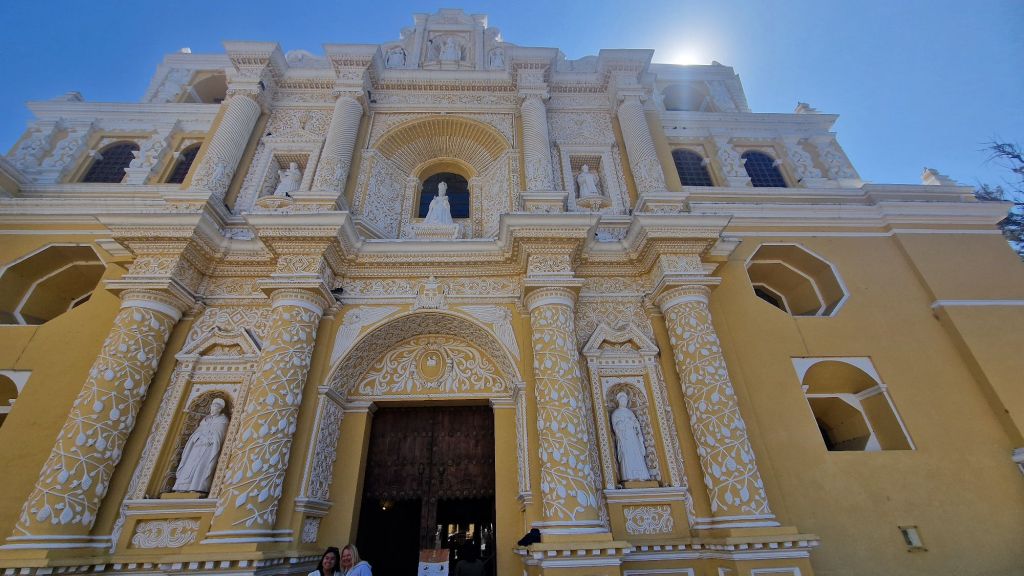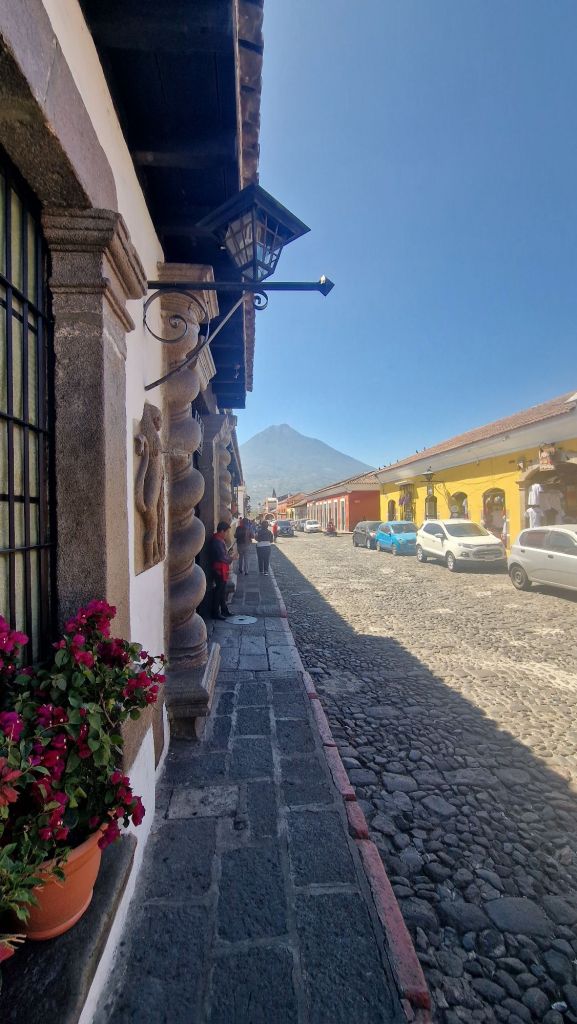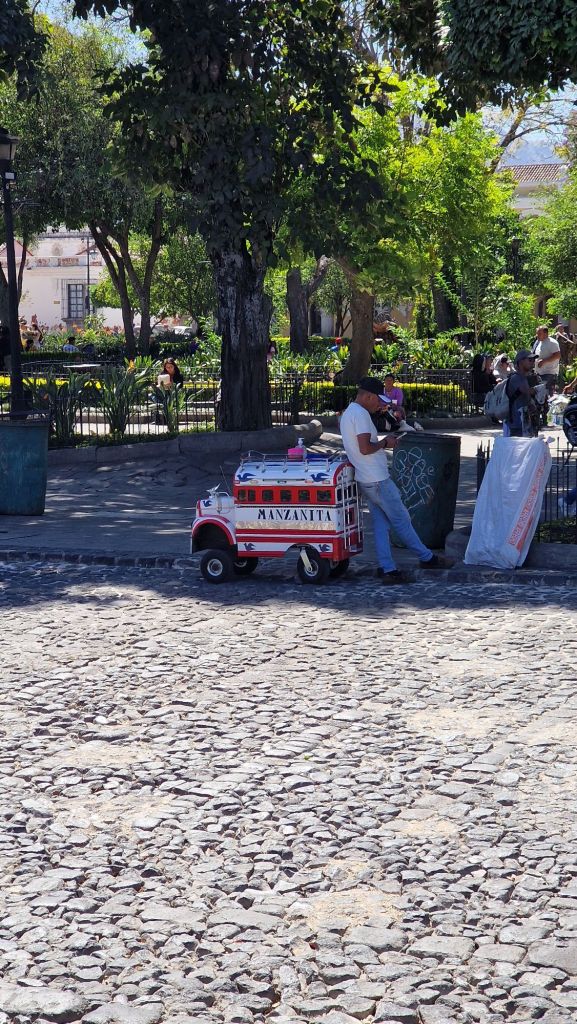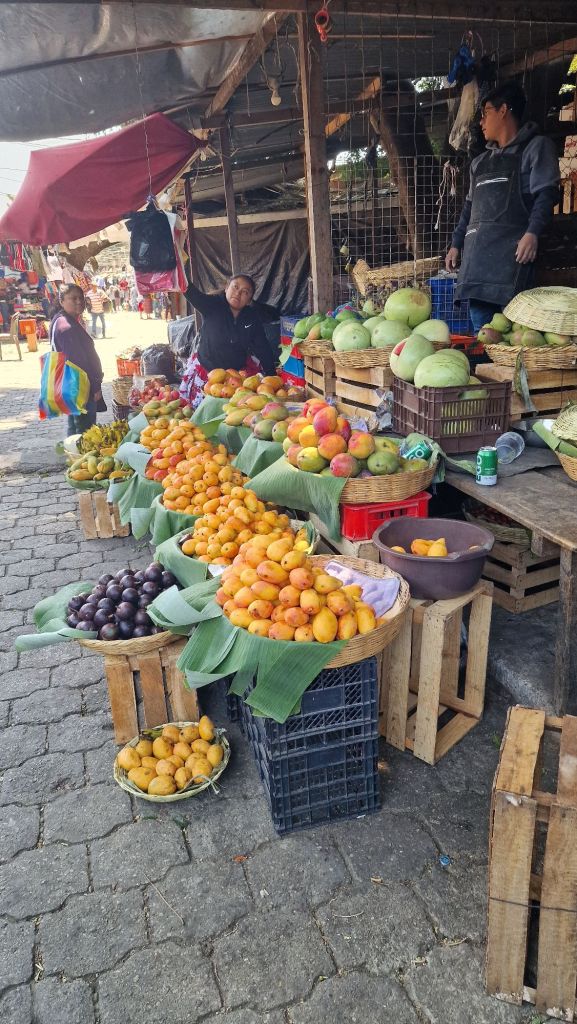
Medellin and Guatapé

Medellin  – en stad som verkligen kan ge kalla kårar längs med ryggen pga dess nutida blodiga historia! Här var, för inte så längesedan, den illegala kokainindustrins Mecka med våld och gangstervälde.  Pablo Escobar styrde och ställde. Det lugnade sig runt år 2000 efter att en kartell sprängdes men återuppväcktes tyvärr igen. Och så sent som 2009 dödades minst nio personer om dagen och året efter, 2010, var Medellin skådeplats för Colombias kanske blodigaste drogkrig någonsin. Så för bara femton år sedan var detta en av världens farligaste städer. Speciellt området som kallas Comuna 13. Idag har det ordnat sig och området är i stället en stor turistmagnet. Hit är vi på väg just nu.

Medellin – a city that can really send chills down your spine due to its current bloody history! Here, not so long ago, was the Mecca of the illegal cocaine industry with violence and gangster rule.  Pablo Escobar ruled and set. It calmed down around the year 2000 after a cartel was blown up but unfortunately resurfaced again. And as recently as 2009, at least nine people were killed a day, and the following year, in 2010, Medellin was the scene of perhaps Colombia’s bloodiest drug war ever. So just fifteen years ago, this was one of the world’s most dangerous cities. Especially the area known as Comuna 13. Today things have settled down and the area is instead a big tourist magnet. This is where we are heading right now.

Medellin
A photo of the military and gang violince

I taxin på väg till Comuna 13 blir vi vittne till en mindre krock mellan två motorcyklar. Den ena föraren börjar sparka och slå på den andra som ligger ner mitt på gatan. Strax efter släpar han iväg honom i kläderna på gatan framför bilarna, som stoppat. Det ser brutalt ut.  Som tur är griper en bilförare in och särar på dem. Och vår taxi kör vidare.

In the taxi on the way to Comuna 13, we witness a minor collision between two motorcycles. One driver starts kicking and hitting the other who is lying down in the middle of the street. Soon after, he drags him away in his clothes in the street in front of the cars, which have stopped. It looks brutal.  Luckily, a car driver intervenes and separates them. And our taxi drives on.

Vår guide i Comuna 13 är Daniel ca 40 år. Han är född och uppvuxen här. Vi pratar om hans uppväxt och han får tårar i ögonen när han berättar om hur många av hans vänner som har blivit mördade under den blodiga tiden. Han är stark och har upplevt saker ingen borde ha upplevt. Daniel berättar också om de osynliga gränserna mellan de sex olika områdena här i Comuna 13. Trampade man över det minsta lilla blev man skjuten. Och på en liten yta som nu är en fotbollsplan skedde dödande av otaliga människor varje dag. Det är ofattbart och så tragiskt. Detta är en öppen plats dit väldigt många kan se från sina fönster i husen runt omkring. Tänk att se detta mördande dagligen. Vi promenerar bland graffitti, barer och souvenirbutiker. Guiden hälsar på släkt o vänner hela tiden. Graffittin, som ofta föreställer kvinnor,  bär alla på en historia och guiden berättar utförligt. Det är mycket symbolik och det är väldigt intressant. Vi tar till oss och känner oss så privilegierade som vuxit upp och levt långt från detta våld och gangstervälde. Vilken fantastisk och givande dag! Vi åker ifrån Comuna 13 med många känslor i kroppen.

Our guide in Comuna 13 is Daniel, about 40 years old. He was born and raised here. We talk about his upbringing and he gets tears in his eyes when he tells us how many of his friends have been murdered during that bloody time. He is strong and has experienced things no one should have experienced. Daniel also talks about the invisible borders between the six different areas here in Comuna 13. If you stepped over the smallest thing, you were shot. And in a small area that is now a football field, countless people were killed every day. It is unimaginable and so tragic. This is an open place where many people can see from their windows in the houses around. Imagine seeing this killer daily. We walk among graffiti, bars and souvenir shops. The guide greets family and friends all the time. The graffiti, often depicting women,  all carry a story and the guide explains in detail. There is a lot of symbolism and it is very interesting. We embrace and feel so privileged to have grown up and lived far from this violence and gangster rule. What a fantastic and rewarding day! We leave Comuna 13 with many emotions in our bodies.

Medellin
On our way to Comuna 13
Medellin
Now we are here
Medellin
Colours
Medellin
Jan and me
Medellin
More colours
Medellin
Here is where a lot of people got killed
Medellin
A kolibri like a helicopter and a bug like a cannon…a lot of symbolic
Medellin
Me and Jan with a lot of graffitti
Medellin
Beautiful grafitti
Medellin
The view
Medellin
They are so prod of their escalators
More grafitti and colours
Medellin
The guide told us to sit here on the place of love
Medellin
Cannabis is popular…..
Medellin
Here is one of the invisible borders
Medellin
Even more colours
Medellin
Jan enjoying the view
Medellin
Medellin
Medellin
We loved the graffitti
Dance of Comuna 13
Medellin
Taking a cold beer
A beautiful view
Medellin
More art

Vi stannar endast två nätter i Medellin och resan går sedan vidare. Denna gång till en mindre by som heter Guatapé som ligger öster om Medellin.

We stay only two nights in Medellin and then the journey continues. This time to a smaller village called Guatapé which is east of Medellin.

Guatapé, Åh vilken vacker o mysig by! Väldigt populär som utflyktsmål för Colombianska familjer. Här kommer vi trivas!

Guatape, Oh what a beautiful and cozy village! Very popular as an excursion destination for Colombian families. We will enjoy ourselves here!

Guatapé
In the small town of Guatapé
Guatapé
A lot of colours here too

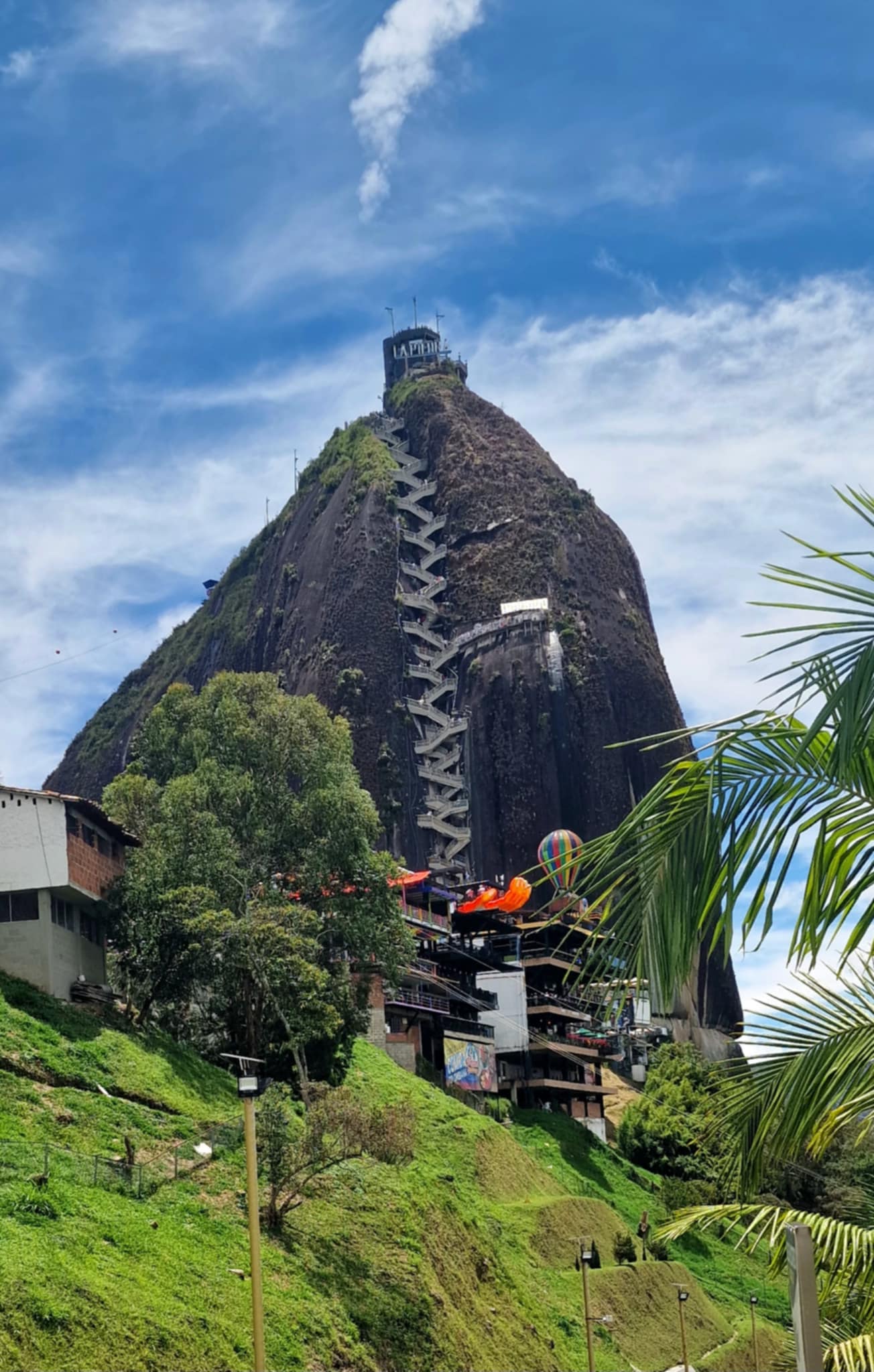
Vi bor i en fantastisk lägenhet utsmyckad på traditionellt vis. Runt byn Guatapé är det ett sjösystem med ofantligt antal armar och fingrar. Vi tar oss inte ut på sjön utan prioriterar byns stora turistmagnet – stenen som växer sig hög mitt ute i ingenting. Den är ofantlig. Det är en monolit som syns på långt håll. Det går att klättra upp via 659 trappsteg vilket vi väljer att göra.

We live in a fantastic apartment decorated in a traditional way. Around the village of Guatapé, there is a lake system with an immense number of arms and fingers. We don’t go out on the lake, but prioritize the village’s big tourist magnet – the stone that grows tall in the middle of nowhere. It is immense. It is a monolith that can be seen from afar. It is possible to climb up via 659 steps, which we choose to do.

Guatapé
The entrance to our room
Guatapé
Down by the lake
Guatapé
More of the lake
Guatapé
Now we are on our way to the big stones
Guatapé
We have many steps to climbing

Vi går och går och trapporna tar aldrig slut. Från det att vi går av den lilla bussen är det 298 trappsteg plus långa branta sluttningar mellan flera av trappstegen. Och nu har vi endast kommit till foten av ”stenen”. En svart monolit som står helt ensam här i landskapet. Nu väntar ytterligare 659 trappsteg. Det är tungt, varmt o trångt. Många vill upp till toppen. O vi klarar det!

We walk and walk and the stairs never end. From the time we get off the small bus, there are 298 steps plus long steep slopes between several of the steps. And now we have only come to the foot of the ”stone”. A black monolith that stands completely alone here in the landscape. Now another 659 steps await. It is heavy, hot and crowded. Many want to get to the top. Oh, we can do it!

Guatapé
About half way up
Guatapé
Almost there. Only 34 more steps

Utsikten är slående. Vi ser ut över en konstgjord sjö som slingrar sig mellan små kullar. Fingrarna på sjön är näst intill oräkneliga. Det är fantastiskt att ha kommit hit upp och få avnjuta den sagolika utsikten.

The view is striking. We look out over an artificial lake that winds between small hills. The fingers on the lake are almost innumerable. It is fantastic to have come up here and enjoy the fabulous view.

We made it! Now we can enjoy the view
Guatapé
The view is stunning
Guatapé
The stone from above (borrowed photo)

Det är en ljuvlig solig eftermiddag. Vi har tagit ut stolar från rummet och sitter o njuter av rödvin o snacks på trottoaren utanför vårt boende. Colombianerna uppskattar vårt tilltag och hälsar på oss när de passerar. Buenas tardes, hola, buenas…..Vi får öva vår spanska. Tiden går och vi promenerar till centrum. Byn myllrar av folkliv o varenda stol på uteserveringarna är fulla. Detta är en plats dit de lokala älskar att vallfärda under helgerna. Vi köper var vår öl o kycklingspett på torget, sätter oss på en mur o njuter av folkvimlet. Det är underbart att få vara en del av det

It is a lovely sunny afternoon. We have taken chairs out of the room and are sitting and enjoying red wine and snacks on the sidewalk outside our accommodation. The Colombians appreciate our initiative and greet us as they pass. Buenas tardes, hola, buenas…..We get to practice our Spanish. Time passes and we walk to the center. The village teems with people’s life and every chair in the outdoor seating is full. This is a place where the locals love to make a pilgrimage during the weekends. We each buy our beer or chicken skewers in the square, sit on a wall and enjoy the crowd. It’s wonderful to be a part of it

Guatapé
Guatapé
Enjoying life!
Guatapé
Taking a rest in the sun
Guatapé
Down by the lake again
Guatapé
One of all dogs in town
Guatapé
And the beautiful church
Guatapé
Jan enjoys Guatapé
Guatapé
Waiting for some food
Guatapé
Fried banana with cheece o  top

Guatapé är en charmig by med fantastiska gränder. Färgerna är inte lika starka som i Salento men minst lika omfattande. Här har husen dessutom utsmyckningar i otaliga variationer. Det är utsökt och originellt på samma gång. Vi njuter här men imorgon åker vi vidare. Nu är det Amazonas som väntar.

Guatape is a charming village with fantastic alleys. The colors are not as strong as in Salento, but at least as extensive. Here, the houses also have decorations in countless variations. It is delicious and original at the same time. We are enjoying ourselves here, but tomorrow we will move on. Now it is the Amazon that awaits.

Guatapé
In town again
Guatapé
A lot of art
Guatapé
It’s lovely to walk around
Guatapé
Colorful umbrellas
Guatapé
Guatapé
And colorful doors
Guatapé
Some of the ornaments

We have reached Salento

Sitter nu på vår lilla balkong till vårt väldigt speciella boende här i Salento. Sängen skall föreställa en gammal engelsk bil. Charmigt men ganska opraktiskt. Har rivit sönder klänningen två gånger på vassa kanter redan. Idag mår Jan inte bra utan ligger i sängen. Så jag får utforska staden själv och bara ta det lugnt.

Now sitting on our little balcony of our very special accommodation here in Salento. The bed should represent an old English car. Charming but quite impractical. Tore the dress twice on sharp edges already. Today Jan is not feeling well and is in bed. So I get to explore the city by myself and just take it easy.

Salento
Our first room. We changed room three times. All to really close doors
Salento
The view from our hostel

Vilken underbar och charmig by! Jag vandrar runt i de smala gränderna. Upp och ner för branta backar. Serveringar och små boutiquer överallt, konstnärer som ställer ut sina verk och många av besökarna har med sig hundar i alla storlekar – från pytteliten knähund till hundar stora som lejon. På var sida av de smala vägarna finns låga hus i allsköns färger. Alla otroligt välskötta o med blomsterlådor under nästan varenda fönster. Det är färger vi aldrig skulle komma på att kombinera hemma i våra skandinaviska hus men oj, vad vackert det är. Vad sägs om rosa, gult o lime? Gult, lila o turkost? Orange, turkost o lime? Fantasin är oändlig o det är sååå vackert. Nedanför vår balkong spraymålar de dörrar idag. Färgen idag är gul eller snarare senapsgul. Vi får se vad det blir imorgon. Samtidigt vandrar trettiotals hästar förbi och en granne några hus bort ”skriksjunger” högt och ljudligt så det ekar mellan hus och bergskullar

What a wonderful and charming village! I wander around the narrow alleys. Up and down steep slopes. Restaurants and small boutiques everywhere, artists exhibiting their works and many of the visitors bring dogs of all sizes – from tiny lapdogs to dogs as big as lions. On each side of the narrow roads there are low houses in all kinds of colors. All incredibly well-kept and with flower boxes under almost every single window. These are colors we would never think of combining at home in ours scandinavian house but oh, how beautiful it is. How about pink, yellow or lime? Yellow, purple or turquoise? Orange, turquoise or lime? The imagination is endless and it is so beautiful. Below our balcony they spray paint doors today. The color today is yellow or rather mustard yellow. We’ll see what happens tomorrow. At the same time, thirty horses walk by and a neighbor a few houses away ”screams” loudly and loudly so that it echoes between houses and hills

Salento
One of all beautiful streets
Salento
Salento
The colorful doors
Salento
An amazing different flower boxes
Salento
Salento
Even shops and street stalls are colorful
Salento
Some of the horses
Salento
I lit a candle for ny parents in the church

Nu lyser en vacker regnbåge över de grönklädda kullarna som är vår utsikt. Vi är mitt i den värsta regnsäsongen men idag skiner solen och temperaturen är som en härlig svensk sommardag. Här är underbart att vara o om bara Jan blir pigg o frisk till imorgon så får även han insupa atmosfären och planen är att åka vi iväg på en utflykt mellan dalar och berg här i området. Kanske inte imorgon men nästa dag.

Now a beautiful rainbow shines over the green-clad hills that are our view. We are in the middle of the worst rainy season but today the sun is shining and the temperature is like a lovely Swedish summer day. It’s wonderful to be here, and if only Jan stays alert and healthy until tomorrow, he too can soak up the atmosphere, and the plan is to go on an excursion between valleys and mountains in this area. Maybe not tomorrow but the next day.

Salento
A rainbow over our view
Salento
Lovely view
Salento
The view in the early evening
Salento
Today colours to paint is yellow

Jan har piggnat till men vi väljer att ta en  lugn dag här i byn så Jan får se sig omkring och uppleva den lilla byn med dess färger. Det finns en utsiktsplats med 300 branta trappsteg upp. Vi blir rekommenderade en annan väg som går runt och väljer den. Väl uppe på berget har vi en fantastisk utsikt över byn Salento. Vi promenerar ner igen och njuter av den pittoreska byn. Det är skönt med en avkopplande och lugn dag. Men imorgon skall vi på utflykt

Jan has perked up but we choose to take a quiet day here in the village so Jan gets to look around and experience the small village with its colors. There is a viewpoint with 300 steep steps up. We are recommended another route that goes around and choose it. Once up on the mountain, we have a fantastic view of the village of Salento. We walk down again and enjoy the picturesque village. It’s nice to have a relaxing and quiet day. But tomorrow we are going on an excursion

Salento
Walking the streets
Salento
Bougainvilla
Salento
Some of the view from the top
Salento
The church on the square
Salento
We enjoy the view
Salento
Back in town again
Traditional music
Salento
Local musicians
Salento
Cute dogs everywhere
Salento
More colours

Vi möter upp nu på morgonen för att bli hämtade av en jeep och en guide. Resan till La Carbonera kommer ta ca tre timmar. La Carbonera, även känd som Vaxpalmernas helgedom, är en dal som, enligt resebyrån, ganska nyligen öppnat upp för turister. Vi är endast tre jeepar på väg dit idag och det känns priviligierat att få uppleva en plats innan turismen når dit fullskaligt.

We meet up this morning to be picked up by a jeep and a guide. The journey to La Carbonera will take about three hours. La Carbonera, also known as the Sanctuary of the Wax Palms, is a valley that, according to the travel agency, has only recently opened up to tourists. We are only three jeeps on our way there today and it feels privileged to be able to experience a place before tourism reaches it in full scale.

Vi står på flaket på jeepen som kämpar sig upp på slingriga, skumpiga och oftast väldigt leriga vägar. Det är en smal väg kantad av gröna kullar, skog, palmer och kossor. På ena sidan vägen stupar det brant rakt ner – långt ner. Utan någon form av staket. Vi hisnar och det kittlar i benen när vi ser ner över stupet. På vägen upp stannar vi på ett flertal ställen för att insupa naturen, vyerna och den bedårande utsikten. Det är en fantastisk resa och framför oss väntar en dal full av Colombias nationalträd – Vaxpalmen, på latin Ceroxylon quindiuense. I Colombia växer det 289 olika palmer varav 47 av dem är endemiska.

We are standing on the back of the jeep which is struggling up winding, squishy and usually very muddy roads. It is a narrow road lined with green hills, forest, palm trees and cows. On one side of the road it drops steeply straight down – way down. Without any kind of fence. We gasp and our legs tingle when we look down over the cliff. On the way up, we stop at several places to soak up the nature, the views and the adorable view. It’s a fantastic journey and ahead of us awaits a valley full of Colombia’s national tree – the Wax Palm, in Latin Ceroxylon quindiuense. In Colombia, 289 different palm trees grow, of which 47 are endemic.

La Carbonera-Salento
On our jeep
La Carbonera-Salento
A lot of cows, they live a fantastic life with a lot of green gras and Wonderful view
The clouds covers The mountains
La Carbonera-Salento
We also enjoy the view
La Carbonera-Salento
A narrow road with a steep on our right side. And we are meeting another jeep
La Carbonera-Salento
This forest looks really old
La Carbonera-Salento
A lonely tree

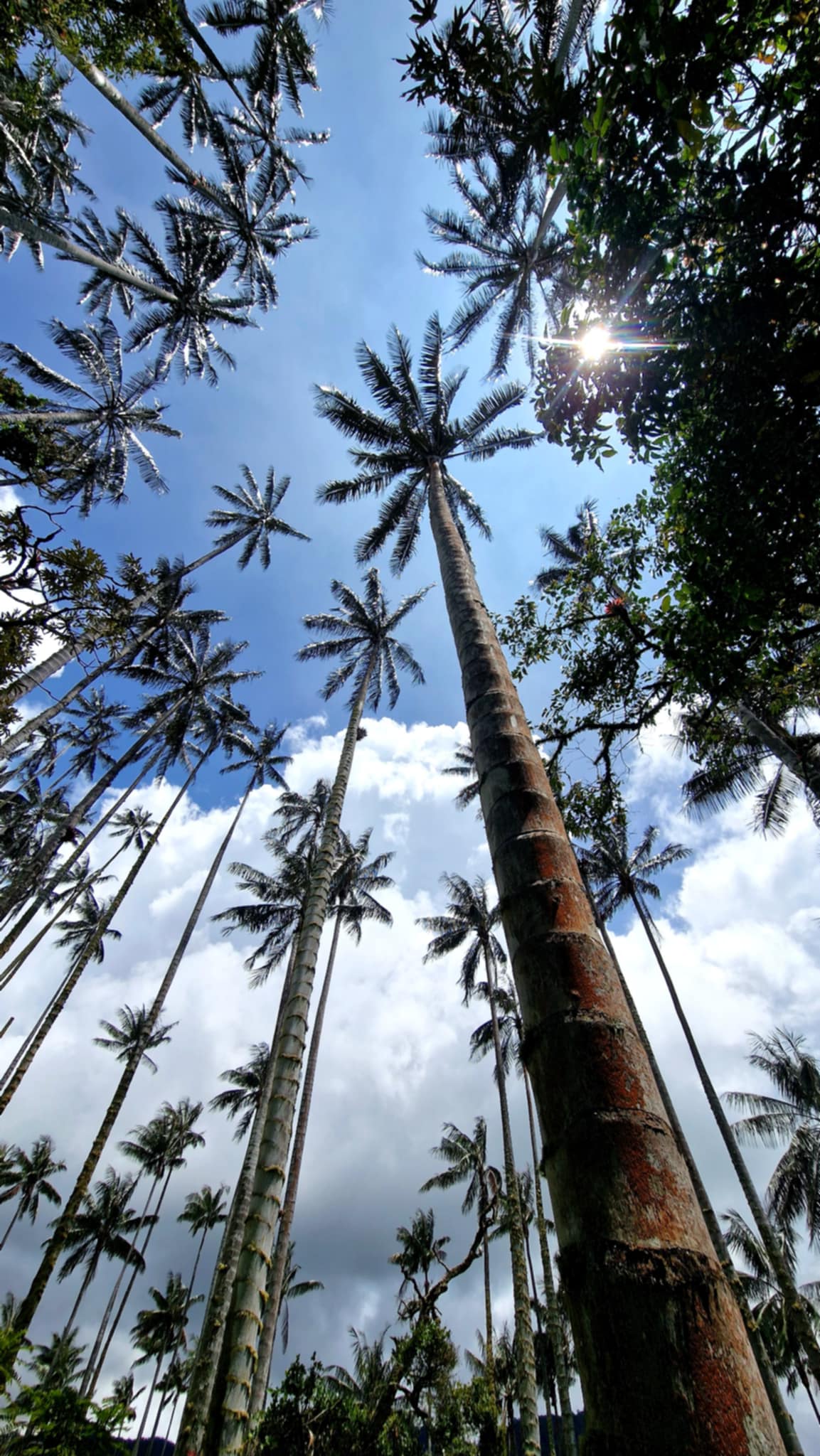
Nu har jeepen stannat och vår vandring genom dalen påbörjas. Vi blir nästan helt stumma av hur vackert det är! De höga palmerna växer sig upp mot sjuttio meter höga rakt upp mot den blå himmelen. Vi böjer huvudena bakåt så långt så vi nästan trillar baklänges. Att lägga sig ner på gräset och titta upp är ett bra alternativ. Det är de högsta palmerna i hela världen. Den här Vaxpalmen är en av de endemiska och växer endast inom ett litet område här runt Salento i Colombia och vi får nu se mängder av dem. Några står ensamma och stoltserar medan andra växer i stora klungor. De växer endast på hög höjd och ofta omsluter molnen dem. Bladen är lite silvergrå och stammarna smala med årsringar. Enligt guiden är varje ring sex år och en palm kan bli upp till tvåhundra år gammal.

Now the jeep has stopped and our hike through the valley begins. We are almost speechless by how beautiful it is! The tall palm trees grow up to seventy meters high straight up towards the blue sky. We bend our heads back so far that we almost fall backwards. Lying down on the grass and looking up is a good alternative. They are the tallest palm trees in the entire world. This Wax Palm is one of the endemics and only grows in a small area here around Salento in Colombia and we now get to see lots of them. Some stand alone and boast, while others grow in large clusters. They only grow at high altitudes and often the clouds envelop them. The leaves are a little silver gray and the stems are slender with annual rings. According to the guide, each ring is six years old and a palm tree can live up to two hundred years.

La Carbonera-Salento
From here we will start our hike
La Carbonera-Salento
The stoic Wax palms
La Carbonera-Salento
This Hill is covered with vaxpalms

Det är fantastiskt att vandra runt i det mjuka gräset och omringas av dessa ståtliga palmer. Och att se oändliga  palmer så långt ögat kan nå. Mäktig känsla.

It’s amazing to walk around in the soft grass and surrounded by these stately palm trees. And seeing endless  palm trees as far as the eye can see. Powerful feeling.

La Carbonera-Salento
The view is stunning

Varje träd sägs kunna, efter att det fällts, ge över elva liter vax. Denna vax användes till att göra ljus. Som i sin tur användes för offer till gudar och helgon. Åtminstone gjordes detta långt bak i tiden.

Each tree is said to be able, after felling, to yield over eleven liters of wax. This wax was used to make candles. Which in turn were used for offerings to gods and saints. At least this was done way back in the day.

Vår vandring lider, efter ca 1 timma, mot sitt slut. För att kunna hämtas upp av jeepen, på ett speciellt ställe, tar guiden med oss ”off the beaten track” och vi får hasa oss neråt minst femhundra meter på stupbranta sluttningar. Vi har iofs inte sett en enda annan turist sedan vi började vår vandring. Men troligen har ingen gått/hasat sig denna stupbranta väg tidigare.

After about 1 hour, our hike comes to an end. In order to be picked up by the jeep, in a special place, the guide takes us ”off the beaten track” and we have to rush down at least five hundred meters on precipitous slopes. We haven’t even seen a single other tourist since we started our hike. But probably no one has walked/rushed this precipitous path before.

La Carbonera-Salento
Sometimes we had to crawl under the fence
La Carbonera-Salento
It dosn’t look so steep – but it sure is

Vi har tur, hela dagen under vandringen skiner solen och himmeln är klarblå. Nu när vi når vårt mål öppnar sig himmelen och regnet börjar ösa ner. Vi har en tre timmars jeeptur tillbaka till Salento och vårat rum. Det blir en riktigt regnig tur hemåt. Regnet smattrar på taket av jeepen, vägen är som en fors av lervatten och lera och blixt och åska är alldeles ovanför oss. Vi är otroligt glada att vi sitter under tak och inte på en motorcykel eller en ATV ( en fyrhjulig motorcykel) som några andra som vi möter. Väl tillbaka i byn slutar det, som tur är  att regna!

We are lucky, all day during the hike the sun shines and the sky is clear blue. Now as we reach our destination the heavens open and the rain begins to pour down. We have a three hour jeep ride back to Salento and our room. It will be a really rainy ride home. The rain patters on the roof of the jeep, the road is like a torrent of muddy water and mud and lightning and thunder are right above us. We are incredibly happy that we are sitting under a roof and not on a motorcycle or an ATV (a four-wheeled motorcycle) like some others we meet. Once back in the village it stops, luckily  raining!

Hela dagen har varit en fantastisk upplevelse. Den storslagna naturen, de fantastiska vyerna, vaxpalmerna och avslutningen med störtregnet och åskvädret.

La Carbonera-Salento
A pig sleeping on the muddy road

The whole day has been a fantastic experience. The magnificent nature, the fantastic views, the wax palms and the ending with the torrential rain and thunderstorm.

Efter de avkopplande och vackra dagarna i Salento väntar nya äventyr. I morgon tar vi bussen till Colombias näst största stad Medellin. Som har en våldsam historia.

After the relaxing and beautiful days in Salento, new adventures await. Tomorrow we take the bus to Colombia’s second largest city, Medellin. Which has a violent history.

Inland Colombia to Bogotá

Äntigen har vi kommit iväg inåt land för att utforska Colombia och Sydamerika. En dröm ända sedan tonåren.

At last we have gone inland to explore Colombia and South America. A dream since adolescence.

Idag flyger vi söderut och in över den stora kontinenten Sydamerika. Första målet är huvudstaden i Colombia, Bogotá. En stor stad  på nästan 2700 meters höjd med nästan lika många invånare som hela Sverige. Den största stad vi besökt hittills sedan vi lämnade Sverige.

Today we fly south and over the great continent of South America. The first destination is the capital of Colombia, Bogotá. A large city at an altitude of almost 2700 meters with almost as many inhabitants as the whole of Sweden. The biggest city we have visited so far since we left Sweden.

Screenshot_20241007_175819_Google
Southamerica. Vilja is on the blue spot up on the northern coast. And we are just exploring the red area

Vi fick precis besked att flyget är försenat med ca tre timmar. Här sitter vi i den kokheta värmen med våra ryggsäckar och skulle precis ta en taxi. Vi funderar lite o bestämmer oss för att vänta en timme. Tiden går fort och vi åker äntligen iväg mot flygplatsen. En del stressade tankar kommer – Tänk om planet ändå går i tid? Borde vi åkt ut till avsatt tid ändå? Väl framme på flygplatsen, efter att ha blivit lurade av vår taxichaufför som tog dubbelt betalt, inser vi att vi är ute i väldigt god tid.

We just got word that the flight is delayed by about three hours. Here we sit in the boiling heat with our backpacks and were about to take a taxi. We think a bit and decide to wait an hour. Time flies and we finally leave for the airport. Some stressed thoughts come – What if the plane is still on time? Should we have left at the appointed time anyway? Once at the airport, after being cheated by our taxi driver who charged double, we realize that we are out in very good time.

Bogotá
We are flying with Jetsmart from Cartagena to Bogotá

Flygresan går fort och vi får bagaget nästan med detsamma. En taxi tar oss till vårt rum där vi installerar oss. Sedan blir det en promenad i kvarteret. Vi klär på oss alla varma kläder vi har men fryser ändå. Här är isande kallt. Runt åtta grader. Det är tre år sedan vi kände sådan kyla sist så kropparna är inte vana. Även om vi är förberedda så blir det en chock. Våra varma kläder är ju dessutom begränsade då de är långt undanstuvade sedan vi lämnade Europa. Det blir ett mishmash av kläder, lager på lager o med sandaler på fötterna. Haha – hade nog aldrig gått klädd så i Sverige 😆

The flight goes quickly and we get the luggage almost immediately. A taxi takes us to our room where we settle in. Then there will be a walk in the neighborhood. We put on all the warm clothes we have but are still cold. It’s freezing cold here. Around eight degrees. It has been three years since we last felt such cold, so the bodies are not used to it. Even if we are prepared, it will be a shock. Our warm clothes are also limited as they have been put away for a long time since we left Europe. It will be a mishmash of clothes, layer upon layer and with sandals on the feet. Haha – probably would never have gone dressed like that in Sweden 😆

Bogotá
Our Airbnb is in this charming courtyard

Det vimlar av folk på gatorna. Mest unga nu kvällstid. Det är minst ett universitet i närheten och troligen är dessa kvarter, det historiska Candelaria, populärt speciellt bland den yngre befolkningen.

The streets are teeming with people. Most young now in the evening. There is at least one university nearby and probably this neighborhood, the historic Candelaria, is popular especially among the younger population.

Första hela dagen i Bogota och vi bestämmer oss för att vara kulturella. Första stoppet blir Museo del Oro – guldmuseumet. Jan går in gratis som pensionär. Det ena rummet efter det andra är fullt med fantastiska guldföremål. Här finns över 34.000 vackra guldföremål, flest utställda, på samma plats,i hela världen. Men nu är vi ju också i den del av världen som gick under namnet El Dorado. En mytologiska utopi som är fylld av rikedomar och guld. Myten uppstod av spanjorerna på 1500-talet. Den fick otaliga lycksökare ut på expeditioner då de fantiserade om guld och drömmde om oändlig rikedom. Det är en fantastisk utställning och vi får bl a se en film där vi lär oss hur de utformade föremålen med hjälp av bivax och lera. Så intressant! Förutom alla otroliga guldföremål finns även utställt underbara och lekfulla lergods, brons och andra föremål. De flesta med en funktion som t ex skålar, för offergåvor, sköldar, utsmyckning eller krukor. Vi vandrar länge mellan montrar och rum och njuter av det vi ser.

First full day in Bogota and we decide to be cultural. The first stop will be the Museo del Oro – the gold museum. Jan enters for free as a pensioner. One room after another is full of fantastic gold objects. Here there are over 34,000 beautiful gold objects, the most exhibited, in the same place, in the whole world. But now we are also in the part of the world that went by the name of El Dorado. A mythological utopia that is filled with riches and gold. The myth was originated by the Spanish in the 16th century. It sent countless fortune seekers on expeditions as they fantasized about gold and dreamed of endless wealth. It’s a fantastic exhibition and we get to see a film where we learn how they designed the objects using beeswax and clay. So interesting! In addition to all the incredible gold objects, wonderful and playful earthenware, bronze and other objects are also on display. Most with a function such as bowls, for offerings, shields, decoration or pots. We wander for a long time between stands and rooms and enjoy what we see.

Bogotá
A golden mask
Bogotá
A beautiful golden figurine
Bogotá
Bogotá
More gold
Bogotá
Bogotá
Beautiful ceramichs
Bogotá
Bogotá
Old photos of Inka indians

Därefter tar vi oss via gågator till Plaza Bolívar, huvudtorget i Bogotá. Här myllrar det av folk, försäljare, lamor, matvagnar, konstnärer och duvor. Mitt på torget står en staty av Simon Bolívar, den sydamerikanska general som befriade flera länder i Sydamerika från Spanien. Han ses nästan som ett helgon här.

Next, we take pedestrian streets to Plaza Bolívar, the main square of Bogotá. Here it teems with people, vendors, llamas, food carts, artists and pigeons. In the middle of the square stands a statue of Simon Bolívar, the South American general who liberated several countries in South America from Spain. He is almost seen as a saint here.

Bogotá
At plaza Bolívar with his statue behind me
Bogotá
Here comes two llamas walking
Bogotá
Local artists selling their art

Nästa stopp blir ett konstcentrum med huvudsakligen konst av den colombianska konstnären Fernando Botero. Namnet är kanske inte så känt för alla men hans konst känner många igen. Lite runda figurer, både människor, djur o frukter. En formidabel utställning med otroliga konstverk. I ett rum finns en tillfällig utställning med osannolika guldföremål. Detta rum var extra starkt bevakat med dörrar som i stora bankvalv.

The next stop will be an art center with mainly art by Colombian artist Fernando Botero. The name may not be so familiar to everyone, but many recognize his art. Slightly round figures, both people, animals and fruits. A formidable exhibition with incredible works of art. In one room there is a temporary exhibition of unlikely gold objects. This room was extra heavily guarded with doors like in large bank vaults.

Bogotá
Typical Botero-painting
Bogotá
The pony
Bogotá

Botero:s Mona Lisa
Bogotá
Beautiful courtyard at Boteros museum

Mellan dessa stopp har vi vandrat runt i kvarteren, lyssnat på härliga sydamerikanska sånger av liveartister, ätit empenadas, tagit en öl på en parkbänk och insupit känslan av att vara här. Regnet kommer plötsligt och vi söker skydd först under ett träd och sedan under tak. Våra regnkläder ligger kvar på rummet. Försäljare med paraplyer och regncapar gör bra affärer.

Between these stops, we’ve walked around the neighborhoods, listened to lovely South American songs by live artists, ate empenadas, had a beer on a park bench and soaked up the feeling of being here. The rain comes suddenly and we seek shelter first under a tree and then under a roof. Our rain clothes are left in the room. Vendors with umbrellas and raincoats do good business.

lovely atmosphere with music on the street
Bogotá
On a street in Bogotá
Bogotá
Another cute lama
Bogotá
It’s raining and we are taking shelter
Bogotá
It’s a bit cold when it’s raining

Snart skall vi äta middag men vi stannar först till på en enkel bar. Musiken strömmar ut ur högtalarna. Vi tar var vår öl och njuter av atmosfären. Mitt emot oss sitter två män som dricker något vi blir nyfikna på. Vi beställer var vår Chelada, det som männen dricker, som ursprungligen kommer från Mexico. Det är en öldrink gjord på öl, färskpressad limejuice och på glaskanten är det en ring av salt och chilli. Jättegott! Tiden går och vi känner oss trötta. På väg tillbaka till rummet köper vi med oss gatumat – kebab och choritzo. Den äter vi sedan på vårat rum.

Soon we will have dinner, but first we stop at a simple bar. The music pours out of the speakers. We each take our beer and enjoy the atmosphere. Opposite us are two men who are drinking something we are curious about. We each order our Chelada, what the men drink, which originally comes from Mexico. It is a beer drink made from beer, freshly squeezed lime juice and on the rim of the glass is a ring of salt and chilli. Yummy! Time passes and we feel tired. On the way back to the room, we buy street food with us – kebabs and choritzo. We then eat it in our room.

Bogotá
Happy in the bar
Bogotá
Now we drink chelada

Vi sitter nu på rummet i stadsdelen Candelaria här i Bogotá. Det är mörkt ute och vi är trötta efter en hel dags promenerande och utforskande av denna stora stad med över åtta miljoner invånare. Genom fönstren hörs ljudet av musik långt borta. Candelaria är en mylrande stadsdel full av folkliv, försäljare, restauranger, konstnärer och kultur. Tyvärr också en hel del tiggare och även bostadslösa som sover där de hittar tak över huvudet för att inte bli blöta när det regnar. Vilket tragiskt liv de lever. På natten går temperaturen ute ner till mellan fem och tio grader så det gäller att ha värmande kläder. Det enda som saknas här är uteserveringar. Vi har fortfarande inte lyckats hitta någon. Delvis beror det kanske på att det är kallt och att det regnar en hel del….men samma sak gäller ju i Sverige.

We are now sitting in the room in the Candelaria district here in Bogotá. It is dark outside and we are tired after a whole day of walking and exploring this big city with over eight million inhabitants. Through the windows, the sound of music can be heard far away. Candelaria is a bustling neighborhood full of folk life, vendors, restaurants, artists and culture. Unfortunately, also a lot of beggars and also the homeless who sleep where they find a roof over their heads so as not to get wet when it rains. What a tragic life they live. At night, the temperature outside drops to between five and ten degrees, so it is important to have warm clothes. The only thing missing here is outdoor seating. We still haven’t managed to find anyone. Partly it may be due to the fact that it is cold and that it rains a lot….but the same thing applies in Sweden.

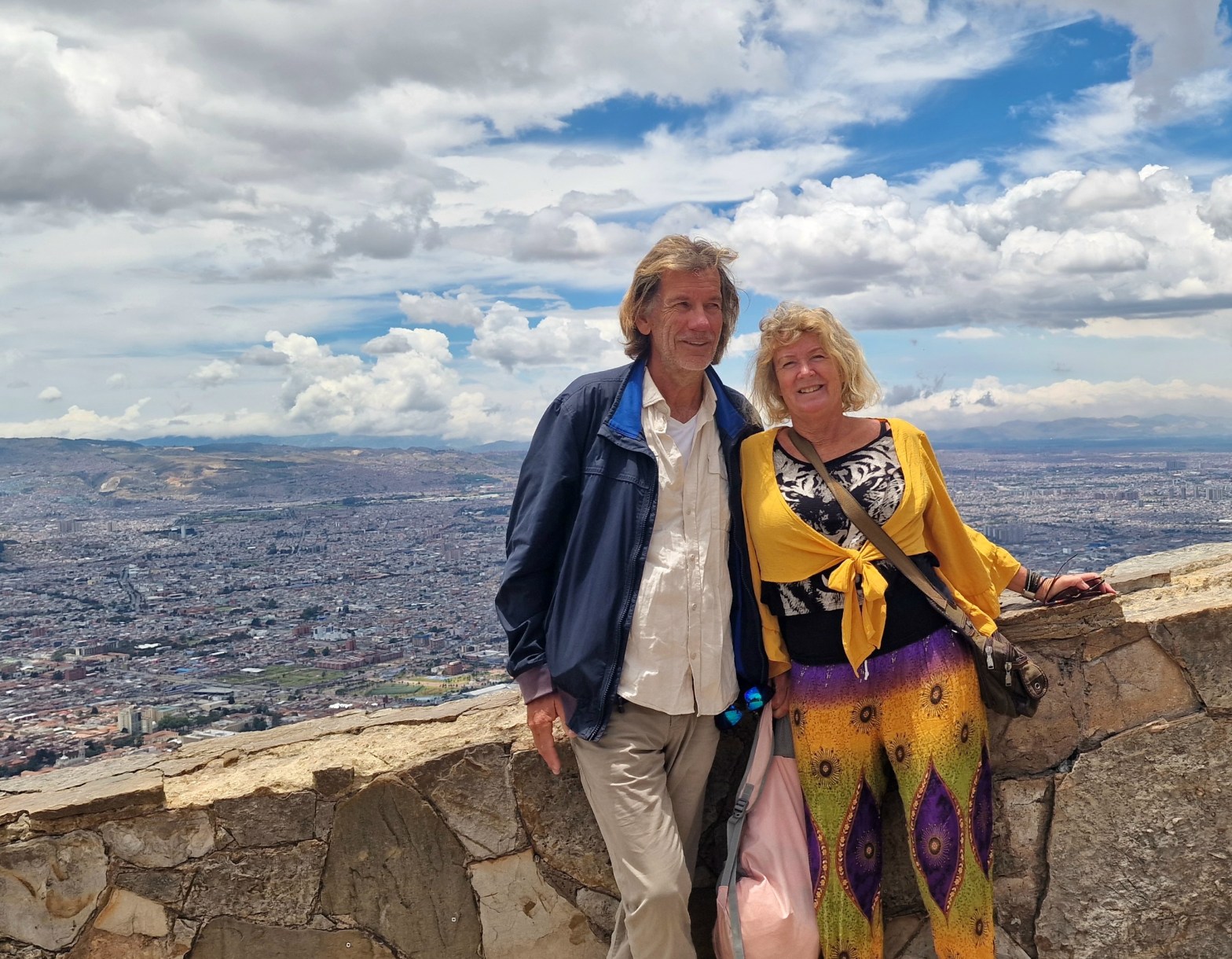
Dag två i Bogotá. Idag har vi bestämt oss för att gå upp till kyrkan uppe på berget Montserrate, en del av Anderna. Detta berg är sedan länge ett känt pilgrimsmål. Vi vandrar, ca 600 meter på gator innan vi kommer till kön för linbanan upp. Det är hisnande att åka upp till nästan 3200 meters höjd över havet. Men oj vad vackert det är! Och vilken utsikt! En kvinna ställer sig på muren och det ilar genom hela kroppen att se det. Vi pratar sedan med henne – en kvinna från Bolivia som pratar svenska!

Day two in Bogotá. Today we have decided to go up to the church on top of the mountain Montserrate, part of the Andes. This mountain has long been a famous pilgrimage destination. We walk, about 600 meters on streets before we get to the line for the cable car up. It is breathtaking to ride up to almost 3,200 meters above sea level. But oh how beautiful it is! And what a view! A woman stands on the wall and seeing it rushes through her whole body. We then talk to her – a woman from Bolivia who speaks Swedish!

Bogotá
Bogotá
Bogotá
On the way up to The cable-car to Montserrate
Bogotá
One of my favorite flowers ”Lily of the Nile”
Bogotá
Almost there
Bogotá
Here comes our cable-car
Bogotá
On the way up
Bogotá
We are almost 3200 meters up
Bogotá
The view is stunning
Bogotá is really big with more than 8 miljon people living here
Bogotá
Jan and me
Bogotá
Another Hill with another church
Bogotá
With a big Jesus Christ statue
Bogotá
Down again and we are eating lunch on the street. I give mine to a poor woman

Måste också påpeka att vi är på hög höjd nu. Och det märks när vi promenerar. Jag vet att jag har dålig kondition…men såhär dålig? Att gå tvåhundra meter, även nedåt, gör att jag fullständigt tappar andan. Jan klarar sig lite bättre men även han märker av höjden. Vi är trots allt på 2700 meters höjd i staden Bogotá.

Also have to point out that we are at high altitude now. And it is noticeable when we walk. I know I’m in bad shape…but this bad? Walking two hundred meters, even downhill, makes me completely out of breath. Jan copes a little better, but he also notices the height. After all, we are at an altitude of 2,700 meters in the city of Bogotá.

Vi lämnar tidigt på morgonen nästa dag för bussresan till Salento. Första sträckan, till Armenia, skall ta allt från åtta timmar och uppåt. Busstationen i Bogotá  är enorm men vi får bra hjälp att hitta. Väl på bussen tar det ca 1 1/2 timme att komma ut från staden Bogotá

We leave early in the morning the next day for the bus trip to Salento. The first leg, to Armenia, will take anything from eight hours or more. The bus station in Bogotá  is huge but we get good help to find. Once on the bus, it takes about 1 1/2 hours to get out of the city of Bogotá

Towards Salento
A graveyard for motorbike and cars

Resan går sedan genom natur med odlingar, betande kor, kaffeplantage, betesmark.  Höga berg o djupa dalar. Vädret växlar mellan strålande sol och fullkomligt skyfall. Det är till stora delar av vägen mycket vägarbete så ibland blir det långa köer men det går ändå smidigt.

The journey then goes through nature with plantations, grazing cows, coffee plantations, pastures.  High mountains and deep valleys. The weather alternates between bright sun and really big downpour. There is a lot of road work on large parts of the road, so sometimes there are long queues, but it still runs smoothly.

It’s heavy rain
Towards Salento
Back to the bus after a breake

Vi kör på kraftigt slingrande serpentinvägar som klättrar högre och högre. Vägen är kantad av bambu som reser sig över 40 meter hög. På den branta sidan ner mot dalen klättrar hus byggda på pelare som klamrar sig fast liksom svävandes över floden långt långt där nere. Omgivningen lyser mestadels i gröna skiftande nyanser av bananplantor, bambu, eukalyptus o palmer men bryts av med färgsprakande bougainvilla och blommande träd i gult, orange, rött och lila över den varierande gröna markvegetationen.

We drive on heavily winding serpentine roads that climb higher and higher. The road is lined with bamboo that rises over 40 meters high. On the steep side down towards the valley climb houses built on pillars clinging as if floating above the river far far below. The surroundings mostly shine in green changing shades of banana plants, bamboo, eucalyptus and palm trees but are interrupted by colorful bougainvillea and flowering trees in yellow, orange, red and purple over the varying green ground vegetation.

Towards Salento
The view is stunning

När vi klättrat långsamt uppåt i ett par timmar kommer vi upp bland molnen. Den vackra utsikten är utbytt mot en gråvit massa som omfamnar oss med sin fuktighet och vattnet rinner ner längs fönsterrutorna.

After climbing slowly upwards for a couple of hours, we come up among the clouds. The beautiful view is replaced by a grey-white mass that embraces us with its humidity and the water runs down the window panes.

Towards Salento
We are high up among the skies

Bussresan tar oss, efter nästan nio timmar, till staden Armenia. Där kliver vi snabbt på nästa buss och resan är mindre än en timma till vårt mål Salento. Vi är trötta när vi kommer fram. Checkar in på vårt väldigt enkla rum och går ut på torget o dess sidogator för att äta middag. Äntligen får vi äta fisk! Röding i vitlök smakar underbart och efter en kort promenad i den lilla byn ger Salento redan mersmak. Men vi är utmattade efter tolv timmars resa o går tidigt till sängs.

The bus journey takes us, after almost nine hours, to the city of Armenia. There we quickly get on the next bus and the journey is less than an hour to our destination Salento. We are tired when we arrive. Checks into our very simple room and goes out to the square and its side streets to have dinner. Finally we get to eat fish! Chard in garlic tastes wonderful and after a short walk in the small village Salento already gives more taste. But we are exhausted after twelve hours of travel and go to bed early.

Mer om våra fortsatta äventyr i nästa inlägg

More about our continued adventures in the next post


Cienfuego  –  Kuba

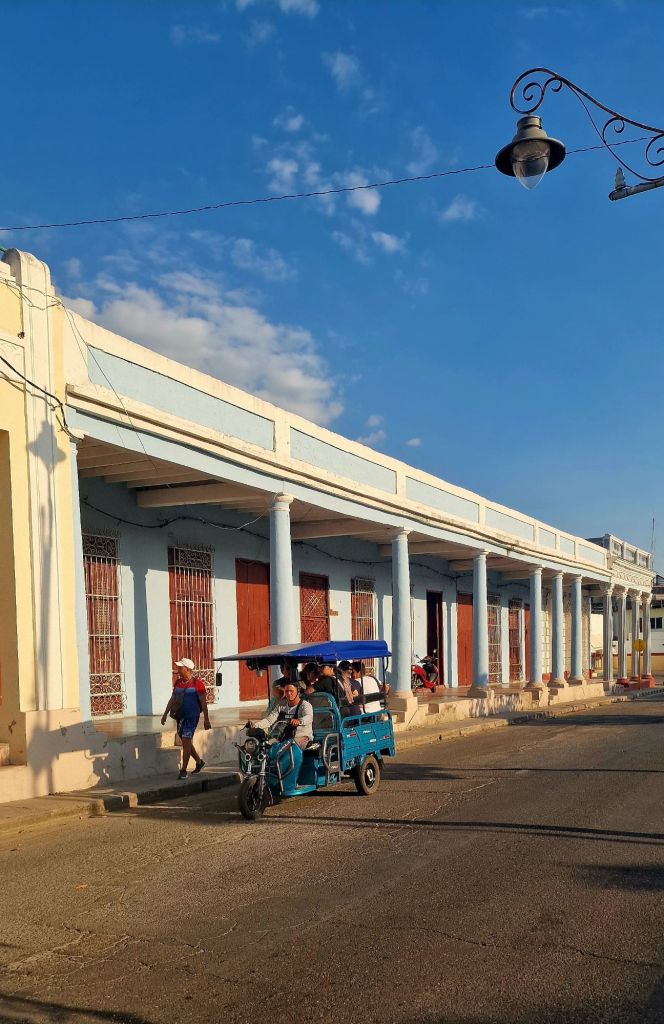
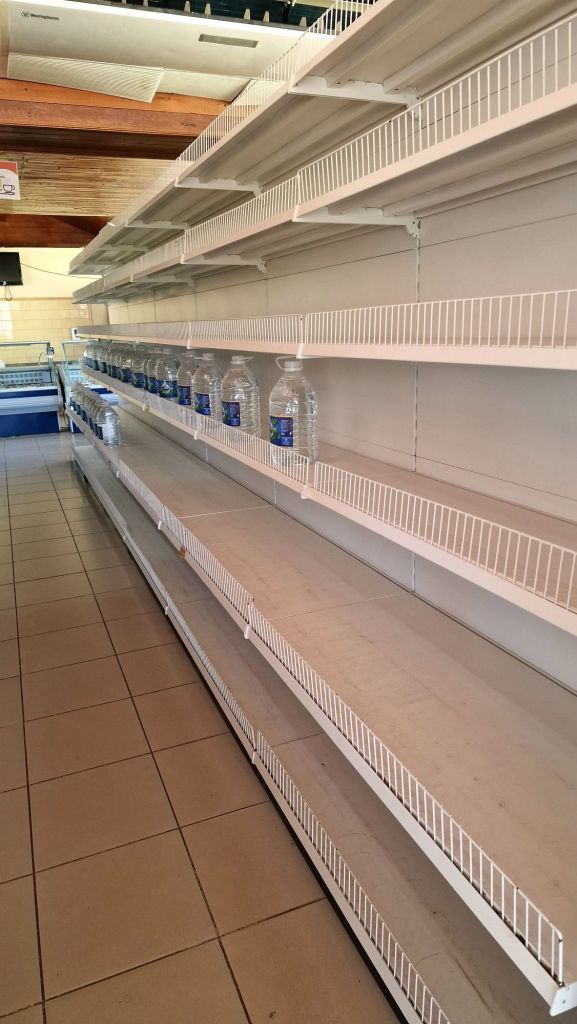
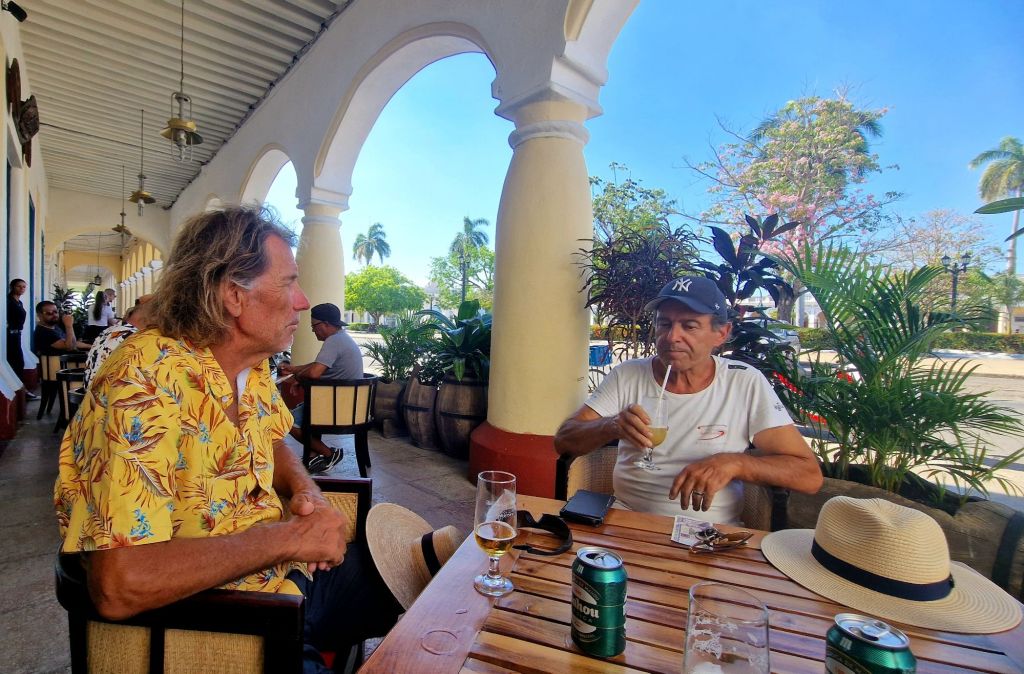
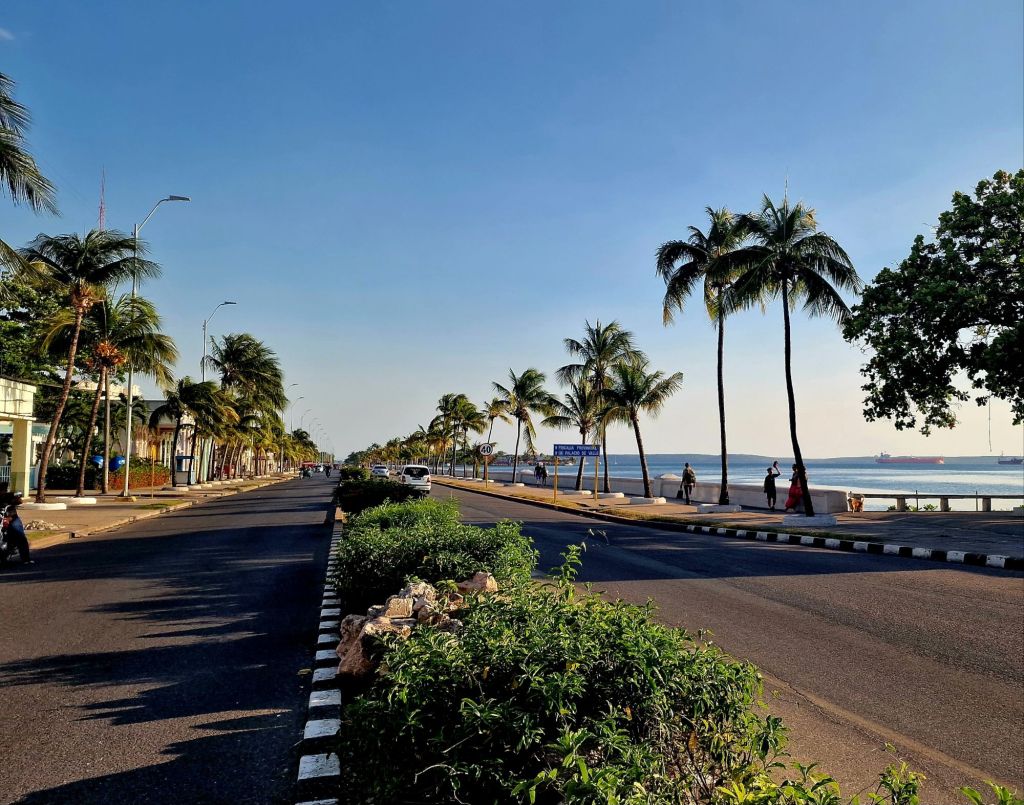
Efter ännu en natt med kryss har vi kommit till Cienfuego som är Kubas tredje största stad. Det är en liten o laidback stad på sydsidan av Kuba. Även kallad Pearl of the South. Med en lång, rak och bred boulevard utan nästan någon trafik. Det är endast tuk tuk:ar, några gamla och ganska slitna bilar av märket Lada, en och annan ”Amerikanare”, cykeltaxis och häst och vagn på vägarna. Trafiken är därför väldigt lugn. Längs med vägen finns restauranger. Det som serveras mest är pizza, inte så som vi är vana vid att äta den utan en färdigbakad rund pizzabotten som de lägger ost på. Billig men ganska smaklös. Affärerna är i stort sett tomma även här. Förutom på sprit och lite konserver.

After another night of cruising, we have arrived in Cienfuego, Cuba’s third largest city.  It is a small o laidback city on the south side of Cuba.  Also called the Pearl of the South.  With a long, straight and wide boulevard with almost no traffic.  There are only tuk tuks, a few old and rather worn Lada cars, the occasional ”American”, bicycle taxis and horse and carts on the roads.  The traffic is therefore very calm.  There are restaurants along the road.  What is served most is pizza, not the way we are used to eating it but a pre-baked round pizza base on which they put cheese.  Cheap but rather tasteless.  The shops are largely empty here as well.  Except for spirits and some preserves.

We have reached Cienfuego and of course we celebrated with an ”Hoppilandare”
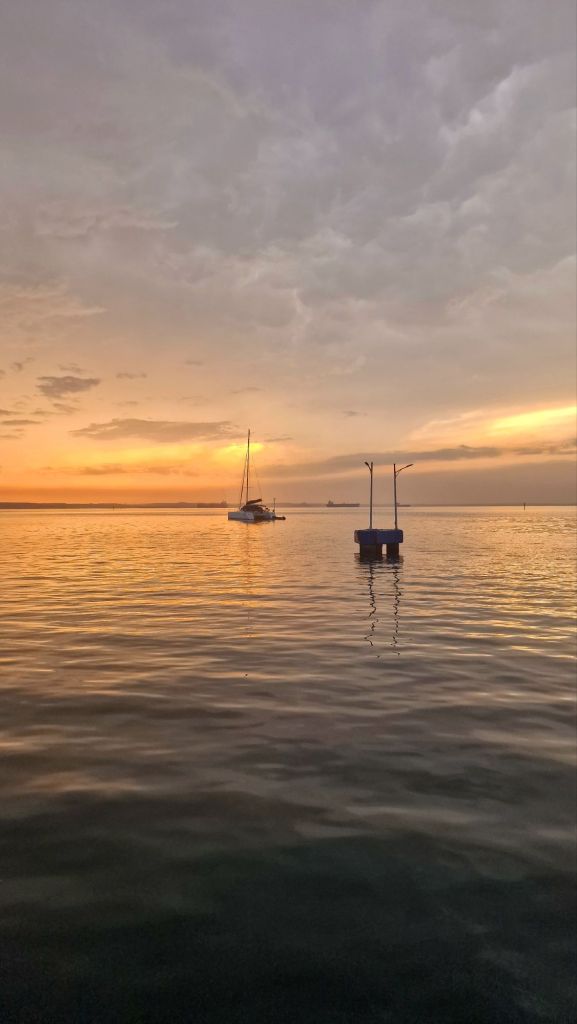
Relaxed and beautiful in the marina
Sunset in Cienfuego
A tuk tuk in front of a colonial house with baldakines
In the citycenter
Waiting for pizza

Till Kuba skall man ha med sig kontanter. ”Cash is king” stämmer verkligen här. Det har vi fått lära oss den hårda vägen. Vi har endast några hundra dollar med oss så vi får verkligen spara på pengarna. Försöken att ta ut pengar i bankomat till väldigt dålig växlingskurs fungerar inte. O betalning med kort är bara möjligt på några få ställen. Överallt där vi går frågar de om vi vill växla dollar eller köpa cigarrer. Svarta marknaden är stor och det är lätt att bli lurad. Nästan alla priser på det lilla som finns i många affärer är i dollar. På gatan får man ungefär tre gånger så många kubanska Pesos pr dollar än i banken eller affären. Så att inte ha dollar i kontanter att växla gör Kuba ganska dyrt. Det går däremot att leva jättebilligt här om man har dollar.

You must bring cash with you to Cuba.  ”Cash is king” certainly rings true here.  We have had to learn that the hard way.  We only have a few hundred dollars with us so we really have to save the money.  The attempts to withdraw money in an ATM at a very poor exchange rate do not work.  O payment by card is only possible in a few places.  Everywhere we go they ask if we want to exchange dollars or buy cigars.  The black market is big and it’s easy to get scammed.  Almost all the prices of the small things found in many stores are in dollars.  On the street you get about three times as many Cuban Pesos per dollar as in the bank or store.  So not having dollars in cash to exchange makes Cuba quite expensive.  However, it is possible to live very cheaply here if you have dollars.

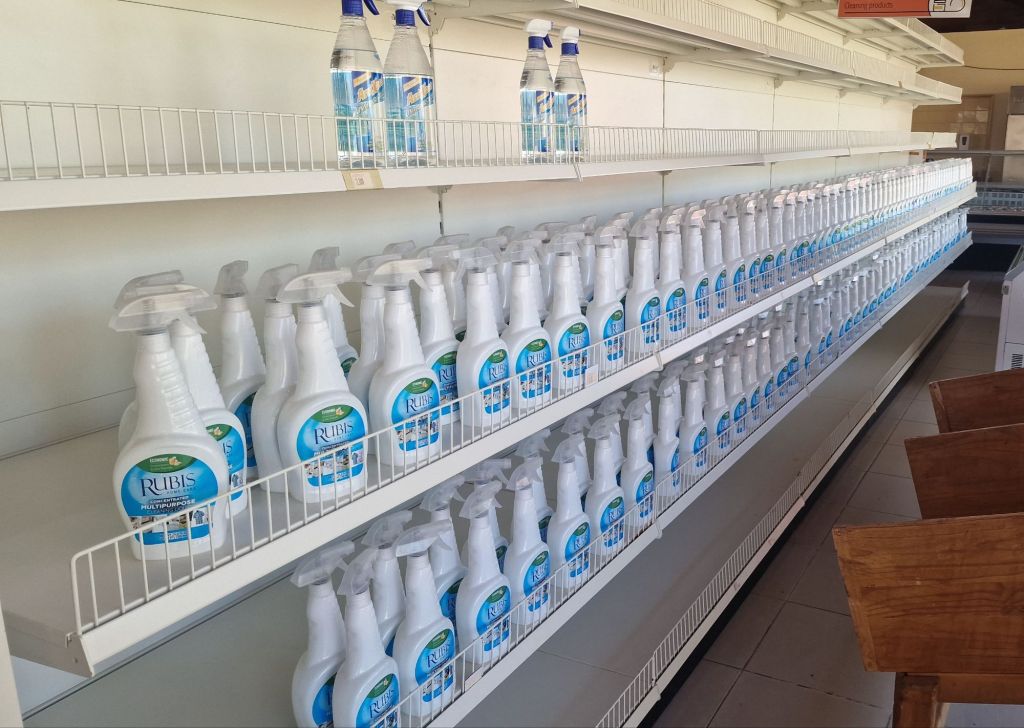
At least they sell water in the shop
And a lot of detergent – only one kind
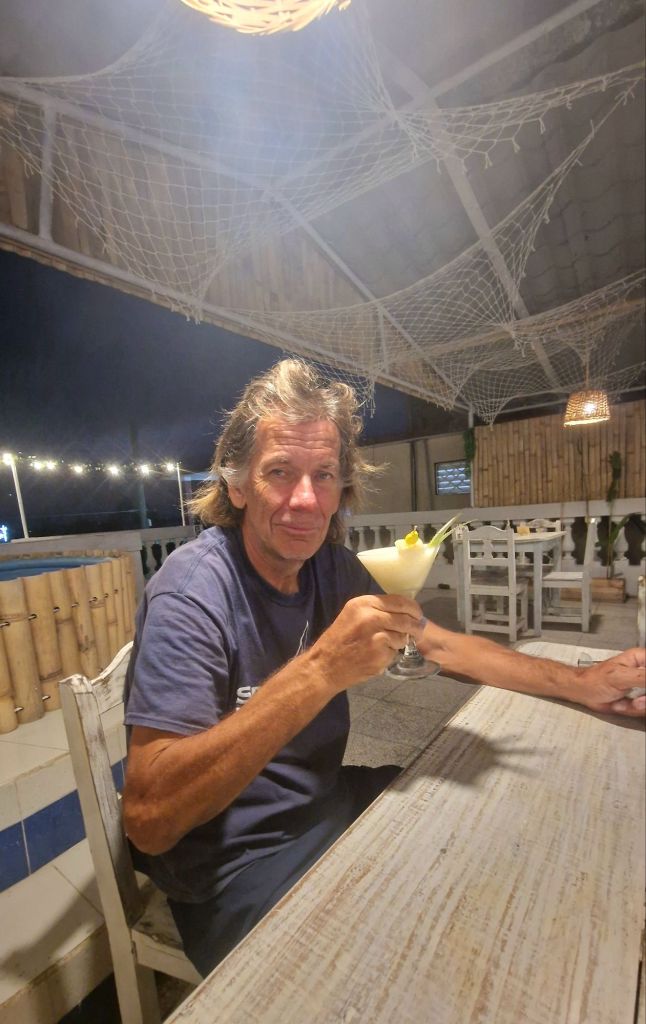
Sometimes we indulge us a cocktail
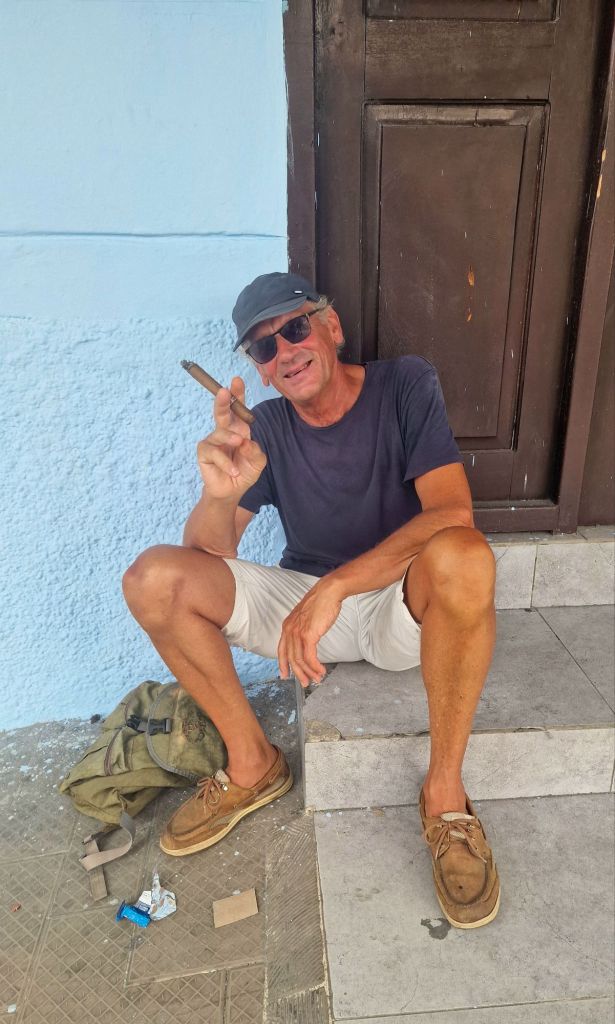
Dag with a big cigar
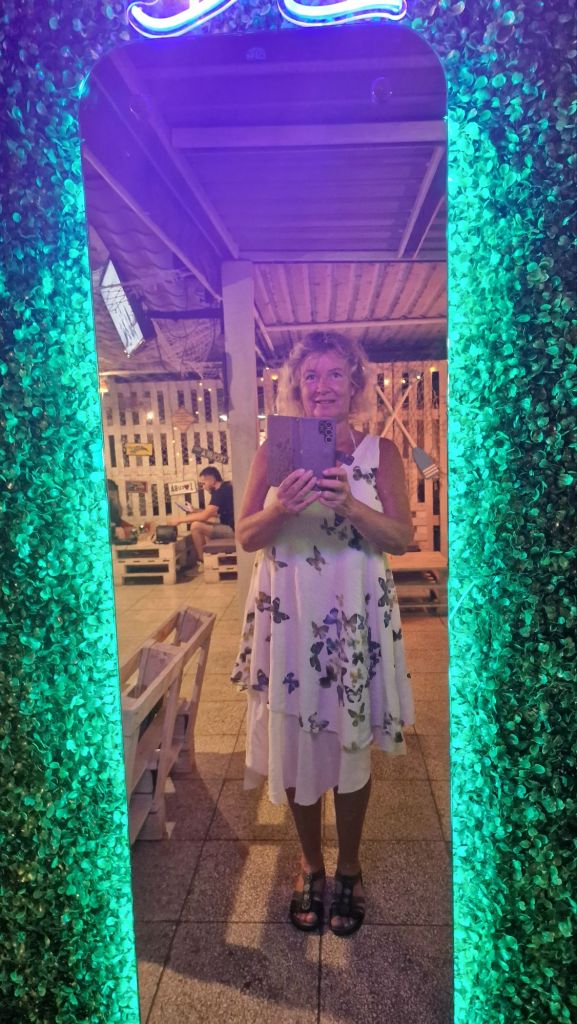
Trying to take a photo like an ”instagrammer”

När man reser runt på Kuba är det vanligt att man bor hemma hos familjer.  Många hus har skyltar i sina trädgårdar som visar att de hyr ut rum. De bostäderna heter Casa Particular och då vet vi att det mesta av pengarna går till en familj som troligen väl behöver pengarna. Det skulle vara väldigt intressant och trevligt att bo hos en familj. Tänk vad mycket vi skulle få lära oss om Kuba

When traveling around Cuba, it is common to stay with families.  Many houses have signs in their gardens showing that they rent rooms.  Those homes are called Casa Particular and then we know that most of the money goes to a family that probably needs the money.  It would be very interesting and nice to live with a family.  Think how much we would learn about Cuba

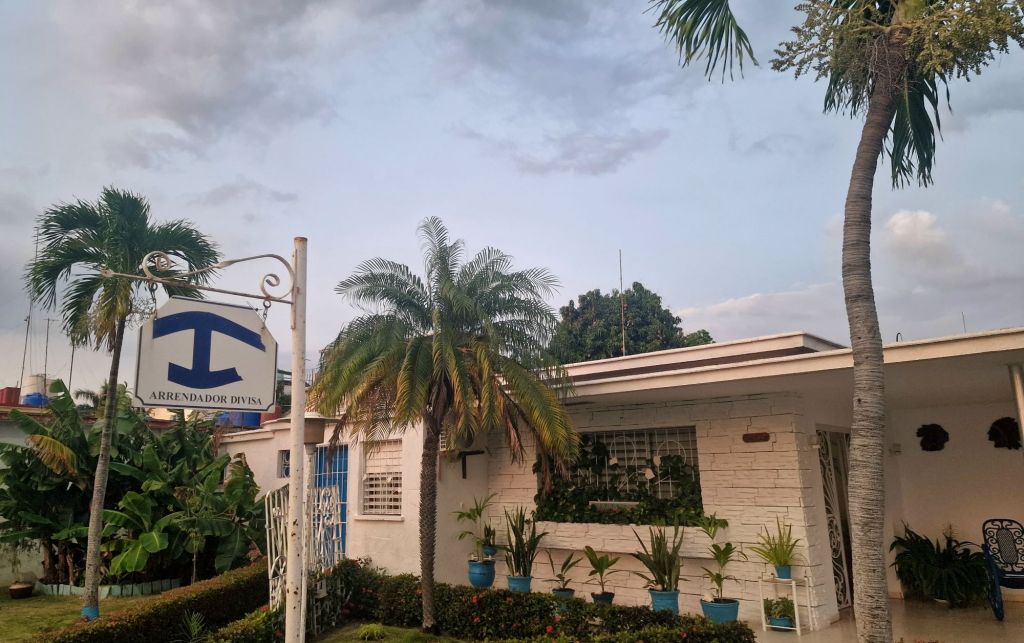
The signs showing that you can stay in the house

Vi försöker däremot läsa in oss lite på Kubas historia. Kolonisationen, Revolution, Fidel Castro, Che Guevara, Guantanamo, kommunism, maffia och osämja med USA är nog det första som dyker upp i de flestas tankar.

On the other hand, we try to read a little about Cuba’s history.  Colonization, Revolution, Fidel Castro, Che Guevara, Guantanamo, communism, mafia and disagreement with the USA are probably the first things that appear in most people’s minds.

Och det stämmer ju. Men det finns så mycket mer att lära sig! Hur var livet här under den långa spanska kolonisationen? Vad hände egentligen under revolutionen? Varför är USA och Kuba så bittra fiender?

And that’s right.  But there is so much more to learn!  What was life like here during the long Spanish colonization?  What actually happened during the revolution?  Why are the US and Cuba such bitter enemies?

Houses from the colonial era
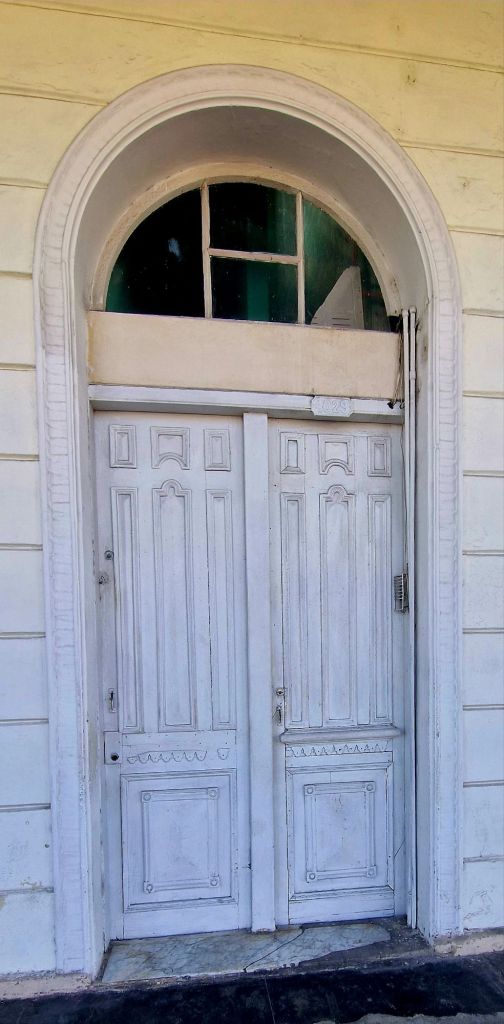
Magnificent doors

Kort historia följer här; Ursprungsbefolkningen bestod av tre olika indianska folkgrupper när Columbus ”upptäcker ” Kuba 1492. Spanien koloniserar Kuba på 1500-talet och tvåhundra år senare öppnas marknaden för Kubanska produkter i USA och ett långvarigt beroende sätter fart. Det är ett strikt klassamhälle på Kuba under kolonialtiden där spanjorer födda i Spanien står högst upp i kedjan. Kreolerna är andra klassens medborgare. Slaveriet är utbrett och omtyckt. Det utbryter många uppror under 1800-talet, vilka alla slås ned av Spanien. Kuba blir ekonomiskt helt beroende av sockerrörsexport till USA. För att skydda sina intressen på Kuba ingriper USA därmed i konflikten mellan Spanien och Kuba och Kuba blir, med hjälp av USA, självständigt från Spanien. Men till priset av Amerikansk ockupation. 1902 blir Kuba formellt oberoende av USA. Men beroendet  av USA förblir stort och styret kommer ofta att vara diktatoriskt eller med korrumperade regimer, terror o maffias ända fram till revolutionen i slutet av 1950-talet. Med Fidel Castro och Che Guevara i spetsen. Guantanamo byggs också under denna period och tillhör än idag USA. Fidel Castro blir, efter revolutionen, ledare för Kuba. Han och sedan hans bror styr landet ända fram till 2018. Han framställer sig först som demokrat men blir mer och mer kommunistisk tills kommunismen blir det enda alternativet. Kuba sätts då i blockad av USA o beroendet av Sovjetunionen blir i stället stort. På 1960-talet inför USA totalt stopp för all handel med Kuba. Castro drog sig då till Sovjetunionen o exilkubanerna i USA fick stöd av USA för att angripa kubanska regeringen. Konflikter har fortsatt vara en stor del av Kubas historia, framför allt med USA,och är det än idag.

Brief history follows here;  The original population consisted of three different Indian people groups when Columbus ”discovered” Cuba in 1492. Spain colonizes Cuba in the 16th century and two hundred years later the market for Cuban products opens up in the United States and a long-term dependence takes off.  It is a strict class society in Cuba during the colonial era where Spaniards born in Spain are at the top of the chain.  The Creoles are second-class citizens.  Slavery is widespread and popular.  Many rebellions break out during the 19th century, all of which are put down by Spain.  Cuba becomes economically completely dependent on sugarcane exports to the United States.  In order to protect its interests in Cuba, the United States thus intervenes in the conflict between Spain and Cuba, and Cuba becomes, with the help of the United States, independent from Spain.  But at the cost of American occupation.  1902 Cuba becomes formally independent from the United States.  But the dependence on the USA remains high and the rule will often be dictatorial or with corrupt regimes, terror and mafias right up until the revolution in the late 1950s.  With Fidel Castro and Che Guevara in the lead.  Guantanamo was also built during this period and still belongs to the United States today.  Fidel Castro becomes, after the revolution, leader of Cuba.  He and then his brother rule the country until 2018. He first presents himself as a democrat but becomes more and more communist until communism becomes the only option.  Cuba is then blockaded by the USA and the dependence on the Soviet Union becomes great instead.  In the 1960s, the United States introduced a total stop to all trade with Cuba.  Castro then retreated to the Soviet Union and the exiled Cubans in the United States were supported by the United States to attack the Cuban government.  Conflicts have continued to be a large part of Cuba’s history, especially with the United States, and still are today.

Befolkningen har det relativt tufft och det är svårt att hitta mat att köpa. Det är vanligt att se köer utanför de butiker som ibland säljer mat som ägg, kött och ost. Grönsaker får man helt enkelt köpa det som finns för dagen. Många tittar längtansfullt in i de affärer där man kan handla, för kubanerna, svåråtkomliga varor som t ex rengöringsmedel och Pepsi cola. Men vi ser ingen total fattigdom utan de flesta är rena och har hela kläder.

The population is having a relatively tough time and it is difficult to find food to buy.  It is common to see queues outside the shops that sometimes sell food such as eggs, meat and cheese.  Vegetables can simply be bought for what is available for the day.  Many look longingly into the shops where you can buy, for Cubans, hard-to-reach goods such as cleaning agents and Pepsi cola.  But we don’t see total poverty, most people are clean and have full clothes.

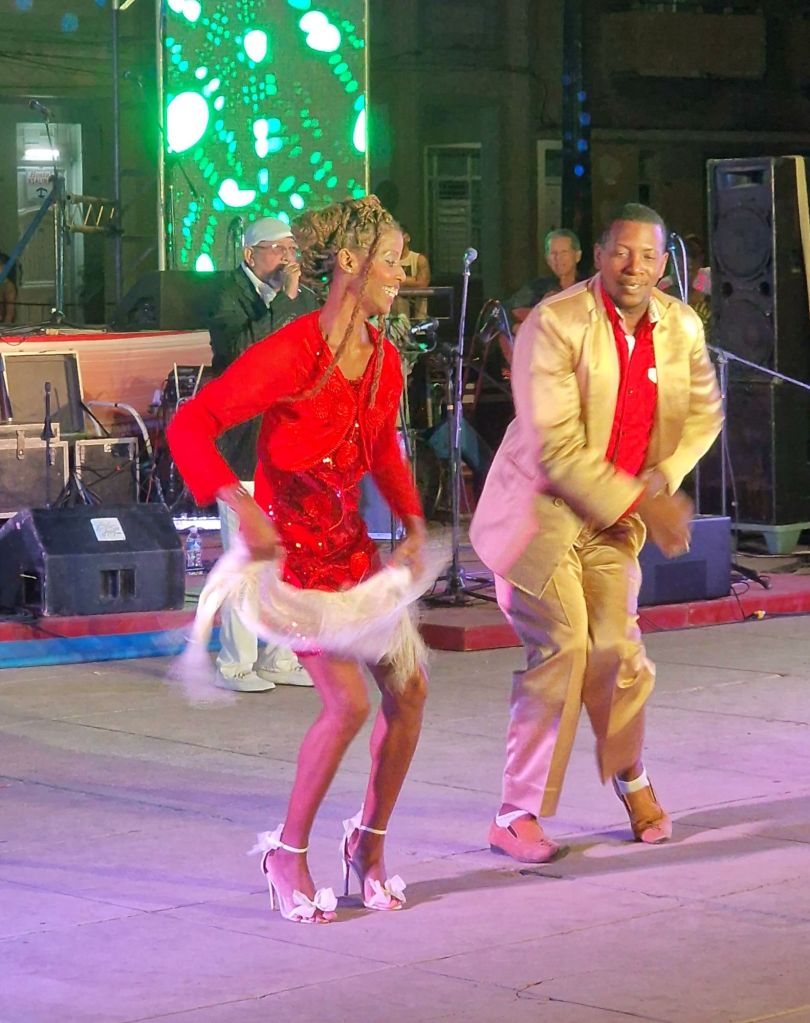
But they know how to dance
Many shops have only a hole in the wall
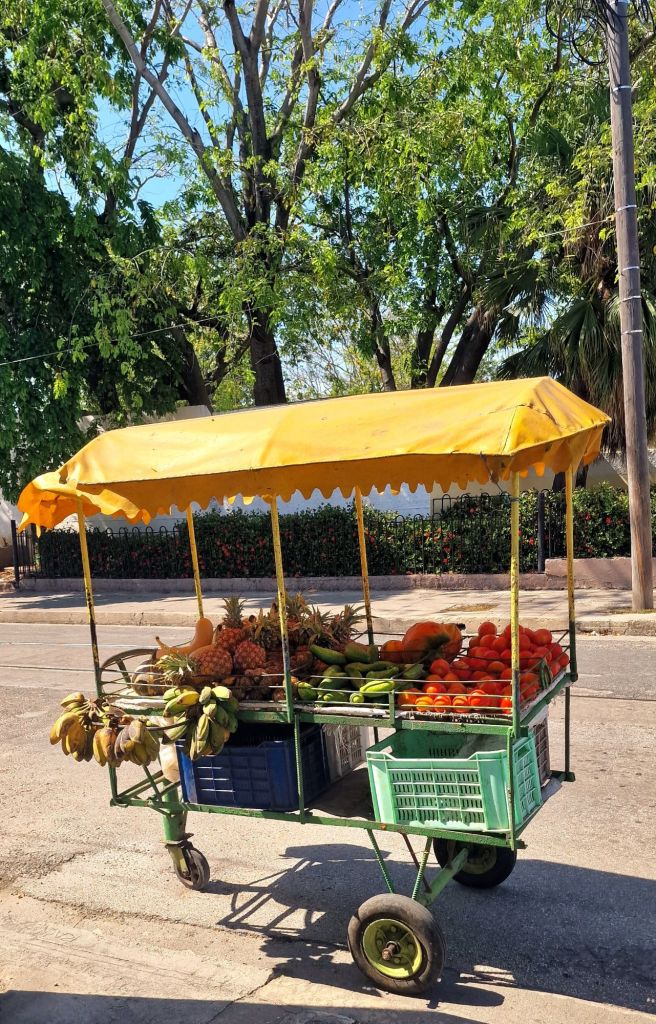
Vegetables for sale
Local Coke in stead of Coca Cola. Almost the same bottle

Människorna vi möter här i Cienfuego liksom på Cayo Largo är väldig vänliga och hjälpsamma. De är nyfikna på oss och är måna om att vi skall tycka om Kuba. Till skillnad mot östra Karibien så är de flesta här både väldigt långa och extremt smala. Både kvinnor och män. Här finns människor med ättlingar från all världens hörn –  Afrika, Kina, Europa och USA  bland annat.

The people we meet here in Cienfuego as well as on Cayo Largo are very friendly and helpful.  They are curious about us and want us to like Cuba.  In contrast to the eastern Caribbean, most people here are both very long and extremely narrow.  Both women and men.  Here are people with descendants from all corners of the world – Africa, China, Europe and the United States, among others.

Kuba var ett av många länder där det var slavhandel. Långt efter att USA avskaffade slaveriet blomstrade det fortfarande på Kuba. Om nu blomstrar är rätt ord på något så fruktansvärt. Det var de spanska kolonisatörerna som, från 1500-talet och framåt, förde hit närmare en miljon slavar för arbete på sockerrörsfält mm. Slaveriet avskaffades först 1886 och därefter har en stor andel kineser, européer och amerikanare emigrerat hit. Så befolkningen är minst sagt blandad.

Cuba was one of many countries where there was a slave trade.  Long after the United States abolished slavery, it still flourished in Cuba.  If flourishing is the right word for something so terrible.  It was the Spanish colonizers who, from the 16th century onwards, brought nearly a million slaves here to work in the sugar cane fields etc.  Slavery was only abolished in 1886 and after that a large proportion of Chinese, Europeans and Americans have emigrated here.  So the population is mixed to say the least.

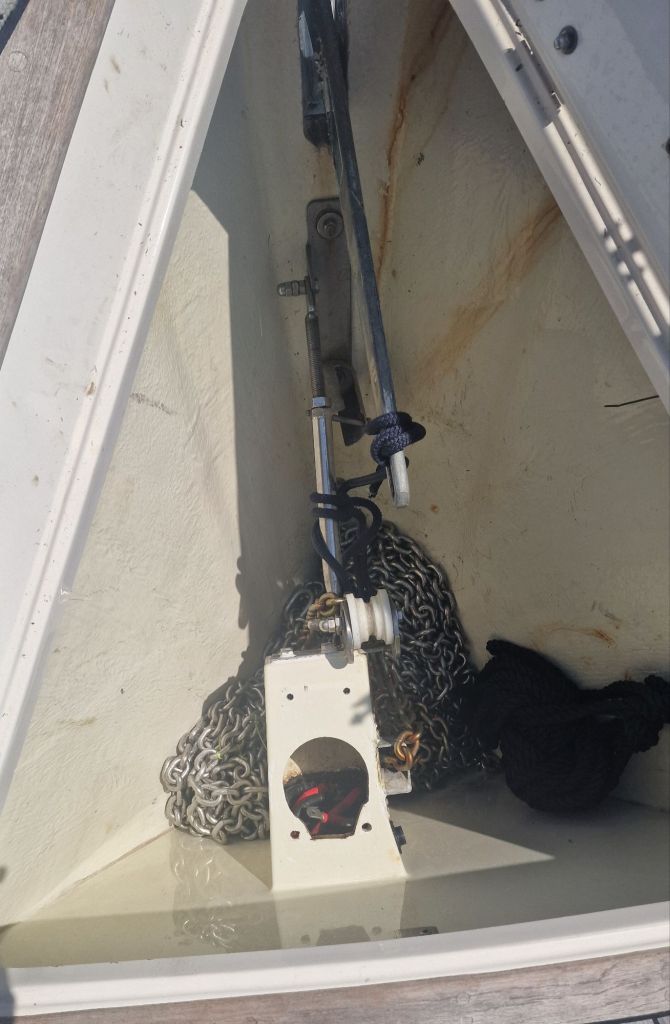
I Cienfuego möter vi Dags vän Alex som bor här. Han har lovat hjälpa oss med vårat ankarspel. Vi skruvar loss ankarspelet och lämnar över det till honom. På minst två ställen är det trasigt och nu är det hos en mekaniker där nya delar skall svarvas och nya spår svetsas. Nu håller vi tummarna för att det blir rätt och för att allt kommer tillbaka på rätt plats och passar så att ankarspelet fungerar igen. Vi är helt beroende av det då vi oftast inte lägger båten i hamn för det är både dyrt och tråkigt och framförallt kommer vi inte till alla öar, vikar, stränder och ensliga ställen som vi vill besöka. Vi vill ankra i vikar utanför vackra stränder där vi tar jollen iland som de flesta långseglare. Det är mycket av målet med långsegling.

In Cienfuego we meet Dag’s friend Alex who lives here.  He has promised to help us with our anchor game.  We unscrew the windlass and hand it over to him.  It is broken in at least two places and now it is at a mechanic where new parts must be turned and new tracks welded.  Now we are crossing our fingers that it will be right and that everything will be back in the right place and fit so that the windlass works again.  We are completely dependent on it as we usually don’t put the boat in port because it is both expensive and boring and above all we don’t get to all the islands, bays, beaches and lonely places that we want to visit.  We want to anchor in bays off beautiful beaches where we take the dinghy ashore like most long-distance sailors.  That is much of the goal of long-distance sailing.

Jan together with Alex

Varje dag promenerar vi de ca en och en halv kilometrarna in till Cienfuego.  En dag växlar vi dollar på gatan och känner oss jätterika. Vi försöker också ta oss in i en bank där kön ringlar sig lång på utsidan. Vi kommer till sist in men får till besked att vi inte kan ta ut pengar på kort där utan blir hänvisade till en annan bank i stället. Vi sitter lite i en rävsax då vi inte har tillräckligt med dollar med oss och vi inte kan ta ut pengar på något av våra kort. Hur länge kan vi stanna på Kuba? Hur länge räcker våra pengar om vi snålar? Vi vill ju så gärna upptäcka och se flera delar av landet. Transport med collectivotaxi betalas i dollar så vi måste spara pengar till det. Vi måste också ha tillräckligt med kontanter så vi kan köpa på oss lite grönsaker, vad vi nu hittar av det, inför kommande segling längs med Kubas sydkust.

Every day we walk the approximately one and a half kilometers into Cienfuego.  One day we exchange dollars on the street and feel very rich.  We also try to get into a bank where the queue is long outside.  We finally get in but are informed that we cannot withdraw money from cards there, but are referred to another bank instead.  We are in a bit of a bind as we don’t have enough dollars with us and we can’t withdraw money from any of our cards.  How long can we stay in Cuba?  How long will our money last if we skimp?  We really want to discover and see several parts of the country.  Transport by collectivo taxi is paid in dollars so we have to save money for that.  We also need to have enough cash so we can buy some vegetables, whatever we can find, for the upcoming sailing along the south coast of Cuba.

The Boulevard in Cienfuego
On the way in to town
Inside a colonial bar

När vi nu ändå väntar på reparationen av ankarspelet skall vi åka iväg på en ca fem dagar lång utflykt till Havanna. Åh vad jag längtar! Smaka bara på namnet Havanna och bilder på vackra men slitna kolonialhus med baldakiner, gatumusikanter, rosa amerikanska cabrioleer, cigarrer, rom, musik och romantik dyker upp. Detta ser vi verkligen fram emot!

While we are now still waiting for the repair of the windlass, we will go on an approximately five-day excursion to Havana.  Oh how I long!  Just taste the name Havana and images of beautiful but worn colonial houses with canopies, street musicians, pink American convertibles, cigars, rum, music and romance come to mind.  We are really looking forward to this!

Om den utflykten och resan tillbaka kan ni läsa i nästa blogginlägg. Som kommer om några dagar. Detta inlägg fortsätter med återkomsten till Cienfuego

You can read about that excursion and the journey back in the next blog post.  Which will arrive in a few days.  This post continues with the return to Cienfuego

Efter en ”näradöden-upplevelse” med taxin tillbaka till Cienfuego är vi åter här. Chauffören hade knappt händerna på ratten, körde i över 100 km/timman och var mest intresserad av sin mobil de tre och en halv timmarna resan tog.

After a ”near-death experience” with the taxi back to Cienfuego, we are here again.  The driver barely had his hands on the wheel, drove at over 100 km/h and was mostly interested in his mobile phone for the three and a half hours the journey took.

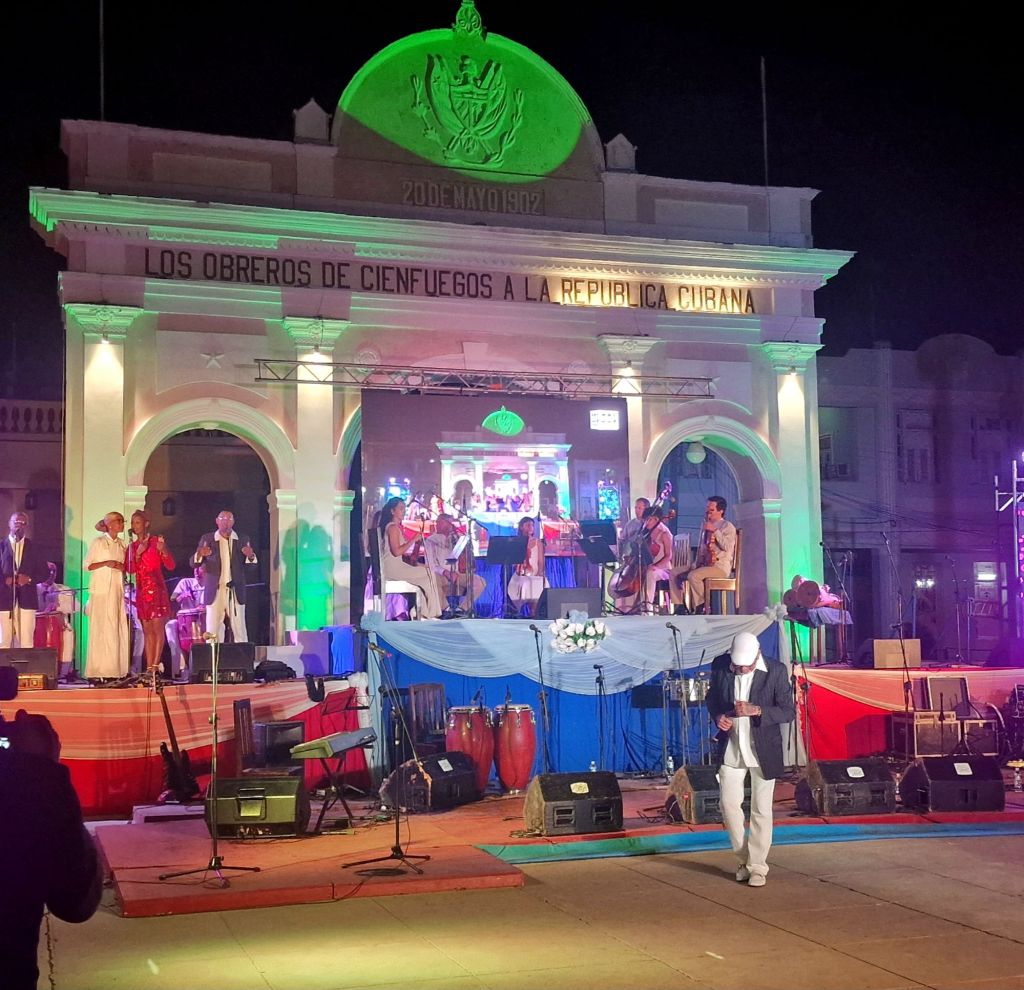
Cienfuego levererar verkligen idag 22 april. Dag, som bott ombord på Vilja när vi varit borta, välkomnar oss med en kall öl i sittbrunnen. Idag firar Cienfuego sin 205:e födelsedag. Det firas stort med en festival mitt inne på torget José Martí, som är med på Unescos Världsarvslista. På en scen med hundratals besökare framför, troligen endast lokalbefolkning utom oss, är det full show med band efter band som avlöser varandra. Det är storband, afrikanskt, rapp, salsa och dans i mängder. Stämningen är hög och publiken står upp och dansar med och mot slutet av showen gungar hela torget i takt till musiken. Vilken glädje! Vilken show! Det är underbart att få ta del av.

Cienfuego really delivers today April 22.  Dag, who lived on board Vilja while we were away, welcomes us with a cold beer in the cockpit.  Today Cienfuego celebrates its 205th birthday.  It is celebrated big with a festival in the middle of José Martí Square, which is on the UNESCO World Heritage List.  On a stage with hundreds of visitors in front, probably only locals except us, it’s a full show with band after band replacing each other.  It’s big band, African, rap, salsa and dance in abundance.  The atmosphere is high and the audience gets up and dances along and towards the end of the show the whole square is swaying to the music.  What joy!  What a show!  It is wonderful to be a part of.

The show is on
The audience are all dancing

Efter showen går vi till en bar där det är ett slutet födelsedagskalas men vi blir inbjudna och musiken och dansen fortsätter.  En kvinna sjunger till musik från en musikanläggning och gammal som ung är uppe och dansar. På hemvägen möter vi en kille som frågar ”change?” Han vill, som många andra, växla penger. Jan tar det bokstavligt och byter i stället sin skjorta mot hans smutsiga och svettiga t-shirt. Jan tycker det är en kul grej men det uppskattas inte lika mycket av mig. Vi tar oss sedan hem med motorcykeltaxi sent på kvällen nöjda och glada. Förutom då bytet av skjortan. T-shirten blir en trasa, tillsammans med andra trasiga kläder, ombord på Vilja.

After the show we go to a bar where it is a closed birthday party but we are invited and the music and dancing continue.  A woman sings to music from a music system and old and young are up and dancing.  On the way home we meet a guy who asks ”change?”  He, like many others, wants to exchange money.  Jan takes it literally and instead changes his shirt to his dirty and sweaty t-shirt.  Jan thinks it’s a fun thing, but I don’t appreciate it as much.  We then take a motorcycle taxi home late at night satisfied and happy.  Except then the change of the shirt.  The T-shirt becomes a rag, along with other torn clothes, on board Vilja.

Ankarspelet är nu repareret och tillbaka på plats. Dag och Jan skruvade fast det och vi har provat att hissa upp och ner det flera gånger. Det slirar inte längre utan funkar perfekt. Till betalning får Alex bl.a en gammal Singer symaskin som hans fru blir mycket glad över.

The windlass is now repaired and back in place.  Dag and Jan screwed it and we have tried to lift it up and down several times.  It no longer slips but works perfectly.  In payment, Alex receives, among other things, an old Singer sewing machine, which his wife is very happy about.

Here the windlass is picked away
Dag working to get the windlass back again

Två dagar senare går vi ut igen på kvällen. Det är livemusik med salsadans på teatercaféet. Än en gång är det härliga rytmer, hög stämning och en massa dans. Jag blir uppbjuden av en man som verkligen kan dansa och showa. Det är svårt att hänga med även om jag känner takten men det är inte lätt att veta var jag skall sätta fötterna. Kul är det i alla fall. Killen Jan bytte skjortan med är också där och han pratar mycket med Jan och bjuder honom på en öl. Även ikväll tar vi oss hem sent – nöjda och glada.

Two days later we go out again in the evening.  There is live music with salsa dancing in the theater cafe.  Once again, there are lovely rhythms, high atmosphere and a lot of dancing.  I am invited by a man who can really dance and show.  It’s hard to keep up even though I feel the beat but it’s not easy to know where to put my feet.  It’s fun anyway.  The guy Jan changed his shirt with is also there and he talks to Jan a lot and offers him a beer.  Even tonight we get home late – satisfied and happy.

Hahaha…none of us can dance salsa
I’m trying but can’t make it right

Kuba Är verkligen dans och musik och glädje. Överallt man går möts man av musiken och dansen. På gator, på serveringar, på torg, utomhus, inomhus. Ja, precis överallt. Det är en fantastisk glädje!

Cuba Is really dance and music and joy.  Everywhere you go you are met by music and dancing.  On the streets, at restaurants, in squares, outdoors, indoors.  Yes, just everywhere.  It is an amazing joy!

Wonderful Lake Atitlan

Wow vilken fantastisk resa vi har gjort båda två tillsammans in till höglandet i Guatemala. Det är verkligen ett otroligt land som har rikt varierande upplevelser och hänförande natur att bjuda på.

Wow what a fantastic trip we both made together into the interior of Guatemala.  It is truly an incredible country that has richly varied experiences and breathtaking nature to offer.

Vi packar våra ryggsäckar och tar en tidig buss på morgonen till  Guatemala City. Det är nästan ett måste att åka tidigt om man sedan skall ta sig vidare samma dag. Resan tar även denna gång ca sex timmar och är mycket bekväm. Vi tar en Uber till det vi tror är busshållplatsen för bussar mot Antigua men väl framme visar sig det vara fel. En tungt beväpnad vakt med skottsäker väst och sin k-pist nästan skjutklar förklarar för oss på spanska. Så vi tar ytterligare en taxi som kör oss till rätt plats. Där möter en inkastare oss som visar oss fram till bussen. Man får otroligt bra service på busshållplatserna i Guatemala. Vi får våra platser längst bak i bussen och resan mot Antigua fortsätter i långsam takt. Inkastaren springer konstant utanför bussen o raggar fler passagerare – även om bussen redan är mer än till synes proppfull

We pack our backpacks and take an early morning bus to  Guatemala City.  It is almost a must to leave early if you are going to continue on the same day.  The journey also takes about six hours this time and is very comfortable.  We take an Uber to what we think is the bus stop for buses to Antigua but once there it turns out to be wrong.  A heavily armed guard with a bulletproof vest and his k-pist almost ready to go explains to us in Spanish.  So we take another taxi that takes us to the right place.  There an usher meets us and shows us to the bus.  You get incredibly good service at the bus stops in Guatemala.  We get our seats at the back of the bus and the journey to Antigua continues at a slow pace.  The Inca star constantly runs outside the bus and grabs more passengers – even though the bus is already more than apparently full

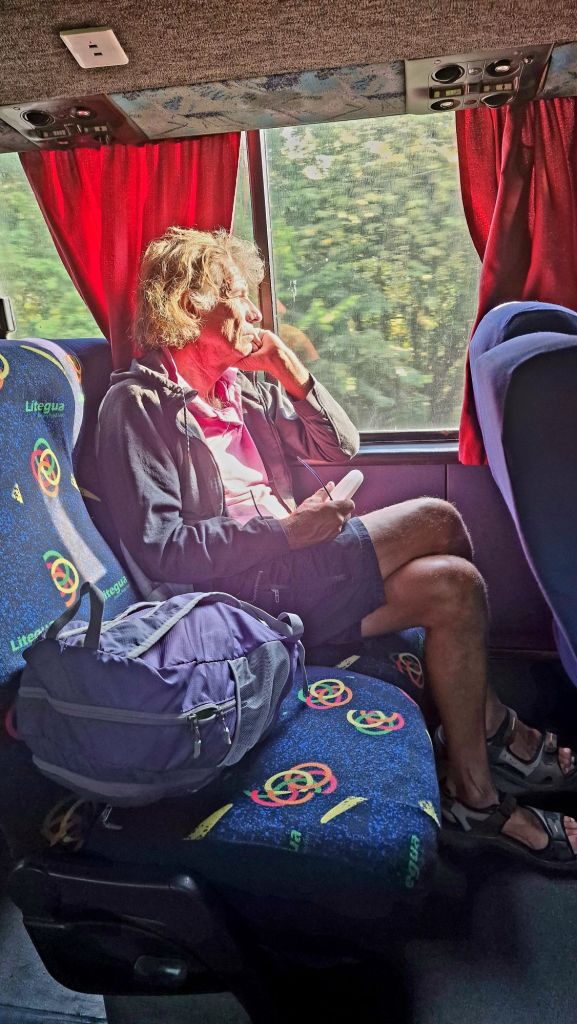
Jan on the Litegua bus to Guatemala City
From the bus when we leave Guatemala City

Resan tar ca tre timmar för det är mitt i rusningstrafiken och det verkar dessutom bara ett stopp mitt på vägen någonstans.

The journey takes about three hours because it is in the middle of rush hour traffic and it also seems like just a stop in the middle of the road somewhere.

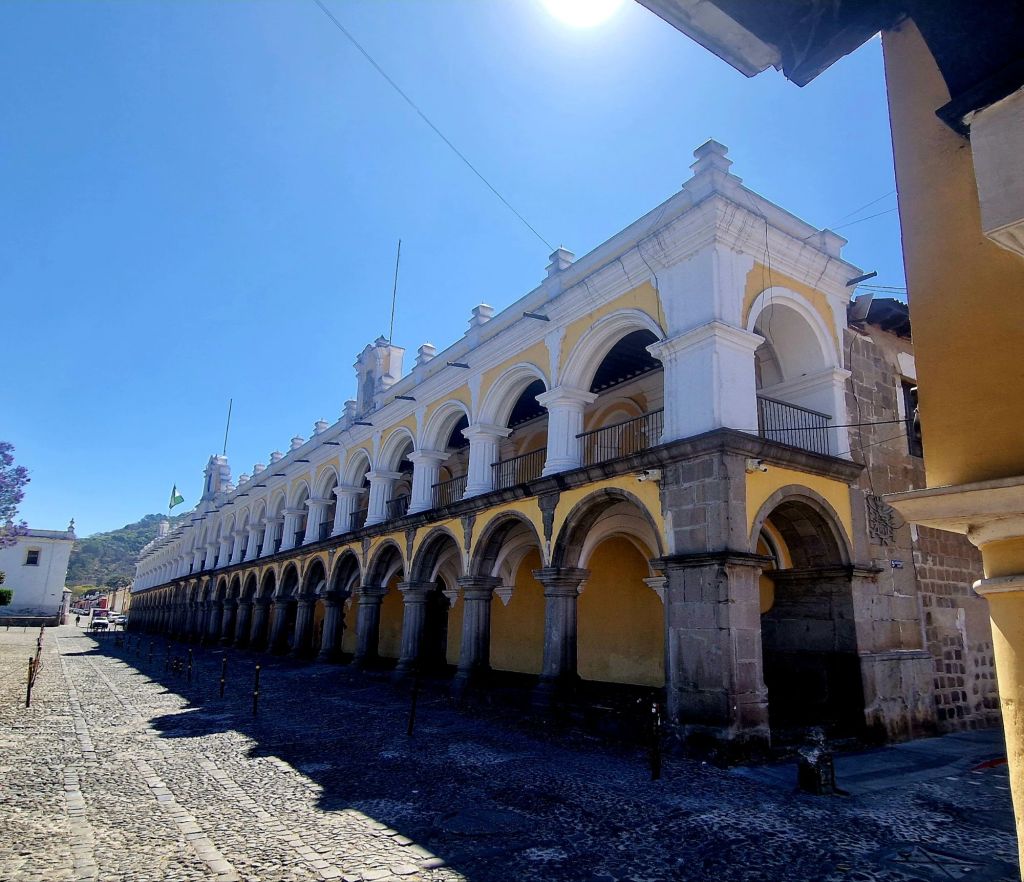
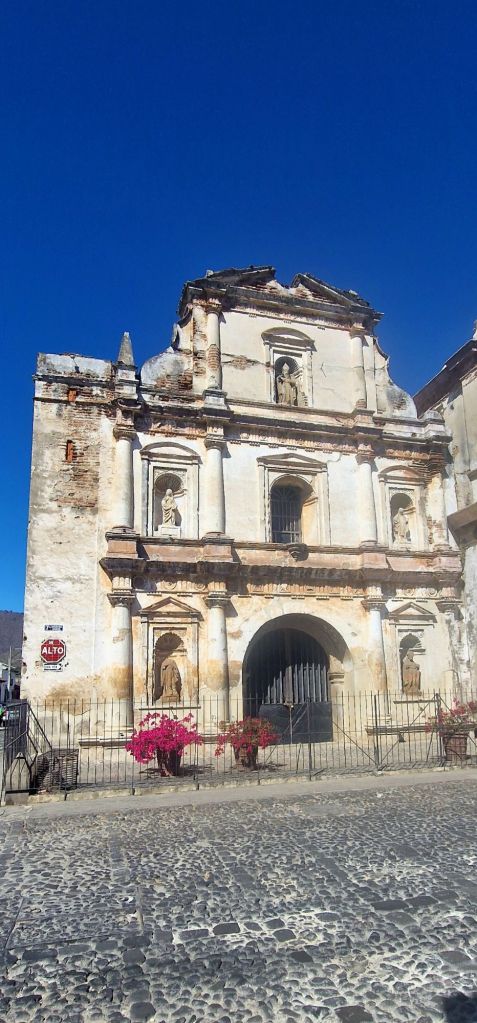
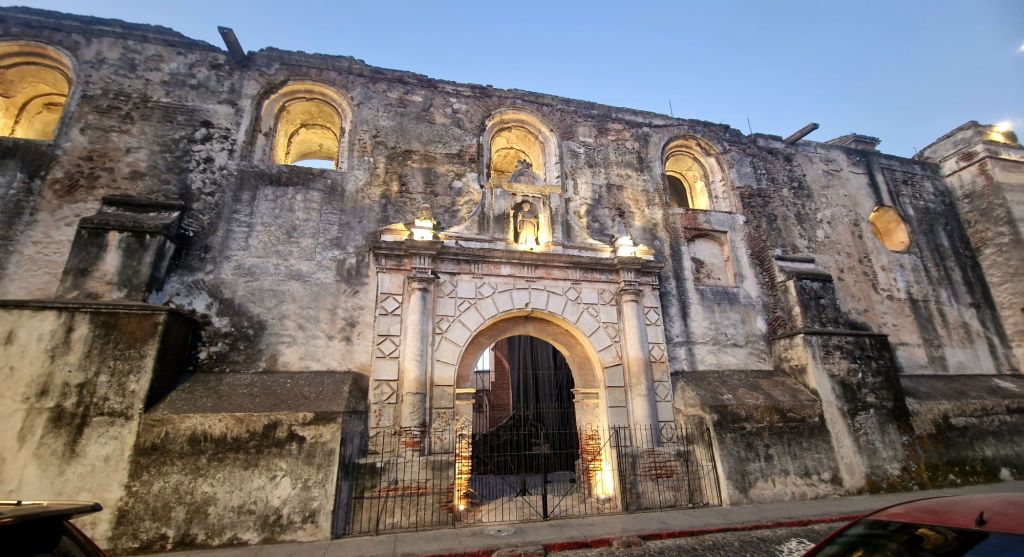
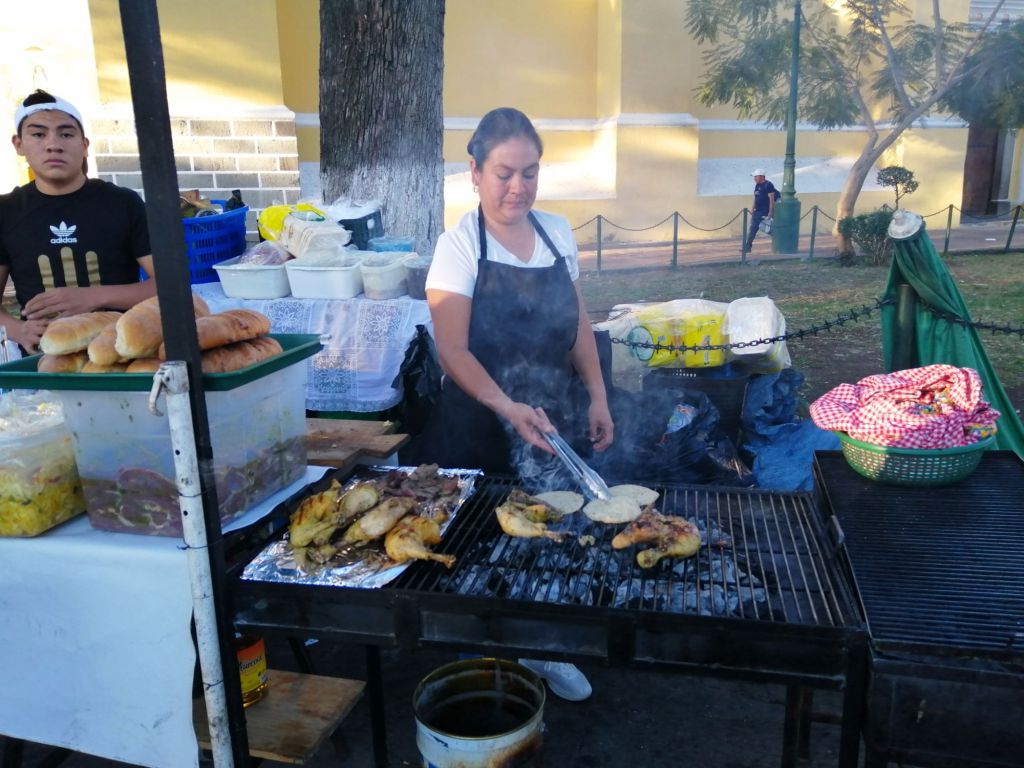
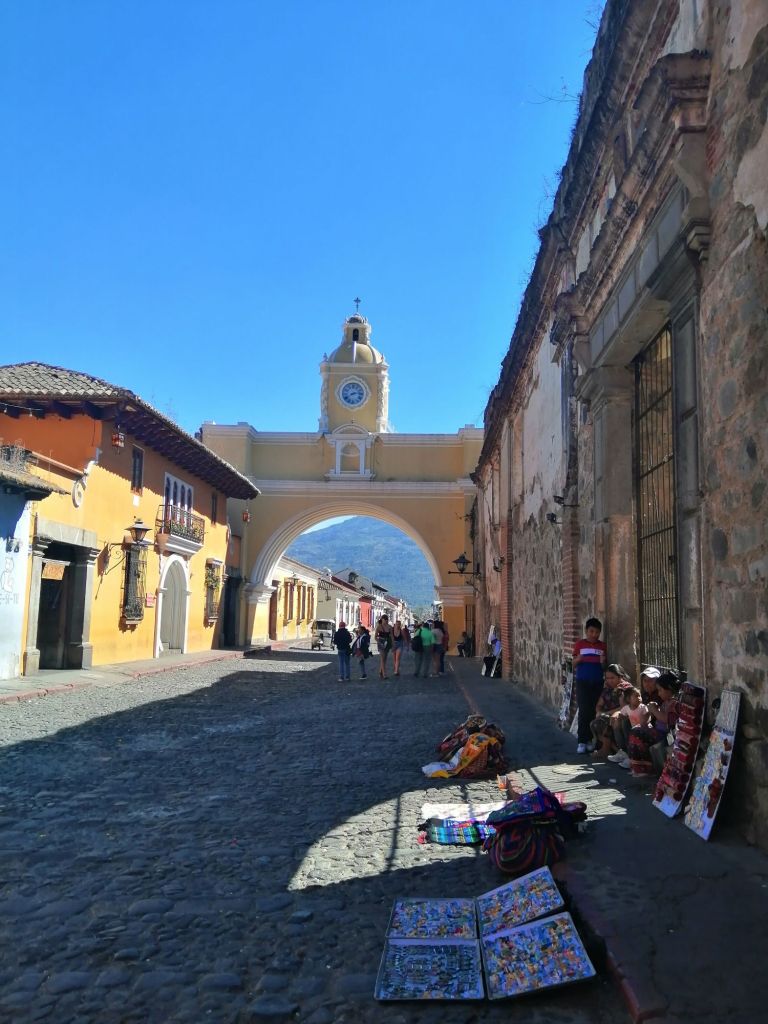
Vi kommer fram till Antigua och hittar lätt vårat hotell. Därefter går vi en promenad i den charmerande byn, tittar på folklivet och äter mat från ett gatustånd. Det blir en tidig kväll då vi var uppe i gryningen och hade en lång resa bakom oss. Dessutom väntar en ny resa kommande dag

We arrive in Antigua and easily find our hotel.  Afterwards, we go for a walk in the charming village, watch people’s life and eat food from a street stall.  It will be an early evening as we were up at dawn and had a long journey behind us.  In addition, a new trip awaits the next day

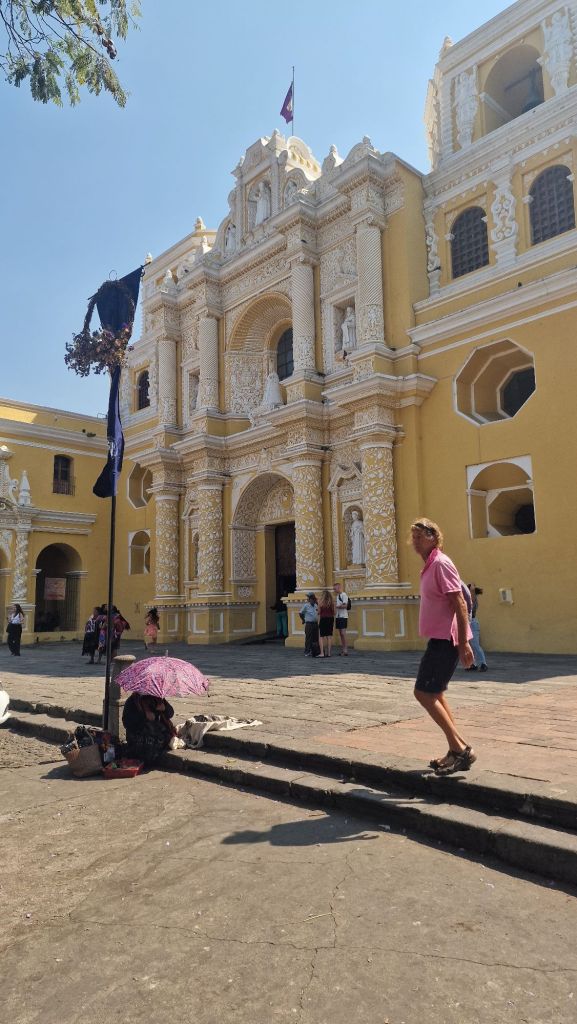
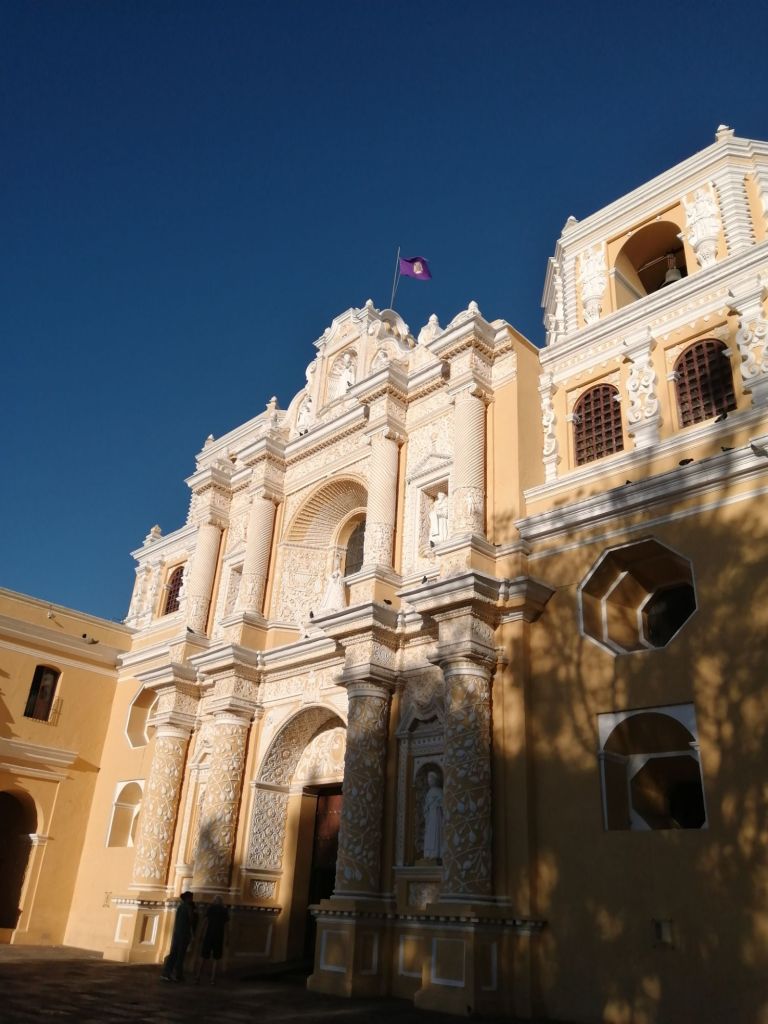
Jan outside the beautiful  Iglecia de la Merced
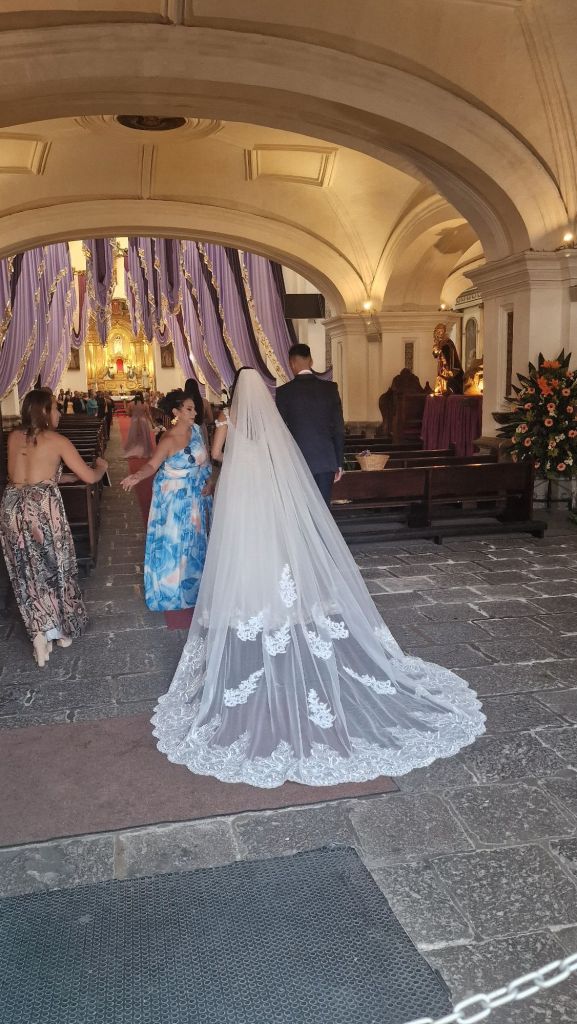
It was a wedding in the church that day
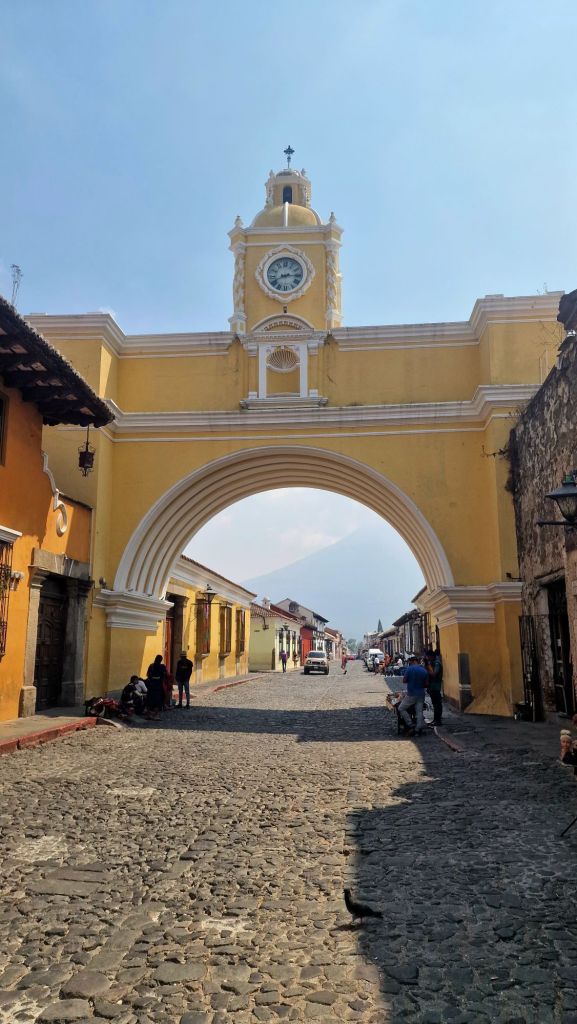
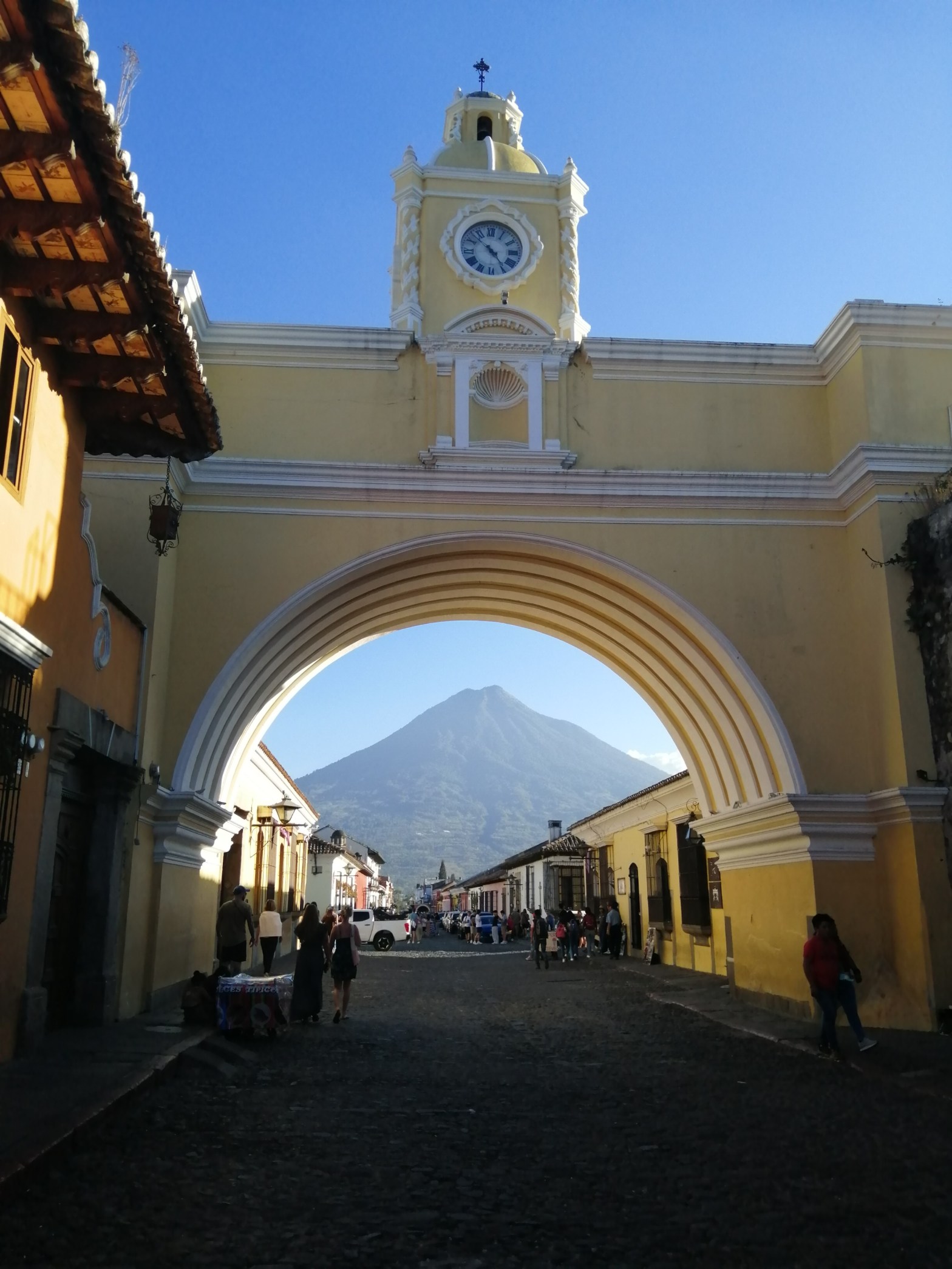
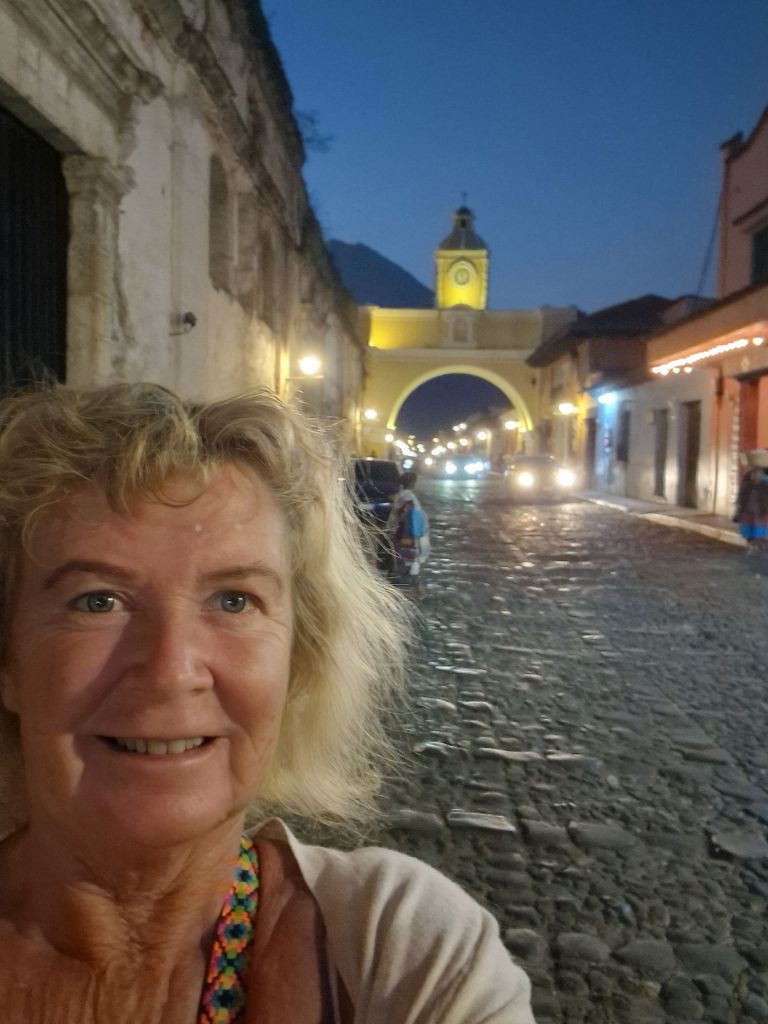
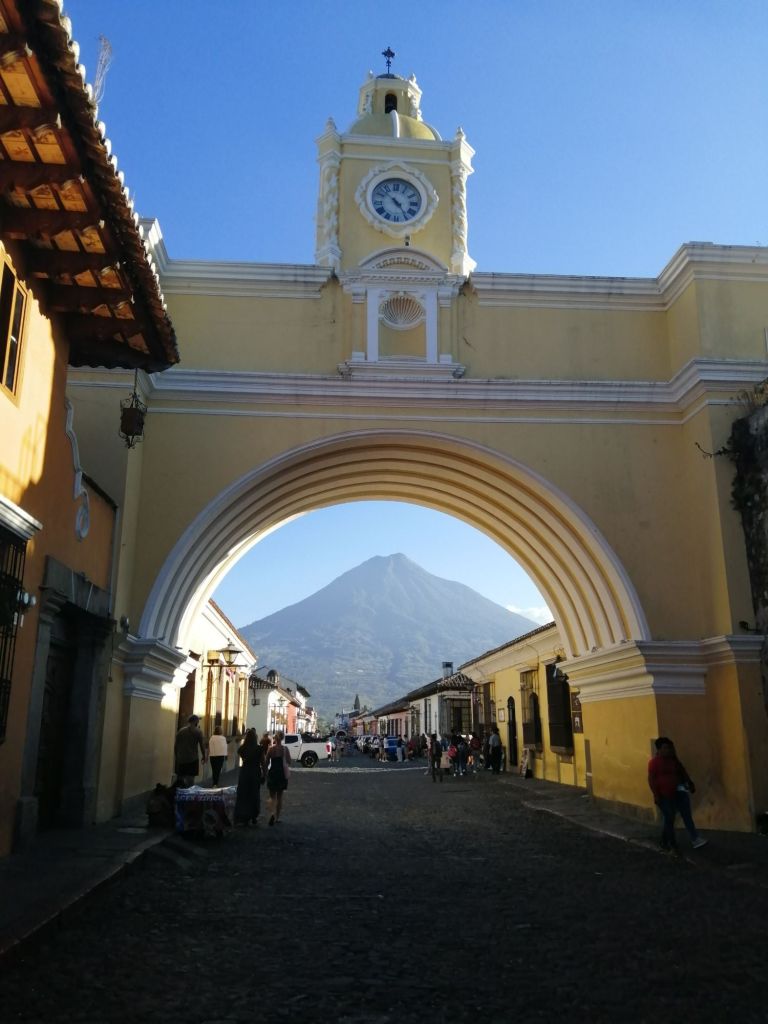
Santa Catalina Arch

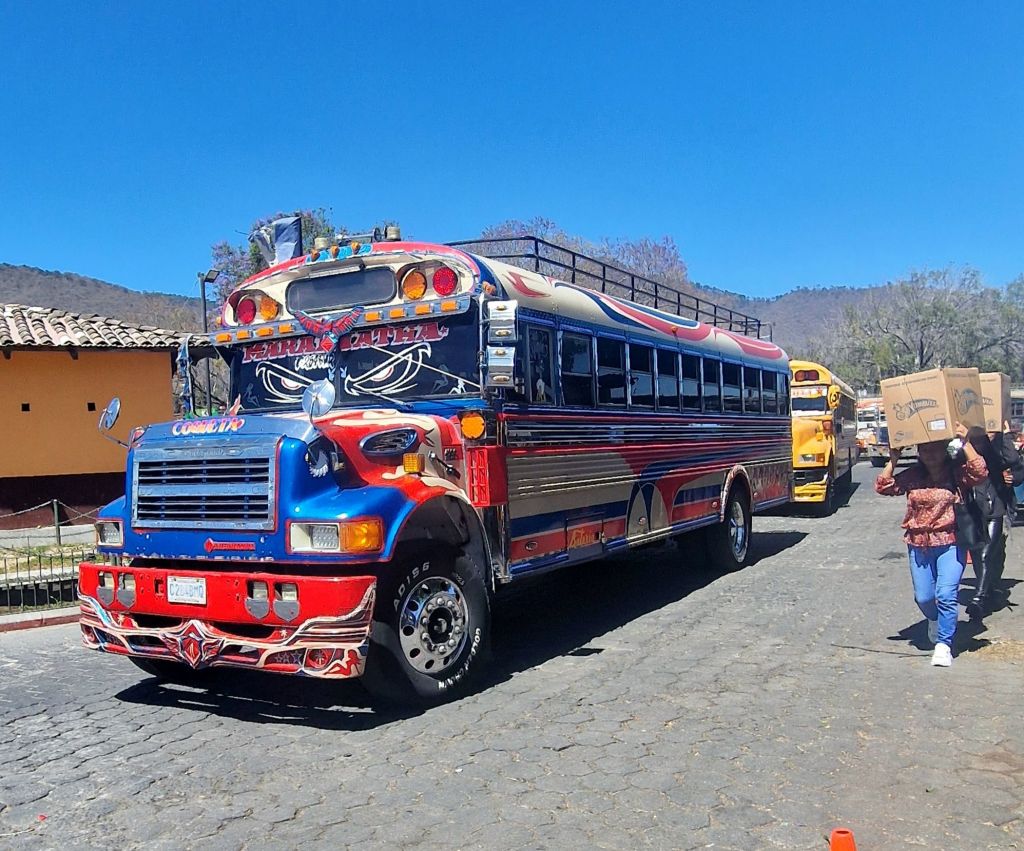
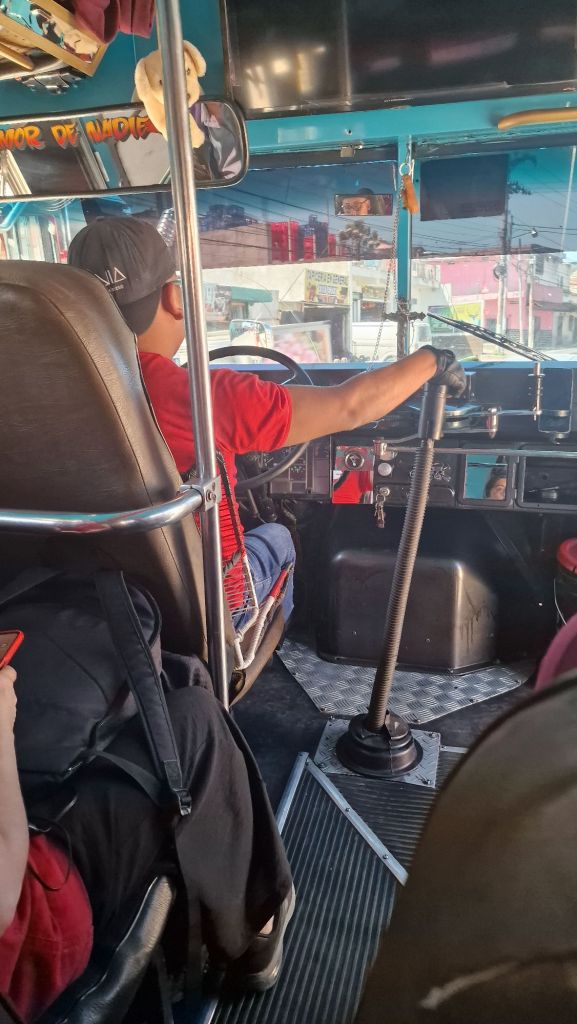
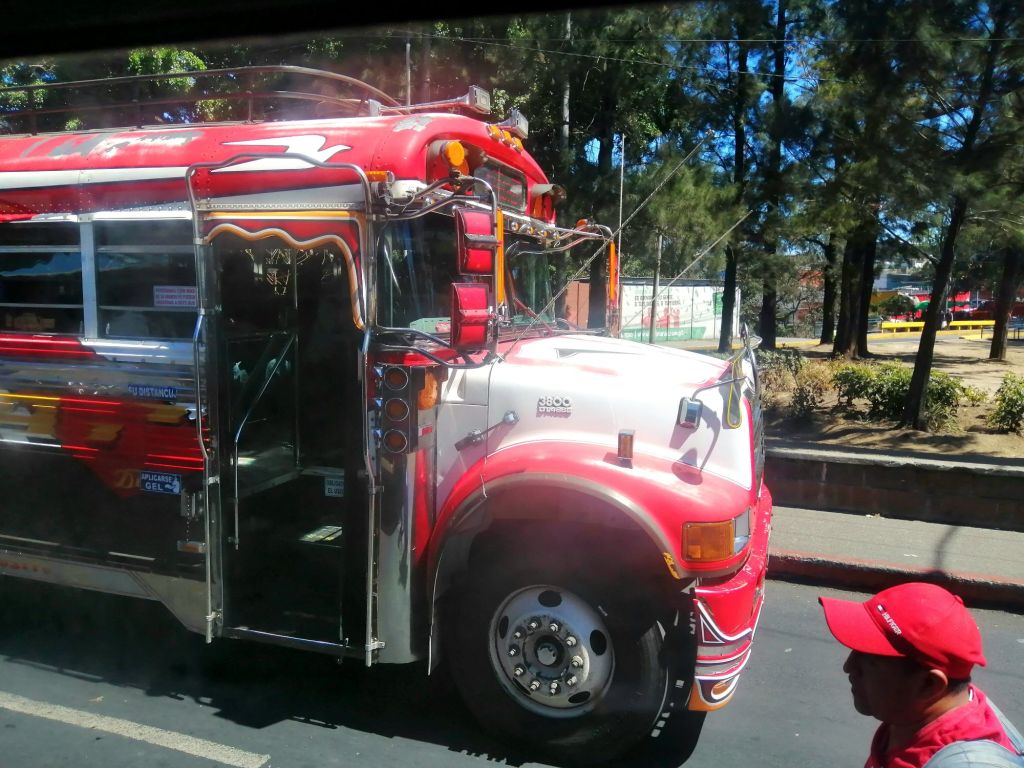
Att åka lokalbussarna som liknar cirkusbussar är ett äventyr. Det är fullt av liv både i och utanför bussarna, det är trångt, otroligt skumpigt och alltid lika spännande med ovissheten om vi blir tillsagda var vi skall gå av och om vi skall hinna av i tid för att byta buss. Bussarna stannar dessutom inte riktigt utan man hoppar på och av i farten med all packning. Första bytet går väldigt smidigt. En man möter oss, tar vår packning och springer i förväg till nästa buss. Det är han som är inkastare, tar betalt och organiserar allt i bussen så att chauffören endast behöver koncentrera sig på att köra bussen. Vi åker fram på serpentinvägar i full fart och om det inte hade varit så trångt i bussen hade vi haft svårt för att sitta kvar på sätet i de skarpa svängarna.

Riding the local buses that resemble circus buses is an adventure.  It’s full of life both inside and outside the buses, it’s crowded, incredibly murky and always just as exciting with the uncertainty of whether we’ll be told where to get off and whether we’ll make it in time to change buses.  The buses also don’t really stop, instead you jump on and off on the fly with all your luggage.  The first change goes very smoothly.  A man meets us, takes our pack and runs ahead to the next bus.  He is the usher, takes payment and organizes everything in the bus so that the driver only has to concentrate on driving the bus.  We drive along serpentine roads at full speed and if it hadn’t been so crowded in the bus, we would have had a hard time staying on the seat in the sharp turns.

Även nästa byte går smidigt o vi börjar resan ner mot Lake Atitlan i ännu snävare kurvor. Lake Atitlan ligger på ca 1500 meters höjd och vi har som högst varit uppe på ca 2100 meter.

The next change also goes smoothly and we start the journey down towards Lake Atitlan in even tighter curves.  Lake Atitlan is at an altitude of about 1500 meters and we have been up to about 2100 meters at the highest.

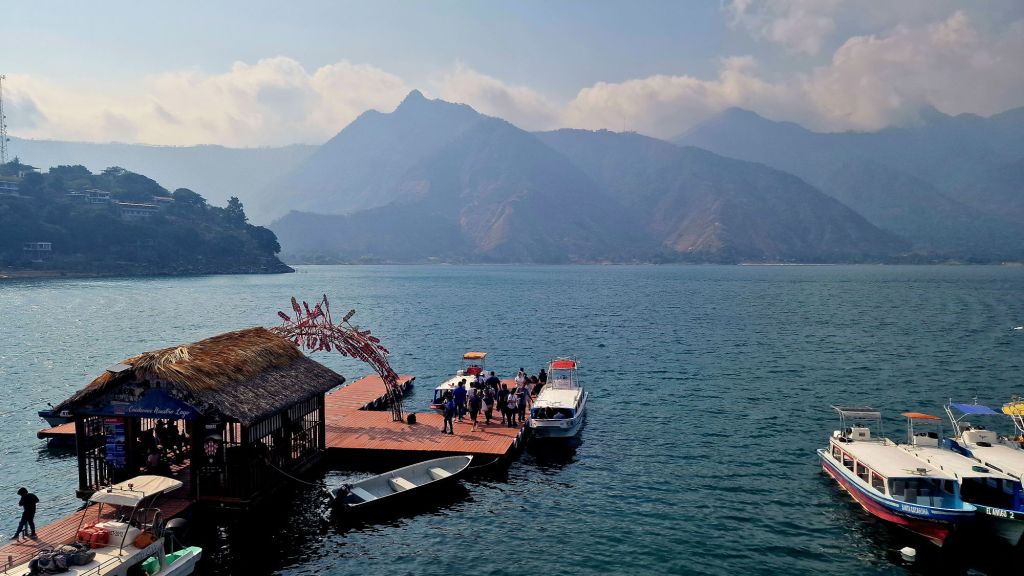
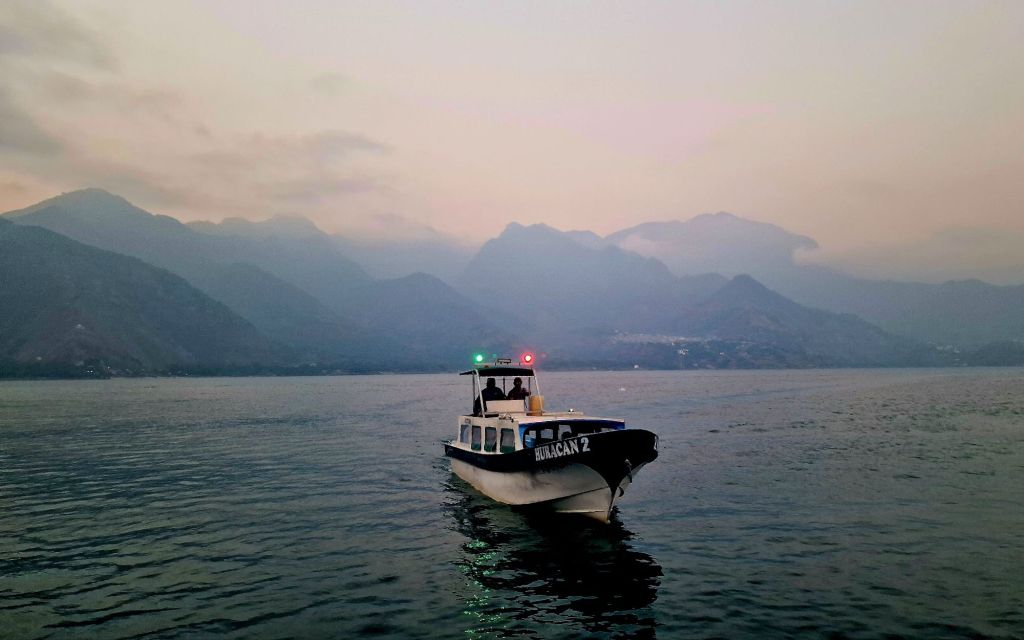
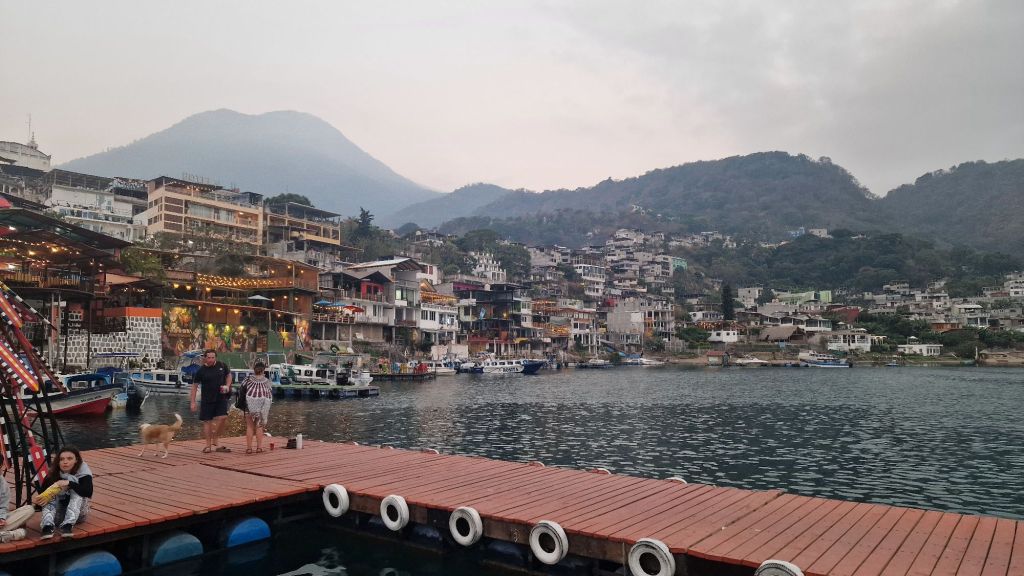
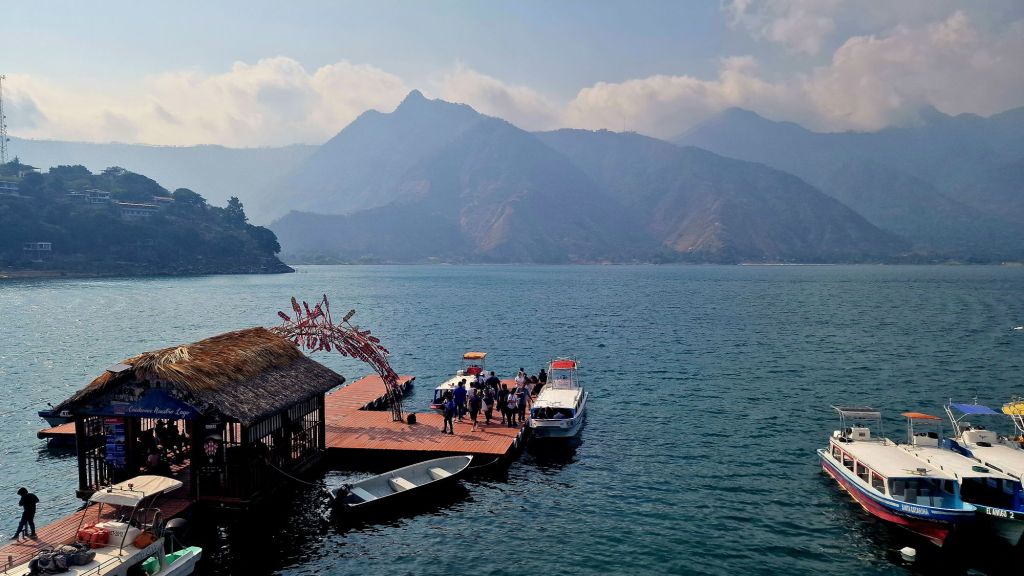
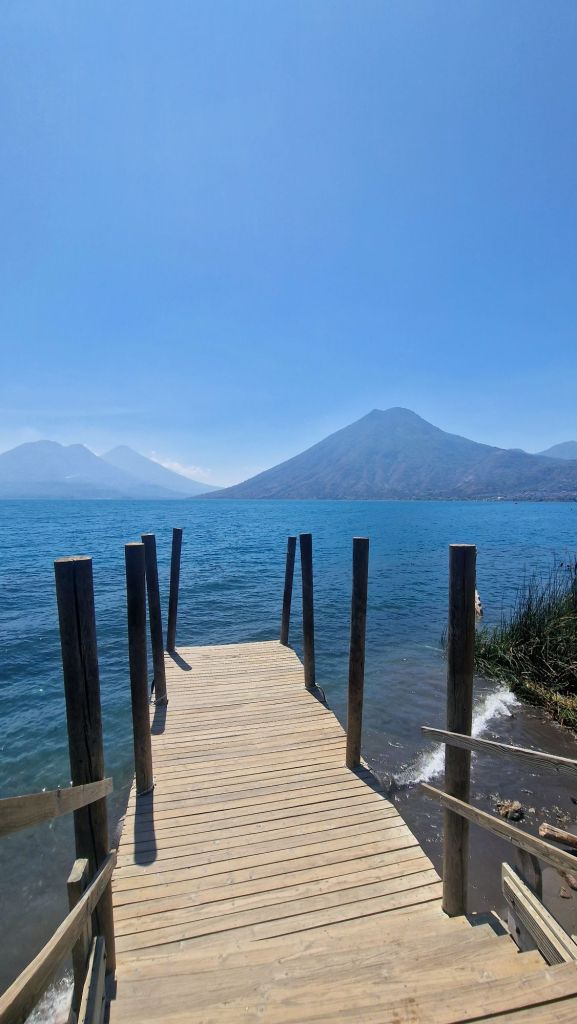
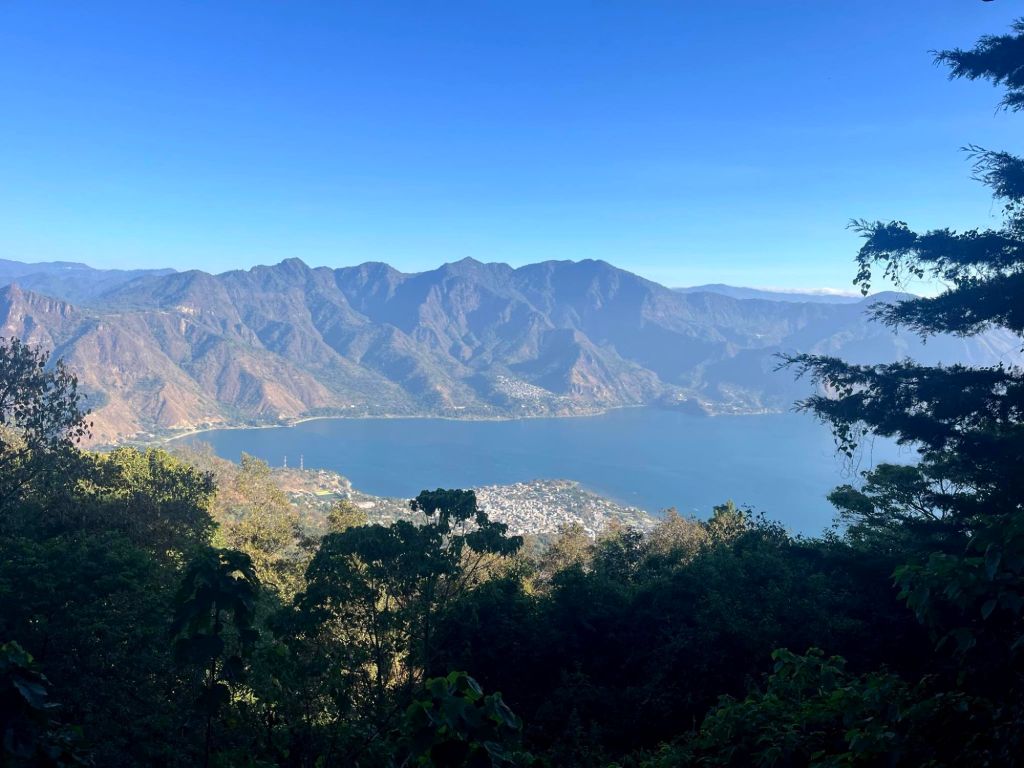
Lake Atitlan är omgärdad av vulkaner, både aktiva och utslocknade. De reser sig ända upp till nästan 4000 meters höjd. Sjön med dess omgivningar sägs vara den vackraste i världen och den blev nominerad till ett av världens sju ”nya” underverk. Den säga också vara en av de mest unika platserna i världen. Sjön bildades genom ett vulkanutbrott för ca 84000 år sedan. Det är hänförande vackert att komma ner till sjön och se vulkanerna som omringar sjön insvepta i ett dis. Vi hade bokat rum i byn San Pedro som är den by där det är mest utvecklat för turister. Alla byar runt sjön är byggda så att det är många branta backar upp och ner från den högre delen av byn och ner mot strandkanten.

Lake Atitlan is surrounded by volcanoes, both active and extinct.  They rise up to an altitude of almost 4,000 meters.  The lake and its surroundings are said to be the most beautiful in the world and it was nominated as one of the seven ”new” wonders of the world.  It is also said to be one of the most unique places in the world.  The lake was formed by a volcanic eruption about 84,000 years ago.  It is breathtakingly beautiful to come down to the lake and see the volcanoes surrounding the lake shrouded in a haze.  We had booked rooms in the village of San Pedro which is the village where it is most developed for tourists.  All the villages around the lake are built so that there are many steep slopes up and down from the higher part of the village down towards the shore.

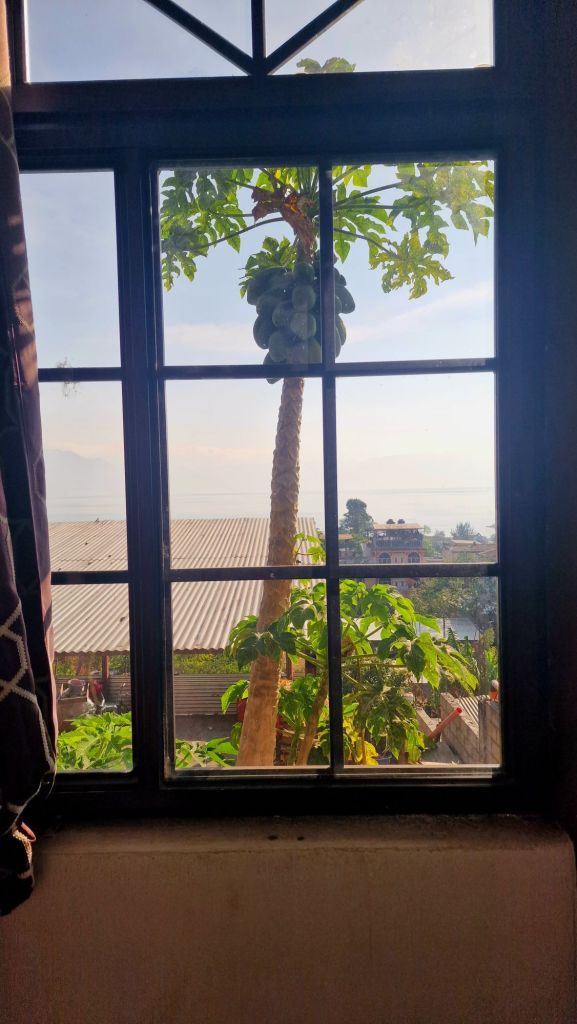
Our lake- and vulcanoeview from the hotel
The beautiful view
A boat bring people between the village on Lake Atitlan
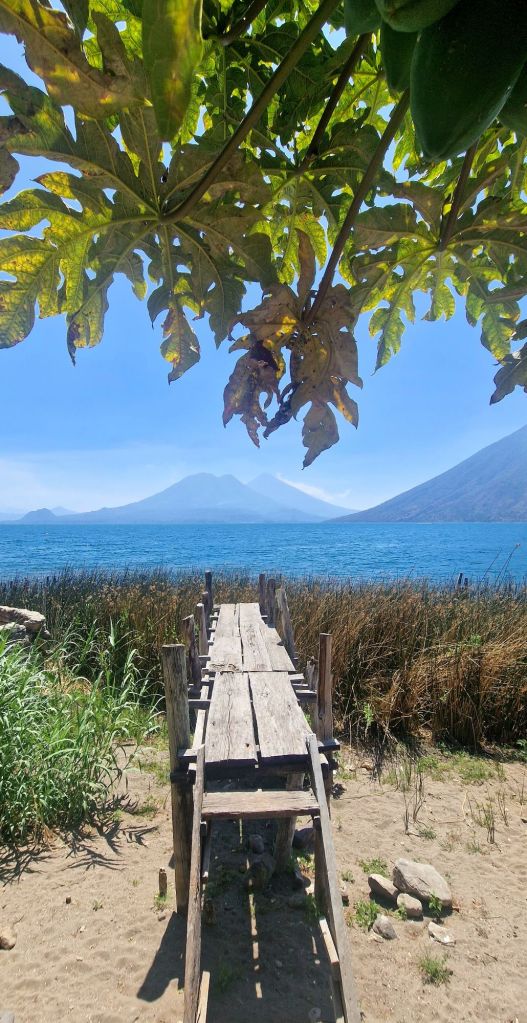
The view again
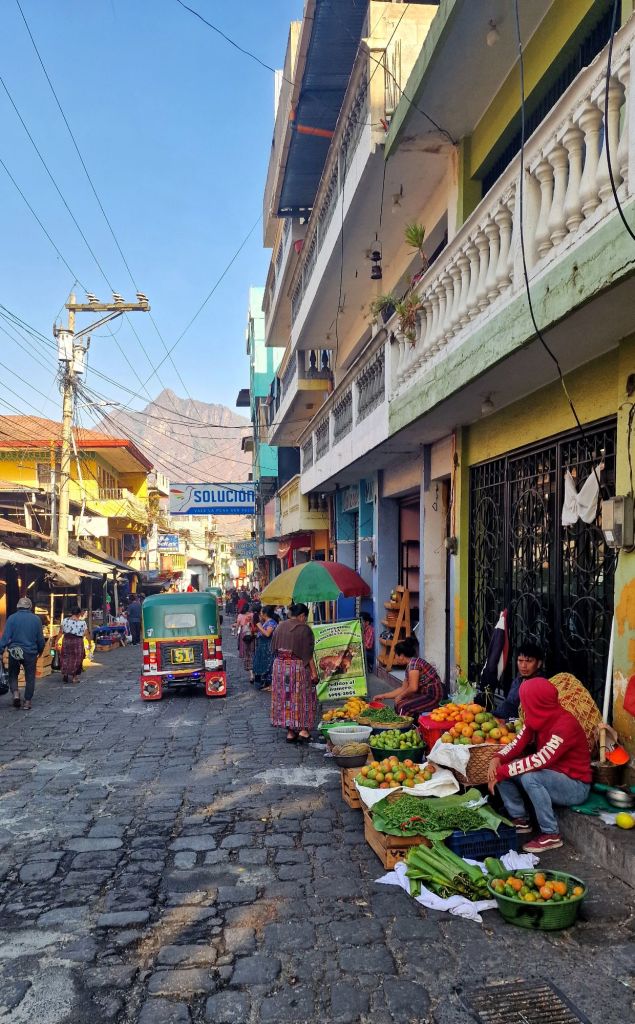
San Pedro main street
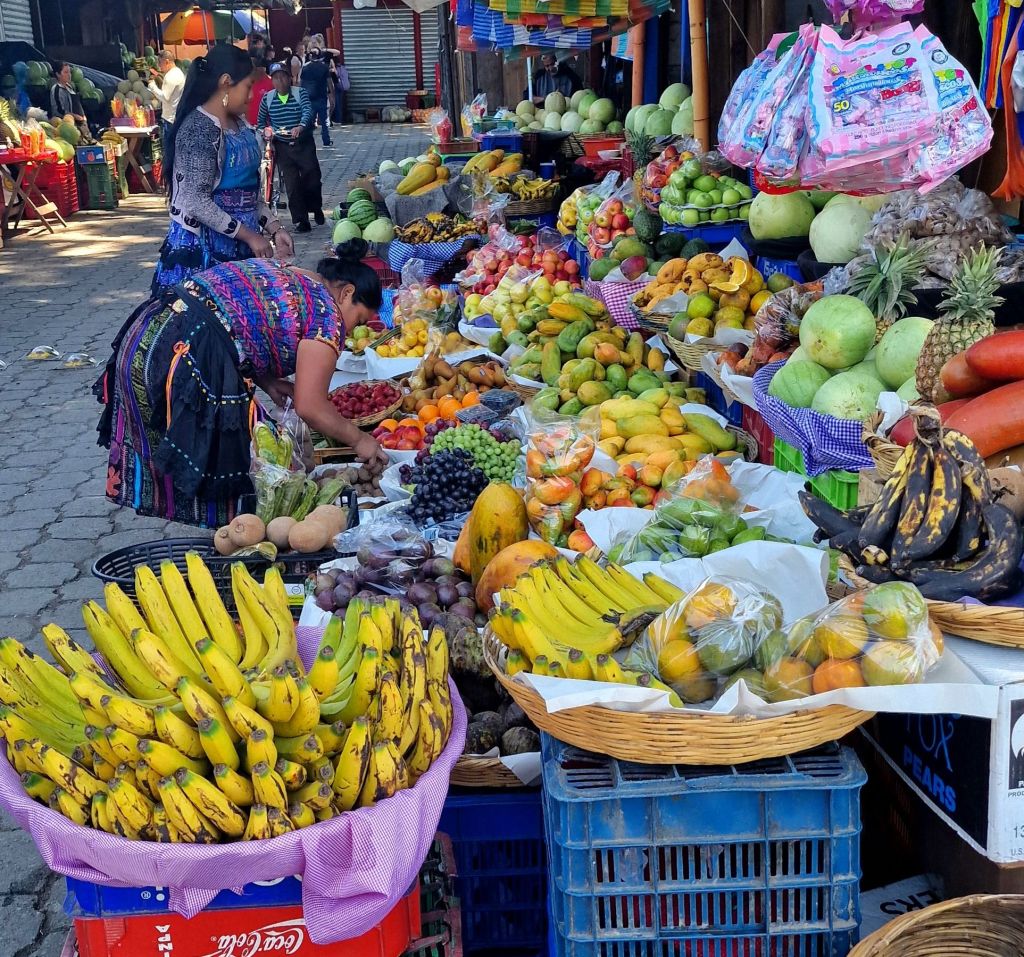
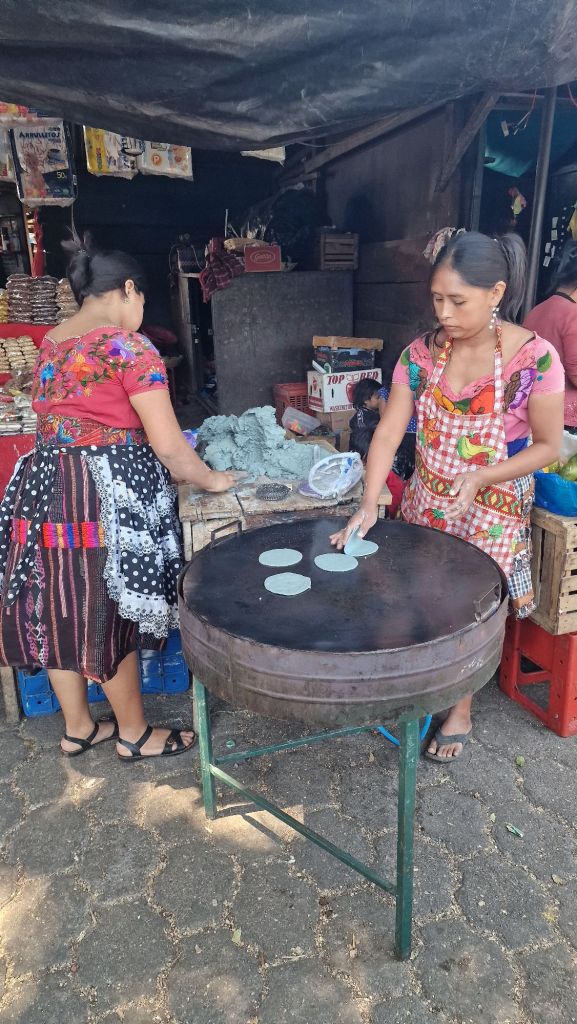
The market in the morning in San Pedro
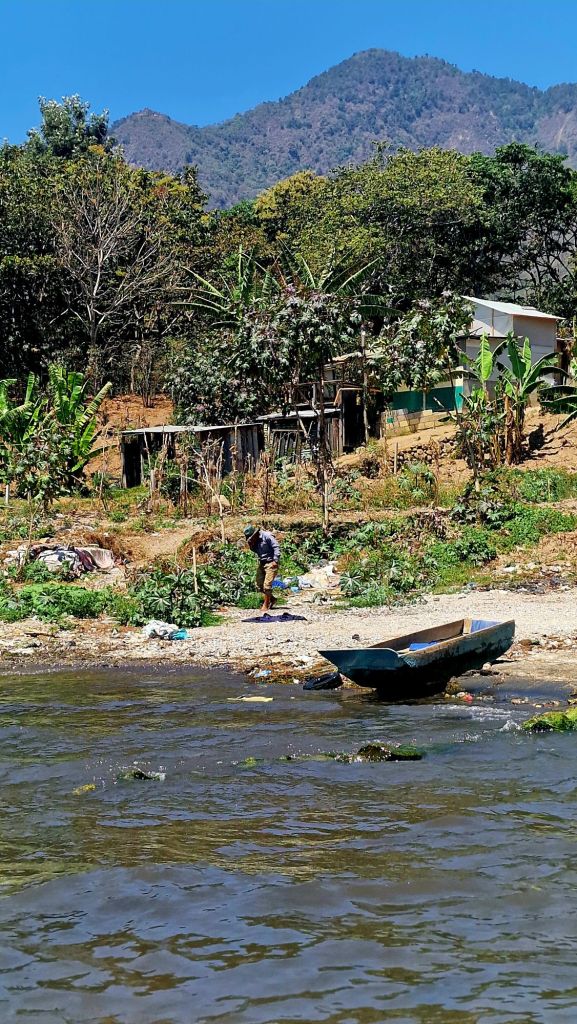
The lakeside of San Pedro
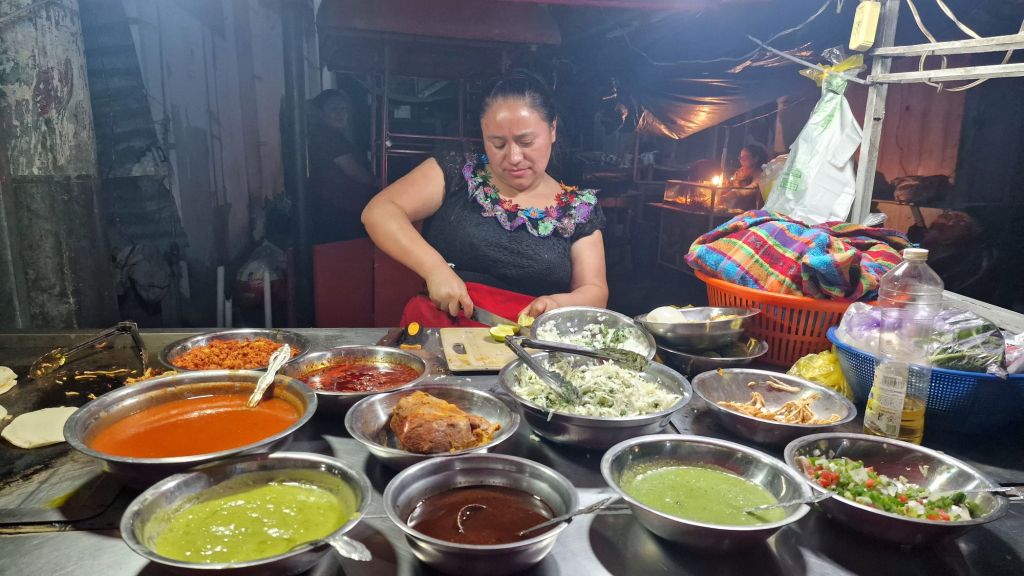
Streetfood in the evening
Lakeview in San Pedro again
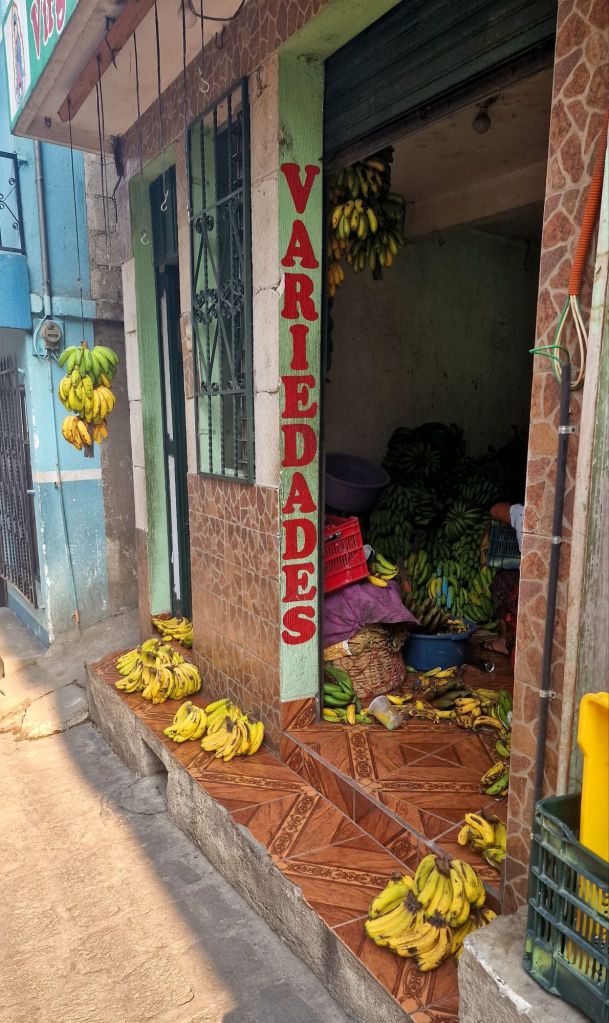
Not so much variation….banans, banans and bananas

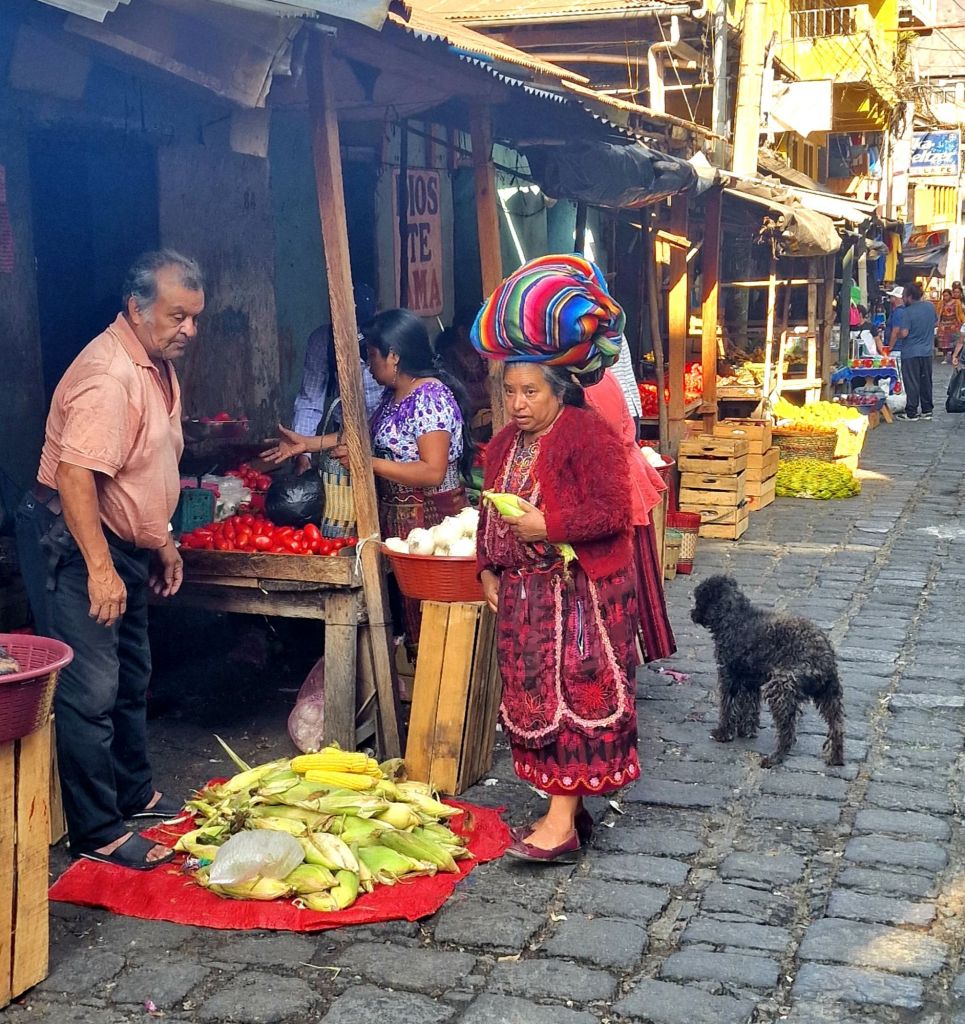
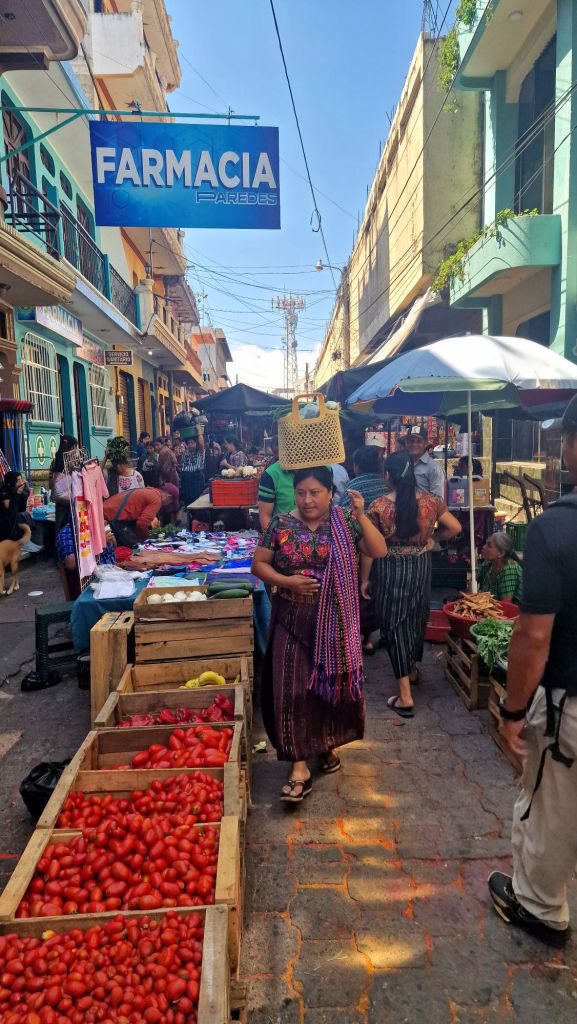
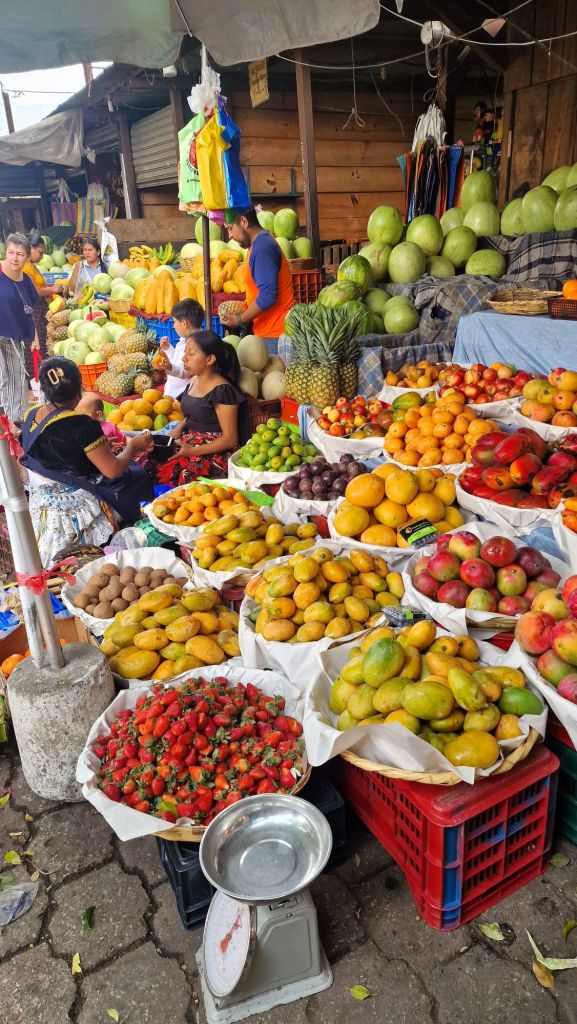
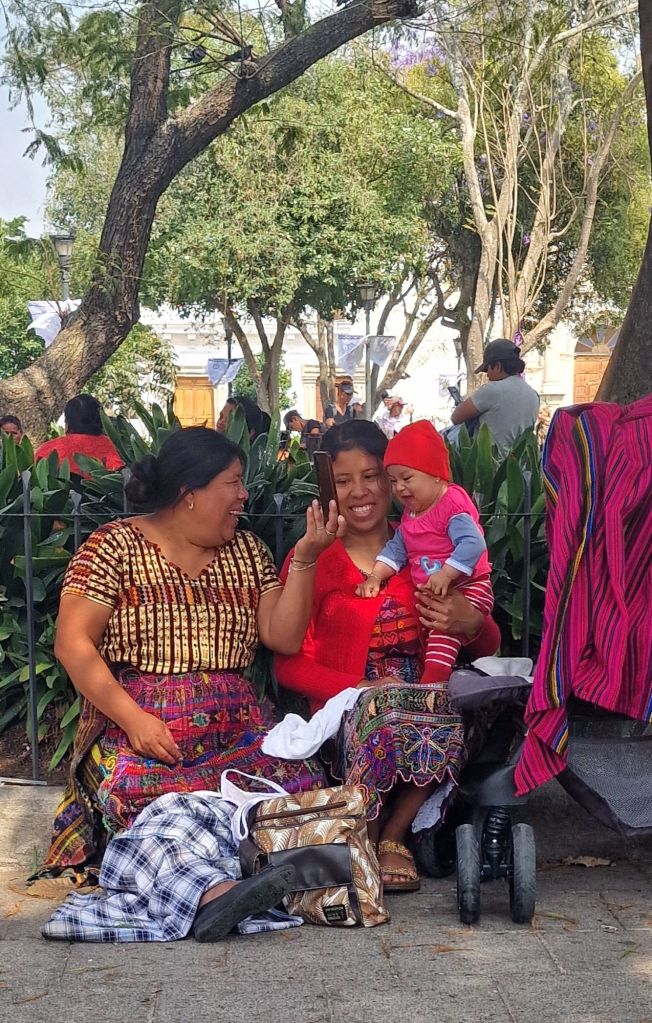
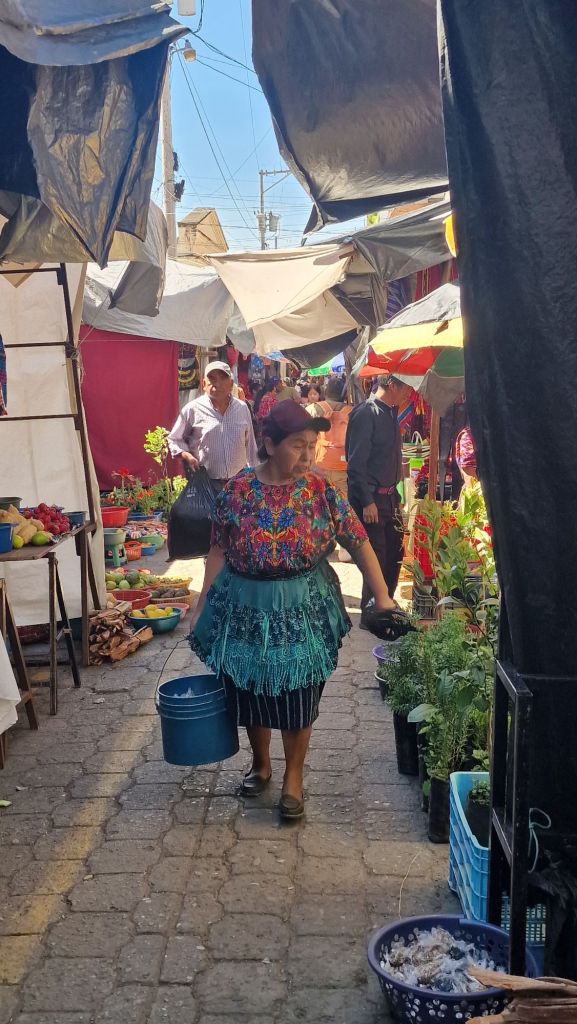
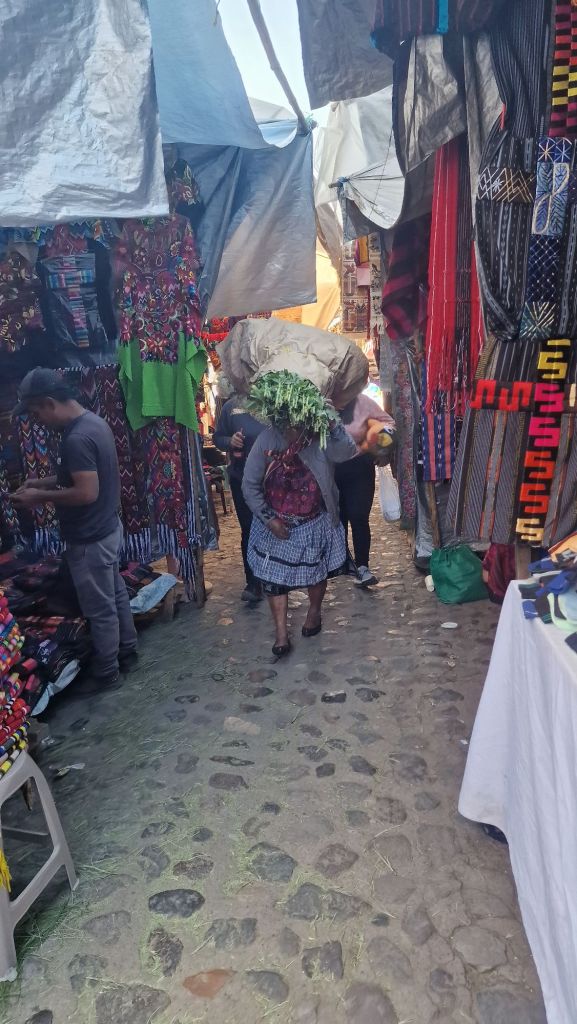
Nästa dag åker vi på en utflykt till tre olika byar. Första stoppet är Santiago Atitlan. En by med en enorm marknad. Vi promenerar igenom delar av marknaden där det bl a säljs både kött, fisk, grönsaker, frukt och vackra tyger. De trafitionella kläderna som de flesta kvinnor bär är handgjorda och tar flera månader att tillverka. Här på landsbygden går i stort sett alla kvinnor och flickor i dessa vackra kläder. Män och pojkar har däremot mer och mer börjat använda ”vanliga” kläder.

The next day we go on an excursion to three different villages.  First stop is Santiago Atitlan.  A village with a huge market.  We walk through parts of the market where, among other things, meat, fish, vegetables, fruit and beautiful fabrics are sold.  The traditional clothes that most women wear are handmade and take several months to make.  Here in the countryside, pretty much all women and girls wear these beautiful clothes.  Men and boys, on the other hand, have increasingly started to use ”regular” clothes.

Beginning of the big market
A Lady segling vedgetables
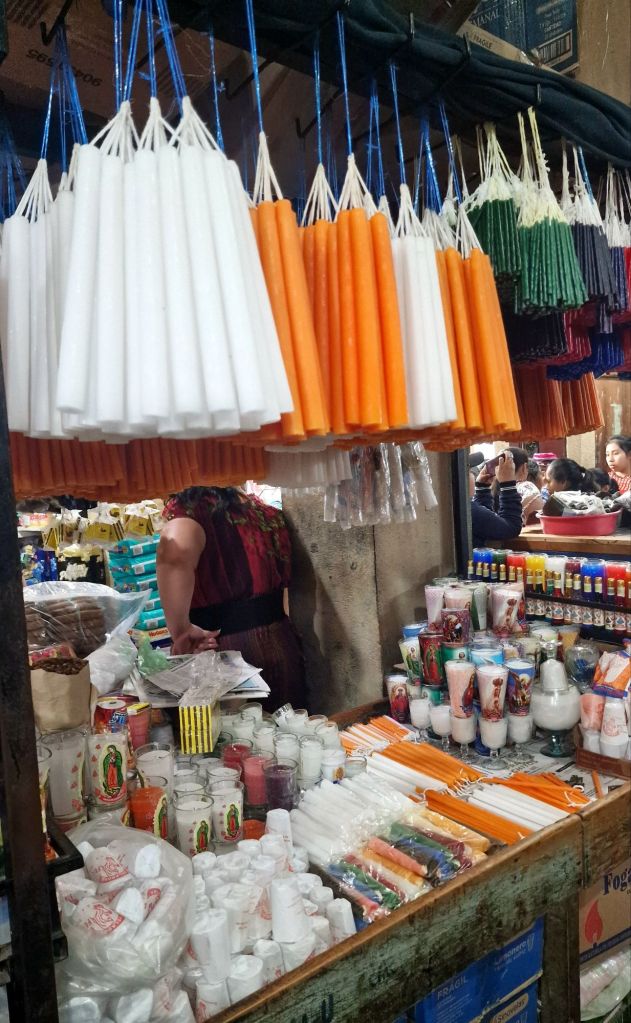
Candles and incence for mayan ceremonies
Inside the market
Colorful fruits
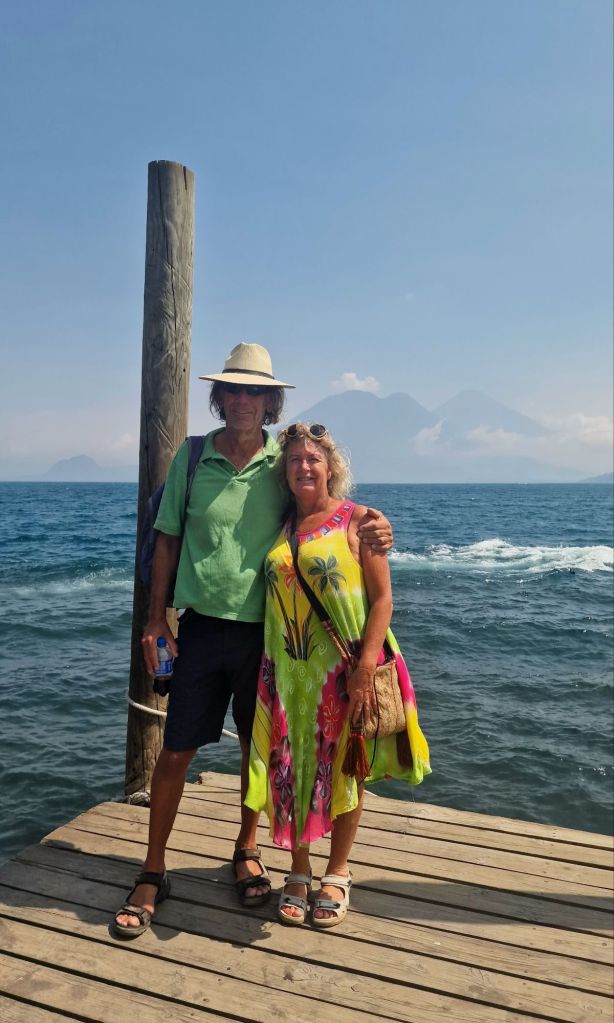
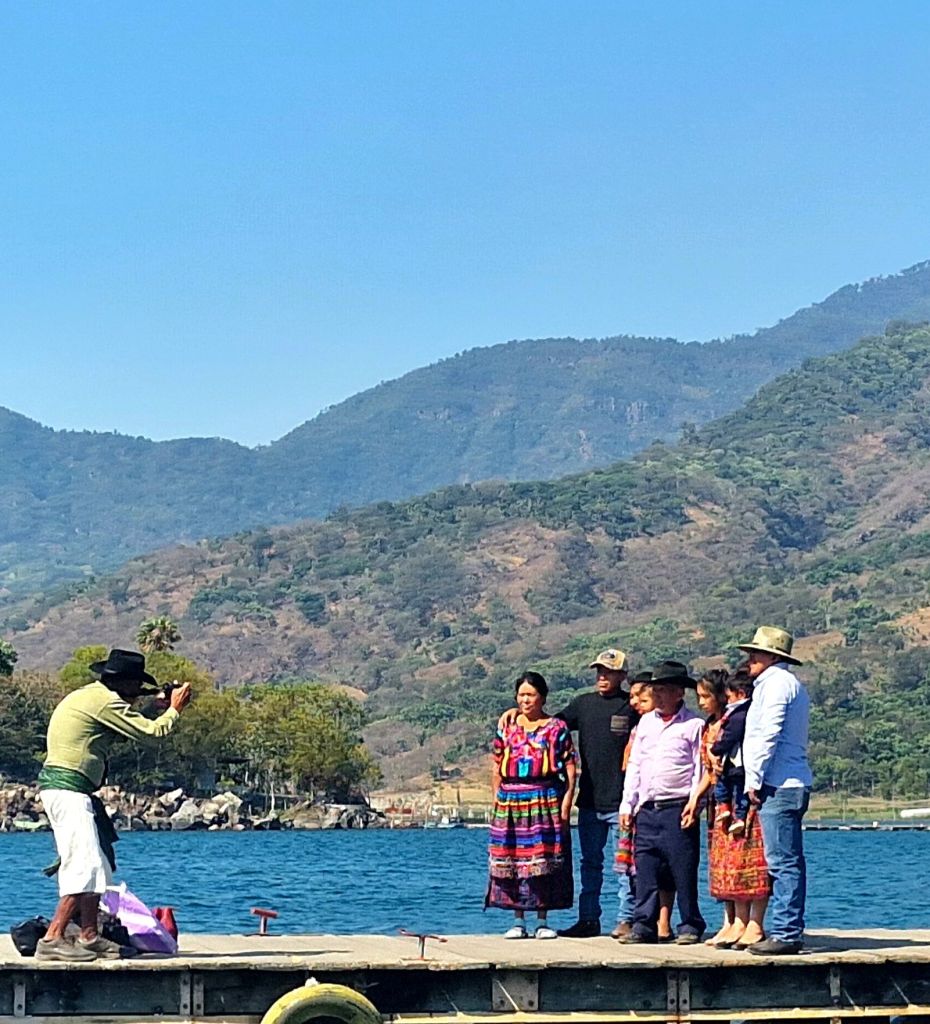
Colorful couple with beautiful view
Even the locals want to have photos with the beautiful view of the lake and vulcanoes

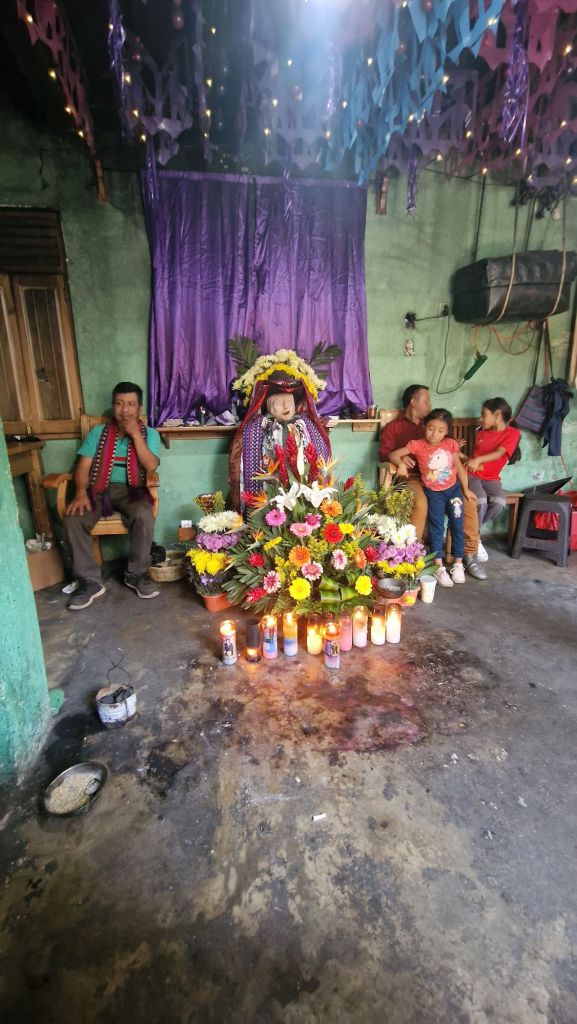
Vår guide berättar att det finns ca 24 helt olika mayaspråk. Alla pratar dessutom spanska som är det gemensamma språket i Guatemala. Många är katoliker men utövar fortfarande traditionella maya-riter. En mycket uppskattad gudom i Guatemalas högland är Maximon. Vi går längs med en massa trånga gränder och kommer till sist in på en bakgård. Där inne i ett rum tillbeds Maximon. Det finns flera Maximon där inne och hans attribut kan vara solglasögon, bandana, hatt och färgstarka girlanger. I hans mun finns ständigt en brinnande cigarett och öl och sprit ställs fram till honom i glas. De som tillber honom dricker också öl under ceremonin. Maximon tillbeds bl a för lycka i arbetet, i äktenskapet, för hälsan och inför döden. Han representerar både mörker och ljus och tros ha uppstått i samband med att Spanien invaderade Guatemala. Det känns magiskt och nästan ockult att sitta där och se på Maximon och när de tillber honom.Our guide tells us that there are about 24 completely different Mayan languages.  Everyone also speaks Spanish, which is the common language in Guatemala.  Many are Catholic but still practice traditional Mayan rites.  A highly valued deity in the highlands of Guatemala is Maximon.  We walk along a lot of narrow alleys and finally come into a backyard.  There, in a room, Maximon is worshipped.  There are several Maximons in there and his attributes can be sunglasses, bandana, hat and colorful garlands.  There is always a burning cigarette in his mouth and beer and spirits are served to him in glasses.  Those who worship him also drink beer during the ceremony.  Maximon is worshiped, among other things, for luck in work, in marriage, for health and before death.  He represents both darkness and light and is believed to have arisen in connection with the Spanish invasion of Guatemala.  It feels magical and almost occult to sit there and watch Maximon and when they worship him.

Maximon with flowers, candles and a cigaretter in his mouth
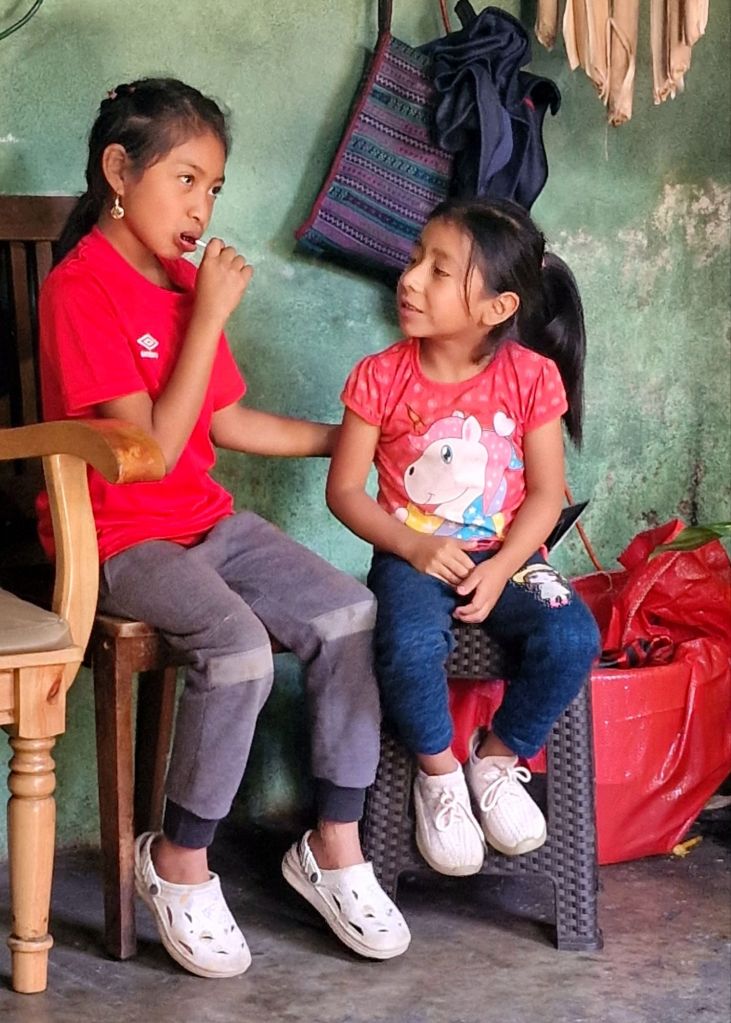
Two Girls beside Maximon
Maximon

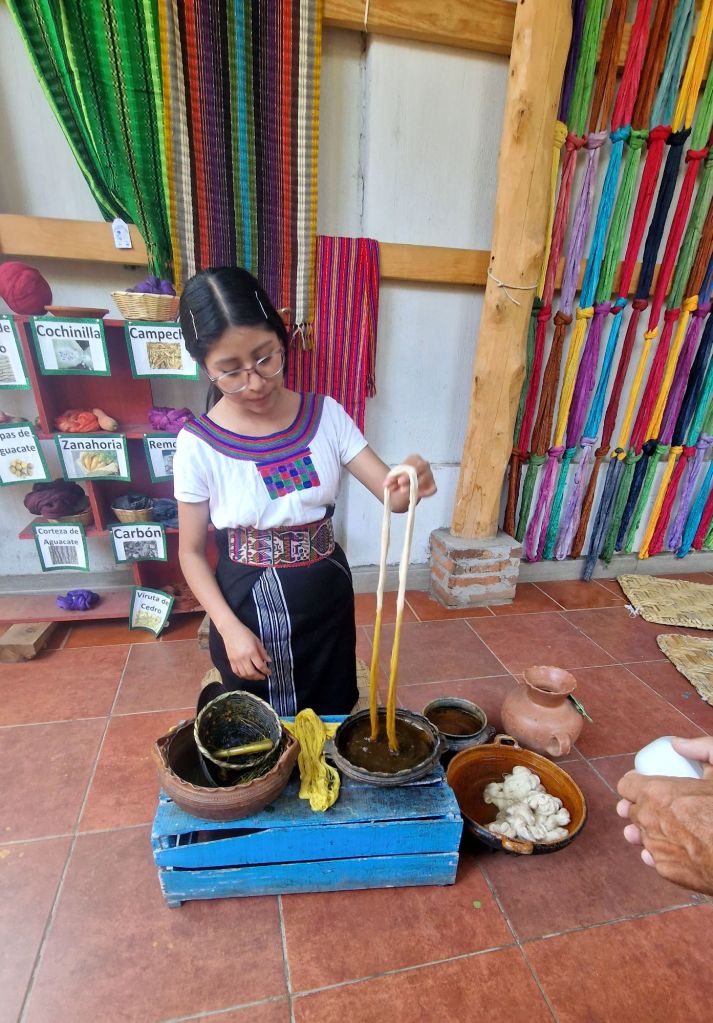
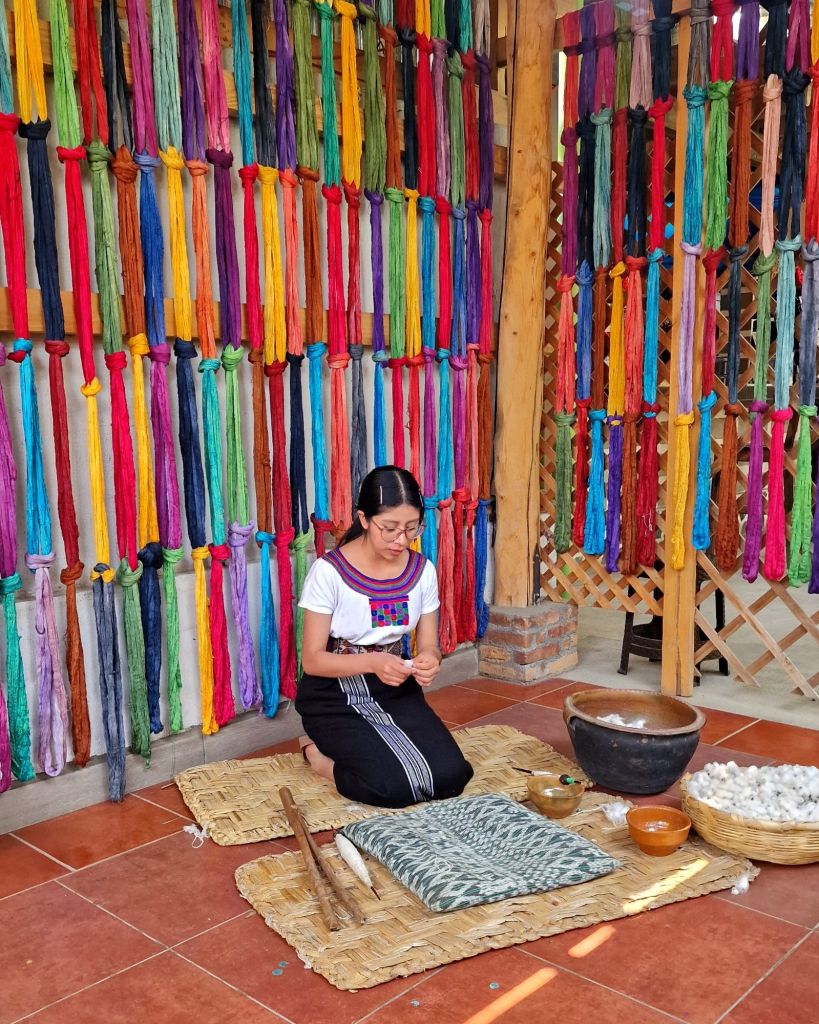
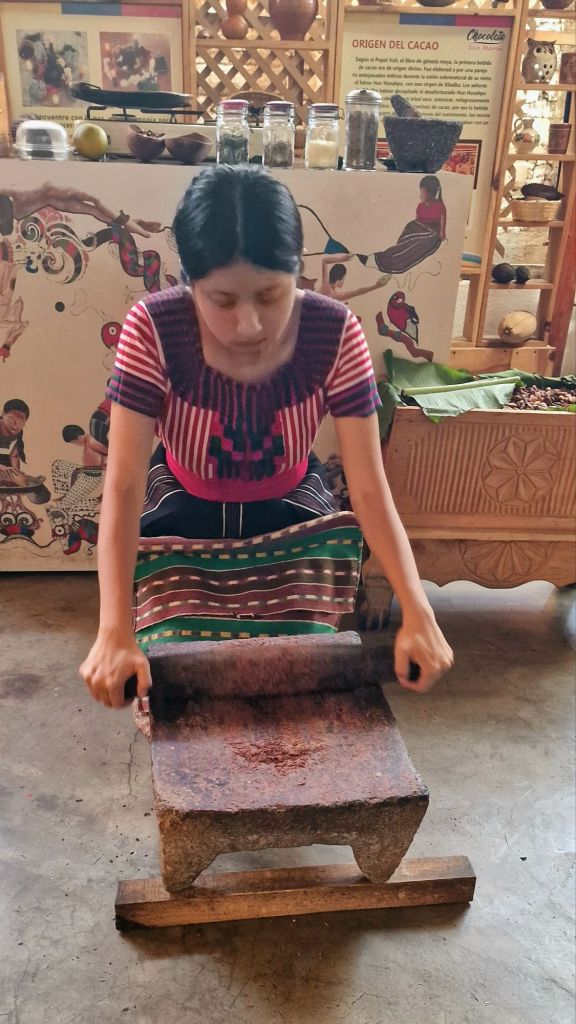
Nästa by vi kommer till är San Juan. Där lär vi oss hur de tillverkar och färgar bomullstråden de använder för att väva de vackra tygerna till kvinnornas kläder samt en mängd nyttoföremål. Vi får också se hur de tillverkar choklad av kakaobönor. Chokladen sägs ha sin födelseplats bland mayafolket i just Guatemala och de är mycket stolta över sin choklad. Orden kakao och choklad kommer från mayaspråket. Det finns  lämningar från kakao ända tillbaka till 450 år f kr i de kungligas gravar och det var endast de högst uppsatta i mayakulturen som fick dricka och äta choklad. Guatemala är även känt för sitt goda kaffe. Höglandet med vulkanisk näringsrik jord skall vara perfekt för att odla kaffebönor.

The next village we come to is San Juan.  There we learn how they manufacture and dye the cotton thread they use to weave the beautiful fabrics for the women’s clothing as well as a variety of useful items.  We also get to see how they make chocolate from cocoa beans.  Chocolate is said to have its birthplace among the Mayan people in Guatemala and they are very proud of their chocolate.  The words cacao and chocolate come from the Mayan language.  There are remains of cocoa as far back as 450 BC in the tombs of the royals, and only the highest-ranking in Mayan culture were allowed to drink and eat chocolate.  Guatemala is also known for its good coffee.  The highlands with volcanic, nutrient-rich soil should be perfect for growing coffee beans.

Here the girl dip the thread in colours from a flower
A lot of different colors
Maskingevär chokolate from the cacaobean

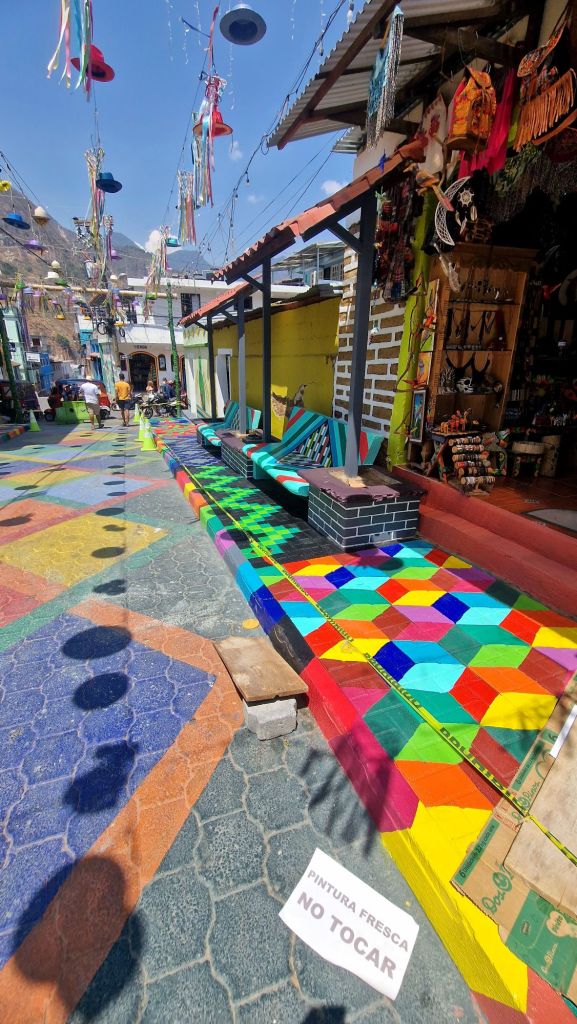
I San Juan finns också många konstnärer som målar på gator, trottoarer och väggar. Över dessa gator hänger också mängder av paraplyer och lyktor. Det finns också vackra krukor, läderarbete, vackra textilier och skulpturer

In San Juan there are also many artists who paint on streets, sidewalks and walls.  Many umbrellas and lanterns also hang over these streets.  There are also beautiful pots, leather work, beautiful textiles and sculptures

New painted street
Umbrellas and light over the painted street
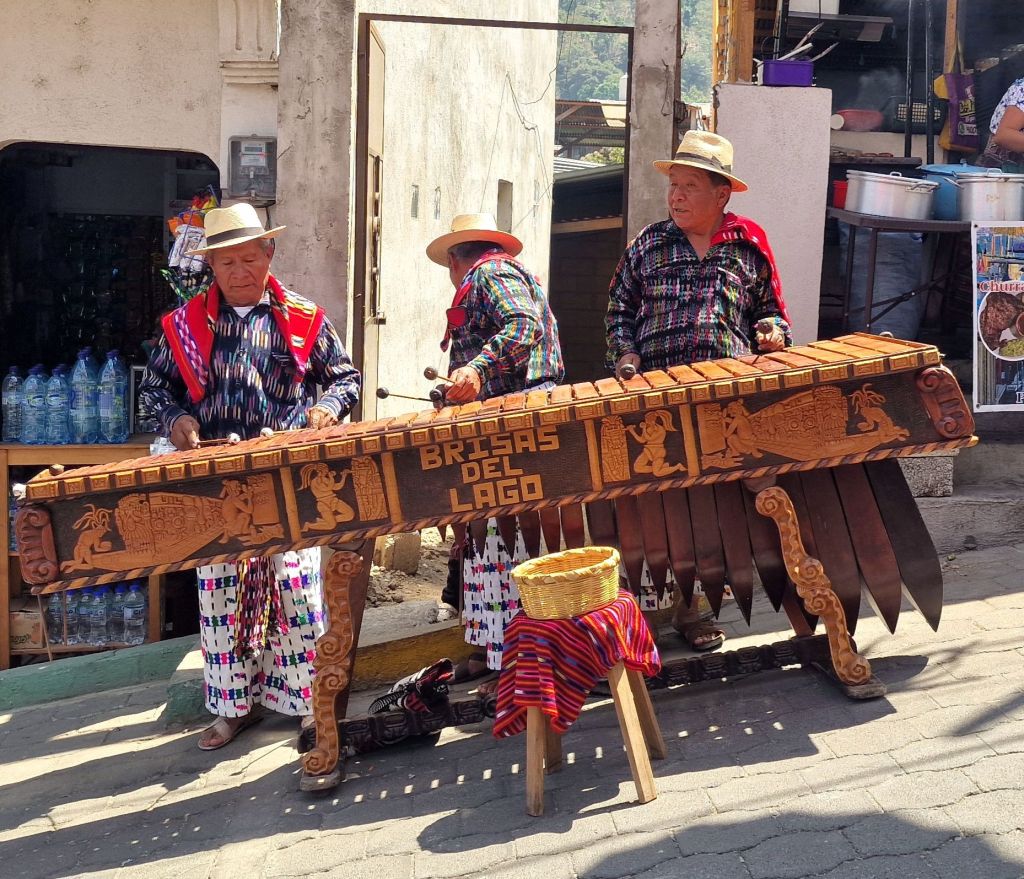
Local musicians
Art on wall

Sista byn vi kommer till är San Marcus. Det är en charmig och liten by med smala gränder, små serveringar, yogaretreats och en del små affärer där de säljer vackra vävda föremål. Här är det en större community av expaths från framförallt Nordamerika.

The last village we reach is San Marcus.  It is a charming and small village with narrow alleys, small restaurants, yoga retreats and some small shops selling beautiful woven items.  Here there is a larger community of expats from primarily North America.

On the boat between the villages
A farmer by the lake in San Marcus
Peaceful view
Vulcanoe and the lake
It’s soo beautiful ä

Hela utflykten är mycket innehållsrik och vi känner oss mycket nöjda med dagen.

The entire excursion is very informative and we feel very satisfied with the day.

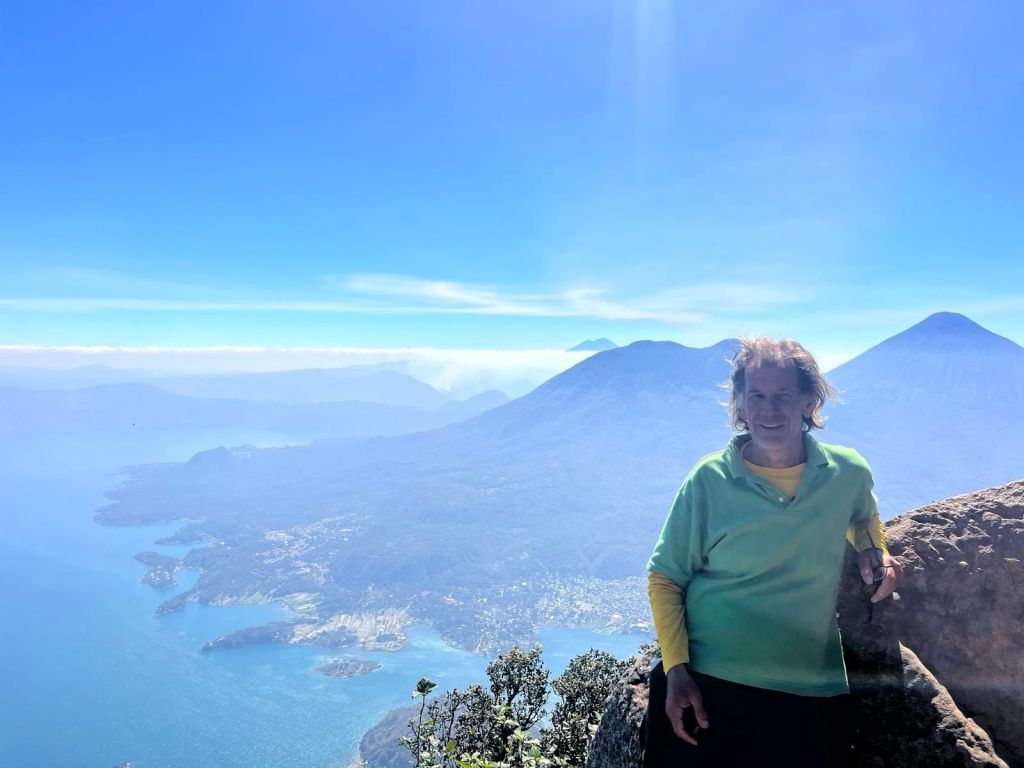
Tidigt nästa morgon ger Jan sig iväg på en vandring upp till toppen av vulkanen San Pedro. Den är 3020 meter hög och vandringen, som brukar ta tre timmar klarar gruppen av på endast två och en halv timma. Det är fantastisk utsikt där uppifrån och väl värt ansträngningen med klättring uppåt på den höga höjden med tunn luft. Att gå ner igen tar dock på knäna så tanken att göra en två dagar lång vulkanklättring med övernattning på toppen får Jan tyvärr avstå. Jag har inte rätt skor så ingen av vulkanturerna är möjliga för mig. Min kondition är troligen dessutom för dålig.

Early the next morning, Jan sets off on a hike up to the top of the San Pedro volcano.  It is 3020 meters high and the group can complete the hike, which usually takes three hours, in only two and a half hours.  It’s a great view from up there and well worth the effort of scrambling up the high altitude with thin air.  However, going down again takes a toll on the knees, so Jan unfortunately has to give up the idea of doing a two-day volcano climb with an overnight stay at the top.  I don’t have the right shoes so none of the volcano tours are possible for me.  My fitness is also probably too bad.

More than half var up and it is beautiful
Jan on top of vulcano San Pedro

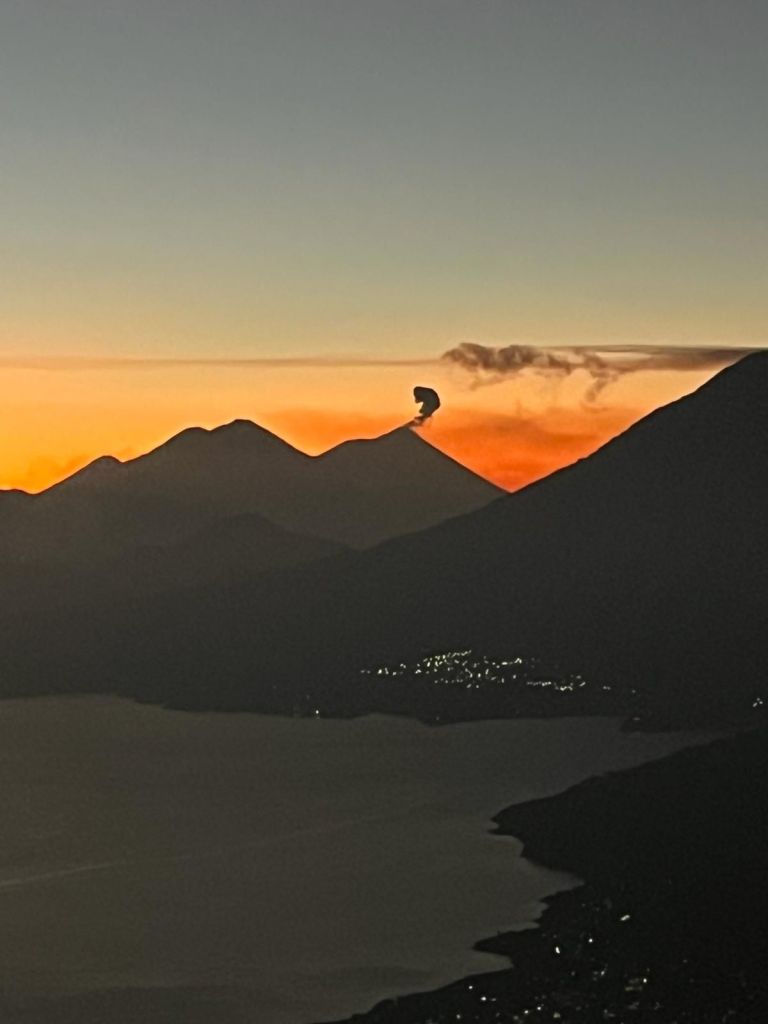
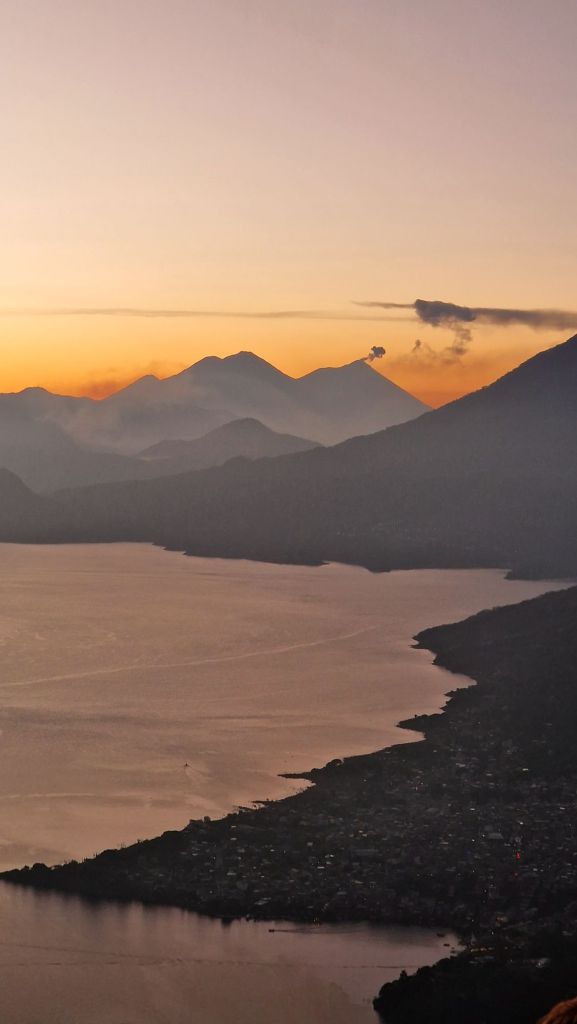
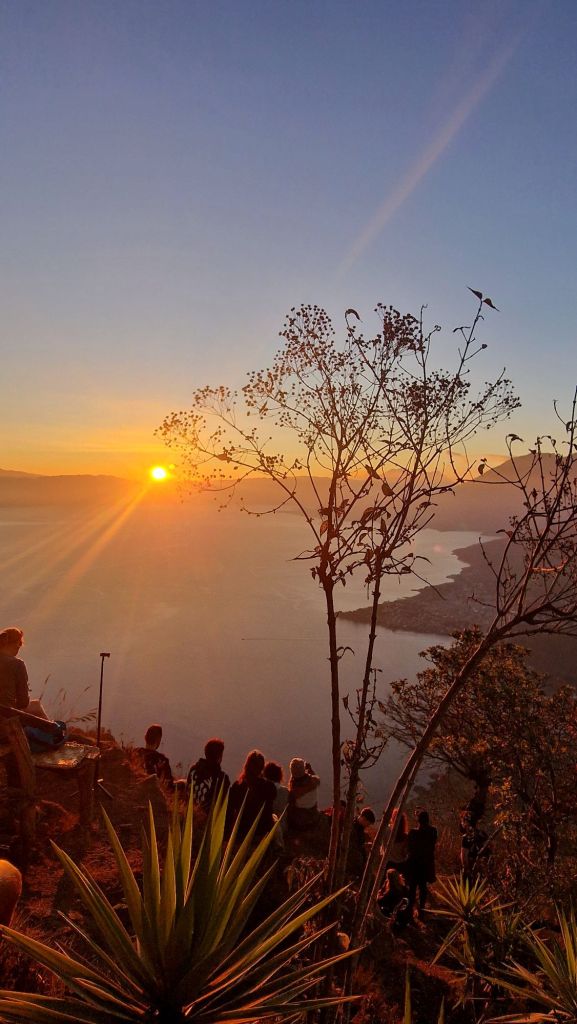
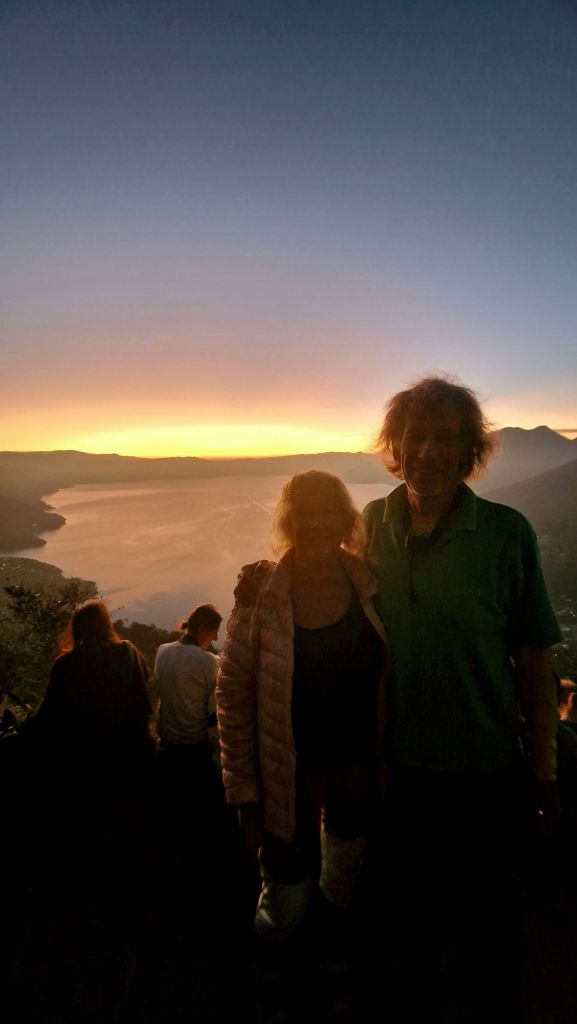
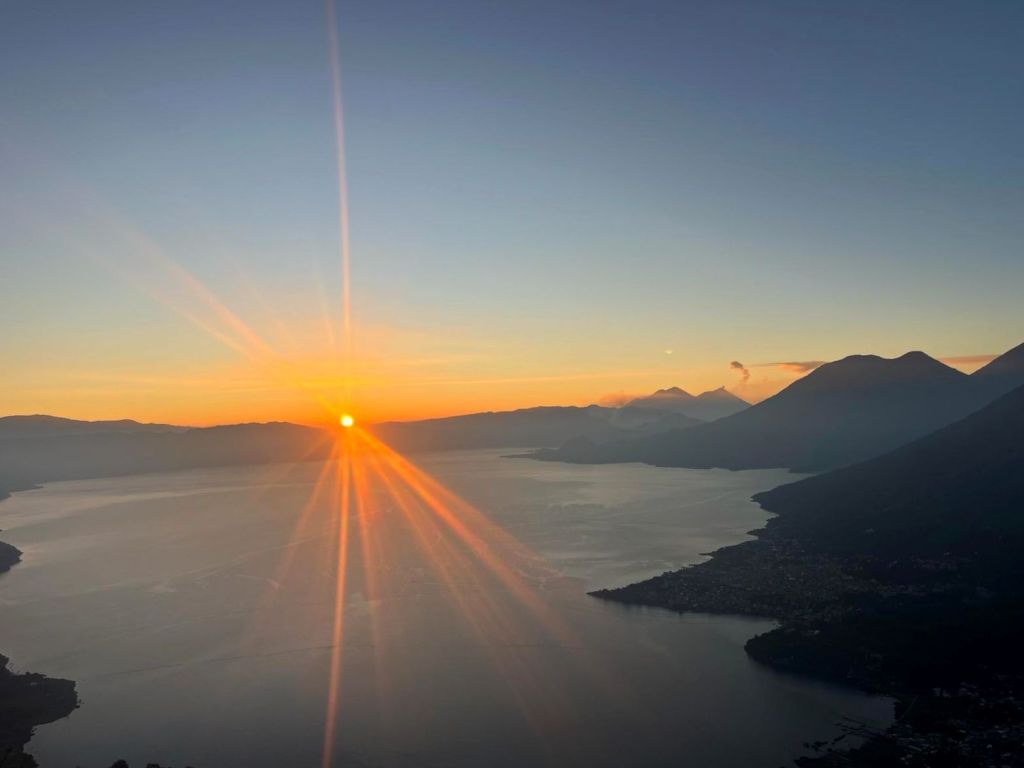
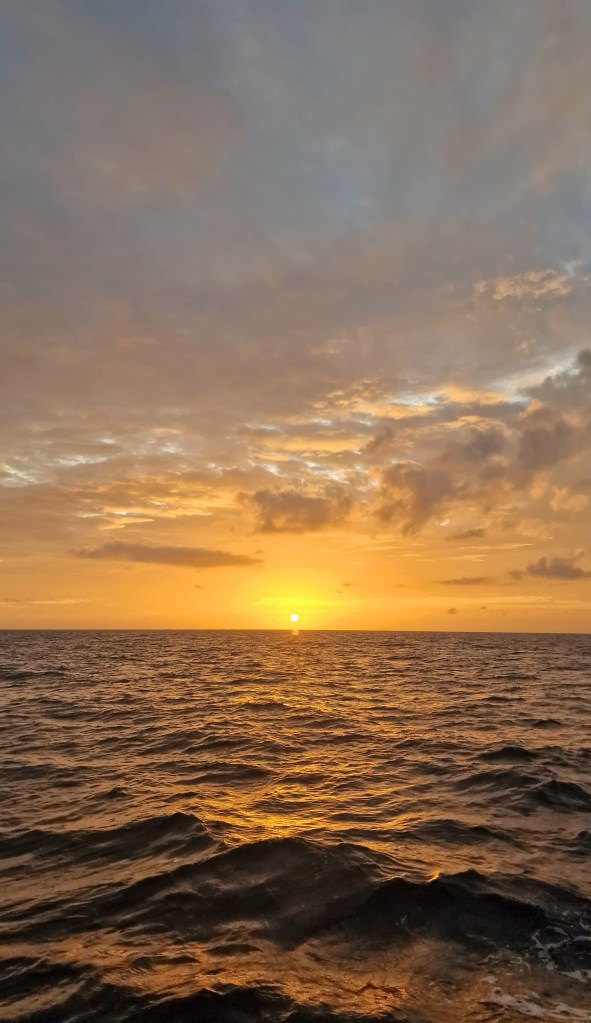
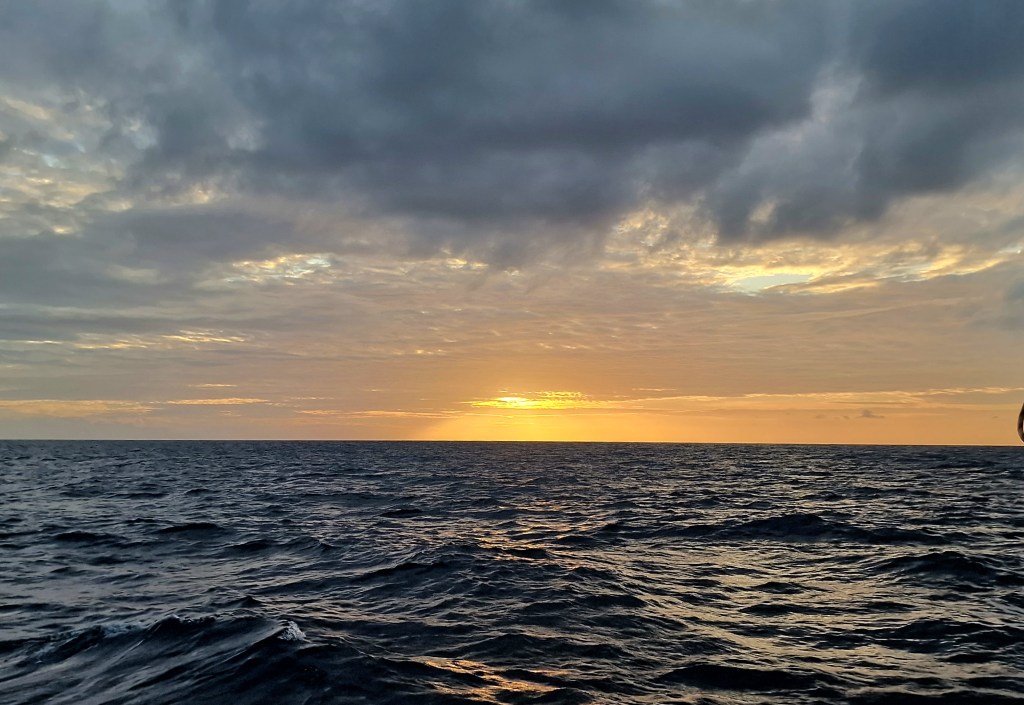
Nästa morgon går vi upp redan klockan 03.30 för att promenera upp till Indian Nose där vi kommer få se soluppgången över Lake Atitlan. Det är flera stora grupper med guider som promenerar upp samtidigt för att få uppleva detta mäktiga skådespel. Vi vandrar upp i totalt mörker med pannlampor tända. För mig, och många andra,blir det en tuff vandring i den tunna luften men oj vad vackert det är. Vi ser först endast konturerna av berg och vulkaner. Himlen börjar sedan färgas i alla skiftningar från ljusgult till gult, guld, brandgult, orange, rosa och lila. Det är en magisk upplevelse. Och i fjärran syns hela tiden rök från en aktiv vulkan utanför Antigua. Vilken känsla! Det är en bild som satt sig i minnet och som kommer vara vacker att plocka fram en mörk, blåsig och ruskig novemberdag i Sverige.

The next morning we get up already at 03.30 to walk up to Indian Nose where we will see the sunrise over Lake Atitlan.  There are several large groups with guides who walk up at the same time to experience this powerful spectacle.  We hike up in total darkness with headlamps on.  For me, and many others, it will be a tough hike in the thin air but oh how beautiful it is.  At first we see only the outlines of mountains and volcanoes.  The sky then begins to color in all variations from light yellow to yellow, gold, fiery yellow, orange, pink and purple.  It is a magical experience.  And in the distance, smoke is constantly visible from an active volcano outside Antigua.  What a feeling!  It is an image that stuck in my memory and that will be beautiful to pick out on a dark, windy and horrible November day in Sweden.

Smoke from the active volcano near Antigus
It’s well worth  the walk up in the dark to see this sunrise
The sun is risig over Lake Atitlan
Silhuettes of us on Indian Nose
Now the sun has come over the vulcanoes

Dagen därpå påbörjar vi vår resa tillbaka till Vilja i Rio Dulche. Först med buss till Antigua där vi stannar en natt. Sedan blir det lokalbuss till Guatemala City där vi skall ta den lyxigare bussen vidare.  Det är tur att vi inte vet vad vi har framför oss. Den resan har tidigare tagit ca sex till sju timmar. Vad vi inte vet är att det ät ett vägarbete på en bro och att det därför är kö precis hela sträckan på ca 27 mil. Vi är därför först framme i Rio Dulce vid midnatt tretton timmar senare. Pust vilken jobbig och lång resa. Stackars chauffören som får köra i kö hela denna resa. Vi har åtminstone möjlighet att luta oss tillbaka och vila ögonen.

The following day we begin our journey back to Vilja in Rio Dulche.  First by bus to Antigua where we stay one night.  Then there will be a local bus to Guatemala City where we will take the more luxurious bus on.  It’s lucky that we don’t know what lies ahead.  That trip has previously taken about six to seven hours.  What we don’t know is that there is road work on a bridge and that there is therefore a queue for the entire distance of about 27 miles.  We therefore first arrive in Rio Dulce at midnight thirteen hours later.  Breathe, what a hard and long journey.  Poor driver who has to drive in line this whole trip.  At least we have the opportunity to sit back and rest our eyes.

A stop in Antigua on the way back
Market in Antigua
A cute girl Playing with the doves
Three generations
We bought a bottle of wine, some cheece and olives in the evening

Nu sitter vi ombord på Vilja och väntar fortfarande på delar till watermakern.

Now we are sitting on board Vilja and still waiting for parts for the watermaker.

Inland Guatemala and a short trip to Florida

Efter ett par dagar i Fronteras i Rio Dulce begav jag mig ensam ut på en tio dagar lång backpacking medan Jan var kvar ombord på Vilja och jobbade med båten

After a couple of days in Fronteras in Rio Dulce, I set off alone on a ten-day backpacking trip while Jan stayed aboard Vilja and worked on the boat

Jag tog en tidig buss mot Guatemala City. Resan skulle ta allting mellan fem och elva timmar. Allt beroende på hur trafiken är, om det skett bilolyckor eller är vägarbeten och hur mycket tung lastbilstrafik det är på vägarna.

I took an early bus towards Guatemala City.  The trip would take anywhere between five and eleven hours.  All depending on how the traffic is, whether there have been car accidents or roadworks and how much heavy truck traffic there is on the roads. 

Vi körde fram på landsvägen genom byar och odlingar och efter några timmar började klättringen uppåt genom bergspassen. Det såg väldigt torrt och bränt ut utan någon grönska på buskar och träd. Guatemala har en starkt varierande natur, mycket levande mayakultur och många aktiva vulkaner. Huvudstaden ligger på ca 1550 meters höjd och det är en stor och bullrig stad.

We drove along the country road passing villages and plantations and after a few hours the climb up through the mountain passes began.  It looked very dry and burnt with no greenery on the bushes and trees.  Guatemala has a highly varied nature, very vibrant Mayan culture and many active volcanoes.  The capital is located at an altitude of about 1550 meters and it is a large and noisy city.

Dry countryside on the way up to Guatemala city

Resan tog, inklusive ett stopp på vägen, ca sex timmar. Vi kom fram till en busstation i utkanten av staden och jag behövde ta mig vidare till den stora busstationen där bussarna till den koloniala staden Antigua avgick ifrån. Alla pratar endast spanska men jag fick hjälp att hitta en taxi som tog mig vidare genom stadens trafik. Vid busshållplatsen skulle precis en av de otroligt charmiga och färgstarka lokalbussarna avgå och jag skyndade mig från taxi till buss och fick en sittplats långt fram i bussen

The trip took, including a stop on the way, about six hours.  We arrived at a bus station on the outskirts of town and I needed to get on to the big bus station where the buses to the colonial city of Antigua left.  Everyone only speaks Spanish but I was helped to find a taxi that took me through the city traffic.  At the bus stop, one of the incredibly charming and colorful local buses was just about to depart and I hurried from taxi to bus and got a seat at the very front of the bus

The lovely and colorful busses
The driver with his bus
The driver

En sak jag reflekterat över är hur alla människor i Guatemala springer överallt. Bussen stannar aldrig riktigt så man mer eller mindre springer och hoppar upp och ner från den. Förutom chauffören är det en annan man som ropar efter passagerare, tar betalt och ordnar med allt bagage och den frakt som skall med bussen. Det fraktas på taket och mannen klättrar upp dit på stegar som finns bak på bussen. Ibland sitter han där uppe långa sträckor. För att komma till stegarna finns en dörr längst bak på bussen som ofta öppnas under resans gång. Där kan man även som passagerare hoppa av och på bussen. Han springer och hämtar fraktgodset och bär det på huvudet när bussen fortfarande har fart och pringer i förväg till busshållplatserna och försöker få passagerare. Bussarna är färgstarka och väldigt speciella, som cirkusbussar. Växelspaken är enormt lång och blinkers sköter man manuellt med knappar. För att tuta finns det en vajer bakom frontrutan som chauffören trycker på

One thing I reflected on is how all the people in Guatemala are running everywhere.  The bus never really stops so you more or less run and jump up and down from it.  In addition to the driver, there is another man who calls for passengers, takes payment and arranges for all the luggage and the freight to be taken with the bus.  It is transported on the roof and the man climbs up there on ladders at the back of the bus.  Sometimes he sits up there for long stretches.  To get to the steps, there is a door at the back of the bus that is often opened during the journey.  There, you can also get on and off the bus as a passenger.  He runs and collects the cargo and carries it on his head while the bus is still moving and calls ahead to the bus stops and tries to get passengers.  The buses are colorful and very special.  The gear lever is enormously long and the indicators are operated manually with buttons.  To sound the horn, there is a wire behind the windshield that the driver presses

The man in red is the man who runs everywhere, taking care of payment, carrying all things and who are ”hunting” for passengers
The enormous gear lever
To the left you see the bus he uses for the blinker
A door and steps up to the roof in the back

Vid busshållplatserna kommer det ombord försäljare av alla de slag som säljer allt från frukt, dryck o mat till strumpor, krämer och lotter. Det är en verklig upplevelse

At the bus stops, vendors of all kinds come on board, selling everything from fruit, drinks and food to socks, creams and lottery tickets.  It is a real experience

A man who came onboard the bus singing of Jesus Christus

Resan till Antigua tog en knapp timme och väl framme i den vackra  byn letade jag mig fram till hostellet jag bokat rum på. Det låg perfekt o nära både den vackra koloniala delen av byn som är med på Unescos världsarvslista, busstationen och marknaden.

The journey to Antigua took just under an hour and once I arrived in the beautiful village I found my way to the hostel I had booked a room at.  It was perfectly located and close to both the beautiful colonial part of the village which is on the Unesco world heritage list, the bus station and the market.

Centrum av Antigua är vacker med sina låga pastellfärgade byggnader i spansk barockstil, spektakulära kyrkor, sevärdheter och kullerstensbelagda gator. Staden byggdes på tidigt 1600-tal. Och ständigt ser man någon av de stora vulkaner som omger staden. Varav en är en aktiv vulkan. Vid nästa tur hit hoppas jag att vi klättrar upp på en vulkan.

The center of Antigua is beautiful with its low pastel buildings in the Spanish Baroque style, spectacular churches, sights and cobbled streets.  The city was built in the early 17th century. And you can always see one of the large volcanoes that surround the city.  One of which is an active volcano.  On the next trip here, I hope we climb a volcano.

The beautiful view of a vulcano in Antigua under Santa Catalina Arch
Soo happy to be here. It is said that Antigua is one of the places that everyone should visit in their lives
The Church ”Iglecia de la Merced”
The cobbeled Streets in Antigua
A man selling icecream from a minibus
The colorful fruit-  and vegetablemarket
A volcanoe in the dawn
The Royal Palace of the Captains Grande
Another beautiful building by night
And by day
A vendor at her fruitshop
Just love to be here
Vulcano and Santa Catalina Arch
Outside the Church you can buy all sorts of food in the street

Jag promenerade runt i denna vackra stadsdel samt runt marknaden i två dagar. Det gav mig ro i kropp och själ och jag njöt av allt det vackra och det färgsprakande omkring mig.

I walked around this beautiful neighborhood as well as around the market for two days.  It gave me peace in body and soul and I enjoyed all the beauty and the colorful things around me.

Colorful fruitmarket
You can buy beautiful art in the street
Making black tortillas
Fruits prepared for juices
Iglecia de la Merced again

Det är en ynnest att få uppleva alla dessa länder och kulturer som vi kommer till. Och att resa in i landet och få se ännu mer än vackra stränder och kustnära byar ger otroligt mycket.

It is a blessing to experience all these countries and cultures that we come to.  And traveling inland and getting to see even more than beautiful beaches and coastal villages gives an incredible amount.

Tredje dagen bestämde jag mig för att göra en bussutflykt till någon by en bit bort. Eftersom det var torsdag och det i byn Chichikastenango är Guatemalas största och mest färgrika marknad där på torsdagar och söndagar så var valet lätt. Än en gång fick jag åka med bussarna som jag älskar. Och det blev mycket buss! Tre stycken både dit och tillbaka så det blev sex bussar och totalt fem timmar på buss. Tredje bussen på väg till Chichikastenango slingrade sig fram på otroliga serpentinvägar med åtskilliga 180-graders kurvor. Vi klättrade dessutom upp på en höjd av ca 2000 meter över havet. Det var liv o rörelse på bussarna och stundtals väldigt fullt. Egentligen är det två sittplatser på varje sida av mittgången. Men man knör ihop sig så att det sitter två och en halv på varje sida. De två närmast mittgången har bara halva rumpan på bänken och man stöttar sig mot den som sitter på andra sidan av den smala mittgången. Jag vet för jag har provat😊

On the third day I decided to make a bus excursion to some village some distance away.  Since it was Thursday and the one in the village of Chichikastenango is Guatemala’s largest and most colorful market there on Thursdays and Sundays, the choice was easy.  Once again I got to ride the buses that I love.  And there was a lot of bus!  Three both there and back, so there were six buses and a total of five hours on the bus.  The third bus heading to Chichikastenango wound its way along incredible serpentine roads with numerous 180-degree turns.  We also climbed to a height of about 2000 meters above sea level.  There was life and movement on the buses and sometimes very full.  Actually, there are two seats on each side of the aisle.  But you knot yourself so that there are two and a half on each side.  The two closest to the aisle only have half their bums on the bench and you lean against the person sitting on the other side of the narrow aisle.  I know because I’ve tried it

Hairpinbends on the way to Chichikastenango
Really full bus
Young mother with her daughter on the bus

Största upplevelsen denna dag var att åka bussarna och se folklivet ombord och längs med vägarna. Men marknaden var enorm och full av vackra hantverk som Guatemalas kvinnor tillverkar. Mitt i marknaden finns en kyrka där det hålls maya-ceremonier som jag hade turen att få se en del av. På trappstegen upp mot den vackra vita kyrkan fanns mängder av blommor. Det kom också rök från aska där något hade eldats tidigare under ceremonin. Två kvinnor svängde med en slags behållare i kedja där de hade rökelse. Och kyrkklockans dingdong hördes. Det var en färgsprakande och häftig upplevelse.

The greatest experience this day was riding the buses and seeing people’s life on board and along the roads.  But the market was huge and full of beautiful handicrafts that Guatemalan women make.  In the middle of the market there is a church where Mayan ceremonies are held, which I was lucky enough to see a part of.  On the steps leading up to the beautiful white church were masses of flowers.  There was also smoke from ashes where something had been burned earlier during the ceremony.  Two women were swinging a sort of chained container in which they held incense.  And the dingdong of the church bell was heard.  It was a colorful and exciting experience.

Traditional colorful clothes, blankets etc
Part of the mayan ceremony  with incence
Outside the church in the market
Streetlife in Chichikastenango
In the market
Candles outside the church
Outside the church with flowers and smoke
Old lady carrying heavy things traditionally on head and shoulders

Jag kom dit relativt sent så det blev tyvärr ett kort besök men väl värt utflykten. Dagen därpå väntade en helt annan upplevelse. Jag skulle flyga till Florida och hälsa på min son i några dagar.

I got there relatively late so unfortunately it was a short visit but well worth the trip.  The next day was a completely different experience.  I was going to fly to Florida and visit my son for a few days. 

Det blev en lång resa från dörr till dörr men sent fredag kväll var jag framme. Under de fyra hela dagar jag var där gjorde vi utflykter till några nationalparker, spelade spel, åt goda hemmalagade middagar. På en av utflykterna, Sweetwater wetlandspark, såg vi ett flertal häftiga fåglar samt en alligator som låg i gräset alldeles vid vattnet och sov. Förutom detta  köpte jag också en ny laptop vilket kändes som en födelsedagspresent. Dagarna gick fort och jag tog mig tillbaka till Guatemala City och därifrån till Jan och Vilja i Rio Dulce. Resan hem tog ca trettiosju timmar så jag var ganska utmattad.

It was a long journey from door to door, but I arrived late Friday evening.  During the four full days I was there, we made trips to some national parks, played games, ate good home-cooked dinners.  On one of the excursions, Sweetwater wetlands park, we saw several awesome birds and an alligator that was lying in the grass right by the water and sleeping.  Apart from this, I also bought a new laptop which felt like a birthday present.  The days passed quickly and I made my way back to Guatemala City and from there to Jan and Vilja in Rio Dulce.  The trip home took about thirty-seven hours, so I was quite exhausted.

Tobias in a national park outside Gainsville
Some of the cool birds
Tobias again
An alligator resting on the grass
Opening my new laptop
At the Sweetwater wetlandspark

Jan hade, under tiden, jobbat på bra med båten i värmen. Det var en lång todo-list. Under den tiden har Jan också knutit många nya kontakter och han har både simmat i poolen, varit på bbq-kväll, film-kväll och besökt The Schack – en populär bar.

Jan had, meanwhile, worked well with the boat in the heat.  It was a long todo list.  During that time, Jan has also made many new contacts and he has both swum in the pool, been to a bbq night, a movie night and visited The Schack – a popular bar. 

De första dagarna efter återkomst till Vilja tillbringade jag några timmar vid och i poolen varje dag. Det kändes riktigt lyxigt och underbart.

The first days after returning to Vilja, I spent a few hours by and in the pool every day.  It felt really luxurious and wonderful.

Really luxury by the pool
With a nice view over Rio Dulce

En dag gjorde vi en grottutflykt tillsammans ned Eva-Lotta o Thomas på Thaleia och Dag, en svensk man på en annan båt. Det var en riktigt häftig upplevelse. Vi klättrade genom en lång och stenig canyon innan vi kom fram till grottmynningen. Där satte vi på oss pannlampor och ömsom vadade, ömsom simmade och ömsom klättrade. Det var riktigt strapatsrikt och på flera ställen kändes det som vi aldrig skulle kunna ta oss tillbaka igen. Längst in kom vi till ett ställe där vi skulle vara tvungna att hoppa från en berghylla till en annan. De flesta av oss avstod och väntade in de som faktiskt gjorde detta hopp innan vi sedan tog oss samma väg tillbaka igen.

One day we did a cave excursion together down Eva-Lotta and Thomas on Thaleia and Dag, a Swedish man on another boat.  It was a really cool experience.  We climbed through a long and rocky canyon before arriving at the mouth of the cave.  There we put on headlamps and sometimes waded, sometimes swam and sometimes climbed.  It was really strenuous and in several places it felt like we would never be able to get back.  Deep inside we came to a place where we would have to jump from one ledge to another.  Most of us refrained and waited for those who actually made this jump before we then took the same route back again.

Climbing the canyon towards the cave
Beautiful nature
Inside the cave where some jumped from one rock to another
The sun shines between all the green and rocks
Happy for the hike
Crystalclear water
Climbing down again
It was a lovely hike

Längre ner i canyonen var det dammar ned vattenfall att bada i. Vattnet i dammarna var relativt svalt men det som kom från vattenfallet var ca 70 grader celcius. Hela dagsutflykter var en minnesvärd, strapatsrik och fantastisk upplevelse

Further down the canyon there were ponds below waterfalls to swim in. The water in the ponds was relatively cool, but what came from the waterfall was about 70 degrees Celsius.  Full day trips were a memorable, strenuous and amazing experience

Jan in the cooler water with 70 degrees hot water coming from the waterfall
Nice with a swim in the hot waterfall

En kväll tog vi jollen en bit bort på eftermiddagen och promenerade bort till en bar med fantastisk utsikt och vacker solnedgång. Det var Eva-Lotta o Thomas på Thaleia, Katherine från en annan båt och vi. Där tog vi en drink i solnedgången och åt en liten lätt måltid.

One evening we took the dinghy a little further in the afternoon and walked to a bar with a great view and beautiful sunset.  It was Eva-Lotta and Thomas on Thaleia, Katherine from another boat and us.  There we had a drink at sunset and a small light meal.

Jan, Thomas and Eva-Lotta enjoying the view and a drink
Mojito – a favourite
Far away is the bridge over the lake

Under denna tid har vi fått ett tre sidor långt reportage publicerat i tidningen Båtliv om vår resa fram till Honduras. Jättekul!

During this time, we have received a three-page report published in the magazine Båtliv about our trip to Honduras.  Great fun!

Arbetet med Vilja fortsätter. Vi väntar fortfarande på reservdel till watermakern och hoppas den blir klar inom en till två veckor då vi har tänkt oss att lämna mot nya resmål. Men innan dess skall vi ut och backpacka i ca en vecka tillsammans. Mer om det i nästa inlägg

The work with Vilja continues.  We are still waiting for a spare part for the watermaker and hope it will be ready within one to two weeks as we intend to leave for new destinations.  But before that, we will go backpacking for about a week together.  More on that in the next post

Belize Cays again

Tillbaka i båten och tillbaka i Placencia. Det var uppiggande och intressant med en kulturell utflykt men samtidigt skönt att vara hemma i segelbåten igen. Nu hoppas vi komma ut i Belize skärgård med alla cays.

Back in the boat and back in Placencia.  It was invigorating and interesting with a cultural excursion, but on the same time, nice to be back home in the sailboat.  Now we hope to get out into the Belize archipelago with all the cays.

One of all cays

En fascinerande upplevelse med att segla i Belize är att man kan vara ute på havet i flera timmar utan att se en enda annan båt. Visst händer det att det är några andra båtar vid en populär cay men oftast är man ensam i paradiset. På en del av dessa cays, framförallt utanför Placencia, kommer det turbåtar ett par timmar på dagen. Men på kvällen har man ön för sig själv igen. Turismen är, som sagt, i sin vagga här med några få undantag.

A fascinating experience with sailing in Belize is that you can be out at sea for hours without seeing a single other boat.  Of course it happens that there are a few other boats at a popular cay, but usually you are alone in paradise.  On some of these cays, especially outside Placencia, there are tour boats for a couple of hours a day.  But in the evening you have the island to yourself again.  Tourism is, as I said, in its infancy here with a few exceptions.

Totally alone on the sea
Looks like open sea but here are coralreefs everywhere

Vi sticker tyvärr ofta för djupt, 2.10, vilket begränsar oss mer än vi önskar. Många cays kommer vi inte fram till över huvud taget även om det ser ut att vara öppet hav och vi måste ofta släppa ankaret långt ut från de vi faktiskt kan komma fram till. Det beror på korallreven som är en egen värld under havsytan. För att navigera oss fram använder vi en bok av Freya Raucher som med sina handritade kartor och utförliga beskrivningar är som en bibel för alla seglare.

Unfortunately, our draft is too deep, 2.10 meters, which limits us more than we wish.  We don’t reach many cays at all, even if it looks like open sea, and we often have to drop the anchor far from the ones we can reach.  It depends on the coral reefs that are one own world under the sea surface.  To navigate our way, we use a book by Freya Raucher, which with its hand-drawn maps and detailed descriptions is like a bible to all sailors.

Vi stannade i Placencia ett par dagar innan vi åkte ut mot nya mål. Båten behövde städas och fixas med och vi hade mycket tvätt som skulle tvättas. Även i detta liv finns det en vardag och praktiska saker som måste ordnas. Det var skönt att inte stressa iväg någonstans dessutom. Men efter två dagar satte vi kursen i rak motvind och motström mot idylliska Moho Cay. En palmklädd ö några timmar från Placencia.

We stayed in Placencia for a couple of days before heading out to new destinations.  The boat needed cleaning and fixing and we had a lot of laundry to wash.  Even in this life there are everyday and practical things that have to be arranged.  It was also nice not to rush off somewhere.  But after two days we set course in straight headwind and headwind towards idyllic Moho Cay.  A palm-covered island a few hours from Placencia.

We do never get tired of this view
A dream to sit here looking out on the sea
Restrooms with a view
Robinson Cruise life
Hundred of palmtrees, with a lot of coconuts
Vilja out in the sea and we took the dinghy in on shore

Än en gång har vi kommit till ett paradis med kristallklart turkost vatten, fantastiska rev och en palmklädd sandö. Tror aldrig vi tröttnar på det. Stillheten, utsikten och känslan av att vara i paradiset. Dagarna gick sin gilla gång och en dag blev plötsligt till tre. Vi njuter i sanning av varenda dag. Tänk att få leva det liv vi verkligen älskar och önskat oss!

Once again, we have arrived at a paradise with crystal clear turquoise water, fantastic reefs and a palm-clad sand island. I don’t think we’ll ever get tired of it. The silence, the view and the feeling of being in paradise. The days went by and one day suddenly turned into three. We truly enjoy every single day. Imagine living the life we really love and wished for!

Another beautiful sunset
Turquoise crystal clear water with palmtrees

På Moho bor det två män som sköter om ön. De städar, krattar och tar in betalning från gästande båtar och dagturister. Och viktigast av allt, de serverade kokosnötrom! Vi beställde var sin och de gick då ut bland palmerna med sina machete och högg ner två kokosnötter. Vi fick dricka ur en del av kokosnötvattnet och sedan fyllde de på med mörk rom. Ända upp till kanten så de snålade inte. Det var jättegott och en kul grej på en paradisisk palmklädd lite cay.

There are two men living on Moho who take care of the island. They clean, rake and collect payment from visiting boats and day tourists. And most importantly, they served coconut rum! We each ordered one and they then went out among the palm trees with their machetes and chopped down two. We got to drink some of the coconut water and then they topped it up with dark rum. Right up to the edge so they didn’t skimp. It was delicious and a fun thing to do on a paradisiacal palm-covered little cay.

It must be a dream to have this as workplace. He has worked here for five years and still loves it
Coconutrum – with plenty of rum
It was delicous
Lovely place to relax and look at the phone

Det blåste en hel del och våra möjligheter att hitta en ny plats där vi får lä bakom en pytteliten ö var begränsad.Vi stannade därför i tre nätter innan vi begav oss tillbaka till Ranguana Cay. Där hade vi ju varit förut och visste ungefär hur bra ankaret grävde sig ner i sanden och att vi kunde komma relativt nära. Väl framme blev vi mötta med glada hälsningar då de kom ihåg oss. Även här stannade vi och badade och kopplade av i tre dagar. Vinden fortsatte tyvärr blåsa vilket gjorde det svårare för oss att ta oss iland med dingen och att snorkla var uteslutet.

It was very windy and our opportunities to find a new place where we could shelter behind a tiny island were limited. We therefore stayed for three nights before heading back to Ranguana Cay.  We had been there before and knew approximately how well the anchor dug into the sand and that we could get relatively close.  Once there, we were greeted with happy greetings as they remembered us.  Here too we stayed and bathed and relaxed for three days.  Unfortunately the wind continued to blow which made it more difficult for us to get ashore with the dinghy and snorkeling was out of the question.

Ranguana is a real Robinson Cruise Island
Shell of a Conch. Widely eaten in the Caribbean
Palmtrees again
And again
Weather is not more difficult than this 😘
Relaxing on the foredeck
Walking on the beach

Då vinden skulle tillta ytterligare beslutade vi oss för att åter gå in till Placencia. Med sorg eftersom vi så gärna hade velat komma till fler cays som ligger längre bort. Men, Placencia är ju en fin liten stad i alla fall. Med många serveringar o barer – även med livemusik.

As the wind was about to pick up, we decided to go into Placencia again. With sadness because we would have loved to come to more cays that are further away. But, Placencia is a nice little town anyway. With many restaurants and bars – also with live music.

The ”Lyrical King” dedicates almost all his songs to someone in the audience
The Lyrical King of Placencia. He is said to have played with both Bob Marley and The Rolling Stones

Här har vi, läs Jan, tagit tag i att försöka reparera både watermaker och plotter som båda har varit ur funktion i över en månad. Vi köpte fem stora tjugolitersdunkar med dricksvatten redan innan vi lämnade Honduras för dricksvatten måste alltid finnas i denna värme. Till allt annat har vi fått snåla, men det går alldeles utmärkt att använda saltvatten till t ex disk och dusch om man måste. Det enda är att allt rostfritt börjat rosta och våra kroppar och håret längtar efter en lång dusch i sötvatten.

Here, read Jan, we have taken to trying to repair both the watermaker and the plotter, which have both been out of order for over a month.  We bought five large twenty liter cans of drinking water even before we left Honduras because drinking water must always be available in this heat.  For everything else, we have been allowed to be stingy, but it is, for example, perfectly possible to use salt water for dishes and showers if you have to.  The only thing is that everything stainless has started to rust and our bodies and hair are longing for a long shower in fresh water.

Plottern visade sig vara strömtillförseln som är dålig. Nu har vi gjort en tillfällig lösning och det fungerar igen. Likaså fungerar watermakern. Där var det en del, ett relä, som hade ärgat. Nu håller vi alla tummar och tår för att de båda fortsätter fungera.

The plotter turned out to be the power supply that is bad. Now we have made a temporary solution and it works again. Likewise, the watermaker works. There was a part, a relay, that had been upset. Now we’re all keeping our fingers and toes crossed that the both continue to work.

Väder och framförallt vind gjorde att vi, till stor besvikelse, tyvär inte kom ut igen. Vi ville inte riskera att dragga eller på annat sätt stöta emot koraller. Inte bara det att båten skulle kunna skadas. Dessutom väntar dryga böter och straff den som stöter emot koraller.

Unfortunately, the weather and above all the wind meant that we didn’t get out again, much to our disappointment. We didn’t want to risk pulling or otherwise bumping into corals. Not only that the boat could be damaged. In addition, hefty fines and penalties await those who collide with corals.

Vårt visum på en månad löpte dessutom ut, alldeles för fort, och vi checkar ut och lämnar Belize efter fyra härliga veckor. Ett land vi tagit till oss med sin vackra natur, vänliga människor och fantastiska mayakultur.

Also, our one month visa expired, way too soon, and we are checking out and leaving Belize after four lovely weeks. A country we embraced with its beautiful nature, friendly people and fantastic Mayan culture.

Vi seglar fram i sakta mak. Endast fyra knop. Vi är på väg tillbaka till Honduras och till ön Utila som vi aldrig kom till när vi var i Honduras sist. Båten gungar lite lätt och sövande genom vågorna. I denna fart är vi framme runt 04.00 imorgon bitti så vi kommer behöva sakta ner farten ytterligare för att slippa komma fram när det fortfarande är mörkt.

Sailing is beautiful

We sail forward at a slow pace. Only four knots. We are on our way back to Honduras and to the island of Utila which we never got to when we were in Honduras last time. The boat sways slightly and sleepily through the waves. At this speed we will arrive around 04.00 tomorrow morning so we will have to slow down further to avoid arriving when it is still dark.

Just det problemet infann sig inte…Natten blev betydligt svårare och jobbigare än vi någonsin kunde ana. Från mörkrets inbrott började vinden snurra från alla håll och kanter. Vindstyrkan varierade lika mycket. Från en minut till en annan kunde vinden vrida 180 grader och hur vi än försökte parera så verkade vinden gå rakt emot oss. Under några timmar styrde vi alla väderstreck och 360 grader runtomkring men vinden, som oftast var svag, var alltid rakt emot oss. Utom ett par minuter då och då. Till sist fick vi starta motorn. Vi kom fram alldeles slutkörda och utmattade nästa morgon. Vi checkade in och sov sedan i nästa tjugo timmar. Nu väntar vi på att upptäcka Utila.

That particular problem did not occur…The night turned out to be significantly more difficult and troublesome than we could have ever imagined. From the onset of darkness, the wind began to spin from all directions and edges. Wind strength varied just as much. From one minute to another, the wind could turn 180 degrees and no matter how we tried to parry, the wind seemed to go straight at us. For a few hours we steered all directions and 360 degrees around but the wind, which was usually weak, was always directly against us. Except for a few minutes now and then. Finally we had to start the engine. We arrived completely exhausted and exhausted the next morning. We checked in and then slept for the next twenty hours. Now we are waiting to discover Utila.

Sailing towards Honduras

Idag ( onsdag), äntligen, är all väntan över! 11.25 lämnade vi vår ankarplats på Curaçau för att starta denna säsongs äventyr på riktigt. Med båttutan i högsta hugg åkte vi ut ur Spaanse water ut på öppet hav. Många båtar tutade tillbaka och önskade oss Fair winds. Underbar känsla att ge sig ut på äventyr.

Today (Wednesday), finally, alll waiting is over!  At 11.25 we left our anchorage in Curaçau to start this season’s adventure for real. With the boat horn at full blast we sailed out of Spaanse water out into the open sea.  Many boats honked back and wished us fair winds.  Wonderful feeling to go on an adventure.

Leaving Curaçau
Now stegring out on new adventures
We say goodbuy with the boathorn

Vi har som mål att segla till några småöar norr om Honduras, Roatan, Guanaja och Utila, som alla tillhör Honduras. Seglingen dit är lika lång som en halv Atlantsegling men vi kanske gör ett stopp på vägen. Det beror på hur seglingen blir och hur vindarna är. Det viktigaste är att vi håller en kurs långt utanför Nicaragua och fastlandet Honduras. Det är två oroliga länder där det inte är ovanligt att fiskebåtar långt utifrån land bestämmer sig för att borda segelbåtar för att komma åt de värdesaker som finns ombord. Inte så kul att vakna med en pistol mot huvudet – vilket vi läst händer en del båtar.

We aim to sail to some small islands north of Honduras, Roatan, Guanaja and Utila, all of which belong to Honduras.  The sail there is as long as half an Atlantic sail, but we might make a stop on the way.  It depends on how the sailing is and how the winds are.  The most important thing is that we keep a course well outside of Nicaragua and mainland Honduras.  These are two troubled countries where it is not unusual for fishing boats far from land to decide to board sailboats to access the valuables on board.  Not so fun waking up with a gun to your head – which we’ve read happens to some boats.

Sailing into the sunset on our way towards Honduras

Tredje dagen ute till havs nu och vi njuter. Vinden var svag i början men nu blåser det åtta till tio sekundmeter och vi håller en bra fart. Ca sju knop i genomsnitt. Vi är ute på ett ganska oroligt och skummande hav. Vågorna går relativt höga, upp mot tre meter, och de kommer från alla håll och kanter vilket gör seglingen ganska rullig. Men Vilja är trygg och seglar på bra. Hon lutar inte nämnvärt eftersom vi har vinden in snett från aktern så livet ombord är ändå ganska bekvämt. Visst blir det lite småjobbigt att laga mat när båten rullar men det går ändå riktigt bra. Att vara ute på havet är så meditativt. Det går att sitta i timmar och bara titta ut över havet och vågorna som glittrar i solskenet på dagen och i månskenet på natten. Vi är ensamma här ute på havet där det tydligen inte ens är någon trafik för lastfartyg eller tankfartyg. Under ett dygns tjogofyra timmar ser vi högst ett fartyg på AIS:en. Och de båtar vi ser där är så långt ifrån oss så vi inte kan se dem med blotta ögat. Det enda vi ser är hav, himmel, moln och en och annan fågel. Vi väntar fortfarande spänt på att få se valar komma upp mot båten. Vi har fortfarande inte sett valar tydligt sedan vi lämnade Sverige för snart ett och ett halvt år sedan. Delfiner har vi sett många, speciellt i Europa men sedan vi lämnade Curaçau har inga delfiner sökt upp oss och lekt runt båten.

Third day out at sea now and we’re enjoying it.  The wind was weak at the beginning, but now it blows eight to ten meters per second and we keep a good speed.  About seven knots on average.  We are  out on a rather choppy and foamy sea.  The waves are relatively high, up to three meters, and they come from all directions and edges, which makes sailing quite rough.  But Vilja is confident and sailing well.  She doesn’t lean significantly because we have the wind slanting in from the stern, so life on board is still quite comfortable.  Of course, it becomes a bit of a chore to cook when the boat is rolling, but it still goes really well.  Being out at sea is so meditative.  You can sit for hours just looking out over the sea and the waves glistening in the sunshine by day and the moonlight by night.  We are alone out here at sea where apparently there is not even any traffic for cargo ships or tankers.  During the twenty-four hours of a day, we see a maximum of one vessel on the AIS.  And the boats we see there are so far from us that we cannot see them with the naked eye.  The only thing we see is sea, sky, clouds and the occasional bird.  We are still anxiously waiting to see whales coming up to the boat.  We still haven’t seen whales clearly since we left Sweden almost a year and a half ago.  We have seen many dolphins, especially in Europe, but since we left Curaçau no dolphins have sought us out and played around the boat.

On full sail
Lovely start to the sunset

Vad gör man då alla dessa timmar? Först hela dagarna o sedan sju timmar ensam på vakt på natten

So what do you do all these hours?  First all day and then seven hours alone on duty at night

Konstigt nog går tiden fort och det är väldigt fridfullt och meditativt. Ljudet av havets brus och vågornas kluckande mot båten samt seglens fladdrande är en skön bakgrundsmusik. Det är en fantastisk möjlighet att bara vara och begrunda livet.  Man får mycket tid med sig själv, vilket kan tyckas jobbigt för många. Men det är en nyttig lärdom att våga möta sig själv och sina tankar.

Strangely, time passes quickly and it is very peaceful and meditative.  The sound of the roar of the sea and the lapping of the waves against the boat and the flapping of the sails is a nice background music.  It’s a great opportunity to just be and contemplate life.  You get a lot of time with yourself, which can seem difficult for many.  But it is a useful lesson to dare to face yourself and your thoughts.

Open sea, sky and skies

Annars går tiden till att läsa böcker, lyssna på böcker, plugga spanska, läsa guideböcker och annan facklitteratur, sortera foton på mobilen, förbereda och laga mat och trimning av segel mm. Har vi tur får vi napp på vårt fiskesnöre och då är vi fort uppe på akterdäck och drar in fisken som sedan rensas direkt. Vi har fått två fiskar än så länge o nu är det dag tre.  På natten är det otroligt fridfullt att titta på månskenet, speciellt nu när det är fullmåne, och njuta av stjärnhimmelen.

Otherwise, the time is spent reading books, listening to books, studying Spanish, reading guidebooks and other non-fiction, sorting photos on the mobile phone, preparing and cooking food and trimming sails, etc.  If we’re lucky, we get a bite of our fishing line and then we’re quickly up on the aft deck and pull in the fish, which is then cleaned immediately.  We have caught two fish so far and now it is day three.  At night, it is incredibly peaceful to look at the moonlight, especially now that it is full moon, and enjoy the starry sky.

The full moon is coming up
Moonshine in the middle of the night
Today we caught a Maha mahi
Another beautiful sunset
Can’t get enough of them
Jan is sewing on one more bag
A lovely shower and needed after a few days sailing

Dag fem, söndag. Mitt i natten vaknade jag, Kristin, av att det stänkte in vatten i akterkojen. Det visade sig vara en stor våg som slog in akterifrå över båten och blötte ner både kapten Jan och allt som fanns i sittbrunnen. Vattnet slog inte in så högt men det skummade av havsvatten runt fötterna och ett litet fönster till akterkojen från sittbrunnen stog öppet. Inget allvarligt hände mer än att dynor blev blöta.

Day five, Sunday. In the middle of the night, I, Kristin, woke up to water splashing into the aft berth. It turned out to be a big wave that swept starboard over the boat and soaked both Captain Jan and everything in the cockpit. The water didn’t come in very high, but there was a foam of sea water around the feet and a small window to the aft berth from the cockpit was open. Nothing serious happened other than the cushions getting wet.

The small window where the water came in to the bed

På morgonen hördes ett ”Besättningen upp på däck”. Kaptenen ropade och det tog inte många sekunder innan jag var uppe. Vi var inne i en åskskur och vinden hade hastigt tilltagit. Rullgenuan behövde rullas in betydligt och om vinden skulle fortsätta tillta skulle rev behövas dras in på storseglet. Motorn på båten var startad för att hjälpa till att hålla upp båten. Autopiloten orkade inte riktigt med utan att båten svängde aldeles för mycket från sida till sida. Regnet öste ner och vi blev genomgått även under biminins skyddande tak. Eftersom det blåste mycket kom regnet in på snedden akterifrån vilket betydde att det inte fanns något bra skydd för oss.

In the morning a ”Crew up on deck” was heard. The captain called and it didn’t take many seconds before I was up. We were in a thunderstorm and the wind had picked up rapidly. The furling genoa needed to be furled in significantly and if the wind continued to pick up, reefs would need to be pulled in on the mainsail. The engine on the boat was started to help hold the boat up. The autopilot couldn’t quite cope without the boat swinging far too much from side to side. The rain poured down and we were passed even under the bimini protective cover. As it was very windy, the rain came in on the slant from the stern which meant there was no good protection for us.

Lika plötsligt som regnet kom, lika hastigt försvann det. Vi behövde, som tur var, inte gå upp på däck och fixa reven utan kunde segla vidare med storseglet fullt ute och rullfocken kraftigt inrullad. Som belöning fick vi en häpnadsväckande vacker och färgrik regnbåge snett framför oss. Det var t o m en dubbel regnbåge där vi såg hela regnbågen från ena sidan till den andra och den kändes otroligt nära. Nästan så vi skulle kunna ta på den. Allteftersom regn och oväder försvann så försvann även denna regnbåge.

As suddenly as the rain came, it disappeared just as quickly. Fortunately, we did not have to go on deck and fix the reef, but could sail on with the mainsail fully furled and the furling jib heavily furled. As a reward, we got a stunningly beautiful and colorful rainbow slanted in front of us. There was even a double rainbow where we saw the entire rainbow from one side to the other and it felt incredibly close. Almost so we could touch it. As the rain and storm disappeared, so did this rainbow.

A beautiful double rainbow

Ut på dagen mötte vi en annan nöjesbåt på riktigt nära håll. Det var en oceangående motorbåt med ett irländskt par som tog sig runt på de stora haven i sakta mak. De fick sakta in farten ännu mer så de inte skulle köra på oss mitt ute på det stora havet. Vi passerade varandra med ca etthundra meters avstånd. De var på väg mot Panama och skulle upptäcka Pacifiksidan av Centralamerika.

Later in the day, we met another pleasure boat at close range. It was an ocean-going motorboat with an Irish couple cruising the big seas at a leisurely pace. They had to slow down even more so they wouldn’t run into us in the middle of the big ocean. We passed each other about a hundred meters away. They were on their way to Panama and would discover the Pacific side of Central America.

The Irish pleasureboat just next to us

Efter lunch hade vi passerat halva sträckan till Honduras och Roatan. Detta firade vi med ett glas vitvin som smakade riktigt gott här ute på havet. Resten av dagen och natten rullade på med behaglig segling och inga incidenter.

After lunch we had passed half the distance to Honduras and Roatan. We celebrated this with a glass of white wine, which tasted really good out here at sea. The rest of the day and night rolled on with pleasant sailing and no incidents.

Dag sex måste vi bestämma oss för om vi seglar rätt till Roatan eller om vi seglar till Caymanöarna för att avbrott i seglingen och för att få se även Caymanöarna. Väder och vind kommer bli avgörande faktorer men vi har ju alltid lust att upptäcka en ny ö och ett nytt land. Nu väntar vi på att Starlink skall komma igång så att vi kan få en överblick över kommande veckas väder.

On day six we have to decide if we sail straight to Roatan or if we sail to the Cayman Islands to break the sailing and see the Cayman Islands as well. Weather and wind will be decisive factors, but we always want to discover a new island and a new country. Now we are waiting for Starlink to start so that we can get an overview of the next week’s weather.

Curaçau, an Island with a lot to offer

För två veckor sedan seglade vi, tidigt på morgonen, från Bonaire till Curaçau. Men till skillnad från Povel Ramels låt ”Måste vägen till Curaçau gynga så” hade vi en behaglig segling med slör nästan hela vägen. Det är en underbar känsla att vara ute på havet.

Two weeks ago we sailed, early in the morning, from Bonaire to Curaçau.  But unlike Povel Ramel’s song ”Must the road to Curaçau swing so”, we had a pleasant sailing with a veil almost all the way. It’s a wonderful feeling to be out at sea.

Lovely open sea

Vi kom fram till ”vattensystemet” Spaanse water på sydsidan ön vid lunchtid och hittade en plats att släppa ankar bland ett flertal andra segelbåtar. Många har tillbringat orkansäsongen här och väntar nu på rätt väderfönster för fortsatt segling. Det är också därför  vi har seglat hit. De flesta är på väg mot Colombia/ Panama eller NO mot de nordligaste Östkaribiska öarna medan vi siktar mot NV eftersom Centralamerica är vårat nästa mål

We arrived at the Spaanse water  system on the southcoast of the Island at lunchtime and found a place to drop anchor among several other sailboats.  Many have spent the hurricane season here and are now waiting for the right weather window to continue sailing.  That is also why we have sailed here. Most are heading towards Colombia/Panama or NE towards the northernmost Eastern Caribbean islands while us aiming towards the NW though Centralamerica is our next goal.

It’s a narrow entramce to Spaanse water
There is an oil rig just outside Spaanse water that we see very clear
View over Spaanse water

Spaanse water eller Spanish water på engelska är fullt av liv. Förutom alla segelbåtar, som ligger här, är det mängder av turbåtar som utgår härifrån till olika fina vikar runtomkring på ön. Många med hög musik och fulla av partyglada ungdomar. Här är också fullt av aktiviteter som mindre segelbåtar, vattenskotrar, vindsurfare och sightseeing båtar. Längs med strandkanten finns otaliga flotta hus det ena mer lyxigt än det andra.

Spaanse water or Spanish water in English is full of life. In addition to all the sailboats that are located here, there are lots of tour boats that depart from here to various nice bays around the island. Many with loud music and full of party-happy young people. Here is also full of activities such as smaller sailing boats, jet skis, windsurfers and sightseeing boats. Along the shore are countless luxury houses, one more luxurious than the other.

Here are some of the houses. Which one do you want?
A local small fishingboat
Sunset

Efter att ha varit på Bonaire med sitt otroligt klara vatten blev det lite av en nedtur att komma hit till det brungröna vattnet utan någon sikt och med lerbotten. Här i Spaanse water är det aldrig så kristallklart vatten men det har regnat en hel del senaste tiden och regnet har dragit med sig jord från land ner i vattnet. Därav att det ser trist ut nu. Så här i Spaanse water blir det tyvärr inget badande. Synd eftersom det fortfarande är väldigt hett och de svalkande doppen känns som en befrielse. Men på hela sydsidan av Curaçau är det fullt av vikar med lika kristallklart och dykarvänligt vatten som på Bonaire.

After being on Bonaire with its incredibly clear water, it was a bit of a let down to come here to the brownish green water with no visibility and with a muddy bottom. The water is never very chrystalclear here in Spaanse water, but it has rained a lot recently and the rain has dragged soil from the land into the water. So here in Spaanse water, unfortunately, there will be no bathing. A shame because it’s still very hot and the cooling dips feel like a release. But the entire south side of Curaçau is full of bays with water as crystal clear and diver-friendly as on Bonaire.

Huvudstaden på Curaçau heter Willhemstad och är en riktigt färgglad och charmig stad.  Vi har vandrat runt några gånger och hänförts av alla färger på husen och den rikliga konsten. Willhemstad är känd för sin mångfald av streetart. Det går t o m att ta guidade vandringar genom staden med beskrivningar av all streetart målad av konstnärer. Förutom all konst är Willhemstad fullt av otroligt färgglada hus och staden är numera upptaget i UNESCOS världsarvslista. Det sägs att det var en tidig holländsk guvernör som beordrade att husen skulle målas i alla kulörer utom vitt då han fick huvudvärk av att solljuset reflekterade i det vita. Om detta är sant vet man självklart inte

The capital of Curaçao is called Willhemstad and is a really colorful and charming city. We have wandered around a few times and been enthralled by all the colors of the houses and the abundant art. Willhemstad is known for its diversity of street art. It is even possible to take guided walks through the city with descriptions of all street art painted by artists. In addition to all the art, Willhemstad is full of incredibly colorful houses and the city is now on the UNESCO World Heritage List. It is said that it was an early Dutch governor who ordered the houses to be painted in all colors except white because he got a headache from the sunlight reflecting off the white. Of course, we don’t know if this is true.

We get welcomed to Curaçau
An iconic corner with beautiful houses
Colours everywhere on the old Dutch houses
More colours..

…and even more
And more streetart
All dressed in blue
Another colorful house
Even the stairs are colourful
One of the biggest paintings
Art of three harts made of small lockers for love. There is a heart-shaped padlock with the initials of King Willem-Alexander of the Netherlands and his wife Maxima from their honeymoon here, among the padlocks
Both times we had a drink on Iguana bar
Passion fruit- and mango daquiri

Ön har också en mörk historia då Curaçau var centrum för slavhandel under en längre tid. Ungefär 273000 passerade ön.

Mango- and strawberry daquiri
Three beautiful mermaids
And two, not as beautiful, men
”Chichi” sculptured by a german lady
We fit in among all the other colors. Here in the knee of Chichi
Cannons from old time
Another streetart??

Curaçau och Willhemstad är också känd för sin flytbro, Queen Emma Bridge, som förenar de två stadsdelarna Punda och Otrobanda. Otrabanda betyder ”the other side” på det lokala språket Papiamento. Bron är precis i inloppet till staden och när en båt, stor som liten, skall passera hängs en orange flagga upp. Tio minuter senare startar en motor i ett litet hus i ena änden av bron och hela bron flyttas åt sidan så båtar kan passera. När bron är öppen går det en färja mellan stadsdelarna.

Curaçau and Willhemstad is also known for its floating bridge that connects the two neighborhoods of Punda and Otrobanda.  Otrabanda means ”the other side” in the local language Papiamento.  The bridge is right at the entrance to the city and when a boat, big or small, is going to pass, an orange flag is hung up.  Ten minutes later, an engine starts in a small house at one end of the bridge and the entire bridge is moved aside to allow boats to pass.  When the bridge is open, a ferry runs between the districts.

The floating Queen Emma Bridge that swings when a boat want to pass
Here the so called ”Swinging old Lady” are in action. It’s one-of-a-kind bridge like this in the world
Outside the floatingbridge

Efter en vecka i Spaanse water, utan ett enda dopp i havet, styrde vi söderut mot Klein Curaçau. Tyvärr var det både motström och stark motvind så vi valde att gå in i Fuik baai i stället. En perfekt skyddad vik mot vind och vågor där man oftast ligger helt ensam. Men…på söndagar vallfärdar lokalbefolkningen hit med egna båtar och partybåtar. Vi la till i lugnet före lunch en söndag och undrade lite på skoj var festen var någonstans. Strax därefter kom den ena båten efter den andra. Alla med hög musik i sina stora högtalare. De backade in mot stranden och partyt var igång. Det dansades, badades, grillades och vattenskotrarna körde runt för fullt. Vi låg för ankare bara ett tiotal meter bort och förundrades över hur en så lugn plats totalt förändrades på någon timma. Alla båtar med sin egen musik på högsta volym  Under kvällen styrde båtarna hemåt igen och vid 22-tiden hade vi viken för oss själva. Vi njöt av lugnet, det mycket klarare vattnet och av att bara vara i ett par dagar innan vi var tvungna att styra tillbaka till Spaanse water igen. Vårt ankartillstånd gällde bara i tre nätter.

After a week in Spaanse water, without a single dip in the sea, we headed south towards Klein Curaçau.  Unfortunately there was both a strong current against us and a strong headwind so we chose to enter Fuik baai instead.  A perfectly protected bay against wind and waves where you usually lie completely alone.  But…on Sundays the locals make a pilgrimage here with their own boats and party boats.  We added In the quiet before lunch on a Sunday and wondered a bit for fun where the party was.  Soon after, one boat after another arrived.  All with loud music in their big speakers.  They backed into the beach and the party was on.  There was dancing, swimming, barbecuing and the jet skis were driving around at full speed.  We were at anchor only ten meters away and marveled at how such a peaceful place completely changed in a few hours. All boats with their own music at maximum volume During the evening the boats steered home again and at 10pm we had the bay to ourselves.  We enjoyed the calm, the very clear water and stayed for a couple of days before we had to steer back to Spaanse water again.  Our anchor permit was only valid for three nights.

Finally we could take a bath again
The boats has started to arrive
Now it’s full party
|Crowded with boats and people

Dagen därpå tog OCC:s (Ocenaseglarklubben) port officer, Victor,  med sig oss och Ingrid och Peter från S/Y Ocean Deva på en fantastisk rundtur runt ön. Vi åkte bland annar delvis  i röd lera till nationalparken Shete Boka till Vodocaves Kueba di brua och Hato plains. Där vandrade vi runt i ett grottsystem med fantastiska bergsformationer och fladdermöss hängande i taket. Vi  upplevde det extremt vilda havet som slogs in mot klipporna och på ett ställe sägs det att ön andas, detta ställe heter Watamulas. Förutom detta såg vi otaliga ödlor, massa grönska på en ö som sägs endast bestå av kaktusar, ett flertal lokala fågelarter och horder av får. Vi stannade också till vid den vackra stranden Grote Knip och vid en utkikspunkt där bergen var översvallade av grönska. Ett hus fanns där och det sägs att den äldre mannen som bor där äger all marken och att dem är till salu. Dessutom hann vi med en god lunch med fantastisk utsikt. Det var en underbar heldag som gett oss minnen från Curaçau för livet.  Tack Victor!

The following day the OCC (Ocean Sailing Club) port officer, Victor,  took us and Ingrid and Peter from S/Y Ocean Deva on a fantastic tour around the island.  We went together in red mud to Shete Boka National Park to Vodocaves Kueba di brua and Hato plains.  There we wandered around a cave system with fantastic rock formations and bats hanging from the ceiling.  We  experienced the extremely wild sea crashing against the rocks and in one place the island is said to breathe, this place is called Watamulas.  In addition to this, we saw countless lizards, lots of greenery on an island that is said to consist only of cacti, several local bird species and hordes of sheep.  We also stopped at the beautiful Grote Knip beach and at a lookout point where the mountains were awash with greenery.  One house was there and it is said that the elderly man who lives there owns all the land and that it is for sale.  In addition, we had time for a good lunch with a fantastic view.  It was a wonderful full day that gave us memories of Curaçao for a lifetime.  Thanks Victor!

The caves with a lot of bats
On the north side the sea was really wild
Beautiful beach Grote Knip on the southwest side
Chrystalckear turquoise water
Viewpoint Boka st Michile
Under the big wind turbine
From the caves out to the sea
Inside the cave
Lot of sheep
We got close to the wind turbines
No rainforest but still green
In front of the wild sea
Ingrid, Peter, Victor, Jan and me Kristin
In a caves in a naturepark
Victor trespassing the signs
Big waves meeting Curaçau
The Nature is really wild here
A path between all cactuses
We heard that it was no other plants than Cactus on Curaçau  but we found the Island really green
Inside the caves again

Vi har bara skummat på ytan av vad Curaçau har att erbjuda men nu inväntar vi ett väderfönster för fortsatt segling norrut. Båten är full med mat och vatten och vi är klara för en kanske upp mot vad som kan bli en halv Atlntsegling i distans och tid.  Det skall bli underbart att komma ut på havet igen. Överseglingarna ger lugn och sinnesro. Det är en obeskrivlig känsla att släppa taget om allt och färdas med vindens hjälp mot nya platser. Mer om denna översegling när vi kommit fram till nästa land och plats.

We have only skimmed the surface of what Curaçau has to offer but now we await a weather window to continue sailing north. The boat is full of food and water and we are ready for a perhaps up to what could be half an Atlantic sailing in distance and time. It will be wonderful to get out to sea again. The crossings bring calm and peace of mind. It is an indescribable feeling to let go of everything and travel with the help of the wind towards new places. More about this crossing when we get to the next country and place.

Back on Grenada and S/Y Vilja

Efter en sommar i Sverige, o en kort visit till Thailand, flyger vi tillbaka till Grenada och fortsätter vårt segeläventyr. Det har varit mycket planerande och vägande och mätande för att få våra sju incheckade bagage samt fyra handbagage accepterade. Totalt elva bagage o nästan ett kvarts ton… Det krävdes också en del logistik att få ut allt bagage till Landvetter samt hantera det på alla flygplatser vi skulle passera under resan hit till Grenada.

After a summer in Sweden, and a short visit to Thailand, we fly back to Grenada and continue our sailingadventure. It has been a lot of planning and weighing and measuring to get our seven checked bags and four hand bags accepted. A total of eleven pieces of luggage and almost a quarter of a ton… It also required some logistics to get all the luggage out to Landvetter as well as handling it at all the airports we would pass through during the journey here to Grenada.

Bosse körde ut Jan med det mesta av bagaget till Landvetter. När Jan kom dit var flygplatsen utrymd då det tydligen hade uppdagats en resväska utan ägare i avgångshallen. Det tog ca två timmar innan avgångshallen öppnade igen. Under tiden körde Bosse tillbaka till Onsala för att hämta upp mig och resten av bagaget. När vi väl lämnat in alla våra väskor för första delsträckan till London Heatrow kändes det som en verklig befrielse och vi satte oss i loungen och njöt 🙂 Vi ankom Heatrow och tog en taxi till hotellet strax utanför Gatwick med allt vårt bagage. Nästa morgon hade vi transfer till flygplatsen och kvinnan i incheckningen undrade om vi skulle emigrera till Grenada😄😄😄

Bosse drove Jan out with most of the luggage to Landvetter. When Jan got there, the airport was evacuated as apparently an ownerless suitcase had been discovered in the departure hall. It took about two hours before the departure hall opened again. Meanwhile, Bosse drove back to Onsala to pick me and the rest of the luggage up. Once we dropped off all our bags for the first leg to London Heathrow it felt like a real release and we relaxed in an airportlounge while waiting for the flight 🙂 We arrived at Heathrow and took a taxi to the hotel just outside Gatwick with all our luggage. The next morning we had a transfer to the airport and the woman at check-in asked if we were going to emigrate to Grenada😄😄😄

Waiting for check-in and bagdrop at Landvetter airport
Some of our luggage
Relaxing at the lounge, just under two weeks since I was in the lounge last time
Cheers!
Not alone this time ❤️
Our hotel just outside Gatwick airport

Från Gatwick till Grenada hade vi köpt en uppgraderad biljett. Stora breda säten på första raden med gott om benutrymme. Vi blev dessutom välkomnade med ett glas bubbel. Kändes riktigt lyxigt. Det var en bekväm dagflygning och vi njöt av lyxen hela resan, förutom att min rygg inte riktigt ville vara snäll mot mig.

From Gatwick to Grenada we had bought an upgraded ticket. Large wide seats in the first row with plenty of legroom. We were also welcomed with a glass of bubbly wine. Felt really luxurious. It was a comfortable day flight and we enjoyed the luxury the whole trip, except that my back didn’t really want to be kind to me.

Lovely with upgraded ticket
We were welcomed with sparkling wine
Vegetarian dinner onboard

Vi var förberedda på att tullen på Grenada skulle vara tuffa mot oss. Speciellt med tanke på allt vårt bagage. Vi hade läst mycket om hur många blivit stoppade, fått fylla i blanketter, betala mäklare och betala moms. Så vi hade förberett listor på allt vårt innehåll samt kvitton på alla de saker som var båtrelaterade. Vi hade redan bestämt oss för att gå på rött. Tulltjänstemannen tittade lojt på våra listor och kvitton, ställde några frågor om vad det var för något och vinkade sedan förbi oss utan att vara det minsta intresserad av att vi skulle behöva tulla in varor. Gissa om vi kände oss lättade och glada! 😀 Att det skulle gå så smidigt hade vi knappt ens vågat drömma om!

We were prepared for the customs in Grenada to be tough on us. Especially considering all our luggage. We had read a lot about how many people were stopped, had to fill in forms, pay brokers and pay VAT. So we had prepared lists of all our contents as well as receipts for all the things that were boat related. We had already decided to go on red. The customs official looked sullenly at our lists and receipts, asked a few questions about what it was, and then waved us past without the slightest interest in us having to clear goods. Guess if we felt relieved and happy! 😀 We could hardly have dreamed that it would go so smoothly!

Sedan vi kom fram lördag kväll har vi bott i ett hotellrum t o m tisdag, som tillhör marinan. Bekvämt med närheten till Vilja och skönt att ha någonstans att sortera upp allt vårt bagage och att ha AC på rummet.

Since we arrived Saturday evening, we have stayed in a hotel room until Tuesday, which belongs to the marina. Convenient with the proximity to Vilja and nice to have somewhere to sort out all our luggage and to have AC in the room.

This is the marina where Vilja is now on the hard
Totally mess
We try to sort out all stuff in the hotelroom from our 11 bags before taking them to Vilja
Luxury lunch 😄

Tyvärr har jag haft ont i halsen sedan jag lämnade Sverige o nu ligger jag här med hosta, är rosslig i luftrören och har feber. Inte så väldigt behagligt när det är stillasående luft o över 38 grader inne i båten. Svett rinner och droppar på hela kroppen och jag blir alldeles dyngblöt. Tur det inte är Jan som är sjuk och han får absolut inte bli smittad. Det är mycket jobb som skall göras med båten nu när hon fortfarande står på land. En hel del riktigt tungt jobb. Många genomföringar skall bytas, botten skall slipas och utsidan båten skall polishas och vaxas. Jag jobbar på inne i båten så gott det går med att packa upp allt som vacuum-förpackades och allt som stuvades undan av Jan innan han lämnade Vilja i början av sommaren. Dessutom hade vi ju med oss våra elva väskor fulla med saker hit från Sverige som skall hitta sin plats i båten. Jobbet går mer eller mindre i slowmotion och att vila mycket är en förutsättning. Även om det fortfarande är kaos inne i båten så börjar sakerna hitta sin, åtminstone tillfälliga, plats. Det får göras om och göras bättre när febern lagt sig och orken är tillbaka. Viktigast nu är att det går att bo i båten från och med imorgon då vi lämnar rummet vi hyrt sedan vi kom hit.

Unfortunately, I’ve had a sore throat since I left Sweden and now I’m lying here with a cough, my airways are rough and I have a fever. Not very pleasant when there is still air and over 38 degrees inside the boat. Sweat runs and drips all over my body and I get drenched. Luckily it’s not Jan who is sick and he absolutely must not get infected. There is a lot of work to be done with the boat now that she is still on land. A lot of really heavy work. Many bushings must be replaced, the bottom must be sanded and the outside of the boat must be polished and waxed. I’m working inside the boat as best I can with unpacking everything that was vacuum packed and everything that was stowed away by Jan before he left Vilja at the beginning of the summer. In addition, we had with us our eleven bags full of things here from Sweden that will need to find their place in the boat. The job goes more or less in slow motion and resting a lot is a prerequisite. Although it is still chaos inside the boat, things are starting to find their, at least temporary, place. It must be redone and made better when the fever subsides and the energy is back. The most important thing now is that it is possible to live in the boat from tomorrow when we leave the room we have rented since we got here.

Too hot inside to work in
Totally mess inside the boat
And also a mess outside

Ett par dagar har gått och nu har även Jan blivit sjuk. Vi kämpar på i värmen med att hålla oss på benen utan att svimma av värmeslag. Detta är verkligen tufft. Vi har flyttat från hotellrummet till båten o i förpiken har vi en nyligen inköpt airconditioner. Dit går vi o hämtar kraft. Det är ca trettio grader i förpiken med aircondition o vi fryser där stundtals. Skillnaden mot runt fyrtio grader i skuggan med stillastående luft utanför är obeskrivbar. Båten är fortfarande i totalt kaos både i sittbrunnen o inne i båten. Dessutom ligger det en stor hög med saker på marken under båten som skall lyftas ombord. Tyvärr är där fullt av myror, vilket är min största fara, de tar sig in överallt i maten som då måste kasseras. Planen är att spola rent allt innan det tas ombord. Förhoppningsvis räcker det

It’s now a couple of days later and Jan has also fallen ill. We struggle in the heat to stay on our feet without fainting from heat stroke. This is really tough. We have moved from the hotel room to the boat and in the bow we have a recently purchased air conditioner. That’s where we go to get strength. It’s about thirty degrees in the front yard with air conditioning and we freeze there sometimes. The difference to around forty degrees in the shade with stagnant air outside is indescribable. The boat is still in total chaos both in the cockpit and inside the boat. In addition, there is a large pile of things on the ground under the boat that must be lifted aboard. Unfortunately, it is full of ants, which is my biggest fear, they may get everywhere in the food, which then has to be discarded. The plan is to flush everything clean before taking it on board. Hopefully that’s enough

Very narrow because of the aircondition. But it’s worth it to stay cool
Nice with a rest under the boat. But unfortunately also a lot of ants
A lot of boats everywhere around us
Of course we had to take a rompunch in the bar one night
Here everything is very expencive. We paid about 8 euro for the vegetables above

Igår var det äntligen dags! Även om det fortfarande är kaos med alla våra saker, så sjösattes Vilja och kom ner i sitt rätta element – i havet. Vilken glädje o lättnad vi kände. Och gissa om det var skönt att doppa sig i det svalkande havet efter att vi lagt till vid en boj. Här har vi dessutom en bris som ger oss bättre temperatur i luften. Härligt! Nu gäller det att få ordning på alla saker så att vi sedan kan börja njuta och, när väderfönstret visar sig vara bra, segla mot Bonaire i Franska Antillerna .

Yesterday was finally the time! Although it is still chaos with all our things, Vilja was launched and came down into its proper element – in the sea. What joy and relief we felt. And guess if it was nice to take a dip in the cooling sea after we docked at a buoy. Here we also have a breeze which gives us a better temperature of the air. Lovely! Now we need to get everything in order so that we can then start enjoying ourselves and, when the weather window turns out to be good, sail towards Bonaire in the French Antilles.

Many boats have been moved and now there is a narrow path for Vilja
Here it’s only like 5 cm between the boats
Lovely!